Mala: the prayer-bead string of Buddhism for recitation
By Ralf Ittermann · last reviewed on
Mala is the term for the Buddhist prayer-bead string. In its common form it consists of 108 beads. It serves to count during the recitation of mantras and is at the same time a sign of mental concentration and of piety.
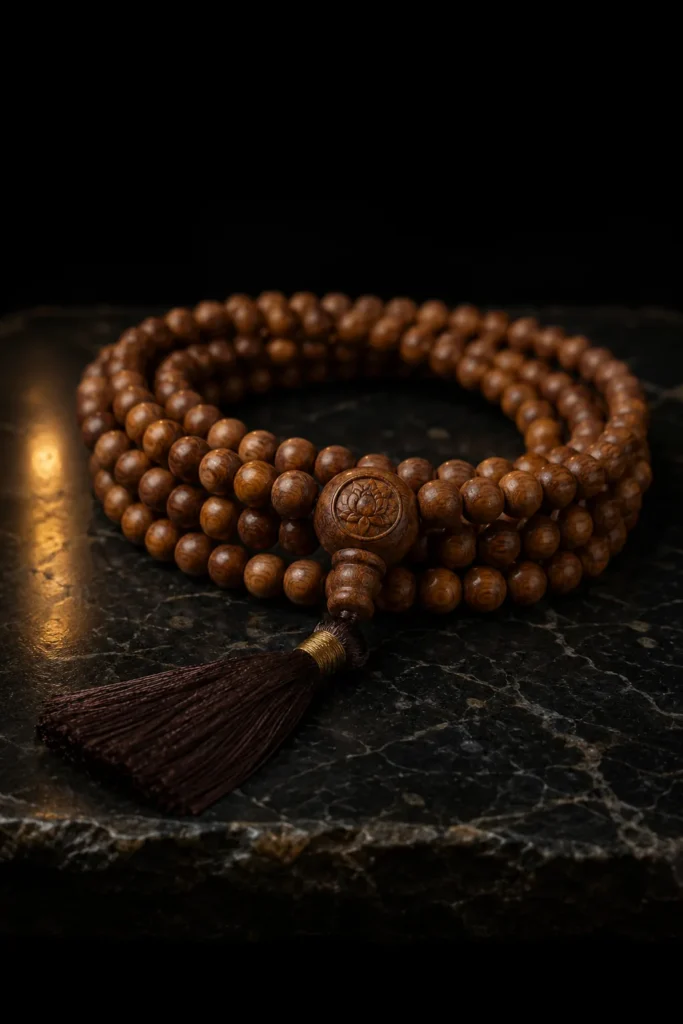
Classification
Mala is the term for the prayer-bead string of Buddhism. The word comes from Sanskrit and means roughly garland or string.
The mala is a cord on which a series of beads is strung. In its most common form it carries one hundred and eight beads. Alongside these there are shorter strings with fewer beads.
Its task is counting. During the recitation of mantras and prayers, one bead is pushed onward after each repetition. The mala helps the practitioner keep track of the number of repetitions.
Beyond this practical task, the mala is a sign of spiritual practice and of piety. Whoever wears a mala identifies as a practitioner.
The mala is also often worn as adornment and as a constant companion, wound around the wrist or placed around the neck. In this form it accompanies the person through the day.
In religious studies, the mala is a good example of a spiritual implement that is both tool and sign. It serves practice and is at the same time a symbol of the pious life.
Origin and spread of the prayer-bead string
The prayer-bead string did not originate in Buddhism. It was known in the Indian world even before Buddhism and also belongs to the tradition of Hinduism.
In Indian piety, the string served from early on to count during the repetition of holy words and names. Buddhism adopted this widespread implement.
With the spread of Buddhism, the mala spread as well. From India it reached Tibet, the countries of East Asia, and Southeast Asia.
In the various regions and schools, the mala took on slightly different forms. The number of beads, the material, and the handling differ according to tradition.
It is noteworthy that the prayer-bead string is known far beyond the Indian and the Buddhist world. Christianity and Islam, too, know knotted or strung aids for counting prayers.
The mala thus belongs to a worldwide group of prayer-bead strings. The idea of guiding the counting of holy words by means of a strung implement is widespread across many religions.
The number one hundred and eight beads
The most common mala carries one hundred and eight beads. This number is not chosen at random but is regarded in Buddhism and in the Indian world as a significant number.
The number one hundred and eight appears at many points in Buddhism. It is associated with various enumerations, for example with a number of entanglements or of obstacles that a person is meant to overcome.
There are various considerations about the precise origin of the number. It is explained in different ways, and no single interpretation is regarded as the only correct one.
What is certain is that the number was felt to be round and complete. A string of one hundred and eight beads encompasses, as it were, a full unit of practice.
Alongside the full mala there are shorter strings. Common are wrist strings with a smaller number of beads, often a divisor of one hundred and eight, worn on the wrist.
The number of beads thus gives the mala a fixed order. With each complete round, the practitioner has reached a definite, significant number of repetitions.
Structure and material of the mala
The mala has an ordered structure. Besides the one hundred and eight counting beads, it has further components, each of which has its own task.
At one point on the string sits a larger or differently shaped bead, which often bears the name guru bead. It marks the beginning and the end of the round and is not itself counted.
Above the guru bead there is often an elongated end piece that closes off the string. It is sometimes associated with the wealth of knowledge or with spiritual perfection.
Some malas carry additional counter beads inserted at greater intervals. They help to keep track of larger quantities of repetitions or of the number of completed rounds.
Various materials are used for the beads. Common are wood, the seed kernels of certain plants, bone, and semiprecious stones. In some traditions a particular material is especially valued.
The articulated structure makes the mala a well-considered implement. Counting beads, guru bead, end piece, and additional markers work together and allow precise guidance of the recitation.
The mala in use
The mala is used in the recitation of mantras and of prayers. Its use follows an ordered manner that is similar across the traditions yet differs in detail.
The practitioner holds the string in the hand and begins at the first bead after the guru bead. After each repetition of the mantra, they push one bead onward with the thumb.
In this way the practitioner moves bead by bead through the string. Once they have arrived at the guru bead, they have completed a full round of one hundred and eight repetitions.
If the practitioner wishes to continue, they reverse the string and begin a new round. The guru bead is not crossed but always forms the turning point.
This handling allows the practitioner to direct their attention entirely to the mantra. The counting happens, as it were, of its own accord, without the attention being drawn away from the recitation.
The mala is thus an implement of concentration. It relieves the practitioner of the counting and leaves them free for the actual spiritual practice, the repetition of the holy word.
Mantra, repetition, and concentration
The mala is related to the mantra. Without the recitation of mantras and prayers, the prayer-bead string would have no task.
A mantra is a holy formula, a word or a sentence that is spoken repeatedly in practice. In Buddhism numerous mantras are in use, assigned to individual figures or teachings.
The meaning of the repetition lies in the concentration of the mind. By speaking the mantra again and again, the practitioner aligns their mind and frees it from restless wandering.
The manifold repetition is here expressly intended. Some practices provide for speaking a mantra many thousands of times. Here the mala becomes an indispensable aid.
The mala guides the counting, yet it is not the essential thing. The essential thing is the mantra and the mental concentration that arises through its repetition.
The mala is thus a serving implement. It stands in the service of recitation and concentration, and its value lies in the fact that it enables and orders this spiritual practice.
The mala as sign and protection
Beyond its task as a counting implement, the mala is a sign. It is often worn all day long and identifies the wearer as a practitioner.
The mala is thus a sign of piety and of spiritual practice. Whoever wears it around the wrist or around the neck professes Buddhist practice.
The mala receives a protective meaning above all through what has taken place upon it. A string on which many thousands of mantras have been recited is regarded as marked by this practice.
In some traditions, malas are moreover blessed by a teacher. A blessed mala is then understood as an object that carries within it the blessing of the practice and of the teacher.
The protection of the mala thus lies not in a repelling power. It lies in the remembrance of the practice and in the connection with the recitation that was carried out upon it.
The mala is thus a good example of an object that becomes a sign through use. From the counting implement of recitation comes a worn sign of piety and of mental concentration.
The mala among the prayer-bead strings of the world
The mala can be viewed within the larger context of prayer-bead strings. Such strings and knotted aids are known in many religions.
In Hinduism, from whose milieu the Buddhist mala derives, the prayer-bead string is likewise in use. There too it serves to count during the repetition of holy names and formulas.
Christianity knows the rosary, a knotted string with beads that guides the praying of a fixed sequence of prayers. Islam knows the prayer-bead string for speaking the names of God.
All these strings rest on the same basic idea. The repeated speaking of holy words is guided by a strung implement, so that the one praying can direct attention to the word.
The differences lie in the details, in the number of beads, in the words spoken, and in the handling. The common core, however, the guided counting of recitation, is everywhere the same.
The mala is thus the Buddhist expression of an implement found worldwide. It shows that the idea of guiding prayer by means of a string was understood across the religions.
Reception today
The mala is to this day a widespread and a living implement in the Buddhist world. In the monasteries and in the practice of the faithful it is in use unchanged.
Monks, nuns, and practicing laypeople carry the mala during recitation and in everyday life. It is a familiar sight in the countries of Buddhism.
Beyond the Buddhist world, the mala has become known in the West as well, along with interest in Buddhist practice and in meditation. There it is widely used and worn.
In this wider spread, the mala is at the same time worn as adornment. As a string around the wrist it has become a widespread piece of jewelry.
In this use, the religious task of the mala can recede into the background. It is then understood generally as adornment or as a sign of a turning toward mindfulness.
At its core, however, the mala remains what it always was, a prayer-bead string for the recitation of mantras, an implement of mental concentration, and a sign of the pious, practicing life.
Literature (selection)
Related key terms: Mala Buddhist prayer-bead string 108 beads mantra recitation guru bead Buddhism mental concentration.
iWell Guard and protective traditions
iWell Guard stands in the cultural-historical lineage of wearable protective objects to which the mala also belongs. A modern companion for people who live with protective symbols: made in Germany, 41 layers of solid gold, platinum, and silver, with a 30-day right of return.
Personal experiences may vary. Not a medical device. No promise of healing.