Proserpina, Goddess of the Roman Tradition
By Ralf Ittermann · last reviewed on
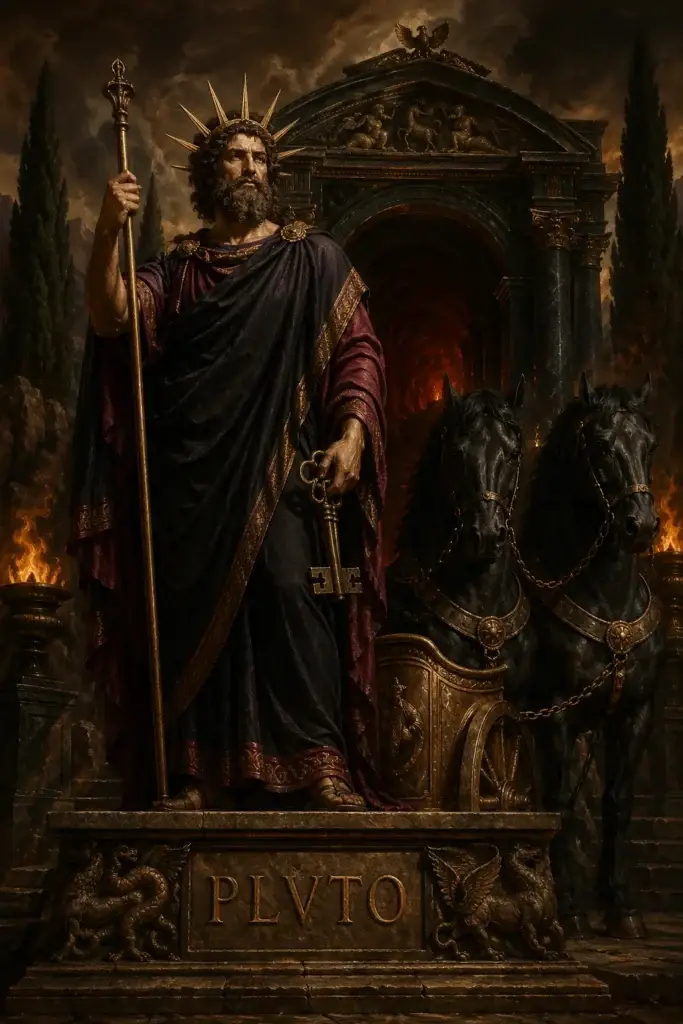
Proserpina is the goddess of the underworld and of rebirth in the Roman tradition. She is the consort of Pluto and ruler over the realm of the dead, yet through her annual return to the upper world she remains bound to the cycles of nature.
In terms of religious studies, Proserpina is the embodiment of the transition between life and death, between above and below.
Proserpina
Proserpina embodies the duality of maidenhood and married life, of innocence and royal authority. She is the daughter of Ceres (grain), wife of Pluto and ruler of the dead.
The myth of her abduction by Pluto explains seasonal changes in plant life and the structure of the year. Her central aspects are fertility, ripeness, transition and the sanction of new life from the realm of the dead. The Eleusinian Mysteries celebrated her role in cosmic regeneration.
Brief Profile: Proserpina
Sources: Ovid’s Metamorphoses 5, Virgil’s Georgics, Cicero’s De Natura Deorum, Apuleius’s Metamorphoses, hymns to Proserpina, Latin inscriptions and gravestone epitaphs. Secondary literature: Georg Wissowa, Karl Latte, Walter Burkert (on the fusion with Persephone), Hubert Cancik. The worship of Proserpina was strong in the Eleusinian cults, but it was also widespread in private households of Italy, Gaul and Africa.
Context
Period of the Texts
The continuity of the tradition across these long spans of time is remarkable and shows a deep, stable cultural rooting. Even in modern times the memory and sometimes also active worship is alive, sometimes transformed, but still recognizable in its basic features.
Mythological Classification
Proserpina is the Roman goddess of spring and of the underworld, daughter of Ceres. Her myth, abduction by Pluto, return, is central to the understanding of the seasons. She is not powerless but ruler of the underworld alongside Pluto. She is an ambivalent figure of transformation.
Area of Distribution
Proserpina was not confined to a particular region or to specific locations, but was universally known and worshipped, or respectfully feared, throughout the entire Roman world.
Whether in large urban centres or in peripheral rural regions, whether among the social elite or among ordinary people, the spiritual or cultural significance of this entity was consistently recognized and universal.
This clearly points to a central role in the self-understanding of the whole people. Trade, migration and cultural exchanges contributed to the geographical spread and to the stable uniformity of the worship.
State of the Sources
Primary sources: Ovid’s Metamorphoses 5 (the rape of Proserpina), Virgil’s Georgics and Aeneid, Homer’s Hymn to Demeter (the Greek counterpart), Cicero’s De Natura Deorum, Seneca’s tragedies. Period: 5th century BCE to 6th century CE. Researchers: Georg Wissowa, Karl Latte (Roman religious history), Walter Burkert (Greek religion), Manfred Clauss (cults). Archaeological evidence: Eleusinian sanctuaries, funerary monuments from Roman times, curse tablets bearing the name of Proserpina.
Designation and Spellings
Proserpina is depicted in the various sources and artistic traditions with certain recurring iconographic elements that remain relatively constant over decades and across different geographical regions. These elements are not purely decorative or chosen at random, but are deeply coded in symbolic terms and carry great meaning.
They convey, in a central way, the functions, sources of power, domains and cosmic role of the being.
The overall system is like a sacred script or a coded image; it allows the initiated or the culturally educated to grasp and correctly understand the essential deeper meaning. Colours, sacred objects or weapons, bodily attributes, specific accessories, everything is significant and traditionally handed down.
Description
Proserpina was central to religious practice, to everyday rituals and to the daily understanding of the Romans. People turned to this entity in critical or specific life situations or at particular ritual times of the year, with structured, often elaborate rituals, prayers or offerings.
The cult of Proserpina was firmly regulated in Rome. In 249 BC her worship was officially introduced together with that of Dis Pater, and the sacrifices at the underground altar of the Tarentum on the Campus Martius followed precise ritual prescriptions. In the Greek-influenced mysteries concerning her model Persephone, specially appointed cult officials conducted the initiations; participation and procedure were subject to strict rules.
The continuity of these practices over many generations clearly shows that the practice was regarded as effective and necessary. The functions were manifold: some were preventive (warding off potential misfortune), some restorative (easing of illness or suffering), some transformative (accompaniment through transitions between stages of life).
Appearance and Symbolism
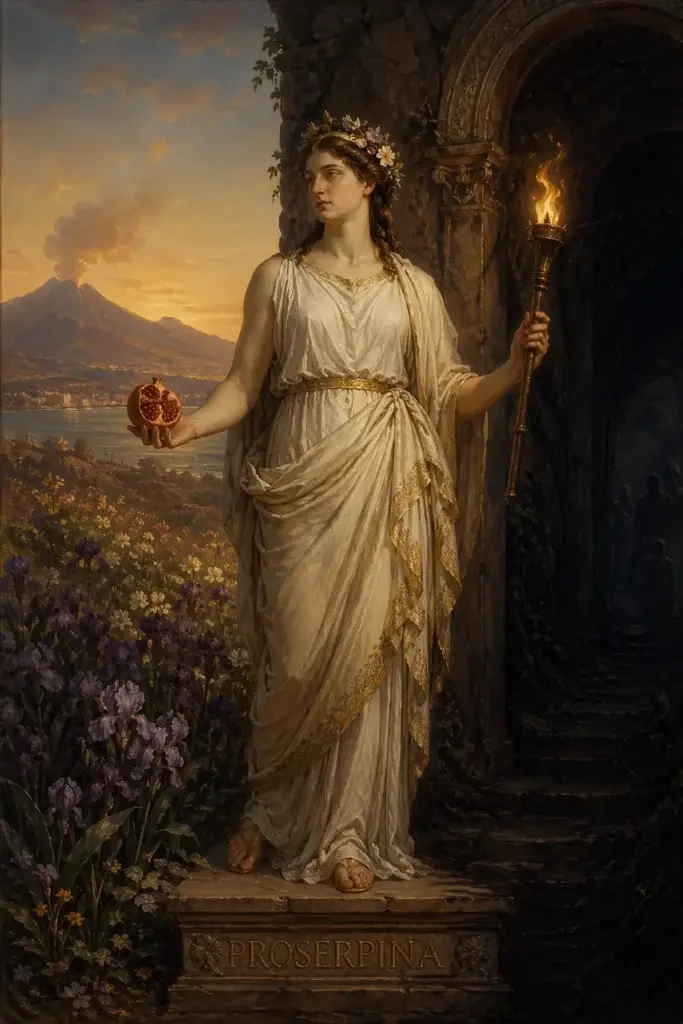
Proserpina is depicted in phases of transition, sometimes young and spring-like, sometimes sombre. She wears a crown and often holds keys. The pomegranate is her attribute (seed of return). Ears of barley and flowers belong to it. Her ambivalence is her strength.
Profile: Proserpina
The Profile explains Proserpina’s nature across six dimensions: her mythical origin and distribution, the forms of her worship in religion and magic, her characteristic depiction in art and symbols, the significance of invocation and respect, related figures in neighbouring cultures and a concluding overview of her cosmic function as goddess of transition.
Proserpina is the Roman form of the Greek Persephone and derives from Indo-European fertility-goddess myths. The abduction myth (Latin: raptus) was originally an explanation for seasonal vegetation cycles. In Rome Proserpina was worshipped as the consort of Pluto, independent and powerful.
The earliest evidence goes back to the 5th century BCE but intensified under Greek influence (2nd to 1st century BCE). Eleusinian mystery cults spread her across the ancient world.
Proserpina was invoked by farmers at sowing and harvest, by pregnant women (as guarantor of new life), by mourners (to appease the dead). The Eleusinian Mysteries were strictly secret, but their participants reported Proserpina’s role as a bearer of hope after death.
In private households people prayed to her for fertility and for the protection of children.
Proserpina was depicted as a young woman or a mature queen, depending on the phase of the myth, young at the abduction, mature and crowned as ruler of the underworld.
Her attributes are the poppy head (symbol of sleep and death), the cornucopia (abundance), the sceptre, the torch (she shines in the darkness of the underworld). On coins she sits beside Pluto or wears a crown. On gravestones she symbolizes transition and the hope of continued life.
Sphere of action: Proserpina (also Persephone, in Greek) is the underworld goddess of Rome, daughter of Ceres (Demeter) and consort of Pluto (Hades). She symbolizes the transition between the seasons, between life and death.
Her abduction into the underworld and her annual return to her mother explain the alternation of summer and winter. She is not powerless or passive; in many texts she is ruler of the underworld, a wife with a realm of her own.
Proserpina was the object of invocation and protective worship, not as a harmful goddess but as a mediator between life and death. Offerings were poppy, honey, fruits and black animals.
In cases of mourning people prayed to her in order to bring the deceased under her rule and to give them peace. Pregnant women wore amulets with her image. Magic often involved her name for conjuration or for protection against evil spirits.
Persephone (Greek) is the direct model and remains structurally identical. Inanna/Ishtar in the Mesopotamian context resembles her in the journey to the underworld, but not in the seasonal binding.
In the Egyptian sphere Osiris (male) shows similar functions as judge of the dead and figure of hope. Hel in the Germanic context is a less ambivalent ruler of the underworld.
Proserpina, Parallels in Other Cultures
Proserpina is the Roman adaptation of the Greek Persephone; her myth was linked with the Roman sowing calendar and the Eleusinian festivals. While Persephone remains the central figure of mourning in the four-seasons myth, Proserpina takes on additional protective tasks for marriage and household in Roman practice.
Jewish tradition: In Jewish mythology there is no goddess of the underworld. Sheol is a passive realm of the dead without a personalized ruler. Only in Kabbalah and apocalyptic literature are angel-like beings mentioned, but no Proserpina analogues.
Graeco-Roman world: Persephone is the Greek original of Proserpina. In shared cults (especially after the 3rd century BCE) the names and functions merged, yet remained structurally the same. Other underworld deities (Hecate) were added without displacing Persephone.
Mesopotamia: Inanna/Ishtar undertakes a journey into the underworld and is briefly held captive there, but returns, structurally similar to Proserpina’s seasonal cycle, but more dramatic and less regenerative.
India/Asia: In Hinduism Kali embodies destruction and regeneration, but does not share Proserpina’s concrete role as consort of the god of the dead. In early Buddhism such a figure is absent; the underworld is less personalized.
The Rape of Proserpina in Detail
The central narrative concerning Proserpina is her abduction by Pluto, the ruler of the underworld. Ovid recounts it at length in the fifth book of the Metamorphoses, and he gives a second, divergent version in the Fasti.
According to Ovid’s account, Proserpina is picking flowers with her companions in a grove near the Sicilian Lake Pergus at Henna. Pluto, struck by an arrow of Amor, catches sight of her, seizes her and descends with her into the depths in a chariot. The ground opens at Lake Cyane, whose nymph resists in vain.
Ceres, the mother, searches for her daughter across the whole earth. In her wrath she renders Sicily barren, according to Ovid. Only the nymph Arethusa tells her that she has seen Proserpina as queen of the underworld. Ceres appeals to Jupiter.
The return, however, fails on account of a condition set by the Parcae: whoever has taken food in the underworld may not return. Proserpina has eaten seven seeds of a pomegranate, observed by Ascalaphus, whom she transforms into an owl for this.
Jupiter brokers a compromise. Proserpina spends part of the year in the upper world with her mother, part in the underworld with Pluto. In the Fasti Ovid names a division into halves, in the Metamorphoses a ratio of two to one in favour of the upper world.
This fluctuation within the ancient sources themselves shows that the narrative had no fixed canonical form. The myth is closely connected with the Greek Demeter-Persephone material, whose fullest version is offered by the Homeric Hymn to Demeter.
Roman literature largely took over the material but preferred to relocate the setting to Sicily, which was regarded as a cult centre of Ceres.
Proserpina and the Myth of the Seasons
The narrative of Proserpina’s divided sojourn was already read in antiquity as an explanation for the change of the seasons. The stay in the underworld corresponds to the season poor in vegetation, the return to the mother to growth.
This interpretation is laid out in the ancient texts, for instance when Ovid links the mourning of Ceres with the barrenness of the earth.
The religious-studies research of the 19th and early 20th centuries, especially in the circle of James Frazer and the so-called Cambridge Ritualists, built from this a comprehensive theory of dying and returning vegetation deities.
More recent research takes a more reserved stance toward this interpretation. It points out that Proserpina does not die but is abducted and reigns, and that the Mediterranean climatic cycle, with its dry summer and wet winter, does not readily fit the scheme.
Some researchers read the myth rather as a narrative of initiation and marriage: Proserpina performs the transition from girl to woman, from the house of the mother into that of the husband. The pomegranate, often associated with fertility and marriage, supports this reading.
The two interpretations do not exclude one another. Ancient cults could understand the same myth on several levels. For the worship of Ceres and Proserpina in Rome the agricultural reference was in any case central, as the festival of the Cerialia in April shows.
Alongside this there was a more personal piety oriented toward the beyond, which had its place in the mystery cults and aimed at the individual hope beyond death. How closely these lines were interwoven in the Roman cult can be reconstructed only partly from the fragmentary sources.
Cult and Mysteries of Ceres and Proserpina in Rome
In Rome Proserpina was rarely the sole object of the cult. She appears mostly together with Ceres. The most important temple of the two goddesses stood on the Aventine, consecrated according to tradition in the early fifth century before our era, together with Liber.
This Aventine cult was regarded as the plebeian counterpart to the patrician triad on the Capitol and thus also possessed a social and political dimension.
A form of its own belonged to the sacra Cereris, a Greek-influenced cult that according to Cicero was attended to by Greek priestesses from southern Italy and was open exclusively to women. This ritual stood in connection with the Eleusinian conceptions but transferred them onto Roman soil.
Alongside this, in republican Rome a mourning ritual for Ceres and Proserpina was performed in times of crisis, which according to Livy could be suspended in cases of severe public distress, because mourning was regarded as inappropriate in such moments.
From the imperial period a nocturnal festival is also handed down, the Saecular celebration observed at irregular intervals, in which, among other things, offerings to Proserpina as underworld goddess played a role.
The state of the sources on the details of these rites is limited, since mystery cults deliberately did not record their contents in writing.
What we know stems predominantly from allusions in Cicero, from Christian polemic and from epigraphic and archaeological testimonies. The exact liturgy remains largely unknown. Comparable structures are found with the Greek Persephone, whose Eleusinian cult is somewhat better documented.
Proserpina in the Visual Arts and on Sarcophagi
The rape of Proserpina is among the most frequently depicted myths of Roman art. The motif is especially widespread on sarcophagi of the middle and late imperial period. The scene typically shows Pluto wrenching Proserpina onto his horse-drawn chariot, accompanied by Minerva, Diana and the resisting Cyane.
The choice of precisely this motif for the funerary context is revealing: the myth of the involuntary transition into the underworld and the partial return offered a pictorial language for death that expressed not only loss but also hope.
Alongside this there are wall paintings, for instance from Pompeii, and mosaics that show the rape or the enthroned Proserpina as ruler of the underworld.
As queen of the underworld she often wears a diadem or polos, occasionally ears of grain or the pomegranate as an attribute. In her function as ruler she sits beside Pluto on the throne, often with the three-headed dog Cerberus at her feet.
The reception continues far beyond antiquity. The most famous modern treatment is the marble group Ratto di Proserpina by Gianlorenzo Bernini from the years around 1621 to 1622, which captures the moment of the seizure with great dynamism.
In painting, among others Rembrandt and later the Pre-Raphaelites, for instance Dante Gabriel Rossetti with his Proserpine, took up the theme. The material also found use in music, for instance in Baroque operas. Together, the archaeological and art-historical testimonies make Proserpina one of the most pictorially documented figures of Roman myth.
Etymology and the Relationship to Persephone
The name Proserpina is not entirely clear in terms of language history. The ancient folk etymology connected it with the Latin verb proserpere, to creep forth, and interpreted it as referring to the sprouting forth of the seed. This explanation is found in Cicero and in Varro.
Modern linguistics regards it as a secondary interpretation. It is more probable that Proserpina represents a phonetic reshaping of the Greek name Persephone, possibly mediated through an Etruscan intermediate stage. On Etruscan mirrors the figure appears under the name Phersipnai or similar forms, which makes a mediation through Etruscan plausible.
The Greek name Persephone itself is likewise regarded as opaque and probably stems from pre-Greek times. The Greeks already knew numerous variant forms such as Persephatta or Pherrephatta, which points to an old, hard-to-interpret name. The numerous variants show that the figure was never wholly fixed in linguistic terms in the tradition.
In Roman religion Proserpina was early on merged with the native conception of the underworld, but was also equated with the Italic goddess Libera, the female counterpart of Liber. This identification is not consistent and shows how different strands of tradition converged in the figure.
For the study of religion Proserpina is therefore a good example of how a Greek myth was fitted into the Roman system through mediating cultures and in the process combined with existing native elements. A complete separation of the Roman from the Greek figure is hardly possible in the surviving sources.
Proserpina as Ruler of the Underworld and in Curse Practice
Beyond her role in the myth of the seasons, Proserpina possessed an independent function as ruler of the realm of the dead. In this role she appears in a genre of sources that is especially revealing for Roman everyday life: the curse tablets, in Latin defixiones.
These texts, mostly scratched onto small lead tablets, were deposited in graves, wells or springs and called upon underworld powers in order to harm an opponent, to influence a trial or to recover stolen property.
On numerous surviving tablets Proserpina is invoked together with Pluto or Dis Pater. She appears there under various epithets, occasionally also in fusion with other underworld figures.
The language of these texts is formulaic and follows recognizable patterns, which suggests that there were models or specialized authors. For research the defixiones are valuable because they document a piety beyond the official state cults and show how people turned concretely to the gods.
Proserpina was moreover associated with reward and punishment in the beyond. In the mystery conceptions that become tangible, among other things, in the so-called Orphic-Bacchic gold tablets, an underworld queen plays a role as the instance before which the deceased soul prevails or fails.
Whether these tablets mean Proserpina in the narrower Roman sense or a more general Greek-influenced underworld goddess is difficult to decide in the individual case.
Overall this group of sources shows that Proserpina was not merely a literary mythological figure but the addressee of actual ritual practice, which extended from love magic to the hope of the beyond.
Research Literature
As a deity of the Roman tradition, Proserpina corresponds to the Greek Persephone and divides her year between the upper world and the underworld; her cult shaped the sowing festivals and the libri Sibyllini.