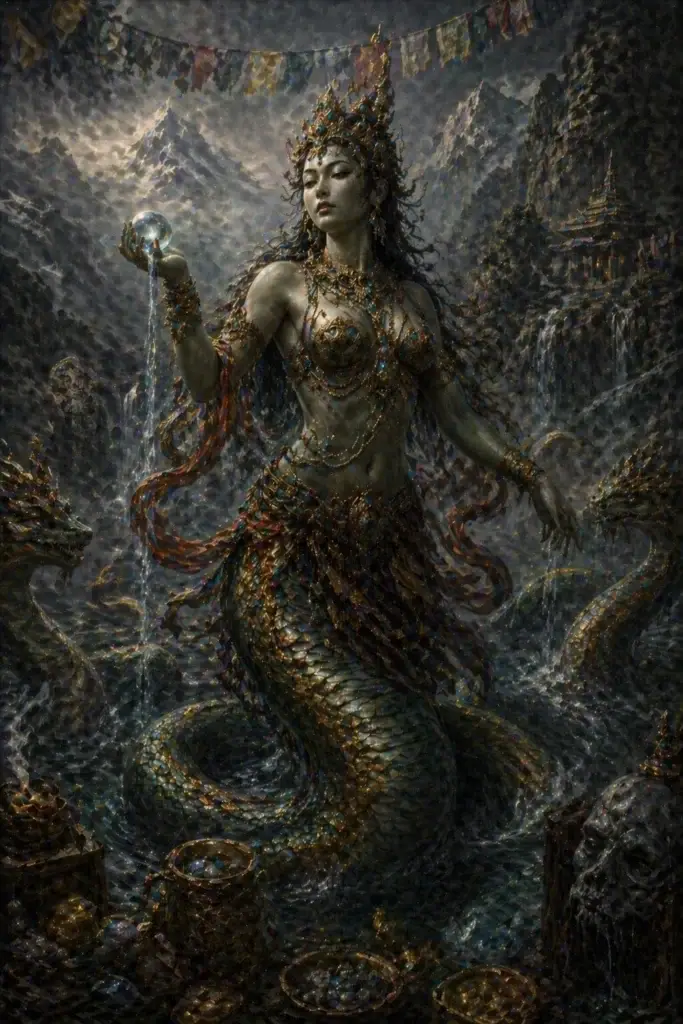
Mamo, spirit of the Tibetan tradition
By Ralf Ittermann · last reviewed on
Mamo is a spirit of the Tibetan tradition.
Female, dark mother spirits of the Tibetan tradition, between protection and plague.
Mamo are not dakini but a darker class of earth mothers of the Tibetan tradition and represent untamed force of nature.
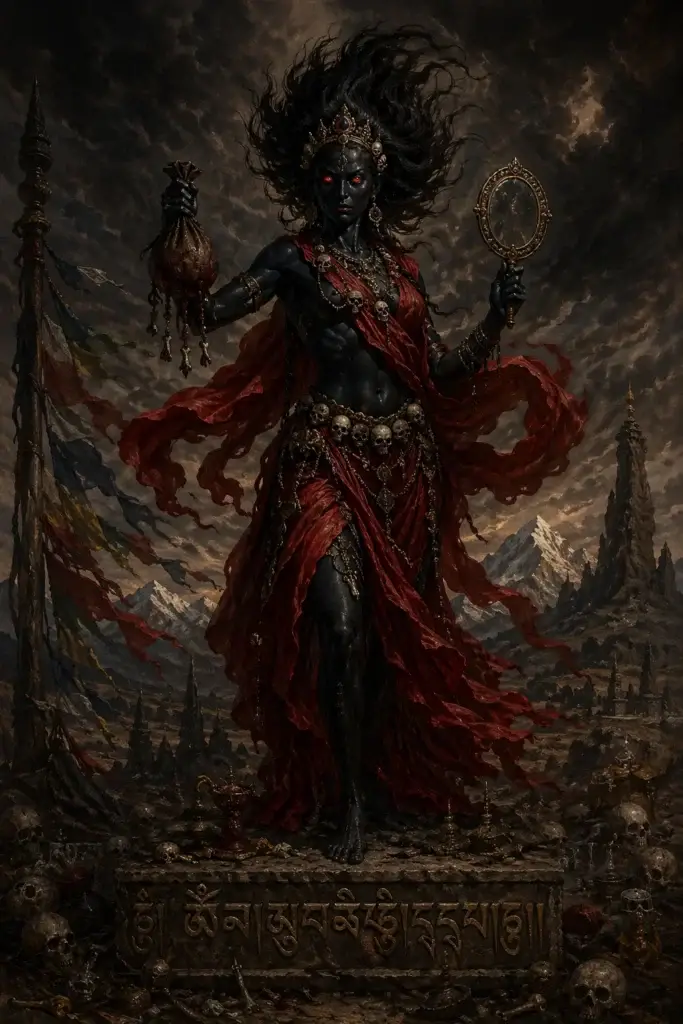
Mamo (ma mo)
The Mamo (Tib. ma mo, “mothers”) are a distinctive class of female beings, widely represented in the Tibetan pantheon. They stand between protective goddesses, earth mothers, and dangerous female demons.
As ambivalent mother spirits, they can bring prosperity, health, and rain, or, when order is violated, unleash plagues, wars, natural disasters, and social unrest.
Mamo are closely linked to the idea of a disturbed balance between human beings and nature. If this balance is thrown out of joint, the mother spirits, according to Tibetan conception, turn against the disfigured world.
Quick Overview: Mamo
Type: Female demon/mother-spirit category
Origin: Pre-Buddhist earth-mother conceptions; Indian-Buddhist dakini and matrika traditions
Texts: Padmasambhava cycles, Kangyur/Tengyur, ritual handbooks of the protective deities
Effect: Plagues, crop failures, wars, mental disturbances; positive: fertility and prosperity
Defense: Ma mo torma, smoke offerings, ritual practice of the dharmapalas
Distinction from Gyalpo: Unlike the Gyalpo, the male king-demons, the Mamo are female, dark mother spirits, not fallen monks, but embodiments of wild, untamed female nature in the Tibetan tradition.
Historical Context
Period of the Texts
The Mamo tradition has two main roots: on one hand, pre-Buddhist Tibetan-Central-Asian conceptions of earth-mother deities and mistresses of the wilderness, and on the other, the Indian-Buddhist heritage of the matrika (mother goddesses) and dakini (sky walkers). In the Tibetan assimilation of these strands, the Mamo field arises with its ambivalent, dark traits.
Prominent is the account that Padmasambhava, when introducing Buddhism to the Tibetan highlands, bound numerous Mamo and integrated them into the circle of protective spirits. In the Gelug writings of later centuries, the Mamo class is systematically described.
Mythological Context
Mamo are female spirits or goddesses in Tibetan Buddhism and in the pre-Buddhist Bon faith. They appear as a collective group rather than as individual beings, there are Mamo deities that serve as mountain protective spirits, and others that act as demons of destruction. Their genealogy reaches back into pre-Buddhist Tibetan religiosity.
Area of Distribution
Mamo are venerated and feared throughout the Tibetan-Buddhist cultural sphere. Individual locally bound Mamo are tied to particular mountains, passes, and monasteries (for example Palden Lhamo at Lhamo Latso south of Lhasa).
The figure of Palden Lhamo (Skt. Shri Devi) is the most prominent institutionalized Mamo, protective deity of the Dalai Lama and of the Gelug school.
Source Situation
Core sources: Padmasambhava cycles and terma texts of the Nyingma school; Kangyur/Tengyur with dakini and matrika literature; ritual handbooks on Palden Lhamo. Standard works: Nebesky-Wojkowitz (1956); Willis, Janice D. (1987) “Dakini: Some Comments on Its Nature and Meaning”; Simmer-Brown, Judith (2001) Dakini’s Warm Breath.
Name and Variants
Tibetan ma mo, whose literal translation “mothers” here stands for a class, not for biological motherhood.
- Du mo, “Mara mothers”, a particularly dark subtype.
- Gya mo, collective name for various Mamo subclasses.
- Palden Lhamo (dpal ldan lha mo), “Glorious Goddess”; the most prominent institutionalized Mamo, Skt. Shri Devi.
- Ekajati, single-toothed, single-eyed, single-breasted Mamo; guardian of the secret terma teachings.
Description
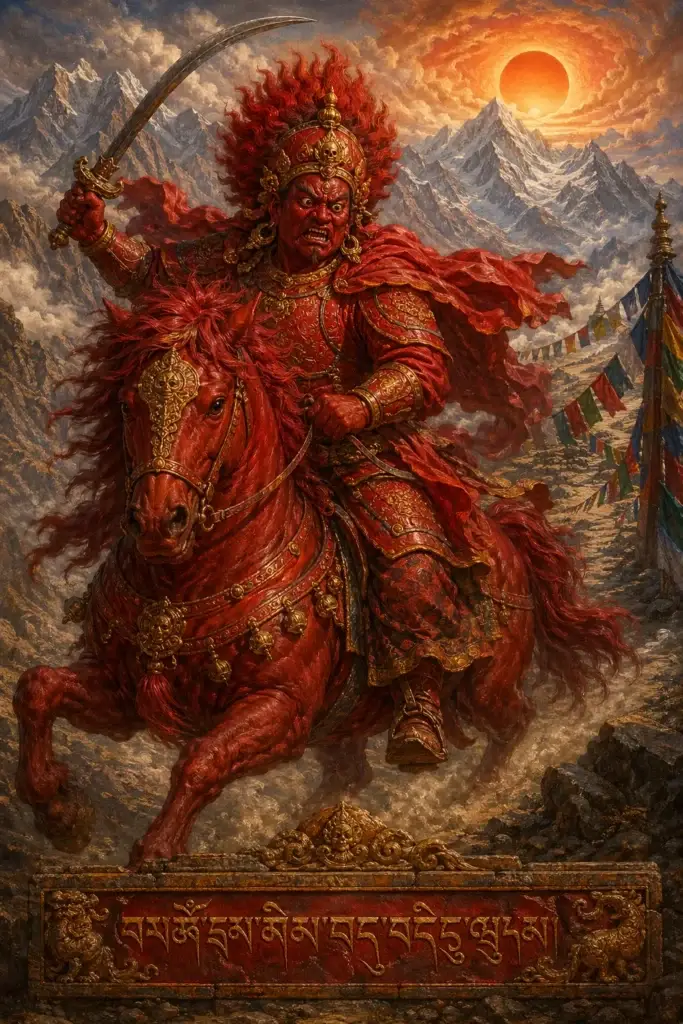
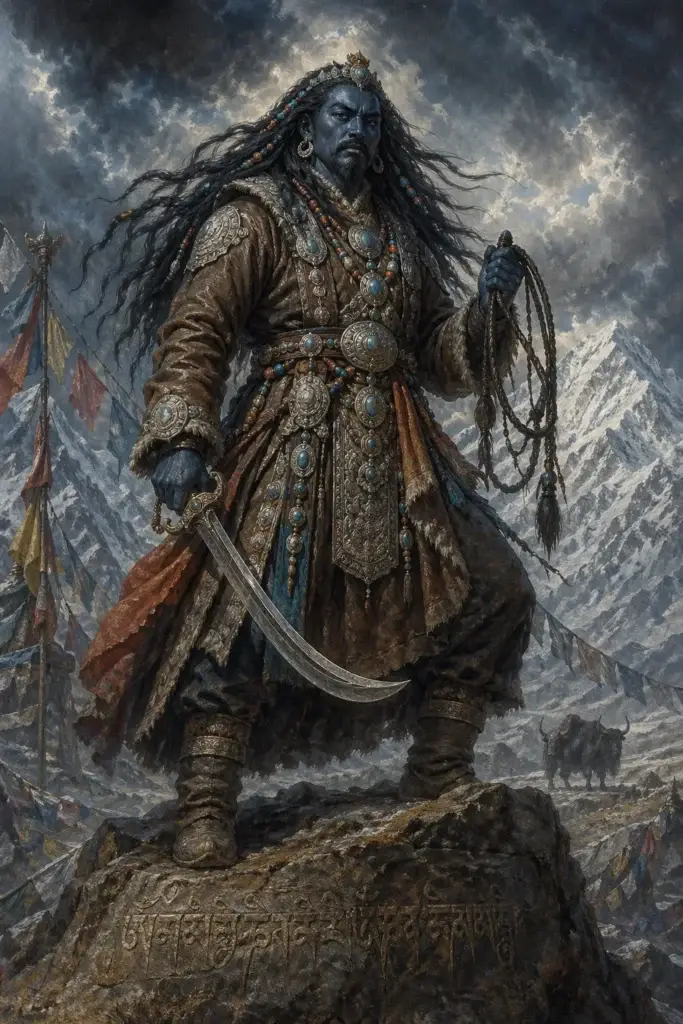
Appearance. Mamo are depicted as dark-skinned or blue-black female figures, mostly naked or clad in tiger skin, with tangled hair, skeleton ornaments, skull necklaces, and wild features. Palden Lhamo rides a mule with a saddle covered in human skin, Ekajati is one-eyed with a single tooth and a single breast.
Behavior. Mamo react violently to moral and ecological disturbances: the breaking of agreements, disregard for sacred places, great imbalances. They can then trigger epidemics, wars, famines, and mental illnesses. In their bound state, they are powerful protectresses of the Dharma.
Times of crisis. In epochs of collective crisis, great Ma mo torma and chöpa rituals are performed.
Appearance and Symbolism
Mamo are depicted as female spirits with red-gold fire or as dark-blue-black furies. They carry weapons and symbols of power. They are often shown in groups of three or five, each with its own color and attribute. The symbolism varies according to whether they are understood as protective or as obstructing spirits.
Profile: Mamo
The most important aspects of the Mamo at a glance.
Pre-Buddhist earth-mother deities, Indian-Buddhist matrika and dakini traditions; systematized through Padmasambhava.
Communities in times of collective crisis; violators of sacred places; the sick and the psychologically unstable; in the positive sense: tantric practitioners and monasteries under their protection.
Dark-skinned or blue-black female figure with tangled hair, skeleton ornaments, and tiger skin; often with weapons (sword, skull cup, trident).
Plagues, crop failures, wars, psychological instability, nightmares; positive: fertility, rain, resolute protection.
Ma mo torma offering, sang smoke offerings, ritual practice of the protective deities (Palden Lhamo, Ekajati), chöpa ritual, tantric visualization.
Functionally related to the Hindu Matrikas and Kali aspects, both appearing as collective wrathful mothers. In the broader Mahayana-Buddhist tradition, the dakini stand, in a manner reminiscent of Empusa, at the threshold between a terrifying and a liberating function.
Tibetan counterparts: Palden Lhamo as a wrathful protective goddess, Ekajati as a wrathful guardian of the tantras, Yamaraja as the judge of the dead.
Defense in Everyday Life
Ma mo torma ceremonies. In times of collective crisis or as part of regular monastic practice, great torma celebrations are held in which numerous Mamo are appeased at the same time.
Palden Lhamo ritual. The great protective deity is venerated daily in many monasteries, especially in the Gelug school; at Lhamo Latso, the “lake of the deity“, visions have been sought for centuries.
Chöpa practice. The tantric Chöd ritual, in which the practitioner offers their body to the hungry beings, is particularly effective in dealing with Mamo forces.
Ecology and morality. Traditionally, protection from Mamo wrath is also achieved through the preservation of sacred places, respect for female teachers, and adherence to collective agreements.
Cult and Veneration
Mamo are venerated in Tibet for the purpose of appeasement, in order to placate their destructive power. Rituals to Mamo are part of the protective practices in monasteries. They are invoked for protection from natural disasters and for warding off female demonic energies.
Mamo, Parallels in Other Cultures
India/Hinduism. The matrika (mother goddesses) and Kali are the closest relatives; the iconography with skeleton ornaments and dark skin color is shared.
Buddhism. Dakini figures are iconographically close to the Mamo; in Western reception the terms are often confused, dakini refers to the sky messengers, Mamo to the darker earth-mother class.
Europe. Baba Yaga and related Slavic forest mothers, the Greek mormo: a worldwide recurring motif of ambivalent Great Mothers.
The Mamo in the Tibetan-Buddhist Pantheon
The Mamo, often written in Tibetan as ma mo, form a class of female beings of their own within the complex spirit world of Tibetan Buddhism. They are regarded as wrathful powers associated with sickness, war, and misfortune.
In the classifications of the Tibetan tradition, they are frequently assigned to the protective deities, yet their position is ambivalent: depending on the context, they appear as untamed, dangerous powers or as protectresses of the teaching bound to the Dharma.
This dual nature is not a contradiction but corresponds to a basic logic of Tibetan religion. Many of the most important protective deities are regarded as originally wild, pre-Buddhist, or demonic beings who were subdued by a great master, in the tradition often Padmasambhava, and bound to Buddhism by an oath.
The Mamo belong to this group of bound but by their nature dangerous powers. Their taming is never definitively secured, it must be renewed again and again through ritual.
Research on Tibetan religion, for instance the foundational works of René de Nebesky-Wojkowitz on the protective deities of Tibet, has worked out the Mamo as an example of the layering of the Tibetan pantheon.
In them, elements of the pre-Buddhist indigenous religion, influences from Indian tantrism, and the ordering systematics of developed Tibetan Buddhism are joined together. The Mamo can therefore not be traced back to a single origin. They are a product of the long religious-historical fusion that is characteristic of Tibet.
Mamo, Sickness, and the Imbalance of the World
In Tibetan conception, the Mamo are closely linked to epidemics, plagues, and social decline. They are regarded as the powers that spread contagious diseases and that grow strong in times of moral decay.
This connection is not coincidental: Tibetan religion often interprets collective misfortune as the consequence of a disturbed order, an imbalance between human beings and the invisible powers of their environment.
In this context, the Mamo are described as especially sensitive to defilement and breach of agreement. When oaths are broken, when ritual obligations are neglected, when the world turns away from the teaching, so it is said, the Mamo fall into wrath and send out sickness and war.
Their action is thus a measure of the state of the moral and ritual order. They are less arbitrary tormentors than a kind of enforcing authority that responds to disturbances.
This interpretation had practical consequences for ritual practice. In times of plague or war, monasteries performed special ceremonies directed at the Mamo and intended to appease their wrath. Such rituals included offerings, confessions of transgressions, and the ritual renewal of the binding of the Mamo to the teaching.
Religious-studies research sees in this a vivid example of how Tibetan religion fitted collective crises into a cosmological framework of interpretation and met them with ritual repair work.
The Mamo were in this not only the cause of the misfortune but also its addressee: to them was directed the ritual effort that was meant to restore the balance.
Further Links
Further reading:
- Culture page Tibet.
- Further individual profiles of Tibet: Lu, Tsen, Nyen, Gyalpo.
Research Literature
Further standard works in the literature index.
The protective practice described here is a religious-studies classification of historical traditions. iWell Guard ties in with this cultural-historical line of portable protective objects and represents a contemporary form of it. More about the iWell Guard →