Jeoseung Saja is a spirit of Korean tradition.
Messenger of the dead in Korean tradition, black hat, relentless guidance of souls.
The Jeoseung Saja (저승사자, “messenger of the beyond”) is, in the Korean conception, the messenger of the dead who collects the souls of the deceased from the world of the living and leads them before the judge of the dead.
He is not a demon in the strict sense, but rather a functionary of the administration of the beyond; nevertheless, in folk belief he is perceived among the awe-inspiring figures and belongs to the fixed repertoire of Gwishin literature.
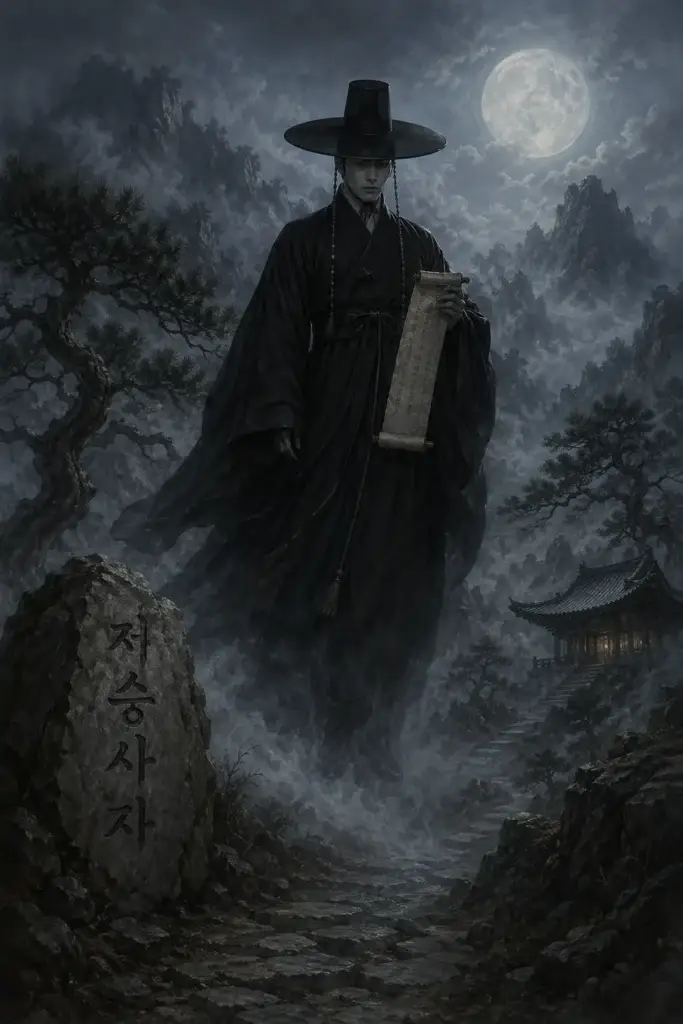
The classic depiction: a tall man in a long black robe (durumagi), with a broad black hat (gat), a pale face and a stern bearing. In his hand he carries the register of the dead (cheonsu-bok) and with him the death certificate.
Type: messenger of the dead, official of the beyond
Origin: shamanic conception of the beyond, with Buddhist and Chinese influences
Texts: Barideggi myth, shamanic chants, yadam collections from the Joseon period
Function: collects souls and leads them to the judge of the dead (Yeomra)
Attribute: black hat, black robe, death certificate
The messenger of the dead is widely attested in Korean shamanic ritual chants (muga). A central text is the Barideggi myth, the tale of the cast-out princess Bari, who goes into the beyond to fetch the healing water for her parents.
Within this framework, messengers of the dead appear as figures who act in the borderland between the worlds.
The figure condenses influences from three layers: the indigenous shamanic conception of the beyond, the Buddhist cosmology of hell (with Yama as judge of the dead, Korean Yeomra) and the Chinese bureaucracy of the underworld. The figure became popular in recent times through the cinema film “Along with the Gods” (2017/2018).
The figure of the Jeoseung Saja is known throughout Korean ritual chants and folk tales. Regional accents exist in particular in the shamanic tradition of the island of Jeju, where the messenger of the dead appears in special ritual cycles.
Typical places of encounter are the dying person at the deathbed, the threshold between the living space and the outside world, and the vicinity of cemeteries. In modern stories he appears at accident sites, in hospital death rooms and in dreams shortly before death.
Core sources: shamanic chants (muga) from various regions, especially the Barideggi and Chesuk cycles; yadam collections from the Joseon period; modern field research.
Central modern works: Walraven, Songs of the Shaman (1994); Kim Tae-gon (1981); Seo, Dae-seok “Han’guk sinhwa-ui yŏn’gu” (1988). For popular culture: publications on the film “Along with the Gods” and its mythological references.
Literally “messenger of the beyond”, from 저승 (“beyond”) and 사자 (“messenger, envoy”).
Appearance. A tall man in a long black robe and broad black hat, with a pale face and a grave gaze. Often appearing as three in a row, sometimes as a trio of Day, Month and Year Chasa. They are relentless, not malicious; they carry out what the order of the beyond prescribes.
Behavior. They come at the moment of the appointed death, call the name of the deceased three times, present the death certificate and escort the soul away. In folk tales they can be softened by good hospitality; rice, soup and rice wine at the deathbed can bring about a reprieve.
Limits. In stories, clever or righteous people occasionally manage to outwit the Chasa, through toasts, riddles or ritual hospitality.
The most important aspects of the Jeoseung Saja at a glance.
A shamanic conception of the beyond with Buddhist and Chinese influences; a functionary of the administration of the beyond, not an individual human being.
All people at the moment of their death; in stories especially the superior righteous whose time has come.
A tall man in a black robe, with a broad black hat, a pale face and a relentless gaze; often appearing as three.
The soul’s farewell from the body; the terror of the bereaved; pursuit in the case of an error or confusion of souls.
Rituals of hospitality (sajabap) with rice, shoes and coins at the deathbed; Buddhist sutras; in folk tales, cunning through hospitality.
Buddhist Yamadūta; Chinese Heibai Wuchang (“Black and White Impermanence”); the European Grim Reaper.
Sajabap. At the deathbed an offering is prepared for the messengers of the dead: three bowls of rice, three pairs of shoes, coins. This is meant to make the Chasa merciful and to let them guide the soul gently.
Buddhist funerary rites. The 49-day Sasiban ritual accompanies the soul along its way before the judge of the dead; the recitation of sutras is meant to influence the verdict favorably.
The shamanic gut. The ssitgim-gut in Jeolla and Jindo ensures that the soul does not remain behind as a Gwishin but takes the prescribed path.
Tales of the messenger of the dead. Folk stories tell of clever people who trick the Chasa through hospitality and riddles, usually with a small reprieve rather than a definitive turn of events.
Buddhism. The Yamadūta, messengers of the judge of the dead Yama, are the closest parallel; the Korean Jeoseung Saja partly takes over their function and iconographic arrangement.
China. The Heibai Wuchang (“Black and White Impermanence”) are a fixed pair of messengers of the dead in the Chinese bureaucracy of the underworld; they directly shape the Korean figure.
Japan. The equivalent are the wardens of hell under Enma-ō; the Japanese tradition emphasizes punishment in hell more than transport.
Europe. The Grim Reaper and analogous figures share the basic metaphor of the messenger who comes at the appointed time.
The Jeoseung Saja, literally the “messenger of the otherworld”, can only be understood in the context of the traditional Korean conception of the beyond, which consists of several layers.
Fundamental is the idea of a journey of the soul from this world (iseung) into the beyond (jeoseung). This journey is not an instantaneous transition, but a path along which the deceased are escorted, examined and finally brought before a court.
Shamanic, Buddhist and Confucian elements flow together in this picture. From Buddhism comes the notion of the ten kings of the underworld, before whom the soul must appear in a series of court proceedings; at their head stands a figure corresponding to the Chinese Yama, in Korea often called Yeomra.
The Jeoseung Saja is the official who collects the soul from the house of the deceased and delivers it to this judicial apparatus. His function is that of an enforcement organ, comparable to a court messenger or bailiff in earthly administration.
This analogy to the world of officials is no coincidence. The Korean beyond is, in folk conception, largely constructed on the model of earthly bureaucracy, with registers, summonses, deadlines and instances. The Jeoseung Saja accordingly appears not as a wild monster but as a functionary: strict, incorruptible, bound by regulations.
His appearance marks the moment in which a person is transferred from the jurisdiction of this world into that of the beyond. Related conceptions are found in the Chinese Heibai Wuchang and in the Japanese judgment of the dead.
The appearance of the Jeoseung Saja is remarkably firmly fixed in the Korean conception, above all through the modern media tradition, but with roots in older folk culture.
He is typically depicted as a tall man in dark traditional dress, with a strikingly pale face and a broad-brimmed black hat, the gat, which in the Joseon period belonged to the attire of the educated man and the official.
This clothing carries meaning. By dressing the Jeoseung Saja as an official of the Joseon period, his role as an officeholder is visually underscored. He is not a spirit from outside the order, but part of an orderly administrative apparatus of the beyond.
The dark color of hat and robe at the same time connects him with the sphere of death and mourning. The pallor of the face signals that he himself no longer belongs to the world of the living.
In older folk art and on shamanic painted panels (musindo) used in rituals, messengers of the dead sometimes also appear in other forms, for example in greater numbers or with attributes such as a scroll and writing implement, with which they record the names of those to be collected.
The form that dominates today, very uniform and with a black gat, goes to a considerable degree back to film and television of the 20th and 21st centuries, which popularized and standardized the image.
Scholarship therefore distinguishes between the multiform older tradition and the unified modern media image. Both belong to the history of the figure’s reception, but must not be equated.
The Jeoseung Saja is not only a theological functional figure, but also a popular protagonist of Korean folk tales, in which he is often given a surprising trait: he is corruptible, prone to error or compassionate.
A widespread group of stories deals with the messenger collecting the wrong person, because two people bear the same name or because the scroll deceives him with an error. The person mistakenly collected is then, after the matter is clarified, sent back to life.
Another widespread type of story reports that a family entertains the Jeoseung Saja.
When the messengers, while collecting a dying person, are received with food, rice and money, they feel obliged and try to obtain a reprieve for the person concerned, for example by putting in a good word at the court of the underworld or by manipulating an entry in the register of life.
In the logic of folk religion, these stories explain why offerings were set out for the messengers of the dead at a death: a small table with rice, shoes for the journey and some money, the so-called saja-bap, the “meal for the messengers”.
An important peculiarity of the Korean conception of the beyond shows itself in these stories. Death is not entirely non-negotiable. Because the beyond is conceived as a bureaucracy, it also has the weaknesses of a bureaucracy: errors, corruptibility, room for discretion.
The Jeoseung Saja thus stands between relentless fulfillment of duty and human approachability. For the bereaved, this conception opened up room for action: through correct ritual conduct one could hope to ease the deceased’s transition. The stories are therefore not only entertainment, but also provide the foundation for concrete practices of mourning and burial.

In Korean shamanism, the Musok, the transition of the soul plays a central role, and the Jeoseung Saja belongs to the personnel of the corresponding rituals. The most important is the Ssitgim-gut in the southwestern region and related funerary rites in other parts of the country.
These ceremonies are concerned with purifying the soul of a deceased person, releasing its resentment and safely escorting it into the beyond. In doing so, the shaman (mudang) enacts the path of the soul and invokes the responsible powers of the beyond.
Such rituals are of particular significance for people who have died a “bad death”, for example through accident, violence, or while young and unmarried. Such souls are considered to be at risk of remaining behind in this world and becoming restless spirits.
The ritual is meant to ensure that the Jeoseung Saja takes them in properly and that the soul follows its intended path. Here the figure of the messenger becomes practically effective: his intervention is the precondition for the dead person not getting stuck between the worlds.
In the present day, the Jeoseung Saja has made a second, media career. Korean films, television series and webtoons regularly take up the figure, most famously the film Along with the Gods and various series in which messengers of the dead appear as main characters.
These portrayals often psychologize the messenger, giving him a backstory, a conscience and a tragic biography of his own.
In doing so they move away from the sober functional character of the traditional figure, yet keep the basic conception alive.
For the study of religion, the Jeoseung Saja is therefore a good example of how a traditional figure of the beyond persists in a modern society by shifting from the ritual into the narrative sphere.
Recommended internal links:
Further standard works in the literature index.
The Jeoseung Saja belongs to those beings that are described in Korean tradition as escorts of the deceased.
In shamanic tales and in folk belief shaped by Buddhism he appears as a messenger of the underworld who collects the soul from this world. His image combines Confucian official iconography with older conceptions of the beyond on the peninsula.
In Korean mythology, Jeoseung Saja appears as an incorruptible messenger of the beyond who escorts the deceased from the world of the living into the realm of the judge of the dead, Yeomra.
Against its influence, cross-cultural tradition names these protective means:
Recommended protective means
The simplest protective means in this collection: 41 layers of fine gold 999, platinum, silver and silicon, manufactured in Ruhla, Thuringia. It requires no activation, is bound to no person, and is effective within a radius of around 50 meters, even without being worn.
Related Beings

The Roane, gentle seal people of Gaelic folklore. Origin, the seal-skin motif, the seal bride and...

Dziwożona, the wild swamp woman of Slavic tradition. Origin in a bad death, child theft and the f...

Ganga is the river goddess of the Ganges: descent through Shiva's hair, purifying water, festival...

Cosmic administrator, regulator of fate and supreme effective power in the Daoist folk tradition ...

The Vodník, West Slavic water spirit who collects the souls of the drowned in pots. Origin in Erb...

Yer-Sub denotes the sacred power of earth and water in the Old Turkic and Tengrist tradition.