Hex Signs: the painted barn stars of the Pennsylvania Dutch
By Ralf Ittermann · last reviewed on
Hex Signs are painted, circular star rosettes that have been applied to the barns of the Pennsylvania Dutch since the 19th century. The Pennsylvania Dutch are descendants of German-speaking emigrants who settled in Pennsylvania from the 18th century onward.
Whether the signs were originally intended as protective symbols or as decoration is disputed in scholarship. Today they are regarded as a well-known folk art motif of the region. This article situates the origin, forms and interpretation of the barn stars.
Classification
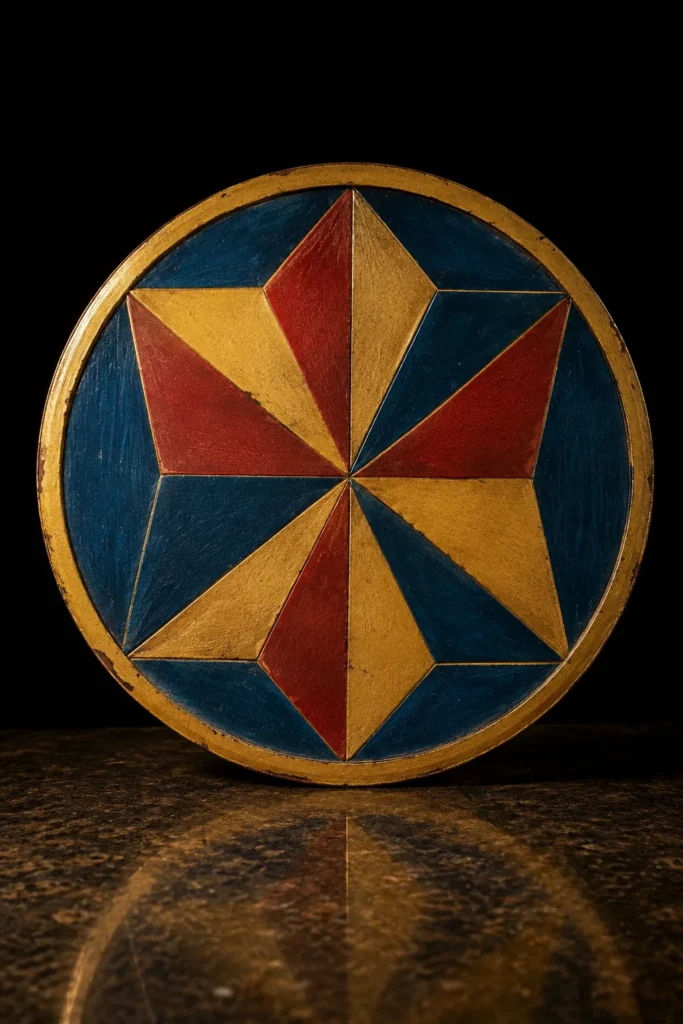
Hex Signs are colorfully painted, mostly circular signs on the exterior walls of barns. They show star rosettes, geometric patterns and stylized motifs such as birds, tulips and hearts. They are found above all in the rural counties of southeastern Pennsylvania.
The term Hex Sign is a blended formation from the German word Hexe and the English word sign. It only emerged in the 20th century. The Pennsylvania Dutch themselves, in their German-derived dialect, spoke rather of Schtanne, meaning stars, or of flowers.
In folkloric terms the Hex Signs are a special case. They belong to the family of painted star rosettes that also occur in European building traditions. At the same time they are an independent phenomenon of the German-derived emigrant culture in North America.
Whether the Hex Signs are to be understood as protective symbols or as pure decoration is a central point of contention in scholarship. This article presents both positions and avoids a premature commitment.
The Pennsylvania Dutch are the descendants of emigrants from the Palatinate, the Rhineland, Württemberg, Alsace and Switzerland. They emigrated to Pennsylvania from the early 18th century onward and preserved language and customs across generations.
It must be stressed from the outset that today’s interpretation of the Hex Signs as bringers of luck or protection is a comparatively recent ascription shaped by tourism. The historical source situation must be assessed considerably more cautiously.
Origin and history
The roots of the Hex Signs lie in the European tradition of the painted and carved star rosette. Such rosettes are found on farmhouses and furniture in Switzerland, Alsace and southwestern Germany, that is, in the regions of origin of the emigrants.
The Pennsylvania Dutch brought this stock of forms with them to North America. Painted star patterns appear there at first on chests, birth certificates and ceramics. Their transfer onto barn walls becomes tangible only later.
Painted barns can be documented in Pennsylvania from the first half of the 19th century onward. The signs were painted directly onto the board wall, often in a regular arrangement. A wide spread set in with the availability of ready-made paints.
The term Hex Sign spread only in the early 20th century. Travel writers and folklorists took it up and connected it with the idea that the signs were meant to ward off witches. This interpretation lastingly shaped the public image.
In the second half of the 20th century a tourist market developed. Hex Signs were now also produced and sold as round wooden disks that could be fixed to house walls. With this the motif detached itself from the painted barn.
The history of the Hex Signs thus shows a change from immigrant folk art through painted barn decoration to a marketed souvenir. In each phase the ascribed meaning changed as well.
A key role in the spread of the term was played by the travel writer Wallace Nutting, who in the 1920s described the painted barns of Pennsylvania and popularized the interpretation as a defense against witches.
Later authors adopted his account, so that the name Hex Sign became established in English-language writing before folkloric scholarship had even examined it.
Form, material and manufacture
The basic pattern of the Hex Signs is the star rosette within a circle. Five-, six- and eight-pointed stars are frequent. They are constructed with a compass, so that the rays radiate evenly from the center.
Beyond the star pattern there is a rich repertoire of motifs. Stylized birds, above all the pair of doves, tulips, hearts, oak leaves and rainbows appear singly or in combination. In the later interpretation each motif received a meaning of its own.
The colors are strong and rich in contrast. Red, blue, yellow, green and white predominate. The choice of color at first followed practical considerations and availability; later, meanings of their own were ascribed to the colors.
Originally the signs were painted directly onto the wooden wall of the barn. For this, oil paints were used that withstood the weather. The painting had to be renewed at intervals.
With the tourist market the form of the freestanding round panel arose. These are made of wood or metal, primed and painted. They can be fixed to any walls and are portable.
Manufacture traditionally lay with itinerant painters and later with specialized folk artists. Some family businesses in Pennsylvania still make Hex Signs by hand today according to traditional patterns.
The stars were usually first sketched out with chalk or a scribing needle on the primed surface. Only after that did the painters apply the colors, often in several sittings, since each layer had to dry. This careful working method explains why some older barn stars have survived despite decades of weathering.
Folkloric background and beliefs
The folkloric interpretation of the Hex Signs is divided. One line of research sees in them pure decoration, another emphasizes an older protective function. Both positions rest on different findings.
The Pennsylvania Dutch can be roughly divided into two groups. The plain folk, the so-called Plain People such as the Amish, tended to reject pictorial decoration. The Fancy Dutch, who belonged to the large churches, by contrast cultivated a rich culture of decoration, to which the painted barns also belonged.
Proponents of the decoration interpretation point out that many older Pennsylvania Dutch expressly described the stars as ornamentation. A well-known saying runs, in essence, that one paints the stars because they are beautiful, not out of superstition.
Proponents of the protection interpretation point to the close kinship with European defensive signs. In European folk magic the star rosette was regarded as a sun and light sign with a warding function. It is plausible, they argue, that a remnant of this idea migrated along with it.
The designation itself is also disputed. In Pennsylvania German the word Hex means witch, yet whether the name comes from the bearers themselves or from outside observers has not been clearly established.
The cautious position of today’s scholarship holds that the Hex Signs served primarily as decoration, but that their formal language goes back to older European protective signs. A clear magical function cannot be reliably demonstrated for the North American practice.
Use and custom
Hex Signs were traditionally applied to the large board barns of the Pennsylvania Dutch. Favored places were the gable side and the area above the large barn doors, where the signs were visible from afar.
Often several signs were painted in a regular row. The arrangement followed compositional considerations and emphasized the architecture of the barn. There was no fixed rule for number and placement.
The application was a craft procedure without ritual accompaniment. No custom is recorded that linked the painting of the Hex Signs with a consecration, an incantation or a ritual. This is an important argument of the decoration interpretation.
In the course of the 20th century the practice arose of applying Hex Signs as round panels to dwelling houses, tool sheds and front gardens. Here they served as decoration and as an affirmation of regional origin.
In the tourist context the custom developed of giving Hex Signs as a gift for particular occasions. Weddings, house-building or birth were marked with a fitting motif to which a good meaning was ascribed.
The use of the Hex Signs has thus become considerably more varied over time. From the fixed barn decoration of the Fancy Dutch it has turned into a movable decorative and gift article.
Regional variants and related forms
Within Pennsylvania there are regional focal points. The counties of Berks, Lehigh and Montgomery are regarded as the heartland of the painted barns. There the tradition has been preserved most densely.
The motifs vary from county to county. Some areas preferred strict geometric stars, others colorful flower and bird motifs. These differences go back to individual painters and their workshops.
Closely related are the European star rosettes on farmhouses in Switzerland, Alsace and southern Germany. They share with the Hex Signs the basic pattern and the region of origin of the emigrants, but are mostly carved rather than painted.
Also related are the incised defensive signs of Europe, which likewise use star rosettes and sun wheels. The protective symbols overview shows this shared family of forms in context.
In a wider sense the Hex Signs belong to the folk art of the Pennsylvania Dutch as a whole. This also comprises painted chests, calligraphically designed birth and baptismal certificates, the so-called Fraktur, as well as tulip motifs on ceramics.
Outside Pennsylvania, Hex Signs have spread through tourism and through emigration. Today they appear as a decorative motif in many parts of North America, often detached from their original cultural context.
A related phenomenon is the painted chests of the Pennsylvania Dutch, on which the same star rosettes and tulip motifs appear. Since many of these chests are dated and can be attributed to a particular painter, they serve scholarship as comparative material.
They show that the stock of forms of the Hex Signs was already alive in the domestic sphere of the emigrants before the painted barns.
Significance as a means of protection
The question of whether Hex Signs count as a means of protection cannot be answered simply. The historical source situation does not support a clear protective function in North America. Many bearers of the tradition understood the signs as decoration.
Nevertheless the stock of forms of the Hex Signs carries within it an older protective meaning. In European folk magic the star rosette was a sun and light sign to which warding power was ascribed. This heritage resonates in the motif.
In the popular interpretation of the 20th century the individual motifs received fixed meanings of protection and luck. The eight-pointed star was regarded as a sign of abundance, the pair of doves of luck and peace, the oak strand of strength.
These attributions of meaning are, however, predominantly recent. They arose in connection with marketing and were systematized by sellers and travel writers. They do not reflect the historical belief of the Pennsylvania Dutch.
Where Hex Signs are given today as bringers of luck or protection, this is a modern, friendly ascription. It connects the beautiful motif with good wishes, without raising a claim to real effect.
It is therefore to be noted that the Hex Signs are first and foremost folk art. They carry a protective meaning as a heritage of the European tradition of forms and as a modern ascription, not as a documented historical function in North America.
Source situation and history of research
The study of the Hex Signs began in the early 20th century. Travel writers and local historians described the painted barns and coined the term Hex Sign as well as the interpretation as a defense against witches.
This early interpretation was at times energetically rejected by representatives of the Pennsylvania Dutch. The folklorist and Pennsylvania Dutch scholar Alfred Shoemaker held the view that the signs were pure decoration and that superstition had been attributed to them from outside.
Other researchers, among them August Mahr, by contrast emphasized the connection to European sun symbols and held an older protective meaning to be plausible. This contrast shapes research to this day.
The source situation is difficult, because written testimonies from the early period of the painted barns are scarce. Much must be inferred from the folk art, from oral statements and from comparison with Europe.
For the European comparative level, the Handwörterbuch des deutschen Aberglaubens offers material on the star rosette and the sun wheel as defensive signs. It supports the thesis of an old protective meaning of the motif.
The history of research shows that the Hex Signs are a textbook example of caution in handling sources. An attractive interpretation, here the defense against witches, can take on a life of its own without being historically secured.
An aggravating factor is that the Pennsylvania Dutch scarcely committed their dialect to writing and that folkloric surveys set in only late.
The statements of old barn owners were recorded predominantly in the 20th century, that is, at a time when the tourist interpretation was already circulating. Research must therefore carefully distinguish between old tradition and subsequent influence.
Present-day reception
Hex Signs are today a well-known emblem of the Pennsylvania Dutch region. They appear on souvenirs, in tourism advertising and as decoration on houses and businesses far beyond their core area.
Several family businesses in Pennsylvania make Hex Signs by hand and sell them as folk art. In doing so they maintain a living tradition and at the same time supply a national and international audience.
In the popular interpretation, Hex Signs are today regarded predominantly as bringers of luck and protection. Accompanying booklets assign a meaning to each motif, such as love, health or prosperity. These ascriptions are kindly meant, but historically recent.
Museums in Pennsylvania devote their own sections to the Hex Signs and convey both the folk art and the scholarly debate about their meaning. They thereby contribute to a differentiated picture.
In esotericism, Hex Signs are occasionally marketed as house-protection signs. Whoever seeks the historical context will find reliable information in folkloric accounts and in the overview of protective symbols.
Present-day reception thus combines three levels. The Hex Signs are living folk art, a tourist emblem and the object of a scholarly debate, still open today, about their original meaning.
In more recent times a critical local history of the Pennsylvania Dutch has also taken up the subject. It emphasizes that the Hex Signs are part of a rich folk-artistic heritage and should not be narrowed down to the catchword of the defense against witches.
These voices argue that the signs should first be appreciated as a creative achievement and as an expression of regional identity.
Literature (selection)
Related key terms: Pennsylvania Dutch barn star star rosette Barn Star Fancy Dutch folk art Fraktur sun symbol emigrants tulip motif barn decoration.
iWell Guard and protective traditions
iWell Guard stands in the cultural-historical line of portable protective objects to which the Hex Signs also belong. A modern companion for people who live with protective symbols: made in Germany, 41 layers of real gold, platinum and silver, with a 30-day right of return.
Personal experiences may vary. Not a medical device. No healing promise.