Kikimora, house spirit and poltergeist of the Slavic world
By Ralf Ittermann · last reviewed on
House spirit and poltergeist of the Slavic world, a small terror lurking behind the stove.
The Kikimora is a female house spirit of the East Slavic tradition, a counterpart to the Domovoi but typically far more negatively connoted. She lives behind the stove, under floorboards, or in cellars.
Her effects: she works against the household at night, tangles needlework, causes noises, and torments young children. Some variants describe her as small and wizened, others as a female figure with spindly legs.
Religiously significant in folk tradition is the distinction between the house-Kikimora (Kikimora domaschnjaja) and the swamp-Kikimora (Kikimora bolotnaja). The former is an ambivalent house spirit, dangerous when disrespected but capable of integration into the household.
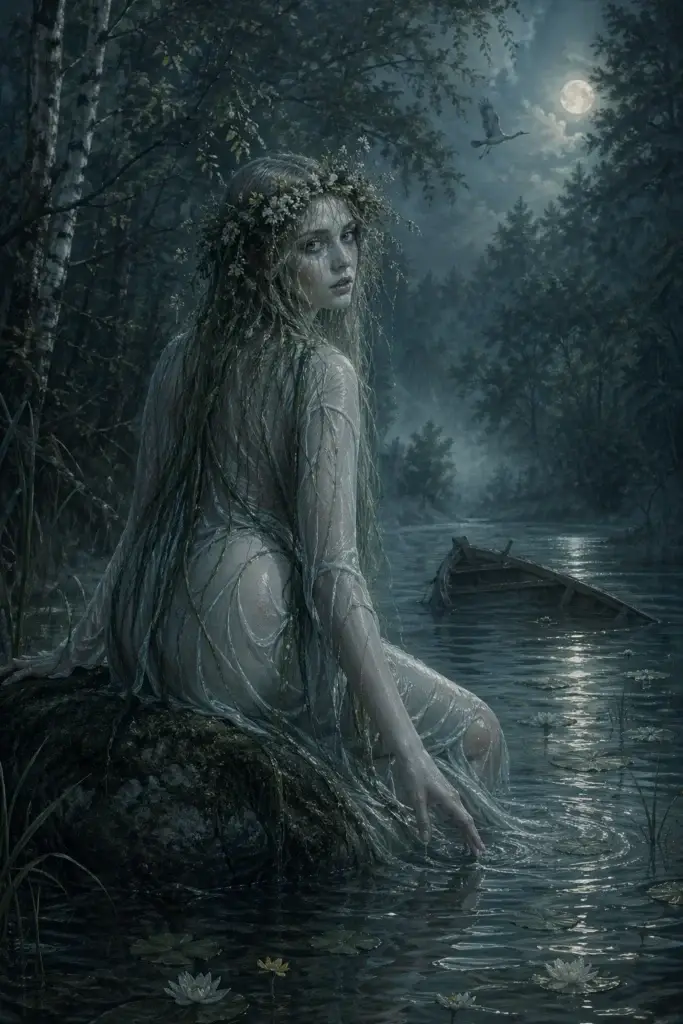
The latter is an openly hostile figure from the marshes who misleads travelers and abducts children. The figure has parallels with the Germanic Mahr and the Alp, likewise female nocturnal beings that oppress without openly killing.
Russian folk tradition and the house-spirit cycle
The Kikimora appears in Russian folklore as the female counterpart to the male Domovoi, a house spirit that protects the prosperity of a farmstead. While the Domovoi maintains order and protection, the Kikimora brings disorder and chaos, especially when the head of the household dies or the family falls into conflict.
She inhabits the space between family and non-family, between culture and wilderness. This explains her ambivalence: she is not destructive like a demon, but rather a sign of familial or social disruption.
Ethnographic literature from the late tsarist period documents Kikimora accounts as widespread and regionally diversified. Different regions knew distinct variants of the being, sometimes named after specific household areas (Kikimora of the pantry, of the main room). This specialization points to an institutionalized classification that was anchored in popular belief.
Quick Overview: Kikimora
Type: house spirit, swamp spirit, female
Origin: deceased children (unbaptized, neglected); poor family traditions
Sources: Russian and Ukrainian folk narratives, Afanasyev
Period: pre-Christian to the present (still present in rural areas)
Two variants: house-Kikimora, swamp-Kikimora
Historical Classification
Pre-Christian Slavic roots. Folk narratives from the medieval period onward; dense documentation in the 19th and 20th centuries (Afanasyev, Maximov, Pomerantseva). Still present in rural Russian and Ukrainian culture today.
East Slavic (Russia, Ukraine, Belarus). West Slavic variants in Poland and the Czech Republic are less pronounced. The swamp regions of northern and western Russia show a particularly dense tradition of the swamp-Kikimora.
Afanasyev, Maximov Nechistaja, nevedomaja i krestnaja sila, Pomerantseva, Tokarev, Vlasova. Ethnographic archives of Russian, Ukrainian, and Belarusian academies.
Name and Spelling Variants
Russian: Kikimora (Кикимора); diminutive Kikimarka.
Variants: Kikimora domaschnjaja (house-K.), Kikimora bolotnaja (swamp-K.).
Etymology: uncertain; possibly derived from kikat (“to screech, to squawk”) combined with mora (a Slavic nocturnal figure related to the Germanic Mahr).
The proximity to mora (nocturnal figure) situates the Kikimora within a broad Indo-European tradition of female night-pressing beings. While the Polish Mora is clearly associated with the sleep paralysis figure, the Kikimora in the East Slavic context has developed into a more broadly effective household tormentor.
Characteristics
Appearance
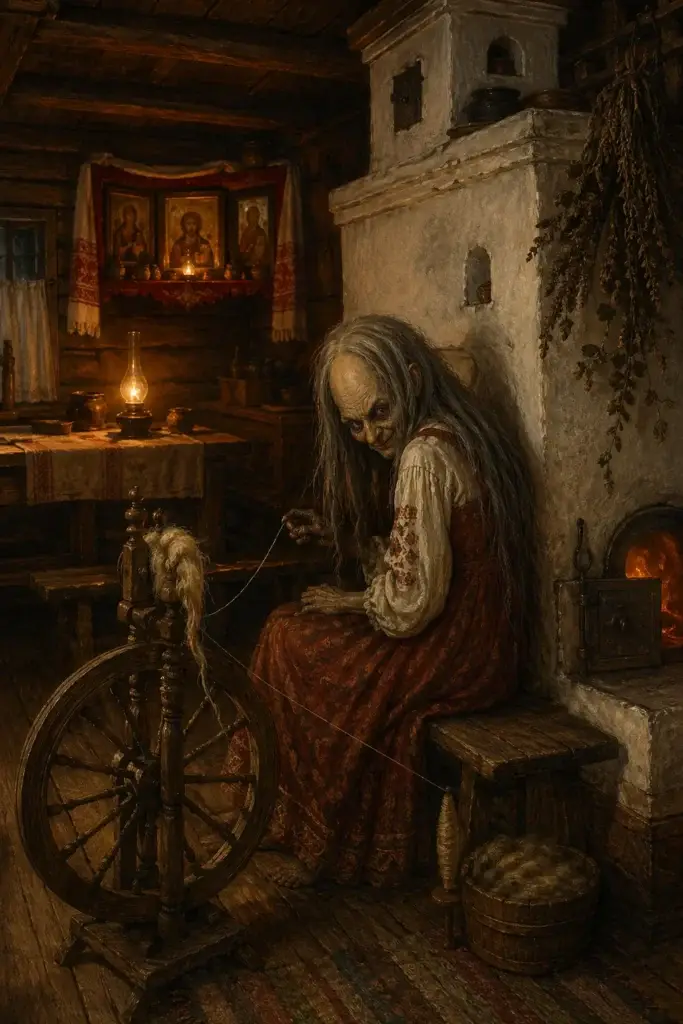
Small, ugly, thin. Long tangled hair like spindle thread. Sometimes with chicken legs or claws. At times recognizable only by sounds in the house: knocking, humming, the clacking of a spinning wheel that is not there, heard in the night.
Behavior
House-K.: destroys needlework, tangles threads, hides tools, spills milk, torments small children with nocturnal whistling and pinching. Rarely lethal. Swamp-K.: more dangerous, leads wanderers astray, pulls travelers off the path, abducts children into the swamp.
Domain of Activity
House-K.: behind the stove, under the floorboards, in storerooms, at looms. Swamp-K.: swamps, bogs, stagnant water. Particularly active at night and during the cold season.
Mythological Classification
Often interpreted as the soul of an unbaptized girl who was not properly buried. In other variants she comes into being when a carpenter curses the family during construction of a house, and then she grows with the house.
Vladimir Propp and structural analysis
The folklorist Vladimir Propp published Morphologija skazki (Morphology of the Folktale, 1928), a structural analysis of Russian wonder tales.
Profile: Kikimora
The key aspects of the Kikimora at a glance.
Soul of an unbaptized deceased girl, or a curse placed by a carpenter that grows with the house. East Slavic house or swamp spirit, female.
House-K.: women spinning, children asleep, the mistress of the house in the pantry. Swamp-K.: travelers, children near the swamp’s edge.
Small, ugly, thin, matted hair like spindle thread. Sometimes chicken legs, claws. More often heard (through noises) than seen.
Destroys needlework, hides tools, torments children. The swamp variant abducts. Rarely lethal, but persistently disruptive.
A broom with bristles facing upward placed in the corner, fern branches on the wall, crosses after Christianization. During needlework: always make the sign of the cross when setting work aside. Do not speak ill of the house.
Alp, Mahr (Germanic), Domovoi (Slavic ambivalent house spirit), Polish Mora, German Kobold in its malevolent form.
Household Practices
Prevention during house construction
Russian carpenters were traditionally regarded as powerful: mistreating them risks a Kikimora. Good food and fair pay are ritually important. Upon moving in: blessing ceremonies, prayers in every corner, salt and bread placed at the stove.
Daily practice
When spinning, make the sign of the cross whenever setting work aside. In the evening, do not leave needlework lying out but put it away. Children’s cradles adorned with St. John’s wort. Never whistle at night. Before eating: the sign of the cross (following Christianization).
When under siege
Persistent disturbance: summon a priest to bless the house with holy water. In some traditions: salt traces in every corner of each room, fern at the windows, an open Psalter in the bedroom. In stubborn cases, the family moves out.
Parallels and Reception
Germanic parallels: The Mahr and the Alp share the nocturnal pressing function. The Kobold and the Heinzelmann are house spirits that can turn malevolent when disrespected. The structural similarity to Mahr and Mora is close enough to be reflected in the names themselves.
Literary reception
Russian literature (Alexei Remizov, the Serapion Brothers) uses the Kikimora as a symbol of domestic confinement. Lyadov’s symphonic poem Kikimora (1909) is the best-known musical testimony.
Modern popular culture: Fantasy literature and role-playing games (The Witcher, which features a Kikimora as a monster in the first game) carry the figure internationally. In Russia and Ukraine she remains part of folk culture but is increasingly treated as a museum curiosity in urban settings.
Similarity to the Domovoi and regional variants
The Kikimora is functionally similar to the Domovoi; both are house spirits with clearly defined behavioral patterns. The difference lies in gender role and domain: the Domovoi protects the entire farmstead, while the Kikimora focuses on household details and childcare.
In some regions they are regarded as a married couple, with the Kikimora as the wife. This pairing suggests a cultural gender coding in which household management is divided.
Regional variants are considerable. In Belarus the Kikimora is sometimes conceptualized as a baby spirit with a particular interest in newborns. This variation shows how a basic concept transforms across cultural boundaries. In the Ukrainian sphere, the Mavka is a distinct forest nymph, not another name for the Kikimora.
The Kikimora as House Spirit in East Slavic Belief
The Kikimora belongs to the house spirits of East Slavic, and especially Russian, folk belief. She is closely associated with the domestic sphere and thus belongs to a field of spirit beings that includes, among others, the male house spirit Domovoi.
In some traditions the Kikimora is regarded as his wife or female counterpart, though ethnography does not confirm this uniformly.
Her preferred location within the house is the area behind the stove, beneath the floorboards, or in the poultry pen. She is considered very small, often invisible or recognizable only briefly at dusk.
Her activity is linked to the traditional women’s work of the peasant household, particularly spinning. At night she could reportedly be heard at the spinning wheel or doing housework, and her behavior was read as a sign of the condition of the house.
From a religious-studies perspective the Kikimora is a good example of how folk belief is anchored in the specific spaces and activities of everyday life. She is not the object of a cult but an explanatory figure for noises, disorder, and the failure of domestic work.
Her ambivalent character, sometimes helpful, sometimes disruptive, corresponds to the ambivalence that characterizes East Slavic house spirits in general: they are part of the household but must be kept in a good relationship through proper conduct. The sources for the Kikimora derive predominantly from the ethnographic collection work of the 19th and early 20th centuries.
The Benign and the Malevolent Kikimora: Two Strands of Tradition
The ethnographic tradition knows the Kikimora in two clearly distinct forms, which scholarship interprets sometimes as regional variants and sometimes as two originally separate conceptions. The first, domestic Kikimora lives in the dwelling. If she is well disposed toward the household, she secretly helps with work, rocks the child, and tends the poultry.
If she is angered, for instance because the house is kept in disorder or because it was built on an unfavorable site, she tangles yarn, breaks crockery, makes noise at night, pinches sleepers, or keeps the inhabitants awake.
The second form is the so-called swamp or forest Kikimora. She does not live in the house but in damp, inhospitable nature, in swamps and in the forest, and is consistently regarded as dangerous.
She lures people into the mire and harms small children in particular. In this form she is related to other dangerous nature spirits of Slavic belief.
Scholarship has proposed various explanations for this dual nature. One widespread interpretation associates the malevolent Kikimora with the souls of unbaptized or unlawfully killed children, a conception that in Slavic belief also accounts for other restless spirits.
The woman who poses a threat to children or to pregnant women is a type found in many cultures.
Whether the domestic and the natural Kikimora were originally one figure that only later merged under a single name cannot be determined with certainty from the available sources. The inconsistency of the tradition is itself a finding: it shows that folk belief had no systematic theology but consisted of regionally distinct traditions.
Etymology and the Unresolved Origin of the Name
The name Kikimora is linguistically striking and has long been the subject of scholarly inquiry without a generally accepted explanation having emerged. The word appears to be compound, and both components are interpreted in different ways.
The second element, -mora, is frequently connected with the widespread Slavic root that also underlies the word Mara or Mora, a being that oppresses sleepers and is associated with the nightmare. This root has cognates in several Indo-European languages and is present, for instance, in the Western term for the nightmare.
The first element, kiki-, is harder to interpret. Proposals include an onomatopoeic origin imitating a shriek or bird cry, as well as various connections to words for bending or for restless movement. None of these interpretations has prevailed.
A possible borrowing from a neighboring non-Slavic language has also been considered, in particular from Finno-Ugric, since the Kikimora was especially widespread in northern Russian regions bordering Finno-Ugric populations. This hypothesis remains unproven.
What can be stated is that the connection to the mora root situates the Kikimora within the large field of nocturnal oppressor beings, which in other Germanic and Slavic traditions includes the Mahr and related nightmare figures.
This linguistic kinship is more revealing than the unresolved first syllable, because it shows that the Kikimora, despite her elaboration as a house spirit, is at her core connected to the older notion of nocturnal pressure.
Warding Off, Appeasement, and the Connection to House Construction
Folk belief knew a whole repertoire of means to defend against a troublesome Kikimora or to prevent her from arising in the first place. These practices are well documented in the ethnographic literature and shed light on the underlying thinking.
A recurring motif connects the malevolent Kikimora with house construction. According to widespread conviction, an angered or devious carpenter or stove-setter could conjure a Kikimora into a house during its construction by inserting a particular wooden figurine or object into the wall or beneath the stove.
The house would then remain plagued by unrest until the object was found and removed. This motif links the spirit to the concrete building trade and to the social relationship between client and craftsman.
Against an already present Kikimora various measures were employed. Widespread was the invocation of the holy figures of folk Christianity, the sprinkling of holy water, or the placement of certain herbs and objects at vulnerable spots, such as in the poultry pen.
A distinctive and frequently cited measure was a perforated stone or the neck of a broken clay jug form, the so-called chicken-god, which was meant to keep the Kikimora away from the poultry.
The appeasement of the benevolent domestic Kikimora was handled, as with the Domovoi, through cleanliness, order, and small offerings.
From a religious-studies perspective this spectrum shows that dealing with the Kikimora was not a special case of magic but was embedded in the everyday concern for an orderly, protected house, in which pre-Christian ideas and folk Christian practice intertwined.
Selected Bibliography
A selection of key works on the Kikimora:
- Maximov, S. V.: Nechistaja, nevedomaja i krestnaja sila. St. Petersburg 1903.
- Pomerantseva, E. V.: Mifologicheskie personazhi v russkom folklore. Moscow 1975.
- Vlasova, Marina: Russkie sueverija. St. Petersburg 1998.
- Tolstoi, N. I.: Slavjanskie drevnosti. Moscow 1995 ff.
Standard literature (Slavic):
- Mańczak, Witold: Slavic Mythology. In: Encyclopedia of Religion 13, Macmillan 1987.
Further standard works in the literature index.
The protective practices described here represent a religious-studies classification of historical traditions. iWell Guard draws on this cultural-historical line of wearable protective objects and constitutes a contemporary form of it. More about the iWell Guard →
Frequently Asked Questions about Kikimora
What is a Kikimora in Slavic mythology?
Kikimora is a female house spirit of East and West Slavic folk religion, a small, often misshapen woman who lives behind the stove or beneath the floorboards.
She is ambivalent: in a well-kept household she helps at night with spinning and weaving; in a slovenly household she tangles yarn, giggles in the night, and makes life difficult for the inhabitants. In some regions she is regarded as the spirit of an unbaptized deceased child.
How does one protect oneself from a Kikimora?
The classical method is thorough housekeeping: a well-maintained dwelling does not allow a Kikimora to become a malevolent spirit. In addition there are concrete apotropaia: juniper branches beneath the spinning cradle, a glass of water with fennel placed at the door, a drawn witch’s cross on the bedroom wall.
In some traditions the Kikimora is also appeased by making the sign of the cross or by special prayers on Thursday evening, Thursday being regarded as her particular day.