Ifrit, Demon of the Islamic Tradition
By Ralf Ittermann · last reviewed on
Ifrit is a demon of the Islamic tradition.
The powerful jinn, fire beings between the Solomon myth and One Thousand and One Nights.
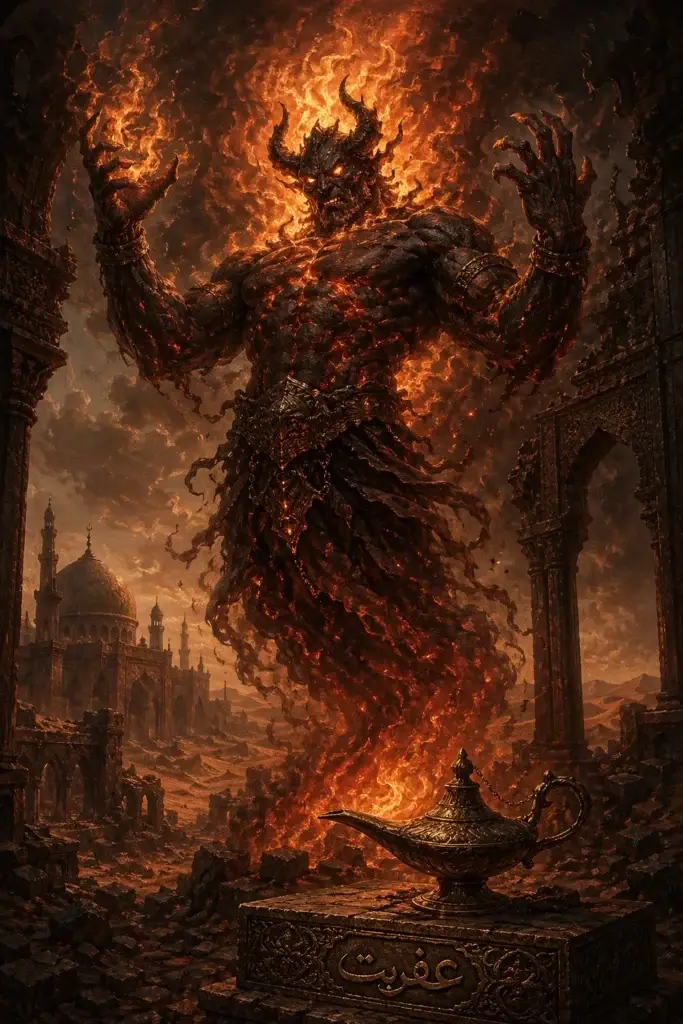
Ifrit
Ifrit is a particularly powerful class of jinn. The Quran mentions this figure once (Surah 27:39): an Ifrit offers King Solomon to bring the throne of the Queen of Sheba in an instant.
This single mention already defines the Ifrit: enormous, strong, fast, and capable of great magic. The later tradition, especially One Thousand and One Nights, expands this into a distinct figure.
Unlike ordinary jinn, Ifrit are usually hostile. They guard treasures, abduct princesses, fight heroes, can be bound and compelled, but also escape and take revenge.
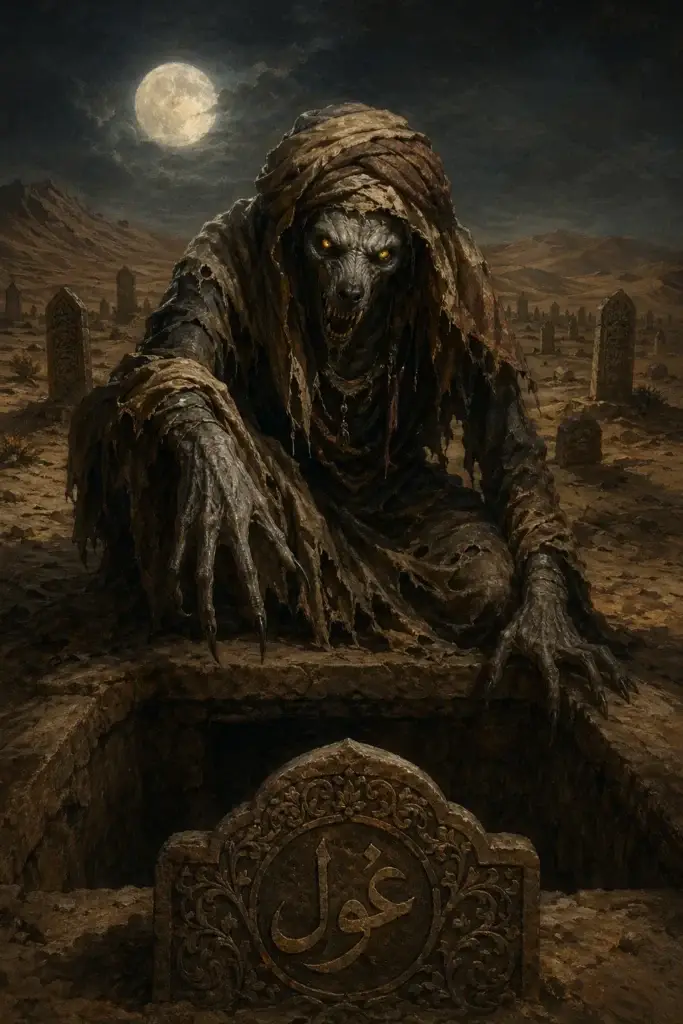
In popular religious imagination they are often associated with cemeteries, places of violent death, and harsh deserts. Their color is red or black, their element is fire, and their size is extraordinary.
The Ifrit in the Quran: Solomon’s All-Powerful Jinn
Surah 27:39 mentions an Ifrit from among the jinn who offers Solomon to bring a throne before Solomon rises from his seat. This presents the Ifrit as a particularly powerful class of jinn; in seconds they can accomplish feats that human craftsmen would need months to achieve.
The Quran uses this as a metaphor for divine omnipotence: if an Ifrit is so powerful, how much more powerful is Allah? This establishes the Ifrit as a cosmological reference point, a being of great force who is still subject to the will of a mortal king who enjoys Allah’s favor.
The Ifrit remains morally neutral in this scene, fulfilling a task suited to its supernatural abilities. In later literature, by contrast, the Ifrit also appears as destructive and defiant.
Ifrit at a Glance
Type: Powerful subclass of jinn
Origin: Fire, desert, places of violent death
Texts: Quran (Surah 27:39), Hadith, One Thousand and One Nights
Period: 7th century to the present
Key characteristics: Strength, size, fiery nature, often hostile
Context
Quranic reference in the 7th century; developed as a literary figure in One Thousand and One Nights (compiled 9th to 14th century); present in medieval Arabic popular literature, modern popular culture, and the fantasy tradition.
The Arab cultural sphere as the point of origin, spread throughout the Islamic world. Modern international presence through translations of One Thousand and One Nights and fantasy literature.
Quran (Surah 27:39), classical Tafsir, One Thousand and One Nights, al-Damiri, al-Qazwini ‘Aja’ib al-Makhluqat, modern ethnographic studies.
Name
Arabic: ʿifrīt (singular), ʿafārīt (plural). Etymology unclear, possibly connected to “dust” or “power”.
English: afrit, afreet.
Relation to jinn: a distinct and powerful subclass, above ordinary jinn.
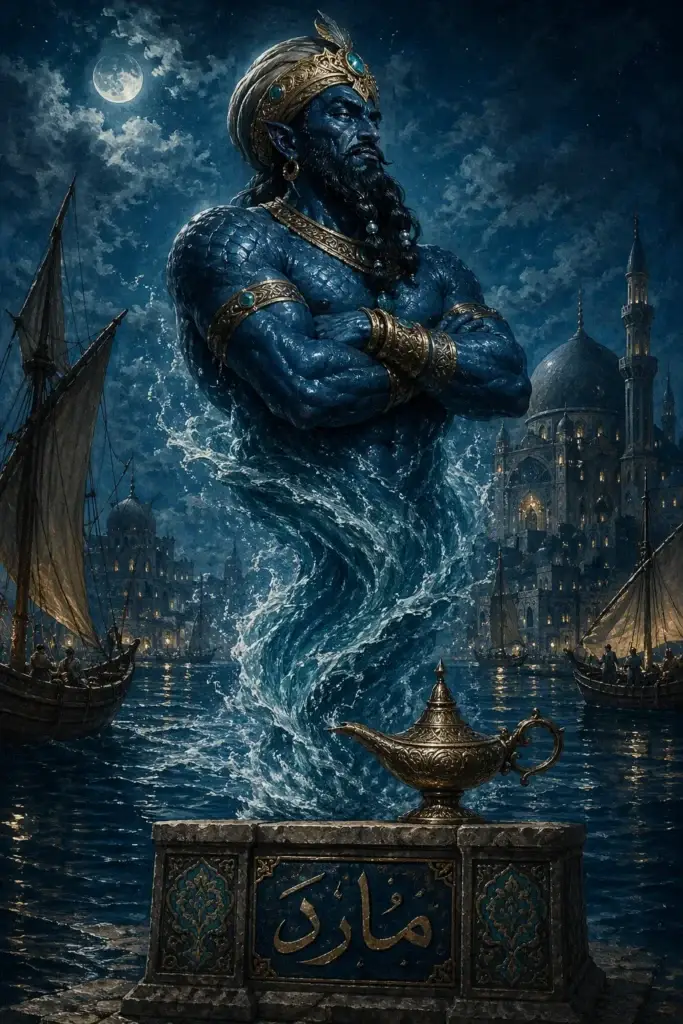
Above: Marid, even more powerful, often associated with water.
The classification Jann < Jinn < Shaytan < Ifrit < Marid is not established in the Quran or Hadith but is the product of classical demonologists. Folk practice follows it loosely; in popular tradition, Ifrit are often associated with particularly ancient or violently killed individuals.
Characteristics
Appearance
Enormous, often described as pillars of smoke and fire that condense into humanoid form. Horned, with fiery eyes and claw-like hands. Red or black in color. Reaching from the earth to the sky in literary hyperbole.
Behavior
Proud, prone to violence, often unapproachable. In One Thousand and One Nights narratives, frequently bound (in bottles, seals, and Solomon’s amulets) and released, whereupon they either reward their liberator or seek to kill them. Magically gifted, long-lived, and difficult to destroy.
Sphere of Influence
Desert, ruins, caves, places of violent death. In popular tradition, often bound to specific locations. Some Ifrit have personal histories (arising from a murdered person, a curse, etc.).
Mythological Classification
Not a singular created figure but a powerful subtype of jinn. In the Solomon tradition, Solomon is depicted as ruler over the jinn and thus over Ifrit as well; his seals are regarded as binding instruments.
Ifrit in Islamic Demonology and Classification
Islamic demonologists and theologians, particularly from the 10th century onward, classified the Ifrit as one of the highest classes of jinn. Al-Ghazali and later mystics distinguished between noble (believing) and evil Ifrit. An evil Ifrit was essentially a demon in the Western sense: powerful, intelligent, manipulative, and inclined to seduce or harm humans.
Islamic magic (sihr) used Ifrit as instruments, which was theologically highly contested: was invoking an Ifrit heresy or an accepted magical art? This debate ran through centuries of Islamic scholarship. An Ifrit might perhaps be bound through Quranic recitation or through supernatural contracts, but never simply destroyed.
Profile: Ifrit
The most important aspects of the Ifrit at a glance.
Powerful subclass of jinn made of fire. In popular tradition, often associated with those who died violently or with ancient places.
Heroes, treasure hunters, grave robbers. In popular religious imagination: people who carelessly enter ruins or desert locations.
Enormous, fiery, horned, with red or black skin. Often appears as a pillar of smoke and fire that assumes humanoid form.
Guards treasures, abducts humans, fights heroes. Magically powerful, capable of shapeshifting, teleportation, and invisibility.
Quranic protective formulas, Seal of Solomon (Star of David, hexagram), targeted Ruqya. In One Thousand and One Nights: cunning and binding formulas used by sorcerers.
Greek Titans, giants (Jotnar, Germanic), medieval ogres, modern fantasy demons.
Folk Beliefs and Practices
Protection at Vulnerable Sites
Before entering ruins, desert areas, or ancient castles: Basmala, recitation of Ayat al-Kursi. Solomonic motifs (hexagram, pentagram) as protective symbols, common in popular religious amulets.
Ruqya in Cases of Encounter
When Ifrit influence is suspected, Ruqya is practiced. In some North African traditions, entire rituals are performed to “appease” an Ifrit, a popular religious practice that orthodox theologians frequently criticize.
Literary Binding
In One Thousand and One Nights, an Ifrit is bound by a seal, bottle, or magical formula. The motif is literary rather than theological, but it has profoundly shaped the Western imagination of the spirit in a bottle.
Parallels and Reception
Classical Parallels: Greek giants and Gigantes, Germanic Jotnar, Egyptian great demons all share the quality of extraordinary scale and mythic power. The Persian Peri tradition includes similar figures.
One Thousand and One Nights: The image of the Ifrit in One Thousand and One Nights (King Shahryar, the Fisherman and the Ifrit, Aladdin) represents the central literary elaboration. From there it also shapes the Western conception of the “genie.”
Modern Popular Culture: Fantasy role-playing games (Dungeons & Dragons, Final Fantasy) adopt the Ifrit as a specific figure. Disney’s Aladdin (1992) popularized a softened version.
The Ifrit in One Thousand and One Nights and Arab Folklore
In One Thousand and One Nights, Ifrit are depicted as archetypal beings of great power and often destructive force. They have long lives (some are centuries old), they store grievances, they can enter humans or change their form.
An Ifrit might destroy a city, but also help a person who cleverly binds or tricks it. The stories frequently show Ifrit as bound to places or objects: magical bottles, ancient ruins, sacred lakes.
This is an Arabized version of universal spirit-binding concepts. In Egyptian-Arabic popular religion, Ifrit traditions merged with older pharaonic and Greco-Roman demon concepts: an Ifrit was sometimes understood as a cursed priest, sometimes as a natural force. This blending is characteristic of North African and Near Eastern religious cultures with deep historical layers.
The Ifrit in the Quran and Early Islamic Interpretation
The word ifrit appears in the Quran only once, in Surah 27, the Surah of the Ant. In the context of the narrative of Solomon and the Queen of Sheba, Solomon asks his assembly who can bring him the queen’s throne.
An Ifrit from among the jinn steps forward and declares that he can bring the throne before Solomon rises from his place. Before he does so, however, another, one who has knowledge from Scripture, brings the throne in an even shorter time.
From this single passage, classical Quranic commentators derive essential characteristics of the Ifrit. The Ifrit belongs to the category of jinn, possesses extraordinary strength and speed, and appears here in the service of Solomon, to whom the Quran attributes power over the jinn.
At the same time, the narrative marks a limit: the strength of the Ifrit is surpassed by the knowledge of the one versed in Scripture.
Early Islamic scholarship interpreted the term in various ways. Some commentators understood ifrit as a designation for a particularly strong or particularly malicious type of jinn; others treated it more as an intensifying term expressing strength and cunning.
This ambiguity has persisted throughout the tradition. What remains clear is that, according to the Quranic evidence, the Ifrit is not unambiguously evil but rather a powerful jinn whose character only shifts more markedly toward the threatening in later literature.
Ifrit, Jinn, and the Hierarchy of Invisible Beings
The Ifrit can only be understood within the framework of the broader Islamic teaching on jinn. According to Islamic belief, jinn are a distinct category of creation, made from smokeless fire, while humans are made from clay.
They are mortal, reproduce, possess religion and moral responsibility, and can be believing or unbelieving. Within this category, tradition recognizes various types and ranks, and the Ifrit is generally classified as a particularly powerful kind, often hostile to humans.
Later popular and scholarly literature attempted to establish a hierarchy of jinn. In some enumerations, ranging from weaker to stronger, ordinary jinn appear first, followed by the ifrit as a more forceful and dangerous grade, and finally the marid as the most powerful and recalcitrant type.
These hierarchies are not transmitted in uniform fashion, however, and vary by source. They represent ordering attempts within narrative tradition rather than fixed theological doctrine.
From a religious-studies perspective, the Ifrit is not a demon in the Christian sense. It is not a fallen angel and is not fundamentally fixed toward evil. It belongs to a created category that, like humanity, is subject to moral testing.
The fact that the Ifrit appears as dangerous and malevolent in many narratives is a feature of literary elaboration, not theological definition. Islamic teaching does recognize believing jinn, and in principle an Ifrit may belong among the faithful.
The Ifrit in One Thousand and One Nights and Modern Reception
The image most people have of the Ifrit today comes less from the Quran than from the story collection One Thousand and One Nights and from modern popular culture.
In the Arabic narratives, the Ifrit is a recurring figure: an immense, often formidable spirit that can be imprisoned in bottles or vessels, that grants wishes or takes revenge, and that commands great magical power.
A defining feature of these narratives is the ambivalence of the Ifrit. In some stories it is vengeful and lethal; in others it is bound by an oath or captivity and serves reluctantly.
European reception since Antoine Galland’s translation in the early eighteenth century has closely tied the Ifrit to the concept of the genie in a bottle, even though this binding motif is only one element among many in the broader Islamic tradition.
In modern popular culture, in fantasy literature, films, and games, the Ifrit has often become a pure fire being, an embodiment of the element of fire. This narrowing is understandable given that jinn are created from fire, but it significantly abbreviates the original conception.
Religious-studies analysis therefore carefully distinguishes three layers: the sparse Quranic evidence of one powerful jinn in Solomon’s service, the theological classification within the doctrine of jinn, and the rich but secondary narrative tradition that made the Ifrit a vivid figure of storytelling. Anyone seeking to understand the Ifrit should keep these layers separate.
Sources and Literature
Further standard works in the literature index.
The protective practices described here represent a religious-studies classification of historical traditions. iWell Guard draws on this cultural-historical lineage of wearable protective objects and represents a contemporary form of it. Learn more about the iWell Guard
Frequently Asked Questions about Ifrit
What is an Ifrit in Islam?
Ifrit (Arabic: ʿifrīt, also Efreet, Afrit) is in Islam a particularly powerful and dangerous class of jinn, the beings created from smokeless fire. The Quran names an Ifrit as a servant of Solomon who was able to bring the throne of the Queen of Sheba in an instant (Surah 27:39).
Ifrit are considered particularly strong jinn, often long-lived, with intellect, will, and the ability to shapeshift. In popular tradition they are usually malevolent and must be controlled with special conjurations.
What is the difference between Ifrit, Jinn, and Shaytan?
Jinn is the overarching term for all beings created from smokeless fire, a distinct category of creation alongside angels and humans, endowed with free will and therefore capable of choosing between good and evil.
Ifrit is a particularly powerful subgroup of jinn, often characterized as evil or unbelieving. Shaytan (Arabic for Satan) is a collective term for all who turn against God, encompassing both jinn and other seductive beings. Iblis, the most prominent Shaytan, is himself a jinn.