Horus, god of the Egyptian tradition
By Ralf Ittermann · last reviewed on
Falcon god, son of Isis and Osiris, lord of kingship. Horus is the power of renewal born out of defeat. With a falcon’s head and the solar disc, in the hand of the priest and on the throne of the pharaoh, he embodies legitimate rule over Egypt and the triumph of light over chaos.
His eye, the *Eye of Horus*, is one of the most potent protective amulets of Egyptian religion, a symbol of becoming whole again after trauma.
Horus is an Egyptian falcon god of royal power.
Type: Egyptian principal deity, god of kingship and the sky
Pantheon: Egypt (all dynasties)
Function: embodiment of kingship, the sky, and protection against the chaos of Set
Main attributes: falcon head, the double crown Pschent, the Was sceptre, the Eye of Horus
Principal cult sites: Edfu (the largest temple of Horus), Hierakonpolis, Behdet
Greek identification: in part Apollo (through the solar aspect)
Classification
Period of the sources
Horus is attested from the predynastic period (before 3000 BCE); on the Narmer Palette he hovers over the king as a falcon. From the beginning, the living pharaoh was regarded as the embodiment of Horus, the deceased pharaoh as Osiris.
The principal flourishing of the temple at Edfu falls in the Ptolemaic period (3rd to 1st century BCE). Several aspects of Horus exist in parallel: Horus the Elder, Horus of Edfu, Harpocrates (the child), and Harendotes (the avenger of the father).
The principal cult site was Edfu (Behdet) in Upper Egypt, the best-preserved Egyptian temple, built in Ptolemaic times. Beyond Edfu stood Hierakonpolis (Nekhen, an early-dynastic centre) and Buto in the Delta.
Letopolis served the Harmerti aspect. As god of kingship, however, Horus was present throughout the entire land; the king’s Horus name stood in the serekh above the palace façade, together with a Horus symbol.
Central sources include the Pyramid Texts (Utterances 219, 359), the Book of the Dead (Spell 17), the Contendings of Horus and Seth (Chester Beatty Papyrus I), the completely preserved wall inscriptions of the temple at Edfu (a late theological elaboration), and Plutarch’s De Iside et Osiride.
Secondary literature includes Junker, Die Goetterlehre von Memphis; Bonnet, Reallexikon; and Meeks/Favard-Meeks, Daily Life of the Egyptian Gods.
Name
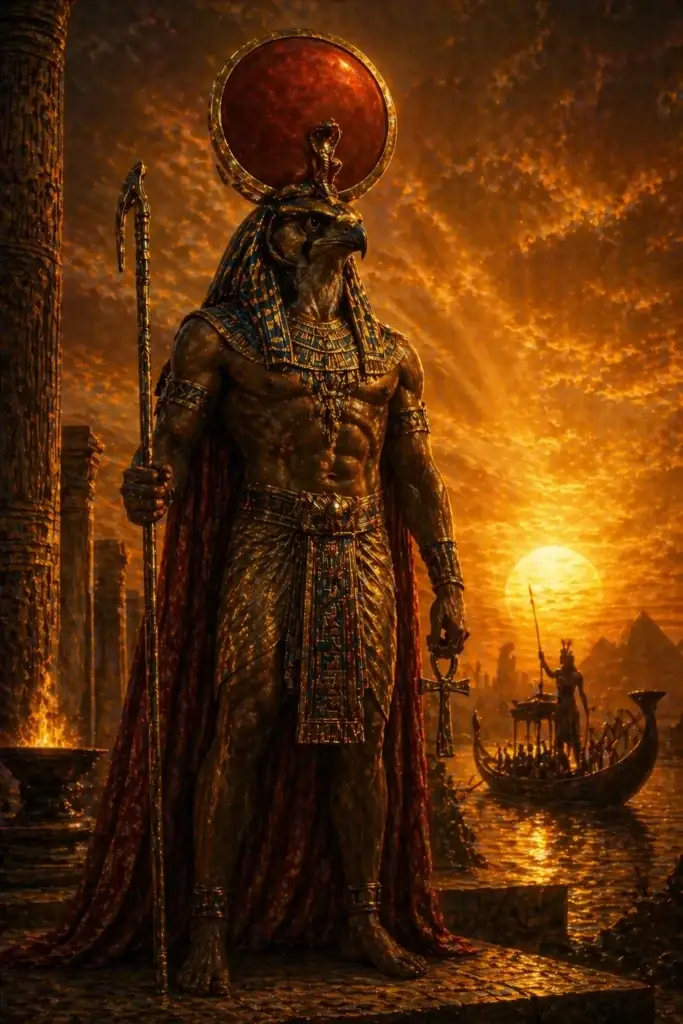
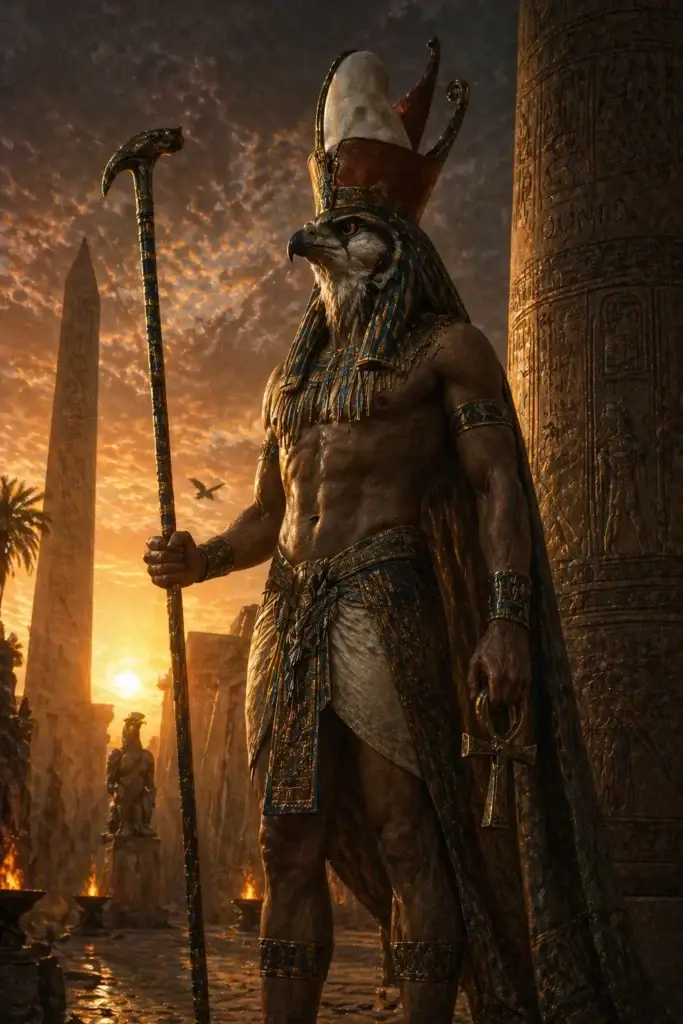
Horus is depicted with a falcon’s head, often wearing the double crown (Pschent: the red crown of Lower Egypt combined with the white crown of Upper Egypt) or the Atef crown (a white feather flanked by horns).
His most famous symbol is the Eye of Horus (also called Wedjat eye), a stylised eye marked with falcon-like features that embodies healing, protection, and wholeness. The falcon itself is his animal; in depictions, falcon wings sometimes shelter his body. The solar disc (Aten) rests upon his head.
Characteristics
Horus avenges his father Osiris against Seth in a legendary conflict in which both are wounded; Horus loses his eye, which is later restored by Thoth or Hathor. As son he becomes heir to the throne: every Egyptian reign is a reign of Horus.
The pharaohs regarded themselves as living falcons, animated by the power of Horus. Priests offered him wild ducks and hymns. The temple of Horus at Edfu was among the wealthiest in the land. In rituals Horus was invoked for the healing of injuries and for the legitimation of power.
Appearance and symbolism
Horus is usually shown as a falcon or as a falcon-headed man wearing the double crown of Egypt (the red and the white crown). His left eye is the lunar eye, his right eye the solar eye, signs of his realms of rule.
The Wedjat eye, his sacred eye, is one of the most powerful protective symbols of Egypt. The falcon is his animal: swift, precise, and flying high in the sky. The double crown signifies the unification of Upper and Lower Egypt.
The most important aspects of Horus at a glance. The following fields summarise origin, function, appearance, veneration, symbols, and parallels.
Horus is the son of Isis and Osiris, born after the death of Osiris, the child whom Isis raised alone in the reeds of Chemmis (the Harpocrates myth).
In earlier traditions, Horus the Elder is the brother of Osiris. The principal conflict is the struggle against Seth over the succession of Osiris; after a long judicial dispute and physical combat, Horus prevails and assumes the kingship of Egypt.
Embodiment of kingship: every pharaoh was “Horus upon the throne”. Protector against Seth-like chaos, against snakes, and against evil.
In healing magic he serves as protective god of children and the sick (the Horus cippi, a common protective object). His Eye of Horus is one of the most important protective amulets in the entire ancient world.
A falcon-headed human figure wearing the double crown Pschent (the red crown of Lower Egypt with the white crown of Upper Egypt), the Was sceptre, and the Ankh. Also shown as a pure falcon with the double crown.
As a child (Harpocrates), a naked boy with a finger to the mouth and the side-lock of youth. As Horus of Edfu, a great winged solar disc embracing him. The Eye of Horus also appears frequently as an independent symbol.
Sphere of effect: Horus was the god of reigning kingship; every pharaoh swore the Horus oath. For the people, Horus was protective god against illness and snakes, and his Eye of Horus was the most widespread protective amulet.
Edfu was a place of pilgrimage in Ptolemaic and Roman late antiquity, and the annual Festival of the Beautiful Union (the meeting with Hathor) drew thousands of visitors.
Falcon (especially the peregrine), the double crown Pschent, the Was sceptre, the Ankh, the Eye of Horus, the winged solar disc (Edfu). Plant: the lotus. Sacred sites: the temple at Edfu with its celebrated pylon, and Hierakonpolis as place of origin.
Apollo (Greece, solar and purificatory aspect), Marduk (Mesopotamia, protective god of kingship), Indra (Hinduism, king of the gods), Tarchunna/Teshub (Hittites), and Jupiter Capitolinus (Rome, protector of the empire). The falcon iconography has no direct Indo-European parallel.
Protective practice
Apotropaic rituals
This section will be filled in with further material from the history of religions.
Invocations
A deeper account with further source material will follow in a later update.
Amulets and protective symbols
At the heart of the protective practice surrounding Horus stands the udjat, the restored Eye of Horus, which in the myth was injured by Seth and healed by Thoth. As an amulet of faience, stone, or metal it was given to the living and the dead alike and was considered the embodiment of wholeness and healing. Finds from all periods of Egypt show that the Eye of Horus was among the most commonly worn protective signs of the country.
Cult and veneration
The cult of Horus was interwoven with the cult of the pharaoh. Every pharaoh was Horus on earth and bore the so-called “Horus name” among his titles. The mythology of the conflict between Horus and his uncle Seth was re-enacted in the temples.
The nine-year-old Horus, who had to test a weakness of his enemy, also stands for initiation. Falcon statues guarded the temples, and Horus was invoked as protector against evil powers.
Horus, parallels in other cultures
Horus is comparable to the Greek Apollo (solar god, healer, archer) and to the Roman Sol. In Indian traditions he bears similarities to Surya (the solar god).
The motif of the wounded and healed eye also appears with Odin (Scandinavia), who sacrifices his eye. The conception of the king as image of the god is pan-Mediterranean and later shapes Christian ideology as well.
The myth of the contest between Horus and Seth
The central narrative concerning Horus is his conflict with Seth over the rule of Egypt. After Osiris is killed by his brother Seth, Isis raises her son Horus in secret so that he may one day claim his father’s inheritance.
The grown Horus appears before the council of gods and demands the kingship. Seth contests his claim, and a lengthy legal dispute follows before the Ennead.
The most extensive coherent version of this confrontation is preserved in the so-called Papyrus Chester Beatty I from the Ramesside period, a text often cited under the title The Contendings of Horus and Seth.
It recounts a series of contests and stratagems: a race in stone boats, a diving competition in the form of hippopotami, and a deception devised by Isis.
The tone of this text is strikingly coarse and at times comic, which long perplexed scholarship. Today it is understood as a literary elaboration that conveys a serious theological core in an entertaining form.
The theological core is the legitimation of kingship. Horus embodies the rightful heir, Seth the violent usurper. In the end, the council of gods, often following a judgment of Osiris from the underworld, awards Horus the rule over the land of the living.
This decision is more than the outcome of a story. It establishes the principle that every reigning pharaoh sits upon the throne as living Horus and that his deceased predecessor becomes Osiris. The myth thereby supplies the basic pattern of Egyptian royal ideology for three millennia.
Forms of Horus and the multiplicity of one god
Behind the name Horus stand several originally distinct divine figures that, over the course of Egyptian religious history, grew together or continued to exist side by side. Egyptology accordingly speaks of forms of Horus in the plural.
One important line is Horus the Elder, called Haroeris in the sources, a deity of sky and light whose eyes are the sun and the moon. From him is to be distinguished Horus, son of Isis and Osiris, called Harsiese in the sources, heir and avenger of his father.
Alongside these stands the child Horus, Harpocrates in Greek form, represented as a naked child with the side-lock of youth and a finger to the mouth. This figure gained particular significance in the Late Period and in Graeco-Roman times within domestic and popular cult.
Harmachis, in turn, Horus of the Horizon, is a solar form associated, among other things, with the Great Sphinx of Giza. Local manifestations such as the Horus of Edfu, Behdeti, possessed their own temples and festival cycles.
This multiplicity is no sign of disorder; it corresponds to the Egyptian way of conceiving the divine. A deity could appear in different aspects, in different places, and in different stages of life without these aspects being perceived as contradictions.
Modern scholarship, notably in the foundational works of Hans Bonnet and in later overview accounts of the Egyptian world of gods, has shown how, out of originally independent local deities, a multilayered god Horus emerged through theological reflection and political centralisation.
The Eye of Horus: pictorial sign, amulet, and system of measure
The Eye of Horus, in Egyptian wedjat, is among the best-known symbols of ancient Egyptian culture. It goes back to an episode in the conflict with Seth: in the struggle, Seth injures one of Horus’s eyes, which is later healed or restored by Thoth.
The healed eye thereby becomes the emblem of restoration, of integrity, and of salvation. In some narratives Horus presents this eye to his father Osiris, whereby it also becomes a sign of the offering and of the revival of the dead.
As an amulet the wedjat was widespread across every stratum of Egyptian society. It appears on mummy bandages, among grave goods, on items of jewellery, and on household objects.
Those who wore it hoped for protection, health, and the warding off of misfortune. Archaeological finds attest the symbol from the time of the Old Kingdom well into the Graeco-Roman period.
A distinct significance belongs to the Eye of Horus in ancient Egyptian mathematics. Its individual pictorial components were linked with fractions that are continually halved, namely one half, one quarter, one eighth, and so on. With this system the scribes notated portions of grain measures.
Older scholarship saw in this a closed arithmetical system; more recent investigations assess the link between myth and units of measure more cautiously and emphasise that the schematic assignment is in part a modern reconstruction.
What remains undisputed, however, is that the Eye of Horus was one of the most effective pictorial signs of Egypt, whose traces extend into present-day popular representations.
Horus and kingship
No god was more closely bound to Egyptian kingship than Horus. Already in the early period, around the turn from the fourth to the third millennium BCE, the king bore a name that identified him directly with the god: the so-called Horus name.
It was written within a rectangle representing the palace facade, with the falcon of Horus above it. The king was thus not only the protege of the god but his manifestation upon earth.
This conception remained foundational throughout pharaonic history. The living king was regarded as Horus, the deceased predecessor as Osiris. The succession to the throne was thereby conceived as an orderly sequence in which every ruler takes the place of the son who enters into the inheritance of the father.
The royal titulary developed later into a system of five names, several of which continued to refer to Horus, including the so-called Golden Horus name.
Horus is also present in the iconography of the king. A famous statue from the Old Kingdom shows King Khafre with the falcon of Horus seated protectively behind his head. In temple reliefs the falcon frequently hovers above the ruler and offers him signs of protection.
The close bond of god and king meant that the cult of Horus was at the same time a piece of state ideology. Religious studies has seen here a vivid example of how a society anchored the legitimacy of its rule in religion and thereby secured stability over long periods of time.
The temple at Edfu and later veneration
The best-preserved great temple of pharaonic Egypt is consecrated to Horus. It stands at Edfu in Upper Egypt and was erected in Ptolemaic times, over more than a century and a half, into the first century BCE.
Worshipped there was Horus of Behdet, a local form of the god, together with the goddess Hathor of Dendera and their common son.
The walls of the temple bear extensive inscriptions of great value for religious studies. They transmit descriptions of festivals, theological texts, and above all a dramatic account of the victory of Horus over Seth, often referred to as the Myth of the Winged Solar Disc or as the Edfu Drama.
These texts grant a rare insight into the ritual staging of a myth, for they appear to have been connected with cultic acts and possibly also with theatrical performances.
A particular festival was the annual journey of Hathor from Dendera to Edfu, the Festival of the Beautiful Union, at which the divine images were brought together.
Edfu shows that the cult of Horus remained vital and richly elaborated even in the final centuries of Egyptian religion, long after the land had come under Greek rule.
In Graeco-Roman times, moreover, the figure of the child Horus spread far beyond Egypt across the Mediterranean, often in the company of Isis. The history of the influence of Horus thus reaches from the oldest royal names of Egypt into the religious world of the Roman imperial period.
Further links
Further reading
Further standard works in the literature index.
Frequently asked questions about Horus
Who was Horus in Egyptian mythology?
Horus (Egyptian Heru) is one of the oldest and most important gods of Egypt, the falcon-headed god of the sky and of kingship. In the Osiris myth he is the son of Osiris and Isis.
After the murder of Osiris by Seth, Horus is raised in secret by Isis, fights as an adult against Seth for the kingship and prevails.
He becomes the legitimate ruler and the divine archetype of every earthly pharaoh. Every reigning pharaoh was regarded as Horus on earth, and every deceased pharaoh as Osiris in the beyond.
What is the Eye of Horus (Udjat)?
The Udjat eye (also Wedjat) is one of the most famous symbols of Egyptian culture: the restored eye of Horus, lost in the struggle against Seth and healed by the moon god Thoth with saliva. It signifies restoration, protection, wholeness, and healing. As an amulet it was one of the most common talismans of Egypt.
In the later medical tradition the Udjat was divided into six parts, whose fractions (1/2 + 1/4 + 1/8 + 1/16 + 1/32 + 1/64) served as fractional parts for the hekat measure (a grain measure). Together they yield 63/64; the missing part is the magical healing of Thoth.