Peg Powler and the foam on the Tees
By Ralf Ittermann · last reviewed on
Peg Powler is a demon of English tradition.
The foam of the Tees betrays the water witch beneath.
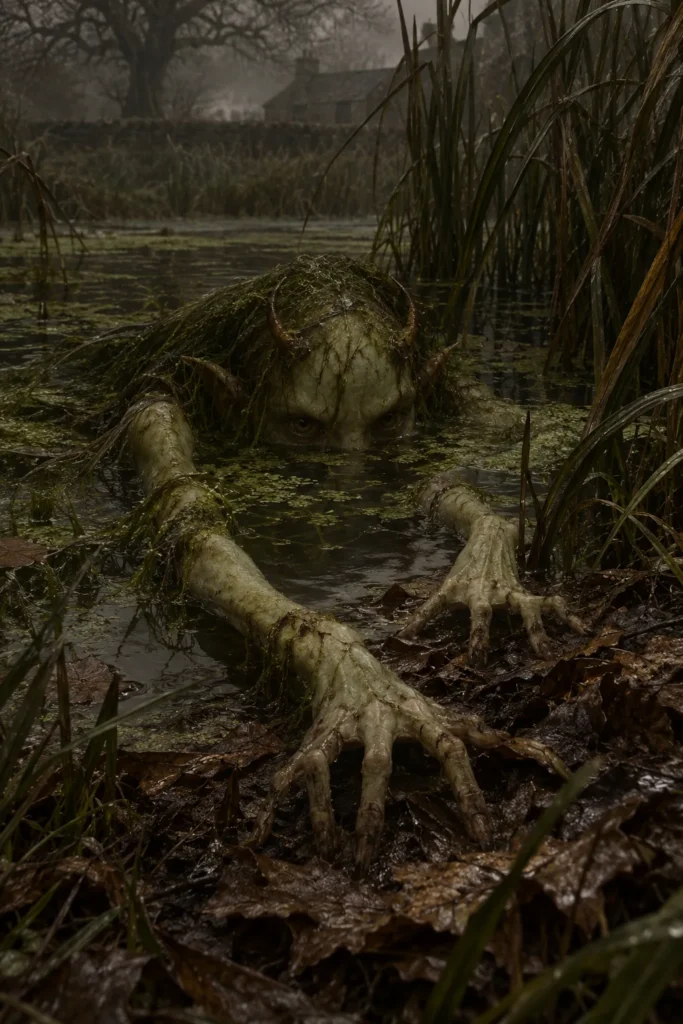
Peg Powler is the green-skinned water witch of the River Tees in northern England. She grabs the ankles of those standing too close to the water, pulls them under, and drowns them. As a bogey figure, she kept children away from the dangerous banks of the fast-flowing Tees.
She is documented in the Denham Tracts, collected between 1846 and 1859, and by William Henderson, and is located chiefly around Piercebridge in County Durham. Unlike many silent water spirits, her presence is even visible: in the white foam on the flowing Tees, which was named after her.
Type: water witch, drowning figure of a single river
Origin: River Tees in County Durham and Yorkshire, especially around Piercebridge
Texts: well documented by Denham and Henderson
Period: north English folklore, earliest mention in the Denham Tracts around 1850
Appearance: ugly old woman with green skin, long hair and sharp teeth, more rarely as a beautiful young woman with green hair

Source context
Period of the Texts
North English folklore of the 19th century: the earliest written mention appears in the Denham Tracts, collected between 1846 and 1859.
Area of Diffusion
The River Tees in County Durham and Yorkshire, with a focus around Piercebridge; on the tributary Skerne the related Nanny Powler is known.
Sources
Good: Michael Aislabie Denham and William Henderson document the figure independently of one another.
Name and variants
English: Peg is a pet form of Margaret, as is typical for female bogey figures. Powler probably derives from a dialect word for tugging and pulling at hair, though the exact etymology has not been conclusively established.
Appearance and behaviour
Appearance
Peg Powler is usually described as an ugly old woman with green skin, long hair and sharp teeth. One variant instead shows her as a beautiful young woman with green hair, who pretends to be drowning in order to lure rescuers into the water. The white foam on the flowing Tees, called Peg Powler’s Suds or Peg Powler’s Cream, marks her presence beneath the surface.
Effect
Peg Powler grabs the ankles of those standing too close to the fast-flowing water, pulls them under and drowns them, driven by an insatiable desire for human life, as William Henderson describes it. Her function is that of a cautionary tale that keeps children away from the dangerous banks of the Tees, especially on Sundays.
Profile: Peg Powler
The most important aspects of the river witch at a glance.
North English river folklore of County Durham, documented since the Denham Tracts in the mid-19th century.
Naughty children on the banks of the Tees, whom tradition says she pulls into the deep water especially on Sundays.
An ugly, green-skinned old woman with long hair and sharp teeth, more rarely a beautiful young woman with green hair who feigns the need for rescue.
A warning against the fast-flowing current of the Tees; the river foam, Peg Powler’s Suds, is regarded as a visible sign of her presence.
Magical warding rituals are barely documented; the threat itself keeps children away from the dangerous bank, especially on Sundays.
Jenny Greenteeth at still ponds and the Grindylow in Yorkshire as the closest English relatives, yet Peg Powler remains bound to the Tees.
The evil goddess of the Tees in Denham
Peg Powler is well documented for northern England; the earliest written mention of the name appears in the Denham Tracts, collected between 1846 and 1859. She is further documented by William Henderson. Her territory is the River Tees, especially around Piercebridge; on the tributary Skerne the related Nanny Powler is known.
Michael Aislabie Denham calls her the evil goddess of the Tees and reports that she pulls naughty children into the deep water, especially on Sundays. The name Peg is a pet form of Margaret, as is typical for female bogey figures; Powler probably derives from a dialect word for tugging and pulling at hair, though the exact etymology has not been conclusively established.
Between river goddess and warning figure
Peg Powler is a popular figure in folklore blogs, modern fantasy and music, and the subject of a dedicated research project. She is considered a prime example of the north English water witches and is still passed on today in the regional storytelling tradition of the Tees.
Denham calls Peg Powler the evil goddess of the Tees, which points to a possible remnant of a local river and water numen, reinterpreted in a Christian context as an evil bogey figure. Primarily, however, she is functionally a cautionary tale for children’s safety at dangerous water, in which the real danger of the river is condensed into a tangible figure.
Upbringing rather than banishing spell
Concrete magical protective rituals for Peg Powler are barely attested in the sources; the protection lies chiefly in upbringing. Children are kept away from the riverbank through the threat of her, told to keep their distance and not to play by the river on Sunday; the warning itself is the function. In addition, a worn amulet for children is regarded as protective supervision, salt as an old cleansing and protective means against beings of the water, and a threshold protection at the water’s edge against the uncanny along the bank.
Drowners of English waters
Among the green-skinned water witches of England, Peg Powler is closely bound to a single place: whereas the equally green-skinned Jenny Greenteeth haunts any overgrown pond in north-west England, Peg Powler remains chained to the Tees. The Grindylow in Yorkshire shares the preference for children as victims, whereas the Asrai shows that not every English water being need be malevolent. Regional sister figures such as Nelly Longarms and Nanny Powler on the Skerne share her nature without having a page of their own.
Frequently asked questions about Peg Powler
Why is the river foam called Peg Powler’s suds?
The white foam on the Tees was taken as a sign of her presence beneath the surface. Wherever the foam drifted, the water witch was thought to be near.
Is Peg Powler the same as Jenny Greenteeth?
No, but the two are closely related: the same class of green-skinned, child-drowning water witches. Unlike Jenny Greenteeth, who is bound to still ponds in north-west England, Peg Powler is fixed to a single flowing river, the Tees.
Are there further Powler figures?
Yes, Nanny Powler on the River Skerne, according to Denham a sister or daughter of Peg Powler.
Further links
Further reading:
- Jenny Greenteeth – the related water witch of the ponds of north-west England
- Grindylow – the related fearsome figure of Yorkshire
- Asrai – the gentler English water being
- Amulet, Salt, Threshold protection – traditional protective means
- Protection Compass – protective means at a glance
Literature (selection)
Further standard works in the bibliography.
Anyone searching for Peg Powler Tees will find the green-skinned water witch bound not to a pond but to a single river. Anyone searching more generally for a water witch of England will likewise arrive at her, the water witch of the swift-flowing Tees.