Jumbie, the Caribbean name for evil after death
By Ralf Ittermann · last reviewed on
Jumbie is a spirit of Caribbean tradition.
A collective name for evil spirits that outlast death.
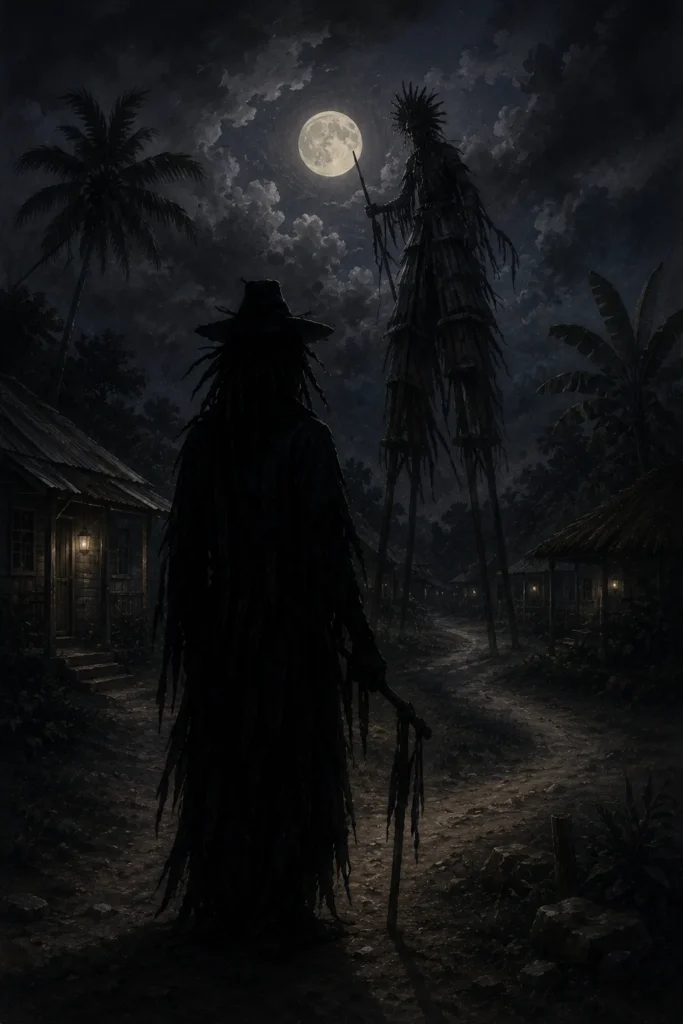
Jumbie is the Caribbean collective term for evil spirits and undead of the deceased. The idea ranges from a dark, shadowy figure that can turn into a dog, pig or cat, to the Moko Jumbie, the towering stilt spirit of carnival.
The name goes back to the Kongo word zumbi, spirit or ghost, and reached the Caribbean from West Africa with the transatlantic slave trade, where it mixed with European ideas of the dead. Dealing with the Jumbies is practised in the context of Obeah.
The belief is widespread throughout the anglophone Caribbean, from Guyana to Antigua and the Bahamas to Trinidad and Montserrat, where, according to tradition, the spirit separates from the body three days after death and the misfortune begins.
Type: Collective term for evil spirits and undead of the anglophone Caribbean
Origin: West African ancestor belief, brought to the Caribbean with the slave trade and mixed with European ideas of the dead
Texts: heterogeneous, documented mainly in the 19th and early 20th centuries
Period: documented in the 19th and early 20th centuries, orally alive to this day
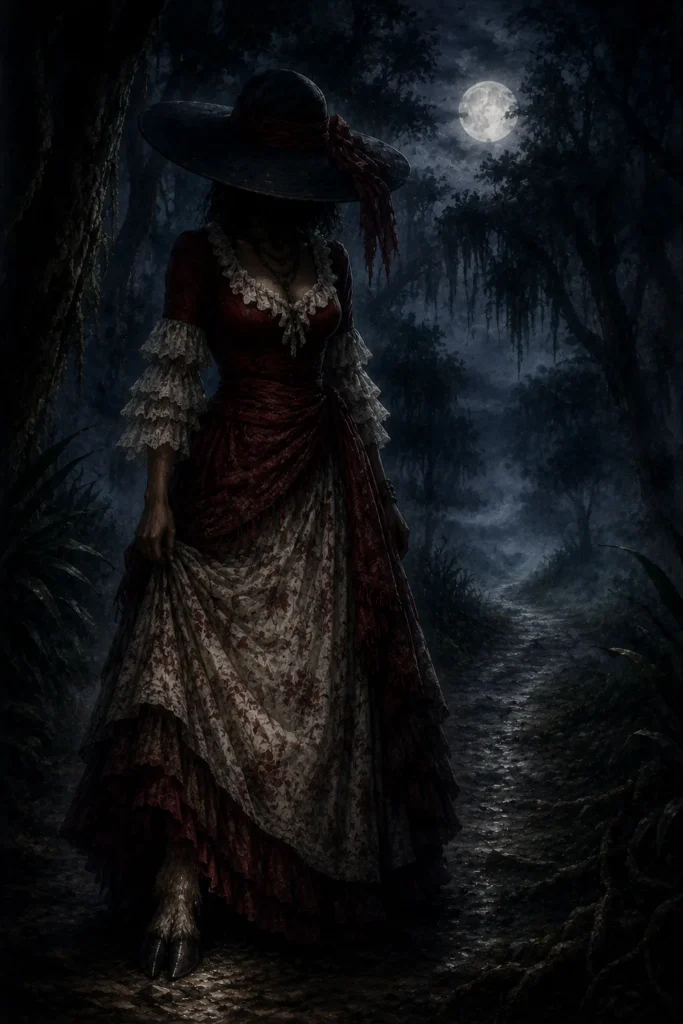
Appearance: dark, shadowy, shape-shifting figure, often as a dog, pig or cat
Source context
Period of the Texts
Documented mainly in the 19th and early 20th centuries, though older in oral form and alive to this day, for instance in the cult around the Moko Jumbie.
Area of Diffusion
The entire anglophone Caribbean, from Guyana to Antigua and the Bahamas to Trinidad and Montserrat.
Sources
Heterogeneous, because Jumbie as a collective term bundles many individual figures; nonetheless, the collections by Parsons, Hill and Besson on the anglophone Caribbean are fundamental.
Name and variants
Kongo: The name Jumbie derives from the Kongo word zumbi, spirit or ghost, related to the Kongo word nfumbi, ancestral spirit.
Nature and effect
Appearance
The Jumbie appears as a dark, shadowy figure, not a mist spirit, often transformed into a dog, pig or cat. A distinct subtype is the Moko Jumbie, the stilt spirit: Moko refers in Central Africa to a healer or a watchful deity.
Effect
The Jumbie is shape-shifting and a bringer of misfortune; the basic idea is that whoever was evil in life becomes, in death, a tool of evil. On Montserrat there are Jumbie dances with Jumbie drums, in which people become possessed by a Jumbie, and Jumbies receive small offerings such as rum and food.
Profile: Jumbie
The key aspects of the Jumbie at a glance.
Umbrella term of the anglophone Caribbean for evil spirits, with roots in West African ancestor belief.
Living people, whom the Jumbie lies in wait for especially at night along paths, bringing misfortune.
Dark, shadowy figure, often transformed into a dog, pig or cat.
Brings misfortune and shape-shifting, on Montserrat also a trigger of possession at the Jumbie dances.
Shoes and countable items placed outside the door, a knotted rope, walking backwards into the house, and small offerings such as rum and food.
The Douen as one of the specific individual types, the Soucouyant as the best-known figure of the wider field.
From the Kongo word zumbi to the Caribbean umbrella term
The name Jumbie derives from the Kongo word zumbi, spirit or ghost, related to the Kongo word nfumbi, ancestral spirit. With the transatlantic slave trade, West African ancestor and spirit beliefs reached the Caribbean and mixed there with European ideas of the dead; dealing with the Jumbies is practised in the context of Obeah. On Montserrat, according to tradition, the spirit separates from the body three days after death before the misfortune begins.
The basic idea is moral: whoever was evil in life becomes, in death, a tool of evil. The Jumbie itself is conceived as a shadow figure, not a mist spirit. A distinct and by no means evil subtype is the Moko Jumbie, the stilt spirit: Moko refers in Central Africa to a healer or a watchful deity, and this guardian role has remained with the Moko Jumbie into today’s carnival.
From feared spirit to carnival icon: the Moko Jumbie
The Moko Jumbie is an over two hundred year old stilt-dancer tradition in Caribbean carnival and today a cultural icon. In literature, the Jumbie appears in the works of Tracey Baptiste and Henry S. Whitehead.
From a religious-studies perspective, the Jumbie is the umbrella term for the diaspora spirit world: it links West African ancestor belief with colonial-Christian conceptions of the dead. Its moral function lies in the idea that evil outlasts death.
Shoes, counting compulsion and offerings
Several tricks against the Jumbie are well documented in the sources: shoes are placed outside the door, which the footless or backward-footed Jumbie tries in vain all night to put on; a pile of salt, sand or rice in front of the door forces it into an endless counting compulsion until sunrise. A knotted rope laid out is also considered effective, as is entering the house backwards or crossing a river the Jumbie cannot pass. Cold iron and protective signs additionally help against evil spirits, and small offerings such as rum and food, along with smoking rituals, appease the Jumbie.
The Jumbie within the Caribbean spirit world
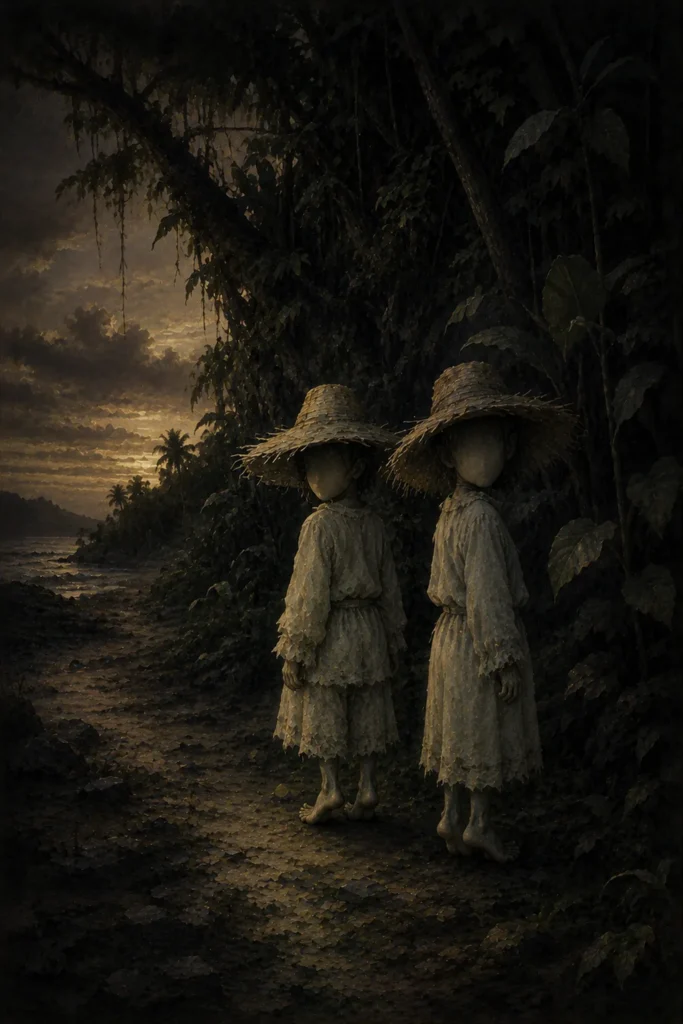
The Jumbie corresponds to the African ancestor spirits of the Congo and the Yoruba, as well as the Jamaican and Barbadian Duppy, an Akan word with the same function. The Francophone counterpart is the Zombi on Guadeloupe and Martinique. Within this broad field, distinctly developed figures stand on their own, such as the Soucouyant, the Rolling Calf and the Lagahoo. A separate, clearly defined type is the Douen, the spirit of unbaptised children who died, which, unlike the Jumbie, is not an umbrella term but a single, clearly defined figure.
Frequently asked questions about the Jumbie
What exactly is a Jumbie?
An umbrella term for evil spirits and the undead of the deceased in the Anglophone Caribbean, not a single, clearly defined figure.
Is the Moko Jumbie also evil?
No. The stilt spirit is regarded as a watchful protector and is today mainly a figure of Caribbean carnival.
Why are shoes and rice placed in front of the door?
Because, according to tradition, Jumbies become entangled in counting and dressing attempts that last until sunrise, keeping them away from the door.
Further links
Further reading:
- Soucouyant, Rolling Calf, Lagahoo – distinct figures within the broader Jumbie field
- Douen – the specific spirit of unbaptised children
- Salt, Iron, Smoking rituals – traditional protective means
- Protection Compass – protective means at a glance
Literature (selection)
Further standard works in the bibliography.
As a Caribbean spirit in the broadest sense, the Jumbie is more a collective name than a single being, and the Moko Jumbie shows that the same root can also give rise to a protective figure that is celebrated today.