Basajaun, the hairy lord of the Pyrenean forests
By Ralf Ittermann · last reviewed on
Basajaun is a spirit of Basque tradition.
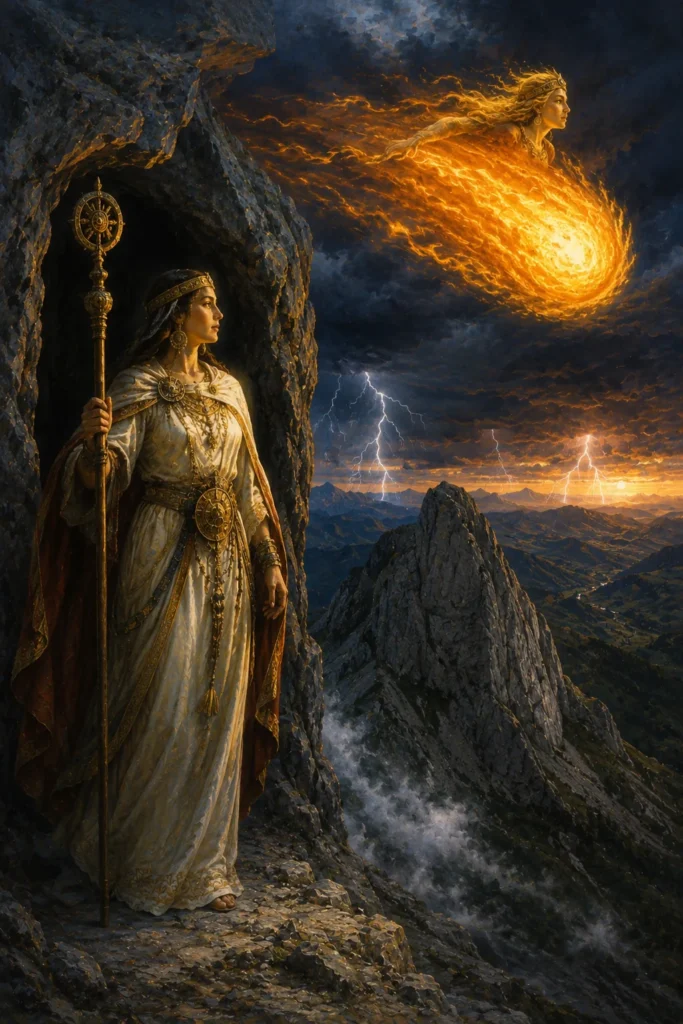
His whistle warns shepherds of storms and wolves. The article situates Basajaun among the Pyrenean forests, where his whistle is said to warn shepherds of danger.
The Basajaun, literally Lord of the Forest, is the great wilderness figure of Basque tradition: a tall, entirely hairy guardian of the woods and herds. He warns shepherds of storms and wolves and is also regarded as the first owner of cultural goods such as grain, the mill and the saw.
He is attested in the oral tradition of the Basque Country on both sides of the Pyrenees, in written form since 1877; systematic documentation was carried out in the 20th century by the ethnographer José Miguel de Barandiarán.
Type: Guardian of the wilderness, herd protector and primordial owner of culture
Origin: Basque Country on both sides of the Pyrenees, including Gipuzkoa, Navarre, Irati Forest
Texts: Webster’s Basque Legends (1877), Barandiarán’s 20th-century ethnography
Period: oral tradition, written from 1877
Appearance: man-sized to giant, entirely hairy wild man, hair reaching to the knees

Historical Background
Period of the Texts
The figure belongs to oral tradition and only becomes traceable in writing late: Wentworth Webster included several Basa-Jaun tales in his collection in 1877, while Barandiarán documented them systematically in the 20th century.
Area of Diffusion
The Basque Country on both sides of the Pyrenees, especially Gipuzkoa, Navarre and the northern Basque valleys, with narrative focal points around Ataun, the Gorbea massif and the Irati Forest.
Sources
Rich corpora of legends and folk tales exist in ethnography, but no medieval texts; the scholarly reference is Barandiarán’s documentation, precise down to specific locations and caves.
Name and variants
Basque: Basajaun, from baso, forest, and jaun, lord: Lord of the Forest. The plural is Basajaunak, the female counterpart Basandere, who appears less often in the sources and remains a paler figure.
Form and Habitat
Appearance
The tales describe the Basajaun as man-sized to gigantic, his whole body covered in hair; the mane falls to the knees at the front and veils his face and chest. He is unusually strong and agile, crossing ravines in a few strides and moving silently through dense woodland. Caves and remote high forests are considered his dwelling places. Despite his wild appearance, he mostly behaves upright, taciturn and orderly; he is not a formless monster but a lord of his domain.
Effect
At the core of the tradition, the Basajaun is a guardian. When a storm approaches or a pack of wolves roams the mountains, he lets out calls and whistles that warn the shepherds; when the sheep shake their bells as if on cue, his approach is announced, and the shepherds could go to sleep. Alongside this stand tales in which a Basajaun pursues or holds people captive and is ultimately overcome by cunning; here the figure overlaps with the one-eyed giant Tartalo. Harm inflicted of his own accord against those who show respect is rarely told.
Profile: Basajaun
The key aspects of the forest lord at a glance.
Wilderness figure of the pastoral worldview of the Pyrenees; symbolically he embodies the wilderness in its dual nature, both threatening and dependable.
Shepherds, charcoal burners and farmers of the mountain valleys: his warning of weather change and wolves is meant for them, and a quiet truce of exchange binds him to them.
Man-sized to giant wild man, entirely hairy, hair reaching to the knees; strong, agile and silent, at home in caves and high forests.
Warner and herd guardian; in the culture legends he is also the first owner of wheat, the mill and the saw, which humans wrested from him through skill.
Respectful distance and a truce of exchange: people avoided his caves, left him bread, milk or cheese, and accepted warning calls and herd oversight in return.
The Slavic Leshy as forest guardian, the Japanese Tengu as a stern mountain lord, and the wild man of medieval art as an iconographic twin.
Guardian of the Wilderness and Dispossessed Owner of Culture
Two strands merge in this tradition. One shows the shy guardian of the wilderness who knows weather and wolves and watches over the herds. The other makes him the primordial first owner of culture: according to the well-known tales, the Basajaunak first possessed wheat, the mill and the saw, until the cunning folk saint San Martin Txiki tricked the secrets out of them, for instance by jumping through the grain heaps in wide boots and carrying off the kernels in the shafts.
The figure only becomes traceable in writing late: Wentworth Webster included several Basa-Jaun tales in his collection of Basque legends in 1877, and the priest and ethnographer José Miguel de Barandiarán systematically documented legends, place references and caves attributed to the Basajaun in the 20th century, including the Muskia cave near Ataun. In the retreat legends, the wild people vanish from the valleys as Christianity advances.
Between Identity Figure and Bigfoot Legend
Today the Basajaun is read in two ways. In Basque cultural preservation he is an identity figure for forest and mountain, present in children’s books, on sculpture trails and at festivals. Alongside this, cryptozoology and internet culture have declared him the Basque relative of the Yeti and Bigfoot; occasionally speculation circulates that he embodies a folk memory of the Neanderthal. Neither view is scientifically tenable, but both show the figure’s lasting appeal; the scholarly reference remains Barandiarán’s ethnography.
From a religious-studies perspective, the Basajaun unites two classic roles: the lord of animals who oversees wilderness and herds, and the primordial owner of culture from whom a human trickster hero wins civilisation’s goods, a narrative type with parallels reaching as far as the Prometheus myth. One clarification is important here: since Basque is not an Indo-European language, the figure is often interpreted as a remnant of the oldest European religion; the motifs themselves, however, are widespread throughout Europe, which is why scholarship remains cautious about claims of great age. What is certain is his firm place in the pastoral worldview of the Pyrenees.
Respectful Distance and Truce of Exchange
No pronounced tradition of defence against him exists, because the Basajaun was predominantly regarded as a guardian. The tales know above all a respectful distance: people avoided his caves, let him be and sought no encounter. Alongside this stands a silent truce of exchange; shepherds left him bread or a share of milk and cheese and accepted his warning calls and oversight of the herd in return. In the tales of distress, it is not the weapon but the cunning with which people escape the stronger being that saves them. Finally, the retreat legends have the wild people yield before church bells and Christian signs; the motif tells of the end of their time, but in folk belief it was also understood as protective knowledge.
Wild People and Forest Lords Elsewhere
Almost every mountain region knows hairy guardians of the wilderness. The Slavic Leshy shares the guardian role and connection to herds, the Sami Stallo the giant form with a threatening note, the Nordic Troll a life in rock and forest away from humans. The Japanese Tengu, like the Basajaun, combines mountain wilderness, superior knowledge and stern discipline. The wild man of medieval European art is the iconographic twin of the figure.
Frequently Asked Questions about the Basajaun
Is the Basajaun dangerous?
Not in the main tradition. He is regarded as a guardian of the herds and a warner of shepherds; he becomes threatening mainly in a separate layer of tales that brings him close to the giant Tartalo. Those who maintain distance and respect are considered safe in the legends.
What does the name Basajaun mean?
Baso means forest, jaun means lord: Lord of the Forest. The plural Basajaunak denotes the wild people as a whole, Basandere the female counterpart.
Does the Basajaun have anything to do with the Yeti?
Only on the surface. Hairy wild people are a narrative type found worldwide, not a zoological finding. The Basque sources describe a legendary being with a social function in shepherd life, not an undiscovered primate.
Further links
Further reading:
- Leshy – the Slavic lord of the forest with a similar guardian role
- Tengu – the stern mountain lord of Japan
- Wild Man – the iconographic twin of European art
- Bells, Threshold Protection, Amulet, Smoke Cleansing – traditional protective means
- Protection Compass – protective means at a glance
Literature (selection)
Further standard works in the bibliography.
The Basajaun shows how closely the lord of the forest connects Basque mythology and everyday shepherd life. Tradition calls the Basajaunak wild people, yet it was precisely this wild lord who kept the most reliable watch over the herds and valleys of the Pyrenees.