Hotoru, the wind as the breath of life
By Ralf Ittermann · last reviewed on
Hotoru is a god of Pawnee tradition.
The wind power that brings breath and life in the Hako ritual.
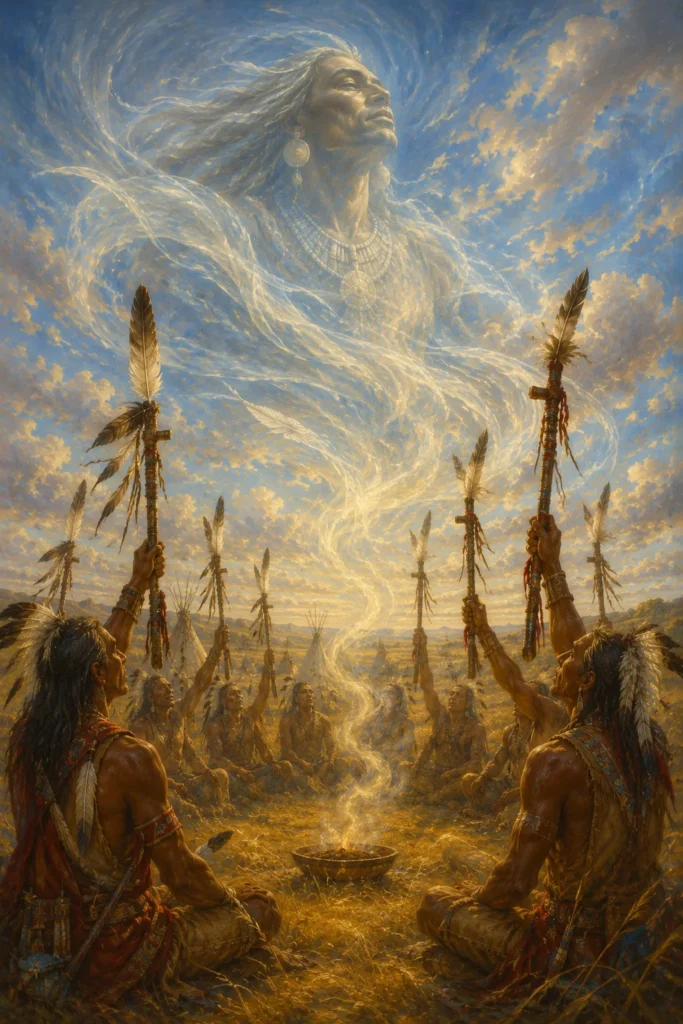
Among the Pawnee, Hotoru is the wind spirit invoked as the breath-giver in the Hako ritual. He is a mediating power created by Tirawa, the Father Above, between the creator and humankind, and brings breath and thereby life.
Hotoru is not fixed in anthropomorphic form; he is experienced in wind, weather and breath. The main source is Alice C. Fletcher’s documentation of the Hako ceremony from 1904, produced with the Pawnee ceremonial leader Tahirussawichi and James R. Murie.
Type: Wind spirit and mediating power, breath-giver in ritual
Origin: Pawnee, Nebraska, Plains
Texts: Fletcher, The Hako. A Pawnee Ceremony (1904)
Period: Pawnee tradition, ethnographically documented in 1904
Appearance: not anthropomorphic, experienced in wind and breath
Textual history
Period of the Texts
Pawnee tradition, ethnographically documented by Alice C. Fletcher in the 22nd Annual Report of the Bureau of American Ethnology, 1904, with the ceremonial leader Tahirussawichi and James R. Murie.
Area of Diffusion
The Pawnee in Nebraska, on the Plains of North America; there Hotoru is embedded in the ceremonial system.
Sources
Good, though bound to the ritual context: Fletcher’s Hako documentation is the authoritative source and a classic of ritual and ethnomusicological research.
Name and variants
Pawnee: hotoru, the term for wind and winds. In ritual he bears the title of breath-giver, which names his task: he brings breath and thereby life.
Nature and effect
Appearance
Hotoru is not fixed in anthropomorphic form. He is one of the lesser mediating powers created by Tirawa between the creator and humankind, and is experienced in wind, weather and breath.
Effect
Hotoru brings breath and thereby life, and is invoked as breath-giver in prayer and song. In the Hako he belongs to the circle of first-created mediating powers, together with the winds, thunder and the directions; the winds are called forth from the directions.
Profile: Hotoru
The key aspects of the breath-giver at a glance.
A mediating power created by Tirawa, the Father Above, between the creator and humankind within the ordered hierarchy of creation of the Pawnee.
The Hako ceremony, the calumet or pipe ceremony of the Pawnee: the invocation of Hotoru is embedded within it.
No fixed form: Hotoru is not depicted in a fixed image, but is experienced in wind, weather and breath.
Breath and life: as breath-giver, Hotoru is invoked in prayer and song and mediates between the creator and humankind.
No independent veneration of Hotoru; the invocation belongs within the complex Hako ceremonial. Further forms of cult or protection are not attested.
Niltsi, the Holy Wind of the Navajo, as a typological parallel without attested equation; alongside the directional and star powers of the Pawnee.
Tirawa's mediating powers and the wind
Hotoru is the Pawnee term for wind and winds; in ritual he is called the breath-giver. The main source is Alice C. Fletcher, The Hako. A Pawnee Ceremony, from the 22nd Annual Report of the Bureau of American Ethnology, 1904, prepared with the Pawnee ceremonial leader Tahirussawichi and James R. Murie.
Tradition places Hotoru within a clear hierarchy: he belongs to the lesser mediating powers created by Tirawa, together with thunder and the directions, and mediates between the creator and humankind. In the Hako, the winds are called forth from the directions; Hotoru’s gift is breath, and with breath, life itself.
Legacy and interpretation
Fletcher’s Hako is a classic of ritual and ethnomusicological research. Modern pop-culture hits for the name are reception artefacts, not sources.
From a religious-studies perspective, Hotoru shows the wind as breath-giver and mediating power within an ordered hierarchy of creation. An important clarification: he is not an autonomous main god, but a subordinate mediating power under Tirawa, and outside the Hako he is not widely attested.
The invocation in the Hako ceremony
There is no independent Hotoru worship; the invocation is embedded within the complex Hako ceremony, the Calumet or pipe ceremony. Beyond this, no verified cult or protective forms specifically for Hotoru have been transmitted. This connection to the ritual context is deliberately presented here with restraint: the Hako is a living indigenous ceremonial tradition, and its details remain a matter for specialist literature.
Sacred winds in comparison
Hotoru stands alongside other mediating powers, the directional and star powers of the Pawnee. As a life-giving wind and breath, he is typologically related to Niltsi, the Sacred Wind of the Navajo, without any attested equation. On the Plains, Taku Skanskan appears as another moving wind power, and in the Northeast, Gaoh orders the directional winds of the Iroquois.
Frequently asked questions about Hotoru
Who is Hotoru?
The wind spirit of the Pawnee, invoked in the Hako ritual as breath-giver. He brings breath and thereby life.
Is Hotoru a main god?
No. He is a subordinate mediating power under the creator Tirawa, and outside the Hako he is not widely attested.
Where is he invoked?
Chiefly in the Hako ceremony, the Pawnee pipe ceremony, documented by Alice C. Fletcher in 1904.
Further links
Further reading:
- Niltsi – the Sacred Wind of the Navajo as a typological parallel
- Gaoh – the wind lord of the Iroquois
- Taku Skanskan – the moving wind power of the Lakota
- Sage (Smudging), Amulet, Protective Candle – traditional protective means
- Protection Compass – protective means at a glance
Literature (selection)
Further standard works in the bibliography.
Among the Pawnee, Hotoru is both wind spirit and mediating power: as breath-giver of the Hako ceremony, he embodies the insight that wind, breath and life are, in this tradition, one and the same gift.