Ninhursag, Mesopotamian mother goddess
By Ralf Ittermann · last reviewed on
Ninhursag is the Sumerian mother goddess and lady of the earth, who was venerated as the midwife of the gods and of humankind.
Ninhursag is an ancient Mesopotamian mother goddess, one of the great creator deities of Sumerian religion and, after Anu, Enlil and Enki, the most important figure of the ancient Sumerian order of the gods.
Her name means “Lady of the Mountain,” a reference to her rootedness in the Near Eastern highlands and her connection to stone, birth and life force. In various traditions she appears under further names such as Ninmah, Nintur or Damgalnuna.
Profile: Ninhursag
Ninhursag: the most important aspects at a glance. The following fields summarise origin, function, appearance, veneration, symbols and parallels.
Ninhursag belongs to the oldest layer of Mesopotamian religion and is attested as early as the 3rd millennium BCE, above all in Kish, Adab and Mari. Her name means “Lady of the Mountain.” She also appears under the names Ninmah, Nintur or Damgalnuna.
Ninhursag is a mother goddess and mistress of the earth, midwife of the gods and of humankind. She is responsible for birth, healing and fertility, as well as for the stones and metals of the mountains. Her help was sought in childbirth, illness, sowing and temple building.
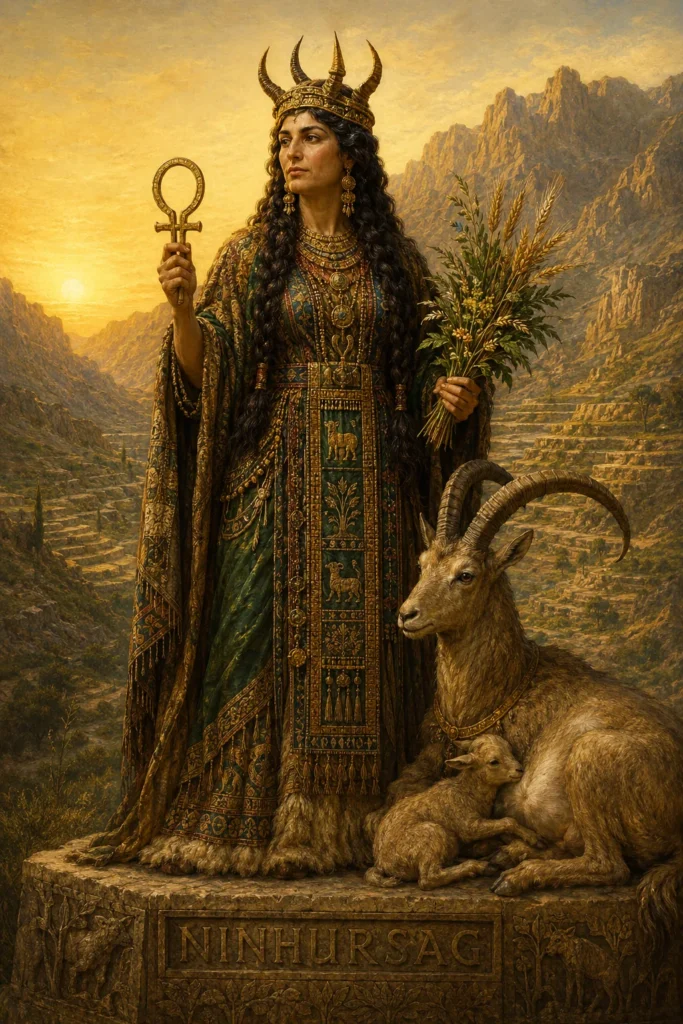
Ninhursag is depicted as a dignified, seated goddess with a horned crown and a long flounced robe, often on a stylized mountain. Some reliefs show an omega as a sign of birth. A small child often accompanies her.
The centers of the cult were Adab, Kish, Tell el-Obeid and Lagash, where she was venerated in the form of Bau. Women called on her in labor, and midwives spoke incantations over women giving birth. Sheep and goats counted as offerings. In Dilmun, present-day Bahrain, she was also venerated together with Enki.
Her symbols are the mountain, the horned crown and the omega as a sign of birth, which appears on boundary stones (kudurru) of the Kassite period and on Old Babylonian seal impressions. Sheep and goats are among the animals assigned to her as goddess of birth.
In the Akkadian pantheon Ninhursag appears as Mami or Mama, creator of humankind in the Atrahasis Epic. She has been discussed as the historical root of goddesses such as Demeter, Cybele or Isis, but a direct line cannot be demonstrated. Ninlil, Inanna and Tiamat are also mentioned.
Myth and Origin
Ninhursag belongs to the oldest stratum of Mesopotamian religion. As early as the 3rd millennium BCE she is attested in inscriptions of pre-Sargonic Mesopotamia, above all in the city-states of Kish, Adab and Mari.
Her roots probably lie in rural mythic conceptions in which the earth was understood as a birthing power, from which stones, plants and living beings emerge. The connection with the mountains, which were regarded as a source of precious stones, wood and metal, explains her epithet “Lady of the Mountain.”
In the ancient Sumerian theogony Ninhursag is at times the sister or consort of Enlil, in later texts often the consort of Enki, the god of wisdom and of fresh water.
This shifting family position is, from the perspective of the history of religion, not a contradiction but an expression of the modularity of ancient Mesopotamian myths, in which each deity is woven as needed into different networks of relationships.
An important testimony to her veneration is the sanctuary of Tell el-Obeid, near Ur, which was erected in the Early Dynastic period. Inscriptions of Aanepada, a king of Ur, name her as the principal goddess of the complex.
In Lagash too she possessed an important cult, and Gudea, the city ruler already mentioned in the Ninurta article, praises his relationship to her in his statue inscriptions.
Her principal myth is the narrative “Enki and Ninhursag,” an ancient Sumerian text that depicts the island of Dilmun (present-day Bahrain) as a pure, paradisiacal land. There Enki and Ninhursag create the first garden and the first living beings.
The narrative belongs to the early documented creation myths of Mesopotamia and develops a theologically rich imagery in which water, earth and seed enter into a living interplay.
Symbols and Attributes
Ninhursag is depicted in visual art as a dignified, seated goddess, often with a horned crown and a long pleated robe.
In some reliefs she bears a symbol of birth, the omega sign, which is interpreted as a stylized female pelvis or as a birth horn. This sign appears on boundary stones (kudurru) of the Kassite period and on Old Babylonian seal impressions.
A further attribute is the mountain, which co-determines her name. On reliefs she frequently sits on a stylized mountain, which underscores her function as mistress of the highland springs, of the stones and of the metals.
Her significance as lady of the mountains connects her with the borderlands of Mesopotamian civilization, that is, with those regions in which wood, stone and ores were extracted.
Animals assigned to her belong to the fertility-related symbols. Sheep and goats frequently appear in the temple inscriptions as sacrificial offerings to her, because as goddess of birth she places both humans and animals under her protection.
In ancient Mesopotamian iconography she is moreover often accompanied by a small child or an infant, a reference to her function as patroness of midwifery.
A later tradition depicts her with a bowl-shaped necklace, said to relate to the birth weight of children. Such iconographic details have been preserved above all in the incantation texts for midwifery, which carried her name across the centuries.
Cult and Veneration
The main cult of Ninhursag lay in several city-states, with focal points in Adab, Kish, Tell el-Obeid and Lagash. Adab, one of the oldest cult centers, was closely connected with her, and the early kings of Kish prided themselves on having been called by her.
Her temple in Adab, the exact name of which is uncertain, was a gathering place for birth rites and healing ceremonies.
In Lagash and Girsu, Ninhursag was venerated in the form of Bau, a healing goddess merged with her. The inscriptions of Gudea report magnificent sacrifices and a statue that the city ruler dedicated to the goddess.
In the Old Babylonian period she continued to be venerated in several city-states, often under the names Ninmah or Aruru.
Her role in birth rites is attested by numerous incantation texts. Women invoked her during labor, midwives spoke incantations over the belly of the woman giving birth, in which Ninhursag was to open the womb and let the child emerge safely.
Such texts are documented down into the Late Babylonian period and underscore the continuity of her veneration.
In the Neo-Assyrian empire the importance of Ninhursag declined, which was connected with the stronger emphasis on the male imperial gods Ashur and Ninurta. She nevertheless remained present in the healing texts, and her name variants appear in inscriptions down into the late Achaemenid period.
Late continuity of the cult is also shown in Dilmun, present-day Bahrain. Archaeological excavations have uncovered extensive temple complexes there in which Ninhursag was venerated in connection with Enki. This connection is explained by the myth “Enki and Ninhursag,” which describes Dilmun as a paradisiacal primordial landscape.
Important Myths
“Enki and Ninhursag” is the central myth and one of the oldest documented creation texts. It begins with the description of Dilmun as pure, untroubled by death and illness.
Enki carries fresh water to the island and makes it fertile. In a series of intersecting generational sequences he begets with Ninhursag and her descendants a series of daughters, which brings the goddess into conflict with him.
Enki then eats eight plants that Ninhursag has raised in the garden, and is thereupon cursed by her and afflicted with eight illnesses in different parts of the body.
Finally she reconciles with Enki and gives birth to a healing deity for each illness. The narrative is a theological example for the relationship of creation, guilt and healing.
A second important text is “Enki and Ninmah,” in which the two gods form humankind from clay in a kind of creation contest.
Ninmah first forms disabled humans, for whom Enki finds places in the social order, then Enki forms a malformed being whom no one can integrate. The narrative contains a deep ethical reflection on the responsibility of the creator and the limits of order.
A third narrative is found in the “myth of Lugalbanda and the Anzu bird,” in which Ninhursag stands by the hero Lugalbanda and supports him in his task. The goddess appears here as a protecting, advising power, a function she assumes in many Mesopotamian hero narratives.
Relationships within the Pantheon
Ninhursag is one of the four highest Sumerian deities, alongside Anu, Enlil and Enki. In creation texts she appears as an independent power that forms humans and animals together with Enki. With Enki she shares the care for fertility and healing, with Enlil the care for order and justice, with Anu sovereignty over primordial time.
Her daughters, born in the myth “Enki and Ninhursag,” partly belong to important cult goddesses of further city-states. One of them is Ninkurra, the goddess of stonemasonry, another is Ninimma, the scribe. This genealogy connects Ninhursag with the most varied craft and cultural cults of Mesopotamia.
With Bau and Gula healing functions connect her, with Inanna a relationship of rivalry, because in ancient Sumerian theology Inanna increasingly took over the preeminent position of the goddesses. In Hellenistic-Roman syncretism she does not come into direct contact with Greek goddesses, because her veneration had already subsided beforehand.
With Damgalnuna, the consort of Enki, Ninhursag shared some functions in southern Sumer, which led to the rare but documented identification Damgalnuna-Ninhursag in Eridu texts. Wilfred G. Lambert interpreted this fusion in an essay of 1992 as evidence for the regional plurality of Sumerian divine names.
In the Akkadian pantheon Ninhursag appears as Mami or Mama, the creator of humankind in the Atrahasis epic. On Enki’s instruction she mixes clay and the blood of the slain god We-ila into seven human pairs. This creation scene is the earliest clay-creation narrative of world literature and has numerous successors in Semitic religions.
Reception and Influence
With the end of the Mesopotamian high culture the cult of Ninhursag faded, yet the healing texts bearing her name were still copied and transmitted in the Late Babylonian and Achaemenid periods.
In the 20th century the goddess was reconstructed through the rediscovery of Sumerian texts, above all through the work of Samuel Noah Kramer, who helped shape Sumerology as a scholarly discipline.
In modern history of religion Ninhursag belongs to the most frequently cited examples of an ancient Near Eastern mother goddess who was discussed as a historical root of later Mediterranean goddesses such as Demeter, Cybele or Isis.
This thesis is today largely treated with reserve, because a direct genealogical line cannot be demonstrated. The typological similarity, however, remains an important theme in the history of religion.
In the feminist reception of the 20th and 21st centuries Ninhursag was received as an example of a powerful, independently acting female deity from the early high cultures.
She stands in studies on the history of the mother cult alongside Ninlil, Inanna and Tiamat. In popular esotericism she appears under the name “Sumerian Earth Mother,” whereby scholarly precision is often lacking in such adaptations.
In modern biblical scholarship the Eve-rib connection has received much attention. Kramer’s hypothesis that the birth of Ninti from Enki’s rib was a motival model for Eve was discussed by theologians such as Claus Westermann in his Genesis commentary and developed further by John Day.
The exact form of the transmission remains open, yet the existence of Mesopotamian models for biblical motifs is today a matter of consensus.
Another line of influence leads via the Hellenistic Magna Mater. Walter Burkert traced the traces of this transmission in “Babylon, Memphis, Persepolis” (2004) and postulated an indirect influence on the Cybele cult of Phrygia.
The exact steps of transmission are not fully clarified, but a motival continuity from Ninhursag via Mami to the Magna Mater is assumed in scholarship.
Religious-Studies Classification
Thorkild Jacobsen, in “The Treasures of Darkness,” interpreted Ninhursag as an example of a chthonic goddess whose activity relates to birth, earth and stone. He sees in her mythology an archaic layered model in which the earth is experienced not only as a geographical reality but as a personified power.
Jean Bottéro emphasizes the theological autonomy of the goddess and her function as a balancing power to the male creator deities. Walther Sallaberger comprehensively reconstructed the cult of Ninhursag in his study of the Ur III calendar and showed that the goddess played a central role at important state festivals.
Stefan Maul and Andrew George edited the healing texts bearing her name. From these texts it emerges that Ninhursag was one of the few Mesopotamian deities whose help could be requested in extremely different situations of life: at birth, in illness, in sowing and in temple construction.
Stephanie Dalley and Wilfred Lambert place her within the literary tradition in which she appears as the indispensable partner of Enki in several creation narratives.
Kesh Hymn and Temple Theology
The Kesh Temple Hymn is one of the oldest preserved Sumerian texts and is at the same time regarded as one of the first religious texts of world literature.
Fragments reaching back to the time of the Third Dynasty of Ur (21st century BCE) are transmitted through later scribal libraries in Nippur, Sippar and Ur. The text celebrates the temple of the city of Kesh and its goddess Ninhursag in 134 lines and eight stanzas, each of which ends with the formula “Who has ever seen this, who has ever seen this?” This repetition lends the hymn an almost meditative structure.
The text has been transmitted anonymously and is not by the poetess Enheduanna, the daughter of Sargon of Akkad; the oldest fragments are still older and probably stem from an oral tradition of several centuries.
In terms of content, the hymn emphasizes the function of Ninhursag as midwife of the gods and of the kings.
She is the “mother of the stones” and the “guardian of the lifeline,” as it says in lines 12 to 17. This dual reference to geology and biology is a constitutive feature of Ninhursag theology and distinguishes her from other mother goddesses of Mesopotamia.
The Kesh temple itself was long unlocated in archaeological research; only since the German excavations at Tell al-Wilayah has an identification with the temple structure found there become plausible.
A detailed edition with translation and commentary was presented by G. B. Gragg in the edition of Sjöberg and Bergmann (The Collection of the Sumerian Temple Hymns, TCS 3, 1969).
Gragg shows that the hymn has stylistic kinship with the 42 temple hymns of Enheduanna, which are known under the collective title “Sumerian Temple Hymns.” Section 7 of this collection is dedicated to Ninhursag’s temple in Adab and names her as “mother of all children,” which attests to the Mesopotamian spread of the cult.
Dilmun Episode and Enki
The long Sumerian myth “Enki and Ninhursag” is one of the richest sources for the theology of the two gods. The text, edited by Pascal Attinger in 1984 in “Enki et Ninhursaĝa,” tells of the paradisiacal land of Dilmun, probably present-day Bahrain. In Dilmun there is no illness, no old age and no death.
Enki, the god of fresh water, feels drawn to the earth goddess Ninhursag. From their union arises a daughter, Ninnisig, from whose further connections with Enki a total of three generations of daughters are begotten. Finally Enki eats eight plants that sprout from Enki’s seed, and becomes mortally ill.
Ninhursag heals Enki by giving birth to eight healing deities from the diseased parts of Enki’s body. Each of these goddesses is connected with a specific part of the body, which represents an early form of the medical correspondence between gods and organs.
One of these healing goddesses is Ninti, whose name means “Lady of the Rib” or “Lady of Life.” This episode was interpreted by Samuel Noah Kramer in “History Begins at Sumer” (1958) as a possible model for the biblical Eve narrative, because the wordplay “rib / life” also resonates in Hebrew.
This connection is today disputed, but accepted as a motival echo.
The Dilmun episode is also significant in the history of religion because it thematizes the idea of a paradisiacal primordial land in which illness and death do not exist.
This conception left traces beyond Mesopotamia in Zoroastrian and biblical paradise traditions, as Thorkild Jacobsen sets out in “The Treasures of Darkness” and Jean Bottéro in “La plus vieille religion.”
Birth, Healing and Royal Theology
Ninhursag was venerated as the goddess of birth and of healing. Several Mesopotamian kings called themselves “son of Ninhursag,” among them Eannatum of Lagash and Mesannepada of Ur. The Stele of the Vultures of Eannatum, dated to ca. 2450 BCE, shows the king in a composite scene in which Ninhursag nourishes him at her breast.
This pictorial formula of divine adoption remained constant over two millennia and still occurs on Neo-Assyrian reliefs.
In the healing arts Ninhursag plays a central role as Belet-ili, the “Lady of the Gods.” The Mesopotamian incantation collection of tablet BAM 234 contains prayers to Ninhursag in cases of severe birth complications.
In the Diagnostic Handbooks as well, which were compiled under Esagil-kin-apli in the 11th century BCE, she appears as the goddess responsible for fever and wound diseases. Stefan Maul, in his studies on the healing arts of Mesopotamia, documented in detail the function of Ninhursag as the point of recourse in cases of birthing problems.
Mesopotamian royal theology closely connected the legitimate birth of a ruler with Ninhursag.
Building inscriptions of Naram-Sin of Akkad name him as “the one to whom Ninhursag gave the breast.” A statue of Naram-Sin shows him with a crown of bull’s horns, which in the visual language of the time expresses the divine status of the king.
This claim to divinity was younger than the simple filial relationship to the goddess, but had the same theological foundation. The tabooing of the human-divine connection arises only in the Old Babylonian period, when Hammurabi refers to himself only as installed by Anu and Enlil, no longer as their son.
Sources and Further Reading
Ancient sources: “Enki and Ninhursag,” “Enki and Ninmah,” incantation texts and midwifery texts from Nippur and Sippar, Gudea statue inscriptions, hymns to Aruru and Ninmah, inscriptions from Tell el-Obeid.
Research literature: Thorkild Jacobsen, “The Treasures of Darkness,” New Haven 1976. Jean Bottéro, “La religion babylonienne,” Paris 1952. Stefan Maul, “Die Wahrsagekunst im Alten Orient,” Munich 2013. Walther Sallaberger, “Der kultische Kalender der Ur III-Zeit,” Berlin 1993. Andrew George, “The Babylonian Gilgamesh Epic,” Oxford 2003. Wilfred Lambert, “Babylonian Creation Myths,” Winona Lake 2013. Stephanie Dalley, “Myths from Mesopotamia,” Oxford 1989. Samuel Noah Kramer, “The Sumerians,” Chicago 1963.