Inari Ōkami, Japanese deity of rice
By Ralf Ittermann · last reviewed on
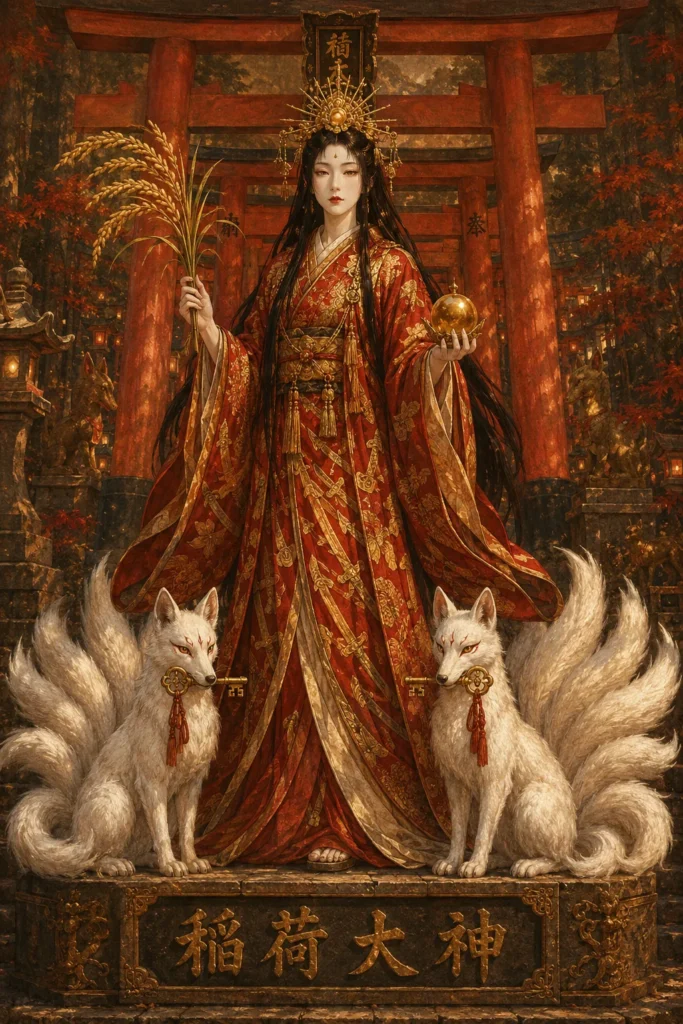
Inari Ōkami is the Japanese deity of rice and at the same time a god of success, to whom both farmers and merchants make offerings for prosperity. Inari Ōkami, Inari for short, is in Japanese Shintō the deity of rice, fertility, economic prosperity and smithcraft.
With over 30,000 shrines dedicated to him in Japan, Inari ranks among the most widespread kami of all; roughly every third Shintō shrine in the country is an Inari branch.
The veneration combines ancient agrarian religion, medieval craft traditions and a modern business piety in which Inari is invoked as a protective god of companies and traders.
Inari Ōkami is popularly referred to as the fox god of Japan: the foxes, however, are only his messengers and guardians.
Table of contents
Name, etymology and identification
The name Inari is traditionally interpreted as a shortening of “Ine-nari” (“rice becoming”, 稲生), which underlines the agrarian core meaning. In the classical imperial chronicles, Inari does not appear independently; only in the “Yamashiro-fudoki” (early 8th century) and in the “Engishiki” (10th century) is the Inari shrine of Fushimi recorded as an imperial great shrine.
The kami names associated with Inari are, depending on the tradition, Uka-no-Mitama-no-Ōkami, Ōmiyanome-no-Ōkami, Sarutahiko-no-Ōkami, Tanaka-no-Ōkami, Shi-no-Ōkami and Ukemochi-no-kami; in the main Inari shrine, five kami are venerated in parallel.
The tradition frequently identifies Inari with Ukemochi-no-kami, the goddess of food mentioned in the “Nihon Shoki”; from her slain body rice, grain and livestock are said to have arisen. This connection is significant in the history of religion because it places Inari within the old Shintō stratum of vegetation and slaying myths.
Myth and founding of Fushimi Inari
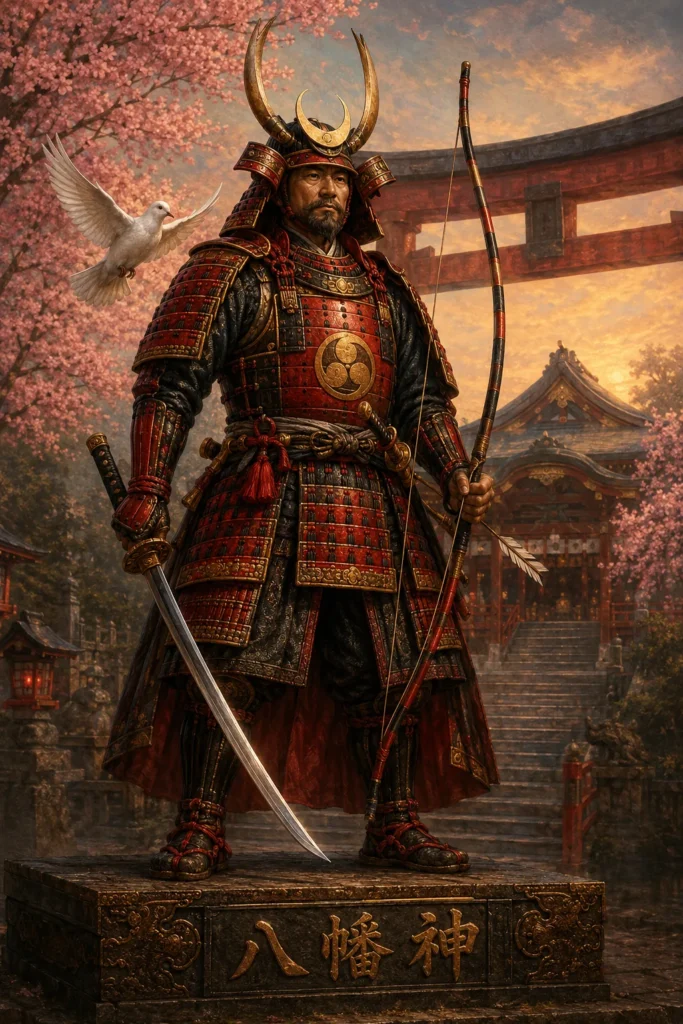
The founding legend of Fushimi Inari Taisha, the main shrine, is handed down in the “Yamashiro-fudoki”. In the year 711, Hata no Irogu, an aristocrat of the Korean-descended Hata clan, is said to have used a rice ball as a target for his bow.
The rice ball transformed into a white bird that flew to the nearby Mount Inariyama. Where the bird alighted, rice grew; at this spot Hata erected the first Inari shrine. The episode is dated to 8 February 711 (Hatsuuma day), which to this day marks the most important festival of the shrine.
The Hata kin originated from the Korean kingdom of Silla and brought silkworm cultivation and advanced rice-growing techniques to Japan. The Inari religion is thus an example of the continental roots of early Japanese cult practice. Klaus Antoni and Helen Hardacre have worked out the Korean connections of the early Inari tradition in several studies.
Symbols, attributes and the role of the foxes
Inari is depicted as an elderly man or as a young woman, often with a rice sheaf or sickle, sometimes also as androgynous.
In the Middle Ages the male depiction as a bearded old man with a rice sack dominated; in the Edo period the female depiction became more widespread. This duality cannot be unified in religious studies and is regarded as a hallmark of the Inari tradition.
The most important symbol is the foxes (kitsune), which are not Inari himself but are regarded as his messengers (tsukai). At every Inari shrine stand one or more pairs of stone foxes, often with a key, rice grain, jewel or scroll in their mouths.
Karen Smyers (“The Fox and the Jewel”, 1999) examined the symbolism of these four attributes in detail: the key to the rice granary, the rice grain as food, the wish-fulfilling jewel and the sutra scroll. The white fox (byakko) is regarded as a messenger of especially high rank.
The Inari-fox connection is not necessarily original historically. Klaus Vollmer and Bernhard Scheid argue that the fox-Inari association first solidified in the Middle Ages under the influence of Buddhist texts (especially the Dakini veneration in the Shingon school). In the oldest Inari sources, foxes play no central role.
Fushimi Inari Taisha and the Thousand Torii
The main shrine Fushimi Inari Taisha, southeast of Kyoto, with its “Senbon Torii”, the “thousand red gates”, is one of the most iconic shrine ensembles in Japan. In fact, more than 10,000 torii stand on Mount Inariyama, lining the pilgrim path to the summit of the sacred mountain in long tunnels.
Each torii is a private endowment; on the back stand the name and donation date of the donor. Most donors are companies that petition Inari for business success or give thanks for success received.
The ascent to the summit of Inariyama (233 m) takes about two hours and passes numerous subsidiary shrines, stone foxes and small altars. The complex encompasses hundreds of hectares of mountain forest and is regarded as a spiritual landscape in which the boundary between official shrine religion and popular spirit belief is especially permeable.
Karen Smyers documented the plurality of practices on the mountain in her ethnographic study: alongside official Shintō rites there are smaller chapels for healers, mediums and private cults.
Further important shrines and the branch system
Besides Fushimi, the three most important Inari shrines are Toyokawa Inari in Aichi Prefecture (actually a Sōtō Zen temple called Myōgon-ji, in which Inari is venerated in Buddhist form as Dakini-Shinten), Yūtoku Inari in Saga (one of the three largest Inari shrines) and Kasama Inari in Ibaraki.
These shrines show that Inari veneration flourished both in Shintō and in Buddhist form. Until 1868, Toyokawa Inari was a classic example of Shinbutsu-Shūgō; the Meiji separation forced many Inari temples to choose between shrine and temple status.
The roughly 30,000 branch shrines are distributed across the whole of Japan. Many are located in unusual places: on the roofs of department stores, next to restaurants, in factory yards, on station forecourts. This urban omnipresence is a distinctive feature of modern Inari veneration and sets it apart from most other Shintō cults.
Rituals, festivals and offerings
The most important festival is Hatsuuma-Sai on the first “Day of the Horse” in the second month, which marks the founding day of the Fushimi shrine.
On this day, hundreds of thousands make pilgrimage to Fushimi, offering rice, sake, adzuki bean rice and inari-zushi (rice in fried tofu), the traditional Inari festival fare. Inari-zushi is regarded as the favourite food of the foxes and is one of the most common offerings.
In spring, rice-planting rites take place (O-Taue-Sai); in autumn, harvest festivals (Niiname-Sai), at which the first rice offerings are presented. At business openings it is customary to ask an Inari priest for a blessing or to set up a mini torii in front of the entrance.
Significance in the history of religion and cross-references
Inari is interesting from the standpoint of religious studies for several reasons: as a rare example of a deity that has undergone a considerable social shift over the course of history (from agrarian religion to urban business piety), as a key figure for the Japanese Shinbutsu-Shūgō (in the Dakini connection), and as a case study for the importance of popular religiosity beyond the official imperial shrines.
Helen Hardacre has described Inari as the “most strongly lived kami of the present”.
Structurally, Inari has parallels to Demeter (Greece), Ceres (Rome), Renenutet (Egypt) and Dazhbog (Slavic) as a deity of grain ripening. The fox messengers have relatives in the Korean Gumiho and the Chinese Huxian traditions.
The connection with smithcraft, mentioned in some sources, links back to Inari’s early function as a protective god of the Hata smiths.
Inari in popular culture
Inari is intensely present in modern Japanese popular culture. Anime series such as “Inari, Konkon, Koi Iroha” (2014) or “The Helpful Fox Senko-san” revolve around kitsune-Inari mythology.
The red torii of Fushimi are one of the most photographed motifs in Japan. Restaurants bearing the name element “Inari” are widespread, and inari-zushi is part of everyday Japanese life.
Sources
“Yamashiro-fudoki” (early 8th century, fragmentary). “Engishiki” (927), Book IX. “Nihon Shoki” (720), Ukemochi narrative. “Konjaku Monogatari” (early 12th century), numerous fox-Inari tales. “Inari-Daimyōjin-engi” (late Middle Ages). Various Edo-period Inari handbooks and sermon books.
Karen A. Smyers, “The Fox and the Jewel. Shared and Private Meanings in Contemporary Japanese Inari Worship”, Honolulu 1999. Nelly Naumann, “Die einheimische Religion Japans”, 2 volumes, Leiden 1988 and 1994. Joseph Kitagawa, “Religion in Japanese History”, New York 1966. Helen Hardacre, “Shinto.
A History”, Oxford 2017. Klaus Antoni, “Shintô und die Konzeption des japanischen Nationalwesens”, Leiden 1998. Klaus Vollmer, “Shintô und Buddhismus”, Munich 2002. Bernhard Scheid, “Religion-in-Japan: Ein digitales Handbuch”, Vienna, ongoing. Inken Prohl, “Religiöse Innovationen”, Berlin 2006.
Inari in Shingon Buddhism and the Dakini cult
The most important Buddhist link of the Inari cult comes about in the Shingon school through identification with Dakini-Shinten, a manifestation of the Indian Dakini goddesses, who in tantric Buddhism are venerated as ambivalent protective deities.
Whereas Indian dakinis are curse-bearing, sometimes terrifying goddesses, in Japanese Buddhism they were reinterpreted as benevolent protective figures and iconographically often linked with foxes. This explains why Toyokawa Inari, a Sōtō Zen temple in Aichi, is formally not a shrine, yet Inari veneration takes place there on a large scale.
In medieval Shingon theology, Inari was equated with Dakini-Shinten; Kūkai, the founder of the Shingon school, is said to have had a direct encounter with Inari upon his return from China in the 9th century, which was embellished legendarily in the “Inari-Daimyōjin-engi”.
The connection between Inari and Tō-ji, the central Shingon temple in Kyoto, goes back to this encounter and remains liturgically alive to this day.
The Hata clan and continental roots
The Hata clan, which according to the founding legend erected the first Inari shrine, belongs to the most significant continental-immigrant kin groups of early Japan. Originally hailing from the Korean kingdom of Silla or Paekche, it brought silkworm cultivation, rice farming, metalworking and brewing technology to Japan.
Historical scholarship (Joan Piggott, Klaus Antoni) has identified the Hata kin as one of the most influential aristocratic families of the early Yamato period; their wealth, their economic importance and their religious endowment practice shaped the cultural landscape of western Japan lastingly.
Through the Hata kin there is a direct historical connection between Inari and several further important sanctuaries. Matsuo Taisha in Kyoto, the Kō shrine and the Kamo shrine are all connected with the Hata kin or with closely related kin groups.
This shrine family formed in the 8th and 9th centuries a religious network that flanked the capital Heian-kyō economically and spiritually. Within this network Inari is the central prosperity deity, the Matsuo shrine the sake deity, the Kamo shrine the water deity.
Inari, smithcraft and ironworking
A less well-known but historically attested function of Inari is his protection of smiths and ironworkers. In the “Yamashiro-fudoki” the connection of Inari with smithcraft is hinted at; it is treated more fully by the “Konjaku Monogatari” in several tales about swordsmiths who owe their success to Inari.
Sanjō Munechika, one of the greatest swordsmiths of the early 11th century, is said to have forged his most famous sword “Kogitsune-maru” (“Little Fox”) with Inari’s help; the legend is the subject of a classical Nō play (“Kokaji”).
Inari’s connection with iron goes back to the Hata kin and their continental metalworking techniques. Archaeological findings in the Inariyama area (iron slag, smelting furnaces, smithy remains) confirm that intensive ironworking took place there from the 7th to the 10th century.
Inari is thus a rare example of a deity that simultaneously spans the agrarian and the metallurgical sphere and religiously integrates two central economic domains of early Japan.
The Hatsuuma-Sai and the festival calendar system
The main festival Hatsuuma-Sai on the first horse day of the second lunar month is a historically significant example of the linking of Chinese sexagenary-cycle astrology with Shintō shrine practice.
The horse day in the Chinese-Japanese zodiac falls on a different date each year; in the Gregorian count it usually lies in February. On this day, which corresponds to the mythical appearance of Inari on Inariyama in the year 711, hundreds of thousands make pilgrimage to Fushimi Inari and to the branch shrines.
The principal ritual offering at Hatsuuma is the “inari-zushi”, a rice ball in a fried tofu pouch (“aburaage”), which according to popular belief is the favourite food of the foxes.
The second central offering is the “Hatsuuma-zushi”, a richer sushi variant with adzuki beans and sesame. These foods are presented in the shrine and subsequently consumed by the pilgrims; the shrine also sells them throughout the year as a souvenir and liturgical foodstuff.
Shrine branch system and administrative structure
The Japanese shrine branch system (“Bunsha-seido”) is a historically significant administrative system in which a main shrine, through a ritual of “shrine division” (“Bunrei” or “Kanjō”), establishes one of its kami in a new shrine at a distant location.
With Inari this system is especially developed: Fushimi Inari is the main shrine of roughly 30,000 branch shrines, which represents a comprehensive nationwide religious network. The branch shrines do not pay direct tribute to Fushimi but are linked liturgically and administratively.
A new Inari shrine is usually founded when a business, a workshop or a farm wishes to establish an Inari relationship.
For this purpose a Kanjō ceremony is performed in the Fushimi main shrine, in which a “Mitama-shiro” (“spirit vessel”, usually a piece of mirror or sword) is consecrated and transferred to the new location.
Karen Smyers documented the ritual diversity of these practices in her ethnographic study and showed that small Inari shrines on roofs, in courtyards, on department-store floors and at railway stations form a characteristic Japanese religious micro-landscape.
Inari in popular belief: kitsune-tsuki and fox possession
A dark side of the Inari complex is the notion of “kitsune-tsuki” (“fox possession”), according to which foxes can take possession of people and force them into uncontrolled behaviour. This belief was widespread in the Edo period and is documented in folk tales and in historical-psychiatric studies.
In a case of kitsune possession, the affected person’s voice, facial expression and behaviour change; it was believed that the fox could speak through cravings for food, fits of rage or visions.
The diagnosis and “cure” of fox possession was, in the Edo period, the task of the shrine priests, the Buddhist monks or regional shamans (“Ogamiya”).
With the compulsion toward modernity in the Meiji period, the kitsune-tsuki diagnosis disappeared from official discourse but remained present in popular religiosity. Carmen Blacker documented the kitsune-tsuki tradition as part of Japanese shamanic religiosity in “The Catalpa Bow” (1975).
History of research and sociology-of-religion assessment
Research on Inari has become strongly internationalised especially over the last thirty years. Karen Smyers (“The Fox and the Jewel”, 1999) set the methodological standard for modern shrine studies with a dense ethnographic description of the Fushimi shrine and its pilgrims.
Helen Hardacre, Bernhard Scheid, Klaus Antoni and Inken Prohl have each prominently placed Inari in their overview accounts and documented his special standing as the “most strongly lived kami“.
From the standpoint of the sociology of religion, Inari is a fascinating example of the adaptability of a conception of god: from the ancient rice god of the Hata kin, through the protective god of medieval smiths and merchants, to the modern patron of companies and the self-employed.
In each of these stages, Inari took up and religiously processed the respective economic hopes and fears of his worshippers. This adaptability explains his importance, unbroken to this day, in an otherwise largely secularised Japanese society.