Hachiman, Japanese war god of the samurai
By Ralf Ittermann · last reviewed on
Hachiman is a Japanese war god who, since the Middle Ages, was venerated especially by the samurai as their protector in battle. Hachiman, by his full name Hachiman-Daibosatsu or Yawata-no-Kami, is in Japanese Shintō the Kami of war, of archery, and of the protection of warriors.
Since late antiquity he has been regarded as the protective god of the house of the Tennō, as patron of the Minamoto clan, and thus of the samurai in general.
His cult combines Shintō and Buddhist elements in a particularly pronounced way and is regarded in religious studies as a key example of Japanese Shinbutsu-Shūgō, the fusion of Kami and Buddha veneration.
Table of Contents
Origin and Identification
The name Hachiman literally means “Eight Banners” (Hachi = eight, Man/Hata = banner) and goes back to an episode in the “Nihon Shoki” in which, at the birth of Emperor Ōjin, eight heavenly banners descend.
The “Engishiki” and the “Hachiman-gudōkun” (13th century) identify Hachiman with the deified Emperor Ōjin (whose mythical reign is dated 270 to 310). Together with Ōjin, his mother Jingū-kōgō and his consort Hime-gami are also venerated in the Hachiman shrine; this triad forms the standard invocation.
The earliest written mention of Hachiman comes not from the mythological corpus but from the “Shoku Nihongi” (797), where, for the year 720, an oracle of the “Great Kami Hachiman of Usa” is recorded.
Hachiman thus belongs to the younger principal gods of Shintō. His rise takes place in the eighth and ninth centuries, parallel to the expansion of the Buddhist monastic state and the military securing of the capital Heian.
Myth, Jingū and the Korean Campaign
In the “Kojiki” and “Nihon Shoki,” Ōjin is born as the son of Empress Jingū-kōgō, who, according to tradition, is said to have led a successful campaign against the Korean kingdom of Silla.
According to the accounts, Jingū was pregnant during the conquest and delayed the birth by means of a magical stone that she carried in her garment. Ōjin is thus regarded as a military commander even before his birth and is subsequently deified as Hachiman.
Jingū’s campaign against Silla is historically untenable, yet significant in religious studies because it formed the ideological basis for the Japanese notion of a divinely legitimized expansion in the Pacific region.
Klaus Antoni showed in “Der himmlische Herrscher und sein Staat” (1991) how this mythology was used in the State Shintō of the Meiji and prewar period to justify the annexation of Korea (1910) and the Pacific expansion between 1931 and 1945.
The myth surrounding Hachiman’s birth is closely linked to the Korean immigrants of the Yayoi and Kofun periods. Scholarship (Hardacre, Antoni, Vollmer) interprets the figure of Hachiman as a religious processing of the intertwined history of Korea and Japan, in which archery, metalworking and horse breeding were introduced by continental immigrants.
Iconography, Symbols and Attributes
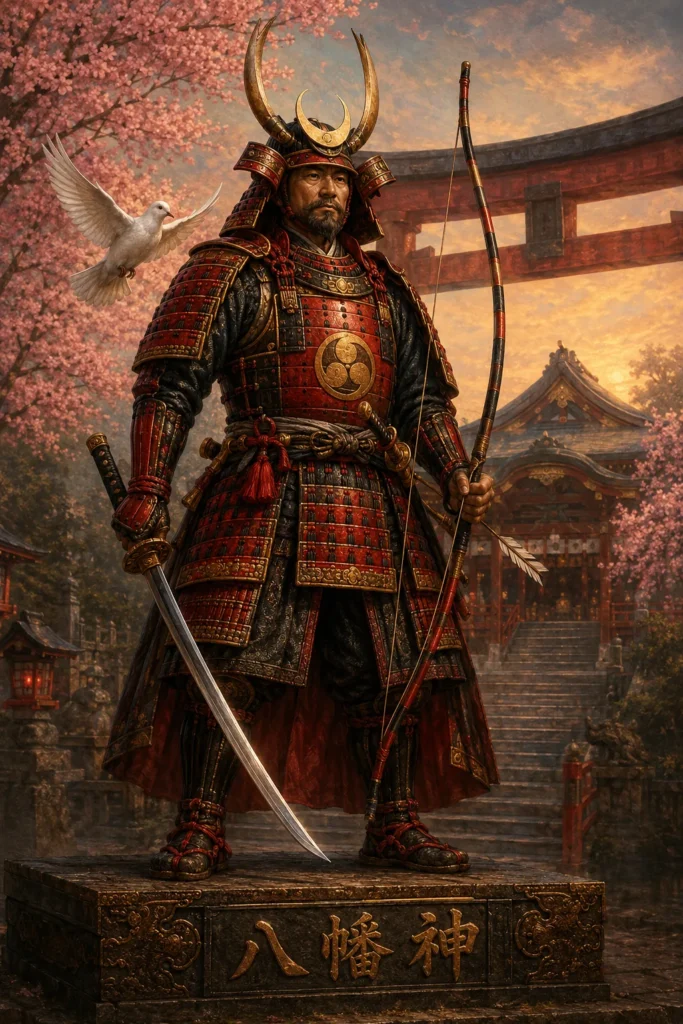
In the visual arts, Hachiman is usually depicted as an old, dignified man with a tonsure, clad in the robes of a Buddhist monk and holding a sword or a bow.
This monastic form goes back to the conferral of the Buddhist bodhisattva rank in the year 781; since then he has borne the title Hachiman-Daibosatsu. In warrior depictions he appears on a white horse, with helmet and armor, often surrounded by eight banners.
His chief attribute is the bow (Yumi) and the arrow (Ya); the archery ritual Yabusame, in which mounted archers strike wooden targets at full gallop, is performed at his festivals and is still practiced today at Tsurugaoka-Hachimangū in Kamakura, at Shimogamo-jinja in Kyoto, and at numerous other shrines.
The dove (Hato) is also regarded as his messenger; the pictographic character “Hachiman” was drawn in the Middle Ages with two stylized doves.
Veneration and Cult Sites
Hachiman’s shrine of origin is Usa-jingu in Ōita Prefecture on Kyushu. Here the Kami is said to have first appeared through an oracle in the year 571; the shrine has been imperially recognized since the eighth century.
From Usa the Hachiman cult spread systematically across the entire country. Today, according to the count of the Jinja-Honchō, there are around 44,000 Hachiman shrines in Japan, making Hachiman one of the most densely venerated Kami.
The most important shrines outside Usa are Iwashimizu-Hachimangu south of Kyoto (founded in 859, the protective shrine of the imperial court) and Tsurugaoka-Hachimangu in Kamakura (founded in 1063, the protective shrine of the Minamoto clan and the Kamakura shogunate).
The latter was expanded into a monumental complex under Minamoto no Yoritomo, the first shogun, between 1180 and 1191. With the rise of the Kamakura shogunate, Hachiman became the official protective god of the warrior class, and the status “Bushi-no-Kami” (warrior Kami) remained with him into the Edo period.
The most important festival days are the Hojo-e (release of animals, in autumn), the Reigan-Sai (festival of appearance, 15 March in Usa) and the Hachiman-Matsuri with Yabusame performances.
Shinbutsu-Shūgō and the Bodhisattva Title
In the year 781 the court conferred upon Hachiman the title “Hachiman Daibosatsu,” that is, “Great Bodhisattva Hachiman.” With this he was officially incorporated into the Buddhist pantheon and identified with various Buddhas and bodhisattvas, most frequently with Amida (Amitabha).
This is the earliest and most significant application of the honji-suijaku principle, the medieval doctrine that Kami are in fact manifestations of Buddhist beings.
Mark Teeuwen and Fabio Rambelli, in “Buddhas and Kami in Japan” (2003), worked out Hachiman’s key role for Japanese religious history: it was with him that the synthesis was carried out first and most consistently.
Only the Meiji Restoration separated the two spheres in 1868 by edict (Shinbutsu-bunri), whereby numerous Hachiman temples were declared pure Shintō shrines and their Buddhist components were removed.
Helen Hardacre documented in “Shinto. A History” how this process affected Hachiman shrines particularly drastically, because they had merged more strongly than others with Buddhist buildings and works of art.
Hachiman, the Mongol Invasions and the "Divine Winds"
During the two Mongol invasions of 1274 and 1281, Hachiman was intensively invoked for aid at Iwashimizu and Usa. When the Mongol fleet was destroyed by violent storms on both attempts, the Japanese court attributed this to the intervention of Hachiman and the other protective gods of the realm.
The storms were interpreted as “Kamikaze” (divine winds); the term acquired a sad second meaning in the Pacific War. Klaus Antoni demonstrated in 1991 that the revival of this topos in Japanese nationalism of the 1930s drew directly on medieval Hachiman texts.
Classification in Religious and Reception History
In religious studies, Hachiman is a key god for several reasons: he is the youngest of the great imperial shrine gods, he is the prime example of Shinbutsu-Shūgō, and he connects the spheres of the imperial dynasty, the warriors and the Buddhist monasteries.
Helen Hardacre characterizes him as “the most politicized Kami of Japanese religious history.” Ross Bender, in several works (from 1979 onward), examined Hachiman’s role in the Dōkyō affair of 769, when a Hachiman oracle prevented the accession to the throne by the monk Dōkyō and thus became the first oracle episode of decisive religious-political importance in Japan.
In modern popular culture, Hachiman is less prominent in manga and anime than Amaterasu or Susanoo, but appears in works such as “Inuyasha” or “Onmyōji.” The doves of the Tsurugaoka shrine have developed into a marketing symbol of Kamakura and are found on sweets, postcards and souvenirs.
Cross-References within the Pantheon
Within the Japanese pantheon, Hachiman stands between the sphere of the primordial gods (Izanagi, Amaterasu, Susanoo) and the later historicized Kami such as Tenjin (Sugawara no Michizane) or Toyokuni Daimyōjin (Toyotomi Hideyoshi).
Structurally he is a deified ruler, but in religious history a classic warrior and protective kami with clear functional parallels to Mars (Rome), Ares (Greece), Tyr and Odin (Germanic), as well as Skanda and Karttikeya (Hinduism, Buddhism).
Sources
“Shoku Nihongi” (797), entry for the year 720. “Engishiki” (927), Book IX. “Hachiman-gudōkun” (13th century). “Iwashimizu-monjo,” shrine archive. “Kojiki” and “Nihon Shoki,” translations by Klaus Antoni and Karl Florenz. “Heike-Monogatari,” Book IV (Yabusame episodes).
Ross Bender, “The Hachiman Cult and the Dōkyō Incident,” Monumenta Nipponica 1979. Mark Teeuwen and Fabio Rambelli (eds.), “Buddhas and Kami in Japan.
Honji Suijaku as a Combinatory Paradigm,” London 2003. Klaus Antoni, “Der himmlische Herrscher und sein Staat,” Munich 1991. Klaus Antoni, “Shintô und die Konzeption des japanischen Nationalwesens,” Leiden 1998. Helen Hardacre, “Shinto. A History,” Oxford 2017. Joseph Kitagawa, “Religion in Japanese History,” New York 1966. Inken Prohl, “Religiöse Innovationen,” Berlin 2006.
Etymology and Spellings
The name “Hachiman” (八幡) is composed of “hachi” (eight) and “man” or “hata” (banner, cloth). The spelling with the character for “banner” became established in classical usage, because the eight heavenly banners that, according to the “Nihon Shoki,” descended at the birth of Emperor Ōjin form the central birth miracle.
An alternative reading, “Yawata” (やわた), survived in some shrine names, especially in Iwashimizu-Yawatamachi. The elevated form “Hachiman-Daibosatsu” (“Great Bodhisattva Hachiman,” conferred in 781) and the shrine address “Hachiman-Ōkami” (“Great God Hachiman”) mark his twofold theological standing.
In shrine archives of the middle Heian period, the extended formulas “Hachiman-no-Kami,” “Hime-gami no Mikoto” and “Okinaga-tarashi-hime-no-Mikoto” frequently appear, designating Ōjin, his consort Hime-gami and his mother Jingū respectively.
This triad forms the “Hachiman-Sansho-Daimyōjin,” the standard triad of all great Hachiman shrines. Helen Hardacre and Bernhard Scheid have worked out this triad as a distinctive profile that sets Hachiman apart from other imperial kami.
Shrine Architecture of the Hachiman Style
The Hachiman shrine building style (“Hachiman-zukuri”) is a class of its own within Japanese shrine architecture. It consists of two main buildings placed in parallel and joined by a common roof. The front building (“Geden”) serves for veneration by the pilgrims, the rear one (“Naiden”) houses the Kami symbols.
This double structure distinguishes the Hachiman style from the older Shinmei-zukuri (Ise) and from the Taisha-zukuri (Izumo). The Usa-jingu and the Iwashimizu-Hachimangu are the classic examples of this style and are at the same time Japanese national cultural monuments.
The roof forms are consistently “Kirizuma” (gable roof) with far-projecting front-roof layers. The main colors are vermilion red for the load-bearing columns and white for the exterior walls, in combination with gold-colored fittings.
This coloring was introduced in the Middle Ages under the influence of Buddhist architecture and is still today the visual hallmark of the Hachiman shrines, clearly distinguishing them from plainer shrines (such as Ise).
Hachiman and the Theology of the Sword
A special tradition is the connection of Hachiman with the “three Holy Swords” of the Minamoto clan. These swords are said to have been blessed by the shrine at Iwashimizu upon the accession of each new head of the family.
The tradition of consecrating swords to Hachiman is attested several times in the “Heike-Monogatari” and the “Genpei-Seisuiki” and shaped Japanese warrior religiosity into the late Edo period.
In the modern Bushidō discourse of the late 19th and early 20th centuries, Hachiman was raised to a symbol figure on which nationalist sword ethics leaned; Klaus Antoni has critically documented this connection.
The “sword-smithing school” of Bizen, which produced blades for the imperial guard, traditionally consecrated its best blades to Hachiman shrines. Several of these blades, including works of the Sōshū school of the early 14th century, are preserved as treasures at Tsurugaoka-Hachimangu and Iwashimizu-Hachimangu and are regarded as important cultural assets of Japan.
Hachiman in the Edo Period and in Folk Religion
During the Edo period (1603 to 1867), Hachiman remained the protective god of the warrior class, but additionally gained importance as the protective god of townspeople and merchants.
In Edo (present-day Tokyo), numerous Hachiman shrines were founded in the newly laid-out districts of the city, often as the protective sanctuary of a trade guild or a street.
The Tomioka-Hachimangu in Fukagawa (founded in 1627) is the largest and best-known of these urban Hachiman shrines; its triennial main festival with the large portable shrines (Mikoshi) is among the three largest festivals of Tokyo.
In the woodblock art of the Edo period (Ukiyo-e), Hachiman is a recurring motif as a mounted figure. Kuniyoshi, Hokusai and Yoshitoshi created several series on Hachiman and on the birth of Ōjin.
These pictures document the popular familiarity with the Hachiman mythology and show that the figure had broad appeal beyond the courtly and military elites.
Controversies over the Historical Substance of Ōjin
The identification of Hachiman with the mythical Emperor Ōjin is controversial both in religious studies and in history. The official imperial chronology dates Ōjin’s reign to the fourth century (270 to 310 by traditional reckoning), yet archaeology shows that the imperial dynasty becomes historically tangible only in the fifth century.
The Konda-Gobyōyama-Kofun in Habikino (Osaka Prefecture) is traditionally regarded as Ōjin’s tomb, but cannot be attributed to him with certainty. It is more likely that the Ōjin figure is a later construction into which several historical royal figures have flowed together.
Ross Bender, Joan Piggott and other historians have argued that the Hachiman-Ōjin identification fulfilled a political function in the eighth century: it offered the rising Yamato dynasty a sacred anchoring in a warrior Kami who at the same time established the connection to the Korean immigrant clans.
Hachiman scholarship of the past thirty years has largely adopted this political reading and emphasizes that the religious history of Hachiman cannot be separated from the political history of early Japan.
Comparative Classification
Structurally, Hachiman belongs to the class of warrior and protector deities represented in almost all the pantheons of the Eurasian high cultures. Within East Asian religious history, the closest parallels are Guan Yu (Chinese war god, a hero of the late Han period deified in Daoism) and the Korean Hwarang cult.
In a broader comparison, parallels emerge with Mars and Hercules (Rome), Ares and Heracles (Greece), Tyr and Thor (Germanic), Skanda-Karttikeya (Hinduism) and Indra in his warrior aspects.
The distinctiveness of Hachiman in relation to these deities lies in the combination of warrior function and Buddhist bodhisattva status. This duality is almost unique in comparative religious history and makes Hachiman a particularly fruitful object of study in religious studies.
Mark Teeuwen and Bernhard Scheid have shown in several studies that this duality is no contradiction, but corresponds essentially to the Japanese understanding of religion since the early Middle Ages.