The Pazuzu Amulet: the demon as protection against Lamashtu
By Ralf Ittermann · last reviewed on
The Pazuzu amulet is one of the most striking protective objects of the ancient Near East.
It shows the head of a feared wind demon, and its purpose lay precisely in this: Pazuzu was meant to ward off an even more dangerous power, the childbed demon Lamashtu. The amulet thus links form and function as closely as almost no other ancient object.
Classification
The Pazuzu amulet is a portable protective object from the ancient Near East. From the end of the second millennium far into the first millennium before our era, it was widespread in Mesopotamia and the neighbouring regions.
It depicts the head or the complete figure of the demon Pazuzu and was worn on the body, hung from cords or set up in the living space. Over several centuries it was a self-evident part of domestic protection.
What makes this amulet special is an apparent contradiction. Pazuzu himself was regarded as a dangerous being, as lord of the evil wind demons. Yet people deliberately sought his protection.
The ancient Near Eastern conception followed a comprehensible logic here: a threatening power can hold in check another power perceived as even more threatening. The amulet was therefore not a good-luck charm in today’s sense, but a targeted object of defence with a clearly defined task.
In religious studies, the Pazuzu amulet is counted among the apotropaia. The term comes from Greek and denotes objects whose purpose is the averting of evil.
The Pazuzu amulet is among the best-researched apotropaia of the ancient Near East, because it has survived in large numbers and because form and function can be linked so closely in hardly any other object. It thus offers a rare, well-documented insight into the everyday religion of a vanished world.
Pazuzu, the lord of the wind demons
In the written sources Pazuzu appears as king of the evil wind demons, as son of the god Hanbi. His sphere of action was the hot, dry wind that swept over the land between the two rivers from the west and southwest.
This wind brought feverish illness, drought and swarms of locusts. Pazuzu thus embodied not an abstract threat, but a very concrete danger that could be experienced every year in rural everyday life.
It is striking that Pazuzu possesses almost no mythology of his own. While other figures of the ancient Near East are described at length in narratives, hymns and epics, Pazuzu is known almost exclusively through the amulets themselves and through a few incantation texts.
He is a being that lives in the object, not in the narrative. This peculiarity has long occupied scholarship, for it is unusual for such a widespread figure. A more detailed account of the figure can be found on the page about Pazuzu in the lexicon of beings.
Precisely because Pazuzu ruled the harmful wind, he could also, according to ancient Near Eastern conviction, hold it back. Whoever brought the lord of the wind demons over to his side gained a powerful ally against exactly those forces over which Pazuzu presided.
The amulet made this alliance visible and lasting. It carried the demon not as a threat, but as a bound, outward-turned protective power.
Form and iconography
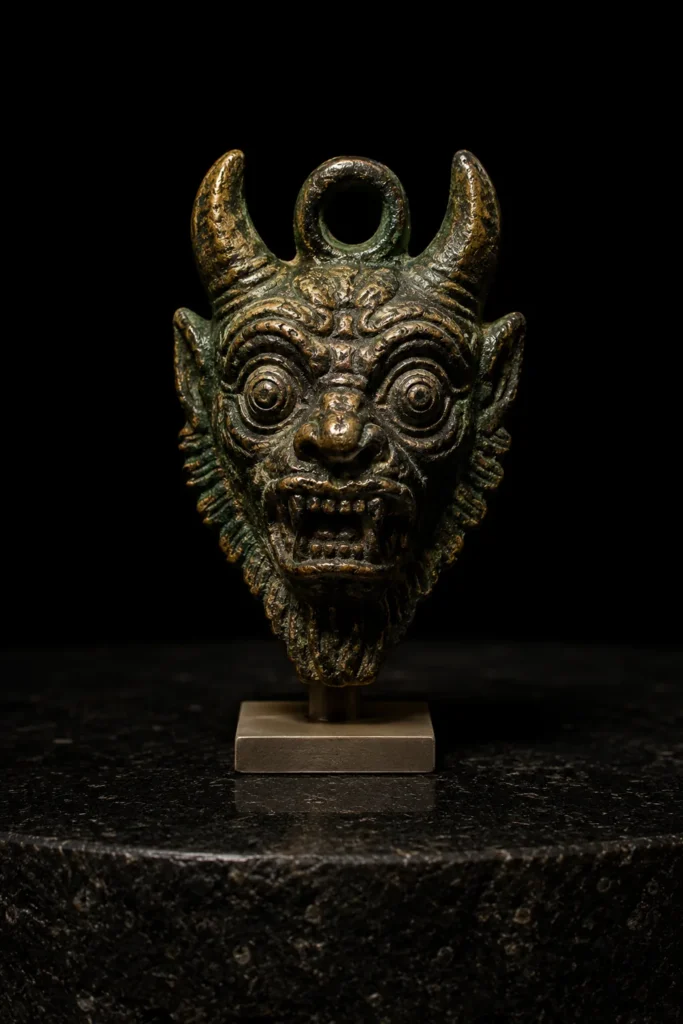
The iconography of Pazuzu is a model example of a composite hybrid being. The head bears a dog- or lion-like face with deep-set, protruding eyes, a pronounced brow and a pair of curved horns.
The human-like body is depicted as scaly, the feet end in bird claws, and the depictions usually carry two pairs of wings. The figure is completed by a scorpion’s tail.
Each of these features comes from the repertoire of dangerous or boundary-crossing animals. Predator, bird of prey and scorpion are creatures to which ancient Near Eastern culture attributed combativeness and danger.
The hybrid form bundles these qualities and makes Pazuzu an apparition that already deters at first sight. One raised and one lowered hand also form a fixed gesture that scholarship interprets as a ritual gesture of threat and defence.
This form was not a free artistic invention, but a pictorial type stable over centuries. Whoever took a Pazuzu amulet in hand immediately recognised what it was.
This very recognisability was important, for the image was meant to act unmistakably, both on the wearer and on the powers it was meant to ward off. The constancy of the type shows how binding the conception of Pazuzu was in the ancient Near East.
Material, size and inscription
As for material, bronze predominates; alongside it, stone, fired clay and faience are attested. Bronze could be cast and allowed fine working of the facial features, which is why the head pendants in particular are often carefully crafted.
The sizes range from small pendants only a few centimetres high to larger heads and complete figures that served as a standing image or as a fitting.
Two basic forms can be distinguished. There is the complete figure as a statuette or pendant, and there is, far more frequently, the isolated Pazuzu head with a suspension loop. The head alone was regarded as full protection.
A part stood in for the whole, a principle widely current in the study of amulets. The head was at the same time handier, easier to wear and cheaper to produce.
Many pieces bear an inscription. Often it is the fixed self-introduction of the demon, which in essence begins by stating that he is Pazuzu, the son of Hanbi, the king of the evil wind demons.
This formula was not mere lettering. It was an active part of the protective effect, for naming the being and recording its rank were regarded as means of binding its power and committing it to the amulet.
Protection against Lamashtu
The most important task of the Pazuzu Amulet was the warding off of Lamashtu. This demon was regarded as a threat to pregnant women, to women in childbed and to newborns.
Miscarriages, the fever of childbed and the early death of infants were attributed to her. Lamashtu was thus the embodiment of one of the greatest real dangers of the ancient world, in which birth and the first weeks of life were highly perilous for mother and child.
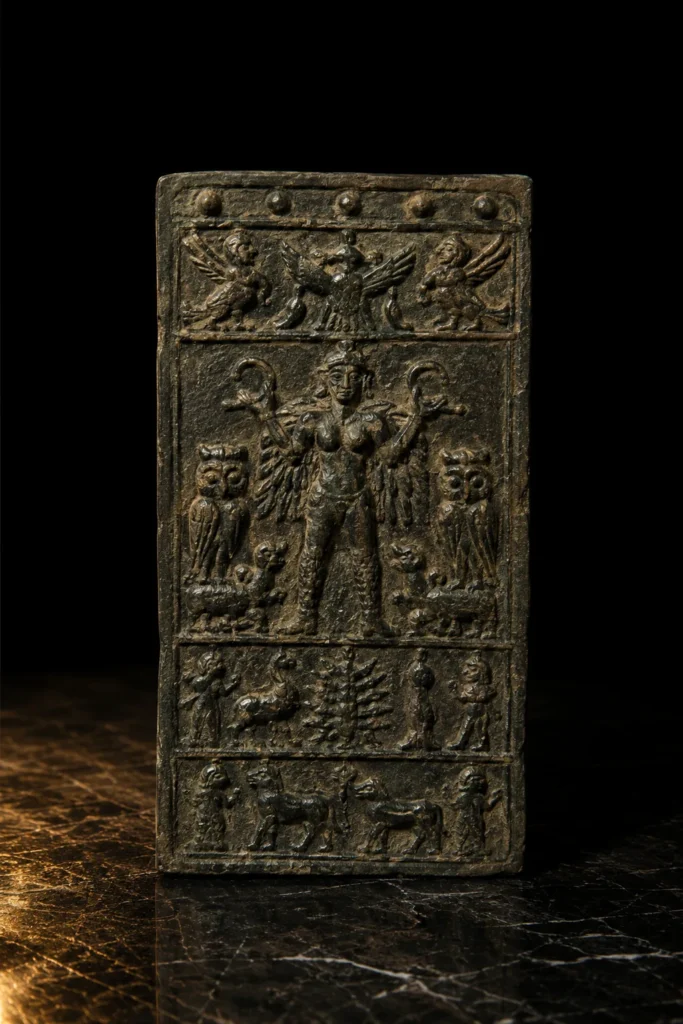
Pazuzu confronted this power as a counterforce. This becomes especially clear on the so-called Lamashtu plaques. These tablets of bronze or stone show, in several pictorial registers, how the demon is conjured and forced back into the underworld.
Over the upper edge of the plaque rises a Pazuzu head, which looks down on the scene and as it were oversees the banishment. The tablets were mounted above the bed or on the wall of the living space.
Pregnant women and small children also wore Pazuzu head pendants directly on the body. The amulet thus accompanied exactly those persons who were regarded as especially at risk. It was therefore closely bound up with the protection of birth and early childhood, an area in which the desire for safety was particularly urgent.
Manner of wearing and domestic use
The Pazuzu amulet was not an object for special occasions, but part of everyday life. The suspension loop on the head pendants shows that the pieces were worn on a cord around the neck or on the garment.
In this way the protection accompanied its wearer through the day and remained close by at night as well.
In addition, the amulet had a fixed place in the house. Larger heads and figures were mounted on walls, above doors or near the sleeping place.
Doors, windows and thresholds were regarded in the ancient Near East as the points at which harmful powers could enter the protected space. It was precisely there that Pazuzu was deployed, to secure the boundary of the house.
Its use extended across all social strata. Simple, plainly cast pieces stand alongside carefully worked examples.
The Pazuzu amulet was thus not a privilege of the wealthy, but a broadly carried protection, borne by the desire for safety for family and household. This everydayness distinguishes it from purely cultic objects that were reserved for the temples alone.
Distribution and dating
The great age of the Pazuzu Amulet was the first millennium before our era. In the Neo-Assyrian and Neo-Babylonian empires it was in use among large parts of the population, and in the subsequent Persian period too it remained alive. Over many generations it belonged to the fixed stock of domestic protection.
The finds reach far beyond the heartland of Mesopotamia. Pazuzu amulets are attested in the Levant, in Iran, in Egypt and even in the eastern Mediterranean. This wide spread shows that the objects travelled with people, goods and ideas, and that the protective idea bound up with them was comprehensible across cultural boundaries as well.
The find contexts are above all graves and dwelling houses, occasionally also sanctuaries. In the grave the amulet was meant to continue accompanying the deceased; in the house it served the living.
The distribution across regions and spheres of life makes clear how deeply the Pazuzu amulet was anchored in the material religion of the ancient Near East.
The operative principle: demon against demon
The Pazuzu amulet follows a protective principle that religious studies describes as defence through an allied frightening power. Instead of asking for help from a benevolent deity alone, one bound the power of a feared being and directed its hostility outward, against Lamashtu and against the harmful wind.
The inscription on the amulets fulfilled a precise function in this. By naming Pazuzu and establishing his origin and his rank, it also fixed him in place. The demon was named, classified and thereby made manageable. His destructive nature remained, yet its thrust was now determined and committed to the protection of the wearer.
This pattern is no isolated case in the ancient Near East, and it is also encountered in other cultures. The terrifying image that deters evil is found, for example, in the Greek Gorgoneion, the head of Medusa on shields and house gables, or in the menacing grimaces of East Asian door guardians.
The Pazuzu amulet is a particularly clearly developed form of this widespread idea that terror can be warded off with terror.
History of research and present-day reception
The scholarly engagement with Pazuzu reaches back to the early 20th century, when Assyriologists such as Heinrich Zimmern opened up the incantation texts.
The overview still authoritative today was presented by Nils Heeßel in 2002. His archaeological and philological study ordered the large body of amulets and plaques and thereby created the foundation for any further engagement with the subject.
Scholarship also owes important classifications to Frans Wiggermann, who has studied the Mesopotamian protective spirits and their ritual texts.
To a broad public the name Pazuzu is known above all through the film The Exorcist from 1973, in which a Pazuzu statue plays a role. This reception has made the demon widely known, but at the same time distorted his image.
In popular perception Pazuzu has since been regarded as the pure embodiment of evil. The historical record is different. The Pazuzu amulet was a protective object, an object of care for pregnant women and children. Whoever wore it did not seek evil, but wanted to ward it off.
Original Pazuzu amulets and the famous statuette of the demon can be seen today in several large collections, including the Louvre in Paris, the British Museum in London and the Vorderasiatisches Museum in Berlin.
They bear witness to a protective tradition that accompanied the everyday life of many people over centuries and that belongs to the most impressive chapters of ancient Near Eastern amulet lore.
Literature (selection)
Related key terms: Pazuzu Lamashtu apotropaion wind demon bronze amulet Hanbi childbed incantation ancient Near East.
iWell Guard and protective traditions
iWell Guard stands in the cultural-historical line of portable protective objects, to which the Pazuzu amulet also belongs. A modern companion for people who live with protective symbols: made in Germany, 41 layers of solid gold, platinum and silver, with a 30-day right of return.
Personal experiences may vary. Not a medical device. No promise of healing.