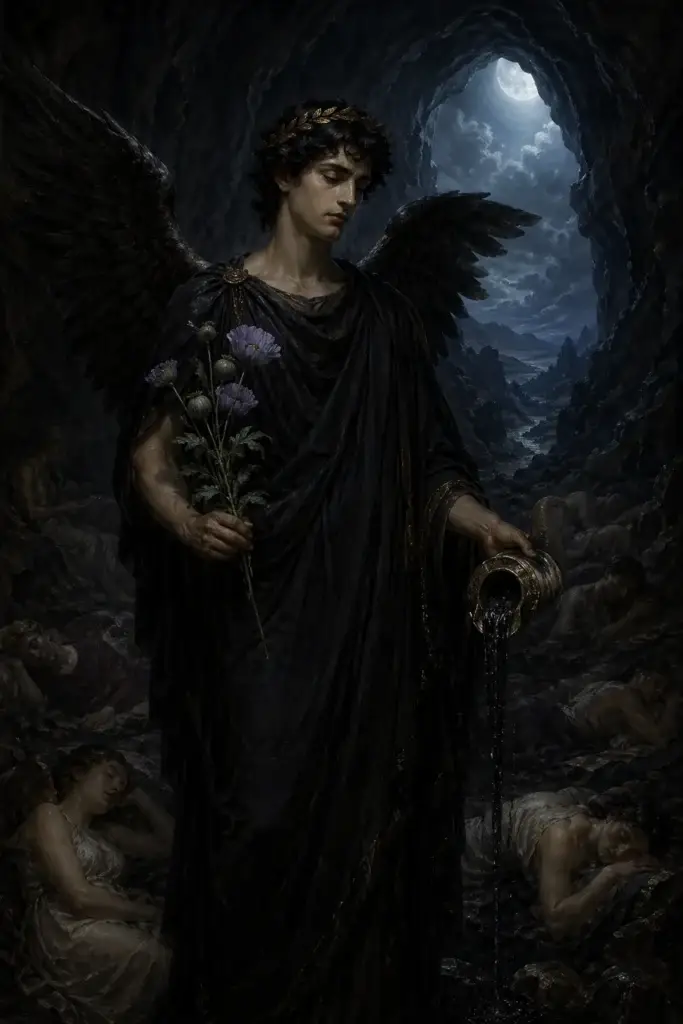
Gello, child-threatening demon of the Greek tradition
By Ralf Ittermann · last reviewed on

Gello
Gello (Γελλώ) is a child-threatening demon of the Greek tradition, rooted in late antique and Byzantine folk magic. She belongs to the broad cultural-anthropological family of beings that threaten pregnant women, women in childbed, and infants, related to the Mesopotamian Lamashtu, the Jewish Lilith, the Roman Strix, and the Syrian Lilitu.
Those wishing to understand the complex as a whole will find its cross-cultural context in the overview Kinderdämonen.
The name Gello appears for the first time in the Greek poet Sappho (around 600 BCE, Fragment 178 Lobel-Page) as a proverb: “more child-loving than Gello” was an ironic expression for a cruel person.
The later tradition develops from this reference a complete profile of the being: Gello is a young woman who died prematurely and returns as a vengeful spirit to the world of the living, attacking the children of other mothers because she herself could not bear or raise children.
Gello in the Greek-Byzantine Tradition
Gello (also Gylou, Gelloudes, or Gillo) is a female demonic figure of the Greek-Byzantine tradition that structurally belongs to the extended succubus class, specializing in threats to pregnant women, women in childbed, and infants.
The earliest mention is in Sappho (Fragment 178), where Gello appears as a being embodying girls who died young.
In the Byzantine tradition she becomes an elaborated disease-demon figure, against whom amulets and liturgical protective formulas were employed. More recent scholarship (Sarah Iles Johnston, Restless Dead, 1999; Richard Greenfield, Traditions of Belief in Late Byzantine Demonology, 1988) has examined the depth of the Gello tradition in the history of religion. This entry traces Gello as a child-threatening demon of Byzantium, examined in depth by recent scholarship on Greek tradition.
Context and Background
The tradition originates from late antique Greek and Byzantine folk magic and is well documented in the history of religion as the late antique child-demon complex.
Mythological Background
The most important sources on the Gello tradition are the late antique and Byzantine protective texts against child-threatening demons.
The central text is the “Narrative of Saint Sisinnios,” an apocryphal hagiographic legend in which Saint Sisinnios and his brothers Synidoros and Sinodoros pursue a child demon named Gyllou (the Byzantine spelling variant) and force her to reveal her twelve names.
The list of names is apotropaic: whoever knows all twelve names has power over the demon.
In addition, lead tablets from the 6th to 10th century have survived that were worn as protective amulets and on which protective incantations against Gello are engraved. This epigraphic source group is particularly valuable for the history of religion because it shows that the tradition was disseminated both in literary form and in concrete practice.
Important philological studies include R. P. H. Greenfield (“Traditions of Belief in Late Byzantine Demonology,” 1988) and R. P. H. Greenfield (“St. Sisinnios, the Archangel Michael and the Female Demon Gylou,” 1989).
Relationship to Lilith and Lamia
Gello forms, together with the Jewish Lilith, the Greek Lamia, and the Mesopotamian Lamashtu, a class of female birth-related demons whose connection in the history of religion is studied in comparative religious studies.
The structural parallels are striking, but scholarship tends to explain them as functional convergence rather than as the result of a common ancient Near Eastern root. The Byzantine-Orthodox Marian tradition has its own apparatus of protective invocations and amulets against Gello, some of which continue to the present day in Greek Orthodox popular religion.
Sources
Primary literature: R. P. H. Greenfield, “Traditions of Belief in Late Byzantine Demonology” (1988); R. P. H. Greenfield on Sisinnios and Gylou (1989); Karl Preisendanz, “Papyri Graecae Magicae” for the late antique magic tradition. Additionally, the archaeological-epigraphic source group of lead amulets from the 6th to 10th century, edited in several collected publications.
Gello in the iWell Guard Protection Field
Gello falls under the second layer of the iWell Guard protection field (see Function Overview): attempts by spirits and demons to threaten the wearer or their pregnancy, birth, or infants are repelled by the protective shield.
The historical tradition of Gello protection offers an instructive case study in the history of religion: protective practices against this class of demons are elaborated in nearly all developed Mediterranean cultures, which points to a universal experiential basis behind the accounts.