Huli Jing, spirit of the Chinese tradition
By Ralf Ittermann · last reviewed on
Huli Jing is a spirit of the Chinese tradition.
The fox spirit, seductress and seeker of enlightenment alike.
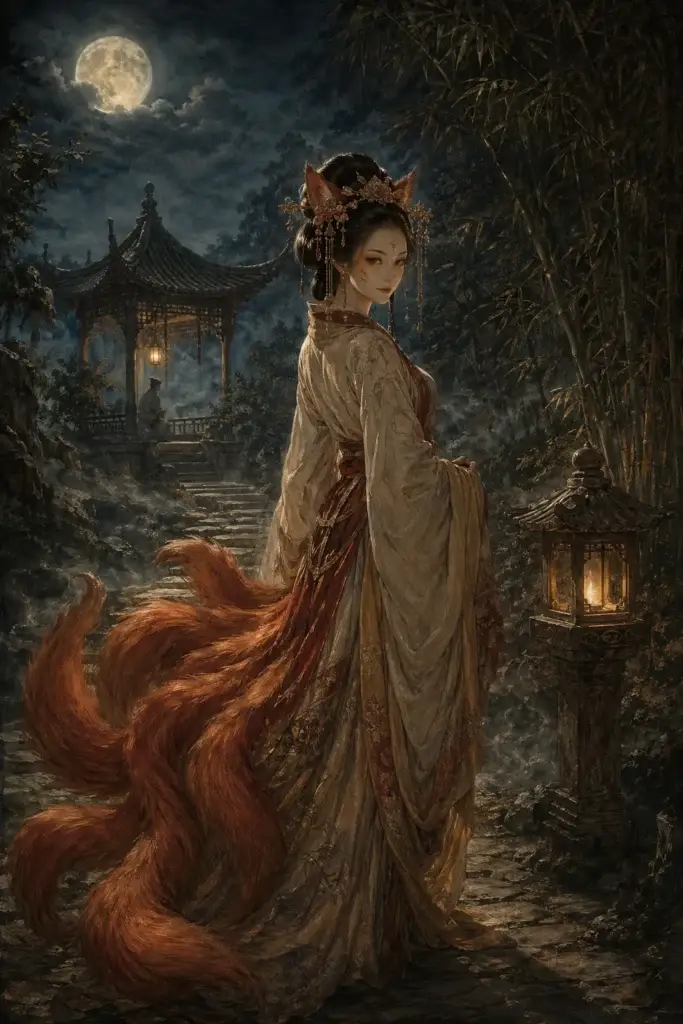
The Huli Jing (狐狸精, “fox essence”) is one of the most heavily literarised figures of Chinese demonology. A fox that, through long life and spiritual cultivation, takes on human form, almost always female, almost always beautiful.
Its ambivalence is programmatic: it can be a dangerous seductress who drains jing (life essence) from men; it can be a faithful companion and loving wife; it can even strive for enlightenment and become a Daoist or Buddhist.
Classical literature, above all Pu Songling’s Liaozhai Zhiyi (17th c.) with its numerous fox tales, paints the nuanced picture: fox spirits are not simply evil, but complex personalities with their own histories.
The motif of the nine-tailed fox spirit (Jiuweihu) is especially well known and has travelled from China to Japan (Kitsune) and Korea (Kumiho). The relationship between human and fox spirit is a central theme of Chinese literature, reaching far beyond horror and demonology.
Type: fox spirit, metamorphosis Yaoguai
Origin: a fox through long life and cultivation
Stages of development: 50 years (transformation), 100 years (beautiful), 1000 years (divine, nine tails)
Texts: Hanfeizi, Sou Shen Ji, Tang Chuanqi, Liaozhai Zhiyi
Period: pre-imperial to the present
Context
Period of the texts
First attestations already pre-imperial (Hanfeizi, Zuozhuan with fox motifs). The Han period develops the theory of cultivation. The Tang period (Chuanqi tales) with fully elaborated fox figures. Pu Songling’s Liaozhai (17th c.) as the literary high point. The modern film and television tradition continues unbroken.
Area of distribution
The Chinese cultural sphere. The Japanese Kitsune and the Korean Kumiho are direct adoptions and independent further developments. The nine-tailed fox woman is present across East Asia in all three traditions. Modern international reception through games and manga.
Source situation
Shanhaijing (early), Sou Shen Ji, Tang Chuanqi (Li Fuyan’s Xu Xuanguai Lu), Pu Songling’s Liaozhai Zhiyi, Ji Yun’s Yuewei Caotang Biji, the modern film corpus and popular culture.
Name and Variants
Chinese: 狐狸精 (húli jīng), “fox essence”; in short 狐 (hú) or 狐仙 (húxiān, “fox immortal”, positive).
Nine-tailed: 九尾狐 (Jiǔwěihú).
Japanese: Kitsune (狐), nine-tailed as Kyūbi no Kitsune.
Korean: Kumiho (구미호, “nine-tailed fox”).
Etymology: huli is the standard word for “fox”, jing marks the gathering of essence.
The stages of development are systematised in classical literature: 50 years to transformation into an attractive woman. 100 years to a perfect human form. 1000 years to divine power, nine tails, Daoist immortality. This doctrine of stages is connected with the general Daoist theory of cultivation.
Characteristics
Appearance
Human form: a beautiful young woman, often particularly charming, educated, musical. When unmasked: a fox tail visible beneath the skirt or behind a door. Fully developed form: a nine-tailed fox with luminous fur (white or golden). In animal form: an ordinary fox.
Behaviour
Ambivalent. Older traditions (the Tang period) often depict the Huli Jing as a dangerous seductress who drains jing energy. The Liaozhai era is more nuanced: many fox spirits are faithful companions, loyal wives, helping friends. Some strive for Daoist cultivation and human dignity.
Sphere of influence
Inhabits graves, old ruins, fox dens in remote mountains. In human form also in towns and villages, often as a merchant’s wife, a wanderer, an honoured member of a family. Certain regions (Shanxi, northern China) are regarded as strongholds of fox spirits.
Mythological classification
Not a creation, but the result of cultivation. In Daoist terms: the fox is an animal that gathers yin qi particularly well and therefore comes to cultivation quickly. The folk-religious tradition venerates Huxian (“fox immortals”) in temples of their own, especially in northern China.
Profile: Huli Jing
The most important aspects of the Huli Jing at a glance.
A fox through long cultivation. Doctrine of stages: 50 years transformation, 100 years beautiful, 1000 years divine and nine-tailed. Daoist cosmology as the framework.
Young men in a context of seduction, scholars and poets (the Liaozhai pattern), travellers and merchants. In positive traditions: husbands and families.
A beautiful young woman in human form, with a fox tail when unmasked. Fully developed: a nine-tailed fox with luminous fur.
Ambivalent. Seduction and the draining of jing (negative) or faithful partnership and a helping presence (positive). Often strives for cultivation and immortality.
In its negative form: Daoshi exorcism, Fu talismans, rooster blood, special mantras. In ambivalent cases: a clever conversation, respect, a testing of intentions (the Liaozhai tales show this in literary form).
Kitsune (Japan), Kumiho (Korea), Yakshini (ambivalent and seductive), European fairies with animal transformation.
Literary Tradition and Cult
The Liaozhai cycle
Pu Songling’s Liaozhai Zhiyi contains many fox-spirit stories, some frightening, many moving. The fox spirit appears as a complex personality who loves the scholar-hero, protects him, educates him. This image shapes the reception to this day.
Huxian temples
In northern China, especially Shanxi and Hebei, there are Huxian temples. Fox spirits are venerated there as “Xian” (immortals), with rituals of their own, offerings and an oracle tradition. The practice is still alive today, having flourished again after the end of the Cultural Revolution.
Tang Chuanqi and the classical tale
Tang-period tales (7th to 10th c.) establish the literary Huli Jing motif. Stories such as “Ren Shi Zhuan” (Biography of Ren) show the fox woman as a tragic, loving figure. These tales feed into Pu Songling and shape the tradition to this day.
Reception and the Modern Era
East Asian parallels: the Japanese Kitsune with its own rich tradition, Inari Shinto, Kitsune marriages, Kitsune sorcery. The Korean Kumiho in K-dramas and modern films. The nine-tailed fox woman is a pan-East-Asian icon.
Popular culture worldwide
Anime (Naruto with the Nine-Tails), Pokémon (Vulpix/Ninetales), video games (League of Legends Ahri), Chinese dramas (The Untamed with fox-spirit supporting characters). The Huli Jing motif is present worldwide, often with a strong anime aesthetic.
Feminist reading: modern Chinese literary scholarship reads the Huli Jing as a figure of female autonomy within patriarchal societies; the fox woman does not obey the rules of the family but remains an independent personality. This reading has shaped the academic reception since the 1990s.
The fox spirit in the records: from Gan Bao to Pu Songling
The fox spirit, in Chinese húli jīng, is one of the best-documented supernatural figures of China, because it has been recorded in literary collections over almost two millennia.
An early stage is formed by the Soushen ji (“Records of an Inquiry into the Spirits”) of Gan Bao from the fourth century, which contains several fox stories and presents the fox as a shapeshifting, long-lived being that can take on human form and give voice to scholarly learning.
The Tang period brought a flowering of the fox tale in the so-called chuanqi, the “accounts of the marvellous”. The most influential collection, however, is the Liaozhai zhiyi (“Strange Tales from a Chinese Studio”) of Pu Songling, written in the seventeenth century.
Pu Songling devoted dozens of tales to the foxes and sketched in them a remarkably nuanced picture: there are malicious, life-force-stealing vixens, but also faithful, clever, morally exalted fox women who stand by their human partners in times of need.
This source situation is significant for religious studies. The húli jīng is not an unambiguous figure of terror, but a highly elaborated literary figure through whom Chinese authors negotiated questions of desire, morality, social advancement and the boundary between human and animal over centuries.
Anyone who reduces the fox spirit to the “femme fatale” overlooks the greater part of the tradition. The collections of Gan Bao and Pu Songling are accessible in reliable translations and remain the basis of any serious study.
Cultivation and the path to the celestial fox
A central, often overlooked aspect of the fox-spirit conception is the idea of self-cultivation. According to the widespread view, the húli jīng is not a supernatural being from the outset, but an ordinary fox that gradually acquires higher abilities through great age and through purposeful practice.
At fifty or a hundred years, so the texts say, a fox can take on human form; with further age its power grows.
This ascent is embedded in the Daoist-shaped conception of nurturing the life force qi and of striving for longevity and transcendence. The fox gathers qi; some tales say it draws it from the moon, from old graves or from human partners.
At the end of a very long path the fox can become the tiānhú, the “celestial fox”, a being with nine tails that has attained the status of an immortal and is no longer harmful but exalted.
This conception makes the fox spirit a mirror image of the human striving for cultivation. The fox does what the Daoist adept also does: it practises, it gathers, it strives beyond its own nature. This explains the moral ambivalence of the figure.
The fox that drains a human being’s life force in order to ascend more quickly acts as a predator; the fox that advances through virtuous conduct and the accumulation of good deeds is an almost exemplary figure.
The fox spirit is thus less a demon than a being on a path whose methods determine its moral rank. It shares this logic with other beings of the Chinese tradition that are capable of cultivation.
The fox cult: veneration, not merely defence
Unlike many figures of terror, the fox spirit was in parts of China the object of an actual cult. Especially in northern China, in the area around Beijing and in Manchuria, the veneration of the fox was widespread until the recent past.
There the fox was regarded as one of the “four” or “five” powerful animal deities, alongside the weasel, the hedgehog, the snake and the rat, which were often invoked together as the húxiān, the “fox immortals”, or under similar honorific designations.
This veneration was ambivalent and, precisely for that reason, intense. The fox could bring a household prosperity, cause or heal illnesses, become involved in phenomena of possession and speak through mediums. Families set up small shrines, presented offerings and sought to keep the powerful and capricious being well disposed.
The fox cult thus belonged to the realm of local folk religion, not to the great institutional religions, and was often combated as superstition by Confucian orthodoxy and later by modern reform movements.
Folkloristic and ethnographic studies of the twentieth century have documented this cult and shown that the literary fox spirit of the collections and the cultically venerated fox of the villages are two sides of the same conception.
The finding is important for religious studies, because it corrects a widespread misunderstanding: supernatural beings that are dangerous are not necessarily only combated.
Precisely because the fox was powerful and unpredictable, people sought to come to terms with it, to bind it through veneration and to draw its power over to their own side.
The boundary between demon and deity here does not run along the line of dangerousness, but along the question of whether a relationship can be established.
Further links
Literature (selection)
In Chinese mythology, the Huli Jing is regarded as a fox spirit that, over centuries, learns to shapeshift and that appears in the collections Soushen ji and Liaozhai zhiyi now as a dangerous seductress, now as a helpful protectress.