Geb, Egyptian earth god
By Ralf Ittermann · last reviewed on
Geb is an Egyptian earth god and, in the Ennead of Heliopolis, the father of Osiris, whose body forms the earth itself. In the ancient Egyptian pantheon Geb is the personified earth god, husband of the sky goddess Nut and father of the five Osirian deities Osiris, Horus the Elder, Seth, Isis and Nephthys.
His name (in its oldest form probably «Gebeb» or «Keb») may be related to the word for «clod of earth» or «gander»; the goose hieroglyph is his most important written sign and leads to his epithet «the great cackler» (gengen wer), understood to be a cosmic egg from which the world is said to have been born.
Geb belongs to the third generation of the Heliopolitan Ennead and holds a fundamental position in the theological system as the bearer of the inhabited land. In kingship Geb has a special significance: the pharaoh sits on the «throne of Geb», which means that he derives his royal dignity directly from the earth god.
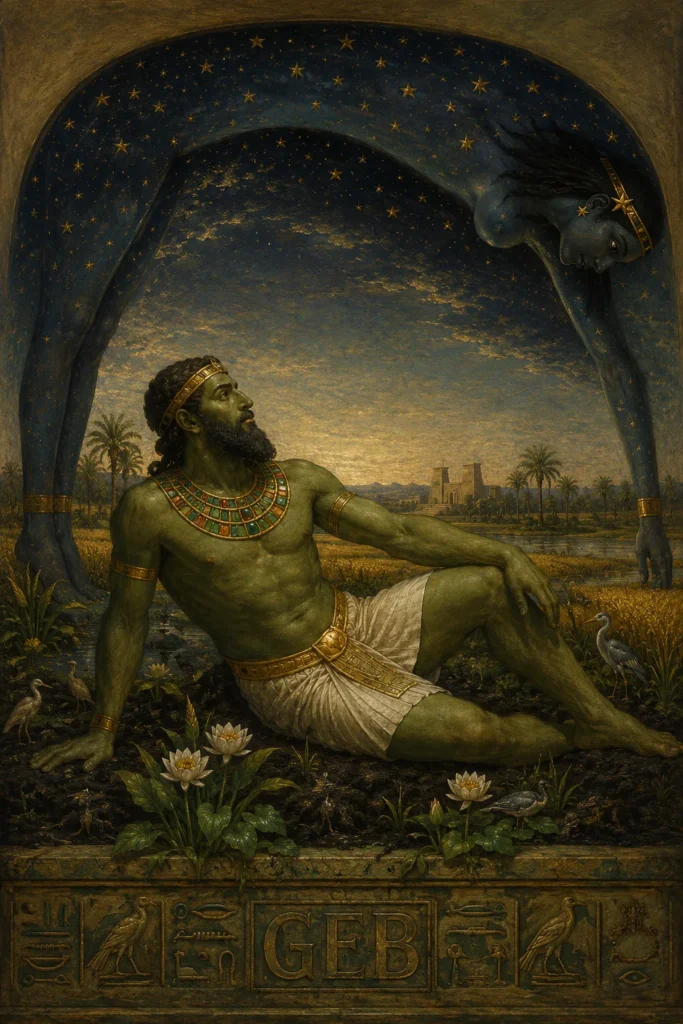
Profile: Geb
Geb: the most important aspects at a glance. The following fields summarise origin, function, appearance, veneration, symbols and parallels.
Egyptian earth god of the third generation of the Heliopolitan Ennead, son of Shu and Tefnut and grandson of the primeval god Atum. He is the consort of the sky goddess Nut and father of Osiris, Horus the Elder, Seth, Isis and Nephthys.
Geb is bearer of the inhabited land, whose power shows in the fertility of the fields and the growth of plants. The pharaoh sits on the “throne of Geb” and receives the royal dignity directly from the earth god. In the dispute between Horus and Seth, Geb acts as arbiter and decides for Horus.
Geb is usually shown as a man stretched out on the ground, touching plants, grain or the sign for “earth”; above him arches Nut, with Shu standing between. On his head he wears the hieroglyph of his name, a goose, or the white crown of Upper Egypt. Rarely he appears with green skin.
Geb had no single main centre and was worshipped in most temples as part of the Ennead, with chapels for example in Heliopolis, Memphis and Thebes. In the harvest festival he received the first sheaves of the new grain. In the temple of Edfu his birthday is recorded in the festival calendar.
His sacred animal is the Nile goose, which supplies the hieroglyphic sign for his name; in some temples sacred geese were kept and mummified. As “the Great Cackler” (gengen wer) he is linked with a cosmic egg from which the world is said to have been born.
In Greek and Roman antiquity Geb was usually identified with Cronus because both were regarded as old ancestors of the younger gods; Plutarch states this explicitly. The equation fitted only to a limited degree, since Cronus bears cannibalistic traits that are alien to Geb.
Myth and Genealogy
Geb is the son of Shu and Tefnut, hence the grandson of the primeval god Atum. In the Pyramid Texts and Coffin Texts this genealogy is firmly established: Atum brings forth Shu and Tefnut through self-generation; from their union come Geb and Nut.
In a mythical primordial time Geb (the earth) and Nut (the sky) embraced so closely that no air lay between them and no living space could come into being.
Shu, the father, stepped between the two and lifted Nut up, so that she was stretched out as the vault of heaven over the earth. Geb remained on the ground, outstretched with arms and legs, often depicted with an erection that symbolises his longing connection to the removed Nut.
From the union of Geb and Nut the five Osirian deities emerged: Osiris (on the first birthday), Horus the Elder (on the second), Seth (on the third), Isis (on the fourth) and Nephthys (on the fifth).
The five intercalary days of the Egyptian year (the epagomenal days) were considered the birthdays of these gods; on each of them a separate festival was celebrated. Plutarch («De Iside et Osiride» 12) preserves the account in one of the few surviving narrative versions.
Mythical narratives portray Geb in tension with his removed wife. One particular episode concerns the dispute between Geb and Shu over divine rule.
In the «Book of Felling Apophis» and in the theologically related tradition it is reported that Geb displaces his father Shu from rule and assumes the royal dignity over the earth himself; his epithets «hereditary prince of the gods» (rpa) and «king of the gods» reflect this mythical phase.
From this kingship of Geb the later Egyptian royal theology is derived.
A further narrative connects Geb with the violation of his mother Tefnut, mentioned in some texts; in the history of religions it may be a reflex of an old earth-father and earth-mother union that was genealogically restructured in Heliopolitan theology.
These darker mythical episodes lie in the background of the otherwise mostly peacefully depicted Geb. In the later tradition Geb is honoured mainly as a seated or reclining god of the inhabited land, whose power is experienced in the fertility of the fields and the growth of plants.
Symbols, Iconography and Attributes
Geb is usually depicted as an outstretched man on the ground, touching plants, grain or the hieroglyphic sign for «earth» (ta) with one or both hands. Above him stretches the figure of Nut as the arched, curved sky; between them stands Shu, who separates the mother from the father with raised arms.
This «Geb-Nut-Shu» configuration is one of the most common iconographic programmes of the Egyptian Books of the Dead and the coffin lids; this depiction is found on every high-ranking sarcophagus of the Late Period.
His sacred animal is the Nile goose, which provides the Egyptian hieroglyphic sign for his name. The goose was an ordinary domestic animal in Egypt, yet its connection with Geb gave it cultic prominence; in some temples sacred geese were kept and mummified after death.
The «great goose» (gengen wer), from which the cosmic world-egg idea emerged, is a theological variant: from the cosmic egg laid by Geb all beings came forth, which places the earth god in a cosmogonically prominent position.
On his head Geb usually wears the hieroglyph of his own name (a goose) or the White Crown of Upper Egypt. In some reliefs he wears the Atef crown, which underlines his royal dignity.
He rarely appears with green skin colour, indicating his connection with vegetation, although this colouring is otherwise reserved for Osiris and is rarely used for Geb. In the astronomical ceilings of the royal tombs Geb appears with stars or plant roots, which links his cosmic and vegetation-related dimension.
Sculpted images of Geb survive from the Old Kingdom onward. On the ceilings of the royal tombs of the Valley of the Kings (especially under Seti I and Ramesses VI) Geb appears in the typical reclining posture.
An important statue from the Late Period shows Geb seated with the Double Crown; it stands today in the Egyptian Museum Berlin.
On the coffin lids of the Late Period, especially of the Third Intermediate Period and the Saite Period, Geb is depicted with great detail; his body follows the line of the coffin lid, and on his chest he bears the spreading plants that the earth god brings forth from his body.
Cult and Veneration
The cult of Geb was indeed omnipresent in Egyptian religion, but it had no single main centre comparable to Heliopolis for Atum or Thebes for Amun. Geb was venerated in most temples as part of the Heliopolitan Ennead, set up in his own chapels and depicted in the theological programmes of the temple reliefs.
In Heliopolis Geb was an integral part of the Atum-Re cult. The Heliopolitan priesthood maintained the theological system of the Ennead, in which Geb held his fixed position. In the daily temple ritual Geb hymns were recited, in which the earth god was invoked as the bearer of the fertile soil and the growing plants.
An important hymn is preserved in the «harvest-offering texts», which are attested in inscriptions in the mortuary temple of Hatshepsut and in the Ramesside mortuary temples (Ramesseum, Medinet Habu).
At the coronation of the pharaoh Geb played a central role. The king stepped «onto the throne of Geb», which signified the ritual assumption of rule over the land.
This formula is attested in coronation inscriptions from the Old Kingdom onward and remained a fixed component of Egyptian royal terminology until the Roman imperial period. At burial the deceased king received an identification with Geb that marked his transition from earthly to otherworldly rule.
At the harvest festival, celebrated in Egypt between February and April, Geb received the first offerings of the first fruits. The farmers brought the earth god the first sheaves of the new grain; in some local cults Geb was identified with the harvest god Nepri, who was the specific personification of grain.
At the great festival processions of Thebes (Opet Festival, Valley Festival) Geb was carried along as part of the assembly of gods. In the Edfu temple his birthday is recorded in the festival calendar; it was observed with offerings and hymns.
Important Sanctuaries and Temples
Geb had no monumental main temples in the style of the great Amun or Ptah sanctuaries. His cult sites have so far been identified only fragmentarily in scholarship.
In Heliopolis Geb had a chapel within the Atum-Re temple, in Memphis a chapel within the Ptah temple, in Thebes a chapel within the Amun-Re complex.
In Edfu, in the great Horus temple, Geb is prominently represented in the theological pictorial sequences of the walls; a separate chapel, however, is not attested. In the mortuary temple of Seti I in Abydos Geb appears in the row of gods who bless the king.
In Dendera (temple of Hathor) Geb has his own wall scene, in which he touches the king with the life sign «ankh»; similar pictorial programmes are found in Philae and Esna.
In the Valley of the Kings the royal tombs of the Ramesside period show on their ceilings the reclining figure of Geb as earth god, above whom the arched Nut stands.
These ceiling depictions are the most impressive Geb images of Egyptian art. In the tomb of Seti I (KV 17) the ceilings are especially detailed; Geb appears there in the fully figured pose with plants growing out of his body.
In the Hibis temple of the Kharga Oasis there is a detailed pictorial cycle depicting the Ennead of Heliopolis; Geb holds a central position here. The inscriptions and reliefs are among the theologically most ambitious of the Late Period.
In the Esna temple and in the temple of Kom Ombo Geb is likewise represented in the theological programmes, though without an independent chapel character. Geb’s significance lay less in dedicated cult centres than in his cosmic and genealogical function within the network of gods.
Mythical Narratives
The most important mythical episode of Geb is the separation from Nut. In the Coffin Texts and in the Book of Day and Night the separation is described in detail: Shu, the father of Geb and Nut, steps between the two tightly embracing siblings and lifts Nut up with both arms.
With this the living space between earth and sky comes into being, which makes creation possible in the proper sense. Geb remains on the ground, often with an erection or with outstretched arms, and tries to reach Nut. This narrative is considered one of the oldest world-separation myths of humanity.
The birth of the five Osirian deities is another central narrative. Re had decreed that Nut should give birth on no day of the year. Thoth, the cunning god of writing, however, won five additional days in a game with the moon that did not count toward the normal year.
On these five intercalary days Nut bore in succession Osiris, Horus the Elder, Seth, Isis and Nephthys. This birth of the Osirian deities is the mythical foundation of the five «epagomenal days» of the Egyptian calendar, which were celebrated as the birthdays of the gods.
A dark mythical episode concerns the dispute between Geb and his son Seth. After the death of Osiris, Horus inherits the royal dignity, but Seth contests this claim. Geb, as father and grandfather of the disputing gods, takes on the function of an arbiter.
In the «Contendings of Horus and Seth» (Papyrus Chester Beatty I), a long narrative from the Ramesside period, Geb is one of the gods who direct the proceedings; in the end he decides in favour of Horus.
With this Geb becomes the founder of the pharaonic royal succession, which passes through Horus to the human pharaohs.
In the Book of the Dead it is said of the deceased that he has «come forth from the body of Geb». This formula makes Geb the origin of all earthly beings and places the deceased in the cosmic line from Atum through Shu and Tefnut to Geb and thereby to creation itself.
In the burial rituals the deceased was identified with Geb, which was intended to ease his transition into the land of the dead.
This identification is noteworthy in the history of religions because it makes the earth god the guarantor of resurrection: whoever comes from the earth returns to the earth in order to come forth from it anew.
Relationships in the Pantheon
Geb is closely embedded in the genealogical web of the Heliopolitan Ennead. With Nut, his sister and wife, he is linked by the cosmic separation; their five children are the central Osirian deities.
With Shu, his father, there exists the relationship of mythical separation; from this separation arises the living space in which the human world exists. With Tefnut, his mother, some texts attest a marriage-like relationship that is, however, suppressed in the main Heliopolitan line.
With Osiris, Geb has a special relationship as father. Osiris inherits royal dignity over the earth from Geb; after Osiris’s death and his transition into the underworld the royal dignity passes to his son Horus.
This genealogical line from Geb through Osiris to Horus forms the mythical model of the pharaonic royal succession. With Seth there is an ambivalent relationship: Seth is Geb’s son, yet his behaviour against Osiris brings him into conflict with the paternal line; Geb ultimately sides with Horus.
With Re, Geb has a theological relationship. Re had forbidden Nut to give birth on any regular day of the year; through Thoth’s cunning this decree was circumvented.
In later texts Re is presupposed as the highest god, to whom Geb too is subordinate; yet Geb retains the function of the earth god and ancestor of the Osirian deities. With Nepri, the god of grain, and with Renenutet, the snake goddess of the harvest, Geb has functional connections that underline his fertility aspects.
Reception
In Greco-Roman antiquity Geb was usually identified with Kronos, because both were considered old ancestors of the younger gods. Plutarch («De Iside et Osiride» 12) names this identification explicitly.
The identification with Kronos was, however, not entirely felicitous, because Kronos in the Greek tradition also bears cannibalistic traits that are wholly foreign to Geb. In the Hellenistic temple texts of Edfu, Dendera and Philae Geb was retained in his Egyptian designation; a complete Hellenisation did not take place.
In the Hermetic writings Geb is occasionally treated as an aspect of the personified earth. The magical papyri and the amulets of the Late Period use invocations of Geb for purposes of protection and healing; in particular in fertility rituals and in illnesses connected with the earth, Geb was invoked.
The image of the reclining earth god with the growing plants survived as a pictorial motif in the Coptic popular tradition, without the name Geb being explicitly carried on.
The modern rediscovery of Geb begins with Champollion’s decipherment of the hieroglyphs. In the nineteenth century Heinrich Brugsch analysed the Geb hymns; in the twentieth century Adolf Erman, Hermann Grapow, Hans Bonnet and Erik Hornung systematically grasped the theological position of Geb.
The more recent research of James P. Allen («Genesis in Egypt», 1988) and Jan Assmann («Ägypten», 1984) reassessed Geb as a model case of the cosmic earth god and emphasised his significance for Egyptian royal theology.
In modern popular culture Geb is present in the novels of Christian Jacq and in the computer game series «Assassin’s Creed Origins».
Religious-Studies Classification
Geb belongs to the category of earth gods, who in many religions represent the personified solid world. Striking in the history of religions is his gender assignment: while in most religions the earth is conceived of as female (Gaia in Greece, Pṛthivī in India, Hou Tu in China), in Egypt it is male.
This is one of the remarkable peculiarities of Egyptian theology and stands in structural kinship with the Anatolian and Nordic religions, in which the earth is occasionally assigned a male character.
The Egyptian configuration of the cosmic siblings (Geb-earth, Nut-sky) and their separation by the father Shu is unique in the history of religions. It reverses the widespread model of the heavenly father and the earth mother and makes the sky the female and the earth the male half of the cosmic pair.
The theologians of the Egyptian Late Period consciously reflected on this peculiarity and emphasised it explicitly in the hymns; it links Egyptian religion with a matrilineal substrate that may have played a role in the early period of the Nile valley.
Henri Frankfort, in «Kingship and the Gods», analysed the «throne of Geb» formula as a model case of Egyptian royal theology. The pharaoh sits not on an abstract or constructed throne, but on the concrete divine body of the earth god; thereby royal rule is grounded cosmically and not merely politically.
Erik Hornung, in «Conceptions of God», emphasised the function of Geb as «father of the Osirian deities» and thereby also grasped the position of Geb in the afterlife-oriented religion of the Egyptians.
The more recent comparative-religious research has found in Geb an important point of comparison for the discussion of the gendered coding of the earth; the Egyptian model shows that «Mother Earth» is not a universal idea but a culturally variable construction.
Sources
Pyramid Texts, especially Spell 222 and 369 (Geb as father of the king). Coffin Texts and Book of the Dead, especially Spell 7 and 17. «Book of Day and Night», edition Hornung.
Contendings of Horus and Seth (Papyrus Chester Beatty I), edition Alan Gardiner. Plutarch, «De Iside et Osiride» 12. Diodorus, «Bibliotheke historica» I, 13. Henri Frankfort, «Kingship and the Gods.
A Study of Ancient Near Eastern Religion as the Integration of Society and Nature», Chicago 1948. Erik Hornung, «Der Eine und die Vielen», Darmstadt 1971. Erik Hornung, «Conceptions of God in Ancient Egypt.
The One and the Many», Ithaca 1982. Jan Assmann, «Ägypten. Theology and piety einer frühen Hochkultur», Stuttgart 1984. James P. Allen, «Genesis in Egypt. The Philosophy of Ancient Egyptian Creation Accounts», New Haven 1988.