Vrykolakas and the call at the nocturnal door
By Ralf Ittermann · last reviewed on
Vrykolakas is a demon from modern Greek folklore.
The bloated corpse that knocks at doors and calls out at night. This profile is devoted to the call at the nighttime door. Vrykolakas is the Greek undead, and the entry shows what beliefs about the afterlife of the dead lie behind it.
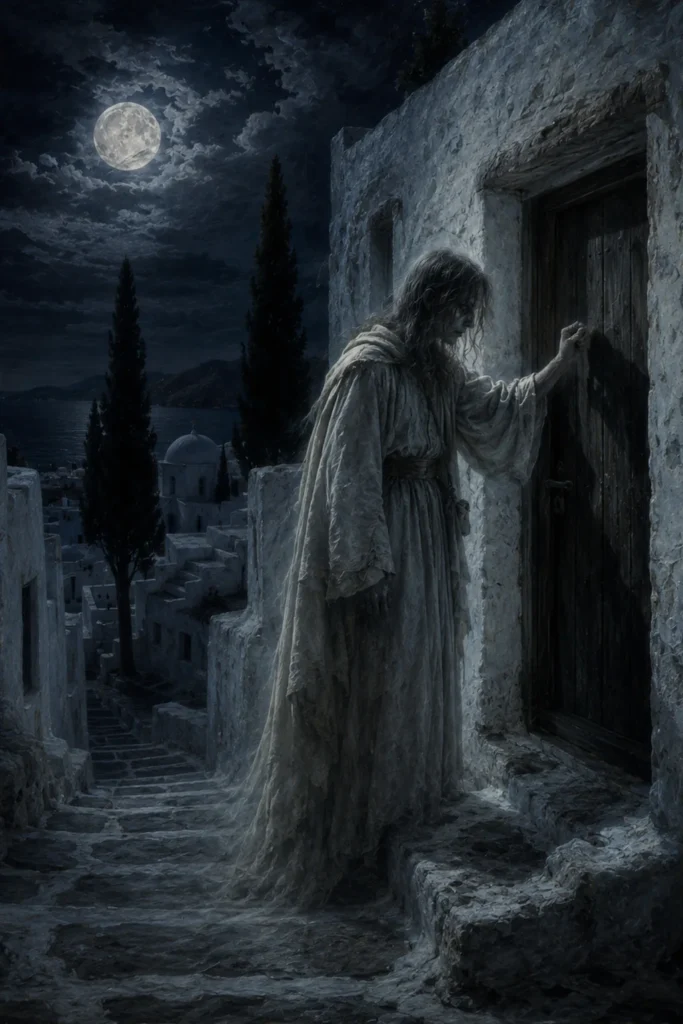
In modern Greek folk belief, the Vrykolakas is the undead revenant par excellence: a bloated, undecayed corpse that rises from the grave at night, knocks on doors and calls out names. Whoever answers first dies, according to the rule, which is why one never opened the door immediately in threatened households.
Unlike the Western European vampire, the Vrykolakas only rarely drinks blood. As a Greek undead, it spreads mainly illness and death through the village, and its origin is closely linked to ecclesiastical excommunication: according to Orthodox belief, a corpse excluded by the Church does not decay and becomes a Vrykolakas.
Type: Bloated, undecayed revenant corpse
Origin: Modern Greek tradition, widespread on the Greek islands
Texts: Well documented, including through Tournefort’s travel account of 1717
Period: Widely attested from the 17th and 18th centuries onward
Appearance: taut, dark-reddened corpse with long nails
Context of the tradition
Period of the Texts
Widely documented from the 17th and 18th centuries onward in modern Greek tradition, with Tournefort’s travel account as an early key testimony.
Area of Diffusion
Greece, especially the Greek islands, as well as the wider Balkan-Orthodox region.
Sources
Good: travel accounts such as that of Joseph Pitton de Tournefort from 1717, as well as the classic studies by Summers, Barber and Perkowski.
Name and variants
Greek: The name Vrykolakas derives from the Slavic vukodlak, wolf’s fur or werewolf, an original werewolf word that took on the meaning of the returning undead in Greek.
Form and effect
Appearance
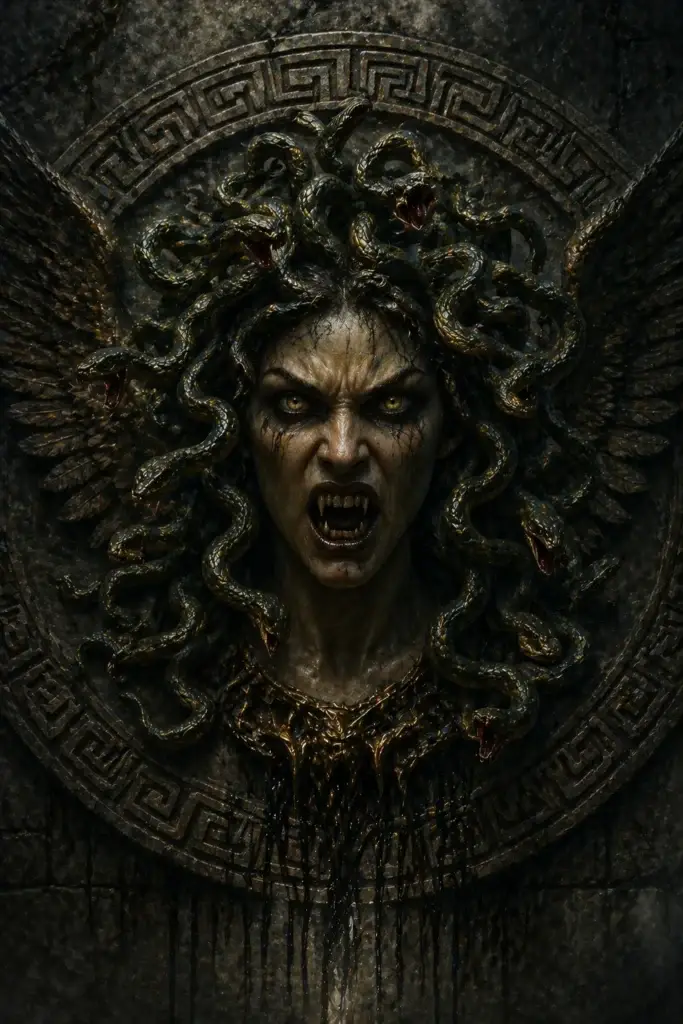
The Vrykolakas appears as a taut, undecayed corpse with dark purplish-red skin, gleaming eyes and long nails. The absence of decay was seen as proof of its unholy state.
Effect
It spreads illness and death, torments families and presses down on sleepers, and only rarely drinks blood as the Western European vampire does. Its nocturnal call at the door is feared: whoever answers the first knock dies, which is why the rule was never to open immediately.
Profile: Vrykolakas
The key aspects of the Greek undead at a glance.
Modern Greek, Orthodox-influenced revenant belief, closely linked to the notion of excommunication and bad death.
The whole village community and one’s own family: the Vrykolakas threatens not only individuals but spreads plagues throughout the entire settlement.
Bloated, darkly reddened corpse with shining eyes and long nails, outwardly undecayed.
Bringer of plague: its nightly call at the door and its wandering spread disease and death through the village.
Exhumation and examination of the suspect, church absolution by a priest, and, in emergencies, burning the corpse.
Excommunication and the undecayed corpse
The name Vrykolakas derives from the Slavic vukodlak, wolf pelt or werewolf, an original werewolf term that in Greek took on the meaning of the returning undead. The transformation was thought to be caused by a godless way of life, excommunication by the church, burial in unconsecrated ground, or eating the meat of a sheep killed by a wolf.
Central to this is the Orthodox belief that an excommunicated corpse does not decay and becomes a Vrykolakas. A key piece of evidence is the travel account of the naturalist Joseph Pitton de Tournefort, who in early 1701 described an exhumation on Mykonos in which the islanders identified a suspect as a Vrykolakas.
One of Europe's oldest vampire cases
The Vrykolakas is one of the oldest documented vampire cases in Europe, recorded in the Tournefort report. Through the Balkan vampire scare it entered Western vampire lore; the word’s kinship with the Slavic vukodlak is cited in Dracula research as evidence of the merging of werewolf and vampire belief.
From the perspective of religious studies, the Vrykolakas is a classic case of the bad death and the restless dead. The Orthodox doctrine of excommunication gives it a church-institutional framing that sets it apart from purely rural folk belief: the church itself can bind or release the dead.
Exhumation, absolution and the wax cross
Well attested in sources are the exhumation and examination of the suspect, along with the correct church absolution by a priest, which releases the excommunicated dead. If this did not help, a wax cross and a shard of pottery inscribed Jesus Christ conquers were laid on the corpse, or people resorted to staking it. On the islands, where reburial in unconsecrated ground was not possible, the corpse was burned as a last resort. In addition, as elsewhere in the Orthodox Balkans, holy water was regarded as a sign of church release, salt at the threshold and branches of rowan at the entrance served as further protective means against the wandering dead.
From werewolf word to revenant relative
The Vrykolakas is directly related by name to the South Slavic Vukodlak and stands alongside the Romanian undead Strigoi and Moroi as well as the West Slavic Upiór. As a restless dead being it is also comparable to the Germanic Nachzehrer and the Nordic Gjenganger.
Frequently asked questions about the Vrykolakas
Is the Vrykolakas a vampire or a werewolf?
Linguistically, its name derives from the werewolf word vukodlak, yet functionally it is an undead revenant of the vampire type. As a Greek vampire, it thus unites two ideas in a single name.
Does it drink blood?
Not necessarily. It mainly spreads disease and death, knocks on doors, calls out names, and suffocates sleepers; blood-drinking is only a rarer secondary form.
How does one get rid of it?
Through exhumation, the correct church absolution, and in emergencies the burning of the corpse, as described in the Tournefort report from Mykonos.
Further links
Literature (selection)
Further standard works in the bibliography.
As a Greek undead being and Greek vampire at once, the Vrykolakas remains above all one thing: the dead that calls before it kills, and whose grip only the church itself can loosen again.