Rūaumoko, the unborn child who shakes the earth
By Ralf Ittermann · last reviewed on
Rūaumoko is a god of the Maori tradition of Polynesia.
The unborn child whose movements shake New Zealand. The account describes how the restless unborn child shakes the ground whenever he stirs beneath New Zealand.
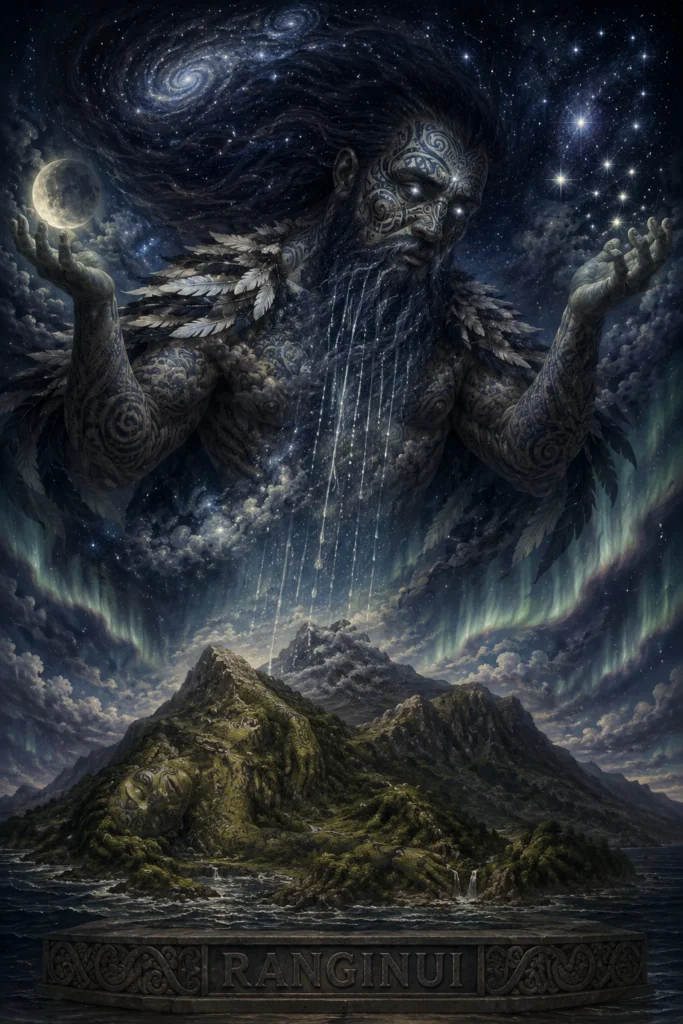
Rūaumoko, in simplified spelling Ruaumoko, is the Maori god of earthquakes and volcanoes, the youngest, unborn child of the primal parents Ranginui, the sky, and Papatūānuku, the earth. His movements within the body of the earth cause earthquakes and volcanic eruptions.
He is not the fire god, that role belongs to Mahuika and Auahitūroa, but the god of the shaking, fire-spewing earth; the modern Maori word rū for earthquake derives from his name.
Type: God of earthquakes and volcanoes
Origin: Maori tradition, youngest child of Ranginui and Papatūānuku
Texts: ethnography by Best, encyclopedia Te Ara
Period: Maori tradition through to modern institutions
Appearance: invisible within the body of the mother, no fixed everyday form

Tradition and source situation
Period of the Texts
Maori tradition, documented ethnographically by Elsdon Best and in the encyclopedia Te Ara; the reception extends into modern New Zealand institutions.
Area of Diffusion
New Zealand: as an interpretation of the country’s real earthquakes and volcanic eruptions, Rūaumoko belongs to the whole of Maori cosmology.
Sources
Well documented: Maori ethnography by Best, the encyclopedia Te Ara and Orbell’s illustrated encyclopedia of Maori myths.
Name and variants
Maori: rū means to shake; the modern Maori word for earthquake derives from the god’s name. The rest of the name cannot be reliably derived.
Form and sphere of influence
Appearance
Rūaumoko remains invisible within the body or at the breast of Mother Earth; there is no fixed everyday form, though modern carvings suggest his presence. He embodies the earth shaking from within and spewing fire.
Effect
His movements cause earthquakes and volcanic eruptions, and at times are also linked to the change of seasons. He is not malicious, yet he is the cause of real, life-threatening natural events.
Profile: Rūaumoko
The most important aspects of the earthquake god at a glance.
Youngest, unborn child of the primal parents Ranginui and Papatūānuku; belongs to the circle of children of Rangi and Papa, which also includes the storm god Tāwhirimātea.
People as those affected by quakes and eruptions: every movement of the god within the body of the earth can be felt on the surface.
Invisible within the body of Mother Earth, without a fixed everyday form; modern carvings suggest his presence, nothing more.
Causes earthquakes and volcanic eruptions, and at times also the change of seasons; for warmth he received the fire te ahi kōmau.
Hardly any formal cults: earthquakes were interpreted as his movements and met with reverence and karakia, prayer formulas.
The Hawaiian volcano goddess Pele, the storm god Tāwhirimātea as brother, and typologically the Japanese earthquake catfish Namazu.
The child who stayed with his mother
When the primal parents Ranginui and Papatūānuku were separated, Rūaumoko, as an infant, stayed with his mother and was carried with her into the underworld; for warmth he received fire, the te ahi kōmau. Since then, his movements within the body of the earth have caused earthquakes and volcanic eruptions, and he is also sometimes credited with the change of seasons.
Thus Rūaumoko is the very reason New Zealand’s earth trembles: the modern Maori word rū for earthquake derives from the god’s name. A regional variant tells that he creates volcanoes out of anger; however, the core of the tradition is the unborn child whose movements shake the surface.
From myth to earthquake authority
Rūaumoko has been strongly received: the word rū for earthquake derives from him, and institutions such as the earthquake authority and the national museum Te Papa draw on him. A crater on Jupiter’s moon Io bears the name Ruaumoko Patera.
From the perspective of religious studies, Rūaumoko is a prime example of interpreting earthquakes and volcanism as the movements of an unborn earth god. It is important to clarify that he is not the fire god, that role belongs to Mahuika and Auahitūroa, but rather the god of the shaking earth; the variant in which he creates volcanoes out of anger is regional.
Karakia and reverence
Formal cults are barely documented for Rūaumoko. Earthquakes were interpreted as his movements and met with reverence and karakia, prayer formulas; an institutionalised system of offerings has not been recorded. Dealing with the god was thus primarily a matter of attitude: whoever felt the ground shake knew whose movement they were experiencing, and responded with spoken words rather than gifts.
Shaking earth in other cultures
Rūaumoko is closely related to the Hawaiian volcano goddess Pele; typologically, without historical connection, he can be compared with volcano and earthquake figures such as the Japanese earthquake catfish Namazu. Within Maori cosmology he belongs to the children of Rangi and Papa, alongside the storm god Tāwhirimātea; the fire side of the tradition is occupied by Mahuika and Auahitūroa.
Frequently asked questions about Rūaumoko
Who is Rūaumoko?
The Maori god of earthquakes and volcanoes, the youngest, unborn child of sky and earth.
Why does the earth shake?
Because Rūaumoko moves within the body of Mother Earth; the modern Maori word rū for earthquake derives from his name.
Is he the fire god?
No. The fire deities are Mahuika and Auahitūroa; Rūaumoko is the god of the shaking, fire-spewing earth.
Further links
Further reading:
- Tāwhirimātea – the storm god from the circle of the children of Rangi and Papa
- Pele – the Hawaiian volcano goddess as a parallel
- Mahuika, Auahitūroa – the fire deities of the Maori
- Amulet, protective candle, salt – recommended protective means
- Protection Compass – overview of protective means
Literature (selection)
Further standard works in the bibliography.
For the Maori, Rūaumoko is god of earthquakes and, at the same time, the volcano god of New Zealand: not an enemy of humanity, but the unborn power whose movements still echo today in the word rū for every quake.