Bergmönch, the giant mine spirit of the miners
By Ralf Ittermann · last reviewed on
The Bergmönch is a spirit of German mining legend.
He rewards pious miners and punishes those who curse underground.
The Bergmönch, also called Meister Hämmerling in the primary text, is a giant mountain and mine spirit of the miners: a giant in a black monk’s habit with glowing eyes and a miner’s lamp. He rewards pious, poor miners and punishes greed, lying and, above all, cursing and whistling underground.
He is attested in the Harz, the Ore Mountains, Saxony and Graubünden, from Georgius Agricola in 1549 through Praetorius to the collections of the Brothers Grimm and Bechstein. He acts fatally through poisonous breath, tunnel collapses and firedamp explosions.
Type: Giant mountain and mine spirit with a dual nature
Origin: Central German ore mining, legendary tradition
Texts: Agricola (1549), Praetorius (1666), Grimm (1816), Bechstein
Period: 16th to 19th century (attestations)
Appearance: Giant in a black monk’s habit with glowing eyes and a miner’s lamp

Sources and attestations
Period of the Texts
The attestations range from Agricola in 1549 through Praetorius in 1666 to the Brothers Grimm’s Deutsche Sagen from 1816 and Bechstein.
Area of Diffusion
Harz, the Ore Mountains, Saxony and Graubünden: the landscapes of historical ore mining.
Sources
Good: Agricola, Praetorius, Grimm and Bechstein attest to the figure across three centuries.
Name and variants
Origin of the name: Monk in the mountain, named after his appearance as a giant in a black habit. In Grimm, Meister Hämmerling is a synonym for the mountain spirit; the name refers to hammer and mining and served as a folk nickname for the devil.
Appearance and dual nature
Appearance
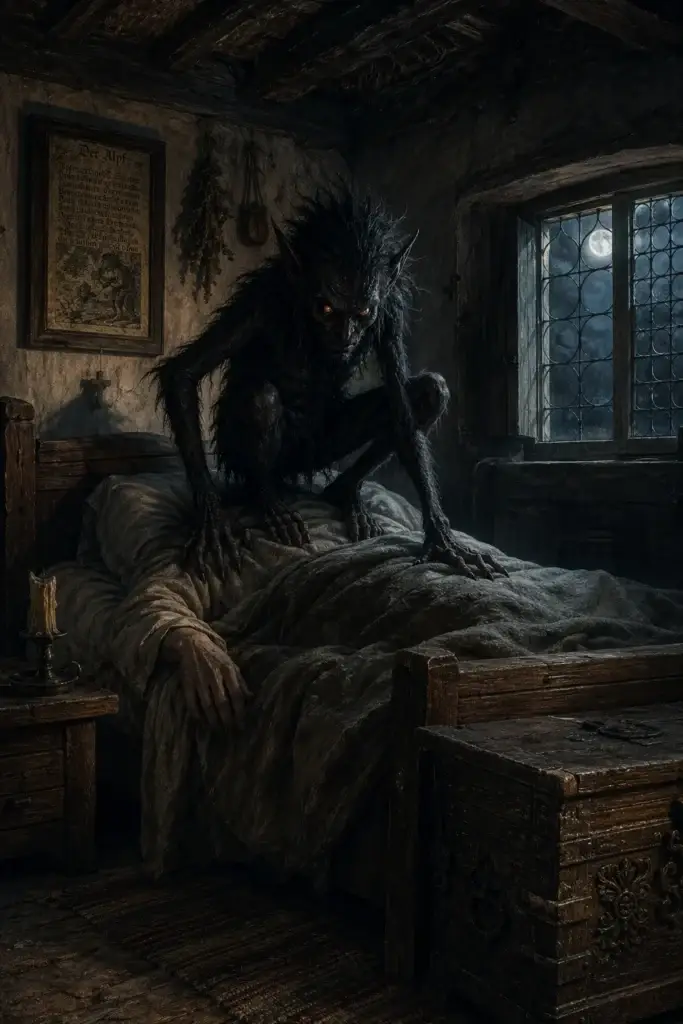
The Bergmönch is a giant in a black habit, stooped, with eyes like plates and fiery; the glowing eyes are a recurring motif, and he carries a miner’s lamp. He changes shape and also appears as a miner with a silver lamp or as a horse with fiery eyes.
Effect
The Bergmönch has a dual nature: he rewards pious, poor miners, gives them ore and refills the oil of their lamp, and punishes greed, lying and, above all, cursing and whistling underground. He acts fatally through poisonous breath, tunnel collapses and firedamp explosions; he is a solitary being of the giant type, not to be confused with the swarming goblin-like mine spirits.
Profile: Bergmönch
The key aspects of the mine spirit at a glance.
Mountain spirit of Central German ore mining, passed from Agricola and Praetorius into the collections of Grimm and Bechstein.
Miners underground: the Bergmönch watches over conduct and attitude in the mine, from honest sharing to the ban on whistling.
Giant in a black monk’s habit, stooped, with eyes like plates and fiery, carrying a miner’s lamp; also appearing as a miner with a silver lamp or as a horse with fiery eyes.
Reward and punishment: gifts of ore and refilled lamp oil for the pious, poisonous breath, tunnel collapses and firedamp explosions for mockers and those who curse.
Behaviour-based: no cursing, whistling or mocking underground, along with piety and honest sharing; offerings are generally recorded for this type of mountain spirit.
From Agricola to the Grimms: the path of the legend
Bergmönch means monk in the mountain, referring to his appearance as a giant in a black habit. Meister Hämmerling is a genuine synonym in the primary text, as in Grimm, where the mountain spirit, Meister Hämmerling, is commonly called Bergmönch; Hämmerling refers to hammer and mining and is a folk nickname for the devil.
The Bergmönch is attested in the Harz, the Ore Mountains, Saxony and Graubünden, by the Brothers Grimm, by Bechstein and by Georgius Agricola, whose 1549 work on subterranean creatures stands at the beginning of the scholarly tradition. From Agricola and Praetorius the figure passed back into legend and the great collections of the 19th century.
Opera, collection and classification
From Agricola and Praetorius the Bergmönch passed back into legend and the collections of Grimm and Bechstein; in 1824 Louis Spohr wrote the opera Der Berggeist. In some cases the figure was diabolised into the mountain devil.
From a religious-studies perspective, the Bergmönch is a classic example of the ambivalent mine spirit, whose danger depends on one’s own behaviour. Important clarifications: Meister Hämmerling is not a confusion but is firmly attested in the primary sources. The Harz is a low mountain range, not a high mountain range; the legend belongs to Central German ore mining. And the Bergmönch is not to be equated with the goblin-like little mine spirits.
Conduct instead of amulet
Protection against the Bergmönch is behaviour-based: no cursing, whistling or mocking underground, along with piety and honest sharing. Offerings such as food, a lamp or a little red coat are generally recorded for this type of mountain spirit; the sources do not name specific amulets or banishing formulas. Anyone who behaves correctly underground has nothing to fear from the Bergmönch and may even hope for his gift of ore.
Rübezahl, Knocker and mine goblins
The Bergmönch stands alongside Rübezahl and the dwarfish, sociable little mine spirits and mine goblins, who as swarming beings are clearly distinct from the solitary giant, as well as alongside Knappenmandl, Skarbnik and the gnomes of Paracelsus. Internationally, the Welsh Coblynau and the Knocker of the tin mines are the closest relatives of this type of mine spirit; as a solitary giant he also has affinities with the Troll of the North.
Frequently asked questions about the Bergmönch
Who is the Bergmönch?
A giant mountain and mine spirit of the miners, also called Meister Hämmerling.
Whom does he reward and whom does he punish?
He rewards pious, poor miners and punishes greed, lying, cursing and whistling underground.
Is Meister Hämmerling a mistake?
No. The synonym is firmly attested in the primary sources of the Brothers Grimm.
Further links
Further reading:
- Germanic – all beings of the Germanic tradition
- Knocker, Coblynau – related mine spirits
- Protective candle, Amulet, Salt – traditional protective means
- Protection Compass – an overview of protective means
Literature (selection)
Further standard works in the bibliography.
As a mountain spirit of the Harz and the Ore Mountains, the Bergmönch, also called Meister Hämmerling in the sources, embodies the old morality of the mine: he lights the way for those who share honestly and do not curse; those who mock are struck by the mountain itself.