Jowang, the Goddess of the Water Bowl
By Ralf Ittermann · last reviewed on
Jowang is a goddess of Korean tradition.
The hearth goddess, embodied in a bowl of pure water.
Jowang is the Korean hearth and kitchen goddess, one of the female household gods, the Gasin. She has no cult image of wood or stone: she is embodied in a daily renewed bowl of pure water placed on the hearth.
As goddess of fire and the hearth, she protects the kitchen, wards off the danger of fire, and promotes prosperity and moral order. Her cult is considered very old and belongs to Muism, Korean shamanism, and to female household religiosity; it is documented in its most differentiated form in southern Korea and on Jeju.
Type: Hearth and kitchen goddess, one of the Gasin
Origin: Korean folk belief, Muism
Texts: Shamanic bonpuri songs, including the Munjeon-bonpuri, Korean folklore
Period: ancient folk belief, practised into modern times
Appearance: bowl of pure water on the hearth, no cult image
Region of origin and sources
Period of the Texts
The cult is considered very old and belongs to ancient Korean folk belief; it is part of Muism and female household religiosity.
Area of Diffusion
Korea, especially the south and the island of Jeju, where the Jowang cult is documented in its most differentiated form.
Sources
Well documented by Korean folklore studies, from Kendall’s fieldwork to the Encyclopedia of Korean Folk Beliefs.
Name and variants
Sino-Korean: The name Jowang derives from the characters for hearth-king, the same as those used for the Chinese Zao Wang. Jowang is the Korean reading of the same word, thus a Sino-Korean loanword.
Nature and effect
Appearance
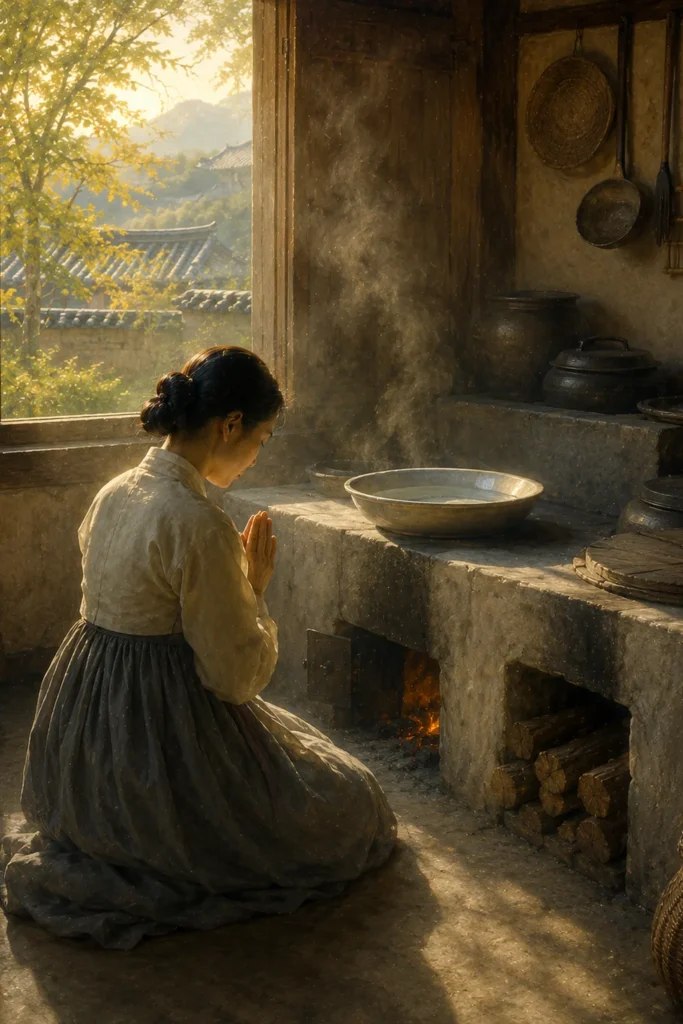
Jowang is not a statue. She is embodied in a bowl of pure water, the Jeonghwasu, well water freshly drawn at daybreak, which stands on the masonry cooking bench above the hearth and is renewed daily.
Effect
Jowang is the goddess of fire and the hearth; she protects the kitchen, wards off the danger of fire, and promotes prosperity and moral order. A motif of ascending to heaven on the 23rd day of the 12th month is present, but noticeably weaker and less ritualised than in the case of the Chinese Zao Jun; in Korea it is expressed mainly as a system of behaviour and taboos, such as not cursing at the hearth or sitting on it.
Profile: Jowang
The key aspects of the hearth goddess at a glance.
One of the Gasin, the Korean household gods, and part of Muism; her cult is the domain of female household religiosity.
Kitchen and household: Jowang protects the hearth and fire, wards off the danger of fire, and watches over prosperity and moral order.
No cult image, but a bowl of pure water, the Jeonghwasu, on the cooking bench above the hearth, renewed daily at daybreak.
Hearth and fire, together with a taboo system of respect: no cursing at the hearth, no sitting on it.
The housewife fetches fresh water at daybreak, fills the bowl and prays; festive offerings are rice cakes and fruit.
From Hearth-King to Water Bowl
The name Jowang derives from the characters for hearth-king, the same as those used for the Chinese Zao Wang; Jowang is the Korean reading of the same word, a Sino-Korean loanword. The cult itself is considered very old, especially in the south and on Jeju, where it is documented in its most differentiated form.
It was carried by female household religiosity within Muism: veneration of the hearth goddess lay in the hands of the housewife, not a priesthood. The origin myth is the Jeju narrative song Munjeon-bonpuri, in which the revived wife Yeosan Buin becomes the kitchen goddess.
Afterlife and interpretation
Jowang is scarcely a living cult anymore; she remains present through the shamanic bonpuri songs and folkloric scholarship.
From a religious-studies perspective, Jowang is a benevolent hearth and kitchen goddess. Important clarifications: the best assessment is syncretism, not simple borrowing, for the name and the reporting motif are Chinese, while the elaboration with the water bowl and women’s cult is distinctly Korean. Bribing with sweets is primarily Chinese. And Jowang is predominantly female, though under Buddhist-Chinese influence sometimes recast as male.
Water, Prayer, and Hearth Taboos
The cult of Jowang is the domain of female household religiosity: the housewife fetches fresh well water at daybreak, fills the bowl on the cooking bench, and prays. At festivals, rice cakes and fruit are offered. Added to this is the taboo system of the hearth: whoever curses at the hearth or sits on it violates the goddess’s domain. The daily renewed water bowl, the Jeonghwasu, is at once a form of worship and a symbol of purity.
Hearth Deities Compared
Jowang corresponds to the Chinese Zao Jun, whose name she adopts, the Japanese Kojin and Kamado-gami, the Vietnamese Ong Tao and the Ainu fire goddess Kamuy-huci; typologically, the Greek Hestia and the Roman Vesta stand alongside her. Within the Gasin, she belongs, together with Seongju and Eopsin, to the Korean system of household gods.
Frequently asked questions about Jowang
What is Jowang?
The Korean hearth and kitchen goddess, embodied in a bowl of clean water on the stove. She belongs to the Gasin, the household gods of Korean folk belief.
How was she worshipped?
The housewife drew fresh water at daybreak, filled the bowl and prayed; at festivals, rice cakes and fruit were added as offerings.
Is Jowang the same as the Chinese Zao Jun?
The name and the reporting motif are borrowed, but the form taken is distinctly Korean: the water bowl and the cult led by women have no equivalent in the Chinese kitchen god.
Further links
Further reading:
- Korea – all beings of the Korean belief world
- Seongju, Eopsin – the other major Gasin
- Zao Jun – the Chinese kitchen god who gave Jowang her name
- Holy water, Salt, Amulet – traditional protective means
- Protection Compass – an overview of protective means
Literature (selection)
Further standard works in the bibliography.
As the Korean hearth and kitchen goddess, Jowang represents a quiet form of piety: no temple, no image, only a bowl of fresh water refilled every morning.