Qutrub, the restless one between graves and madness
By Ralf Ittermann · last reviewed on
The Qutrub is a demon of Arabian tradition.
The restless demon of the graveyards, between ghoul and werewolf. Fits of madness and nocturnal graveyard haunting are both attributed to the Qutrub.
The Qutrub is a restless demon of classical Arabian tradition, often translated as an Arabian werewolf and related to the ghoul. At night it threatens people at graveyards and desecrates corpses.
The name primarily conveys restlessness and covers three levels of meaning: the demon, a grammarian of the Basra school, and a melancholic mental illness. This complexity makes the Qutrub one of the most unusual figures in Arabian demonology.
Type: Restless demon that haunts graves, related to the ghoul
Origin: Old Arabian folk tradition
Texts: Ibn Durayd, medical literature, Ullmann
Period: classical Arabic, Abbasid
Appearance: werewolf-like or dog-like
Context of Tradition
Period of the Texts
Classical Arabic and Abbasid: the demon is Old Arabian folk tradition and is attested early in Ibn Durayd, died 933.
Area of Diffusion
Arabia: the Qutrub belongs to the demonic landscape of the peninsula, with graveyards as its preferred domain.
Sources
Well documented: Ibn Durayd’s Jamharat al-Lugha, the medical literature, and the studies of Ullmann and Metzger.
Name and variants
Arabic: qutrub, a restless small animal that never rests, lexically a field mouse, owl or water insect. Three registers must be distinguished: the demon, the grammarian Qutrub, a philologist of the Basra school, died 821, and the medical term for a melancholic mental illness.
Description
Appearance
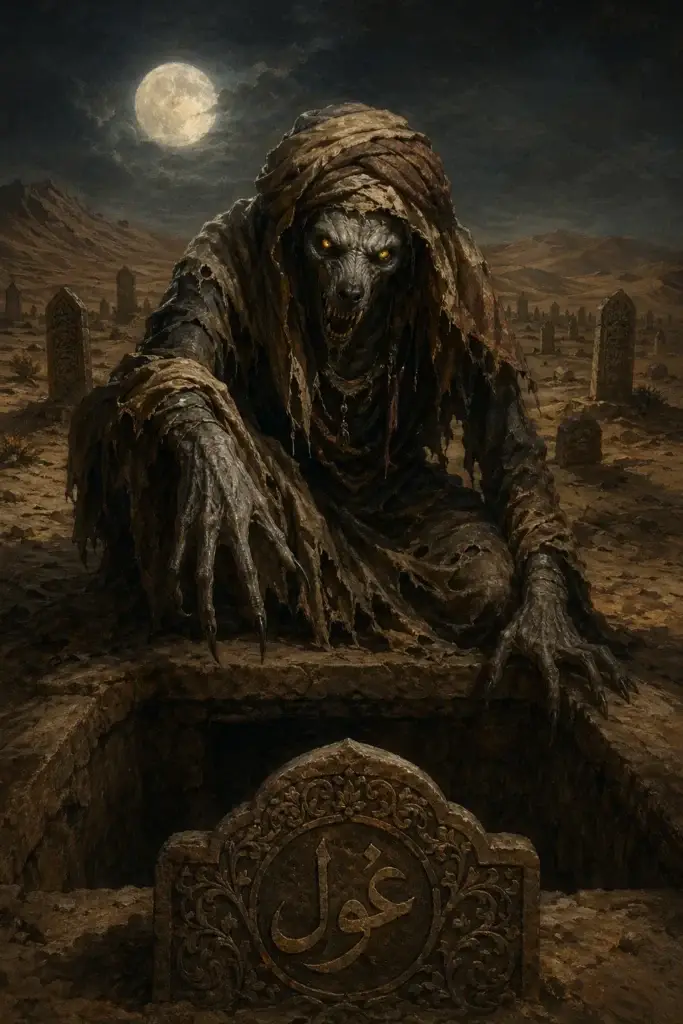
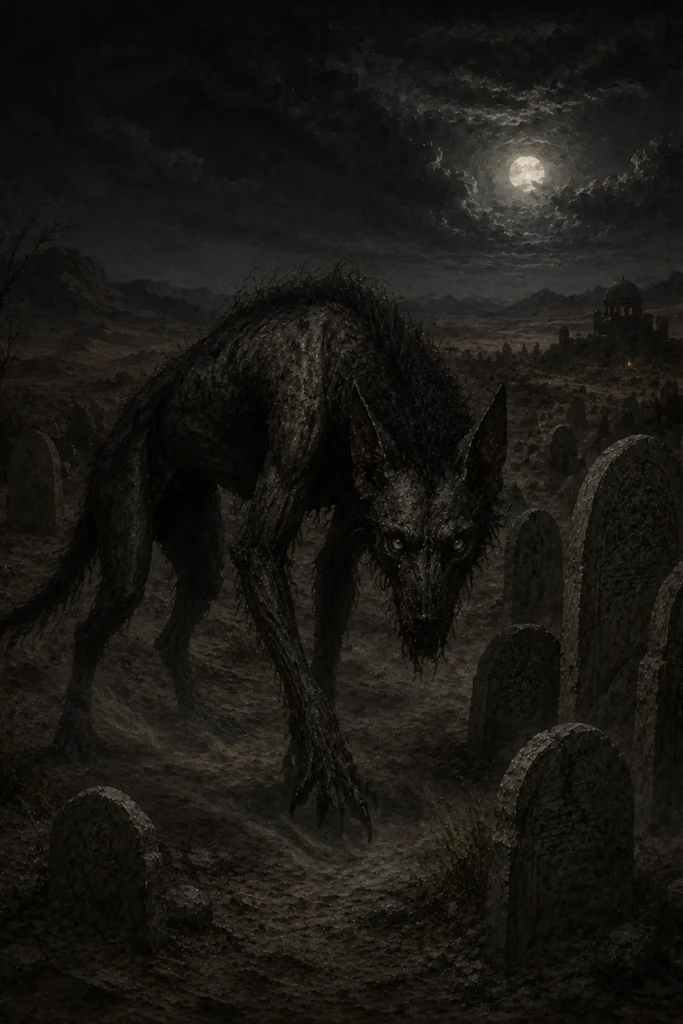
As a demon, the Qutrub is described inconsistently: werewolf-like or dog-like, ghoulish and haunting graves. A cat form is attested only in a single source and is not canonical.
Effect
The Qutrub threatens people at night at graveyards and desecrates corpses. On the medical level it is possession in the sense of illness: when the Greek concept of lycanthropy was translated into Arabic, the wolf disappeared and was replaced by the word qutrub, a water insect.
Profile: Qutrub
The key aspects of the restless demon at a glance.
A homonym across three registers of Arabian classical culture: demonology, philology and medicine share a single word.
Graveyards and their nocturnal visitors: the Qutrub roams among graves and violates the dead.
Inconsistent: werewolf-like or dog-like, ghoulish; the cat form is attested only in a single source.
Nocturnal threat at graveyards and desecration of corpses; medically the name of a melancholic mental illness.
Against the demon, Quran recitation and the call to prayer; against the illness, bloodletting and a cooling, moistening diet.
As a demon related to the ghoul and the European werewolf; medically related to Greek lycanthropy and mania lupina in Avicenna.
One word, three registers
Qutrub denotes a restless small animal that never rests, lexically a field mouse, owl or water insect. From this basic meaning the word branches into three registers that must be kept strictly apart: the demon, the grammarian Qutrub, a philologist of the Basra school who died in 821, and the medical term for a melancholic mental illness.
The demon is old Arabic-folkloric and is first attested by Ibn Durayd, who died in 933. The medical register arose when the Greek concept of lycanthropy was translated into Arabic: in this process the wolf disappeared and was replaced by the word Qutrub, which actually denotes a water insect. Anyone who simply describes the Qutrub as an Arabian werewolf overlooks this remarkable shift.
Medical history and classification
The Qutrub lives on in the specialist literature on the werewolf motif and in the medical-historical reception, later latinised as cucubuth in Avicenna.
From a religious-studies perspective, the Qutrub is not a single, unified being but a homonym spanning three registers. Important clarifications: reducing it to Arabian werewolf massively oversimplifies matters; the medical Qutrub is precisely missing the wolf, which is replaced by a harmless insect; and the demon, the grammarian and the illness must be kept separate.
Call to prayer or bloodletting: two-track protection
Against the demon, as with the Ghul, Quran recitation and the call to prayer apply. On the medical level, by contrast, it is therapy rather than exorcism: bloodletting and a cooling, moistening diet against the black bile of melancholy. This rationalising approach is, from a religious-studies point of view, the most interesting aspect: the same culture that warded off the Qutrub as a demon treated it as an illness using the methods of humoral medicine.
From the Ghul to mania lupina
As a demon, the Qutrub is related to the Ghul and to the European werewolf; medically it corresponds to Greek lycanthropy and to mania lupina in Avicenna. Within the Arabian desert world it stands alongside the Ghaddar, the Nasnas and the Si’lat, all figures that a lone person may encounter in the wilderness.
Frequently asked questions about the Qutrub
What is a Qutrub?
A restless Arabian demon, often translated as werewolf, that haunts graveyards.
Does the word have several meanings?
Yes: a demon, a grammarian named Qutrub, and a melancholic mental illness.
Is the Qutrub really a werewolf?
Only roughly; in the medical sense the wolf is precisely absent, replaced by an insect.
Further links
Literature (selection)
Further standard works in the bibliography.
Whether as an Arabian werewolf, a demon of the graves, or the name of an illness: the Qutrub shows how a single word could combine demonology, scholarship and medicine of classical Arabic culture.