Buga, High God and Lord of the Universe of the Evenki-Tungus
By Ralf Ittermann · last reviewed on
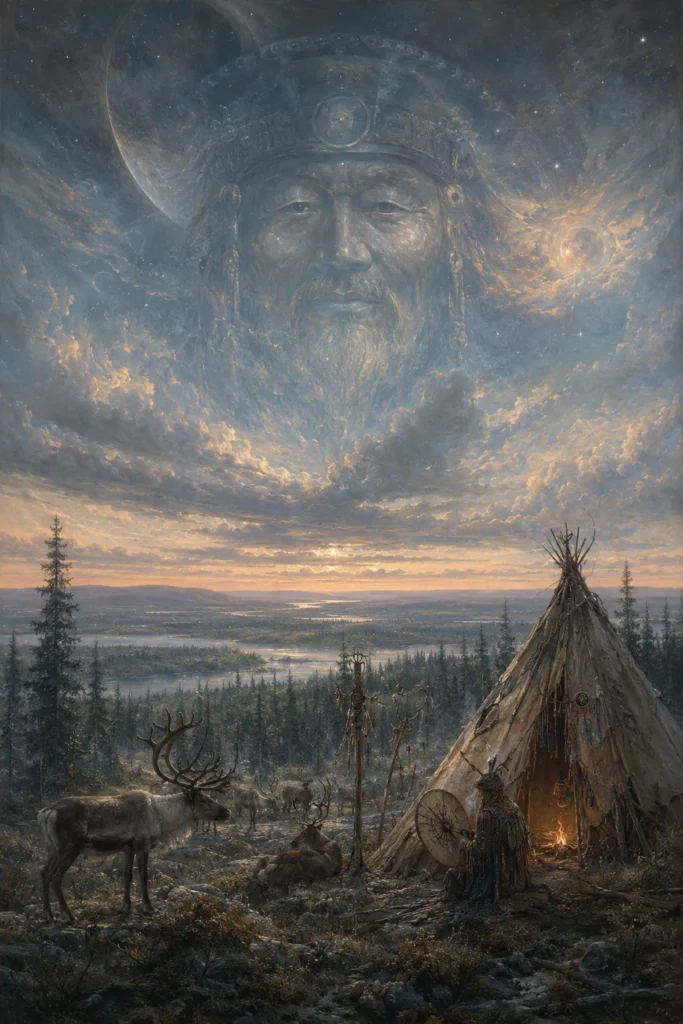
Buga is, in the religious system of the Evenki and other Tungusic peoples, simultaneously high god, sky, universe, and world. He is the cosmic totality within which shamanic journeys, the order of the hunt, and the cycle of life each find their place.
Buga is regarded in the shamanism of Tungus-Evenki peoples as the high god of the upper world and founder of cosmic order. The Buga mythology and its sources are documented in Evenki songs only sparsely and in reshaped form.
Profile: Buga
Buga: the most important aspects at a glance. The following fields summarise origin, function, appearance, veneration, symbols and parallels.
Buga is the high god of the Evenki (formerly called Tungus) and other Tungusic peoples in eastern Siberia between the Yenisei and the Pacific. He is regarded as a very old layer, presumably Altaic and Palaeo-Siberian; some scholars, including Anisimov, see in it the most original form of all.
Buga means at once heaven, world, universe and high god and is the cosmic whole in which shamanic journeys, hunting order and life cycle find their place. He is regarded as founder of the cosmic order. In initiation he sends the initiation illness, “splits” the initiate and teaches him the journey through the three levels of the world.
Like Tengri, Buga has no form of image of his own. On the shaman drums of the Evenki, which show three levels of the world and a world tree growing through them, he stands on the upper level, sometimes as a symbolic sun with a ring of rays. On shaman costumes he is not depicted directly, but is represented by the uppermost sun-disc motif.
Among the Evenki there is no temple cult. A continuous practice of invocation is attested: before the hunt, before a long journey and at the campfire Buga is named, and a little tobacco or fat is put into the fire. In their chants shamans maintain the connection between Buga and the three levels of the world.
Symbols are the sun with a ring of rays and the sun wheel at the crown of the world tree, a giant larch whose roots reach into the underworld of the Khargi spirits. In addition there are the duck as helper in creation, tobacco and fat as gifts into the fire, and carved guardian figures (seven) with inlaid eyes.
Buga is related to the Num of the Samoyeds and typologically comparable with the Chinese Tian, since in both heaven and high deity merge into one concept. In the South Siberian comparison he stands closest to Tengri, less to Ülgen, who has taken on a more personal form. The world tree is comparable with the Vedic notion of the aśvattha and the North Germanic Yggdrasil.
Classification and Brief Profile
The Evenki (formerly called Tungus) live in eastern Siberia between the Yenisei and the Pacific.
In their religion, Buga (in some dialects Boga, Buya, Buwa) is a term that simultaneously means “sky,” “world,” “universe,” and “high god,” a remarkable linguistic compression that the Russian ethnologist Sergei Shirokogoroff analyzed at length in his classic work Psychomental Complex of the Tungus (1935).
Within the Siberian-Tengrist tradition, Buga represents a very ancient, probably Altaic-Palaeosiberian stratum; some scholars (Anisimov) regard it as the most original form of all. The Evenki speak a Tungus-Manchu language, placing them linguistically apart from the Turkic-Mongolic Tengri world, an interesting borderline case.
Buga is especially valuable from a religious-studies perspective because Sergei Shirokogoroff carried out extraordinarily detailed fieldwork among the Evenki on the Amur in the 1910s; his work is a milestone in shamanism research and provides one of the finest bodies of material on the religion of any indigenous Siberian people.
Name and Etymology
The word buga is Tungusic and etymologically difficult to resolve with certainty. Related forms appear in Manchu (boγo, “world”) and in some dialects of Even.
The religiously decisive observation is the identity of word and referent: Buga is not a being who lives in the sky, but Buga is the sky and simultaneously the world.
This semantic compression is of particular interest for the phenomenology of religion because it represents a stage prior to the separation of the numinous and the concrete, a precursor to what is later conceptualized as a “high god.” Shirokogoroff developed an entire theory of “psychomental fusion” around this point.
In the Manchu tradition, which is linguistically related to Evenki, boγo later appears as a specialized term for “world” without retaining the high-divine connotation. This specialization follows the Buddhicization of the Manchu during the Qing dynasty.
Description and Iconography
Like Tengri, Buga has no iconographic form of his own. The shamanic drums of the Evenki do, however, depict the three world levels (upper, middle, lower) and a world tree growing through them; on the upper level Buga sometimes appears as a symbolic sun with a radiant circle.
Evenki shamanic costumes from the collections of the Russian Museum of Ethnography (St. Petersburg) and the Museum of Anthropology and Ethnography (MAE) show very elaborate iron pendants whose religious significance Shirokogoroff documented in his standard work. Buga himself is not directly depicted on the costumes, but is represented through the uppermost sun-disc motif.
The world-tree concept of the Evenki is typologically comparable to the Vedic aśvattha and the Norse Yggdrasil, which Eliade interpreted as evidence of a universal “Axis Mundi” experience.
Mythological Narratives
Anisimov (1958) documented an Evenki creation narrative in which Buga asks a duck to retrieve mud from the primordial sea in order to form the earth from it, a classic Siberian diving motif that we also find in Ulgen.
In Evenki variants, a malevolent deity (Khargi) often appears as rival or brother, fitting the role of Erlik Khan.
A second narrative recounts how Buga sends the first shamans: he “splits” a human being and places into one half the ability to see into the other world. This splitting narrative is, from a religious-anthropological perspective, a key myth for understanding the initiation practice of Evenki shamans.
A third narrative describes how Buga erects the world tree: a great larch trunk whose roots reach into the underworld of the Khargi spirits and whose crown bears the sun wheel. The shaman rides this tree into the upper world, often aided by a horse-drum symbol.
Cult and Veneration
The Evenki practice no temple cult; instead, invocation is continuous: before the hunt, before a long journey, and at the campfire, Buga is named, and a little tobacco or fat is offered to the fire.
Shamans maintain the connection between Buga and the three world levels through their songs, which Eliade described as a model case of classical shamanism.
Evenki shamanic knowledge was traditionally transmitted orally, often in a line from mother to daughter or father to son. Soviet repression in the 1930s severely disrupted these lines; G. M. Vasilevich was still able to document some of the last practitioners in Ewenki (1969).
In contemporary practice, the Buga complex is experiencing a renaissance in the Evenki Autonomous Region and in some settlements of the Sakha Republic. Young practitioners draw on Shirokogoroff’s records, a remarkable case in which Western academic ethnography becomes the source for an indigenous religious reinvention.
Protective Practice and the Apotropaic
From a religious-studies perspective: apotropaic practices focused primarily on the Khargi harmful spirits (often described as “Buga-Tungus harm” because they are conceived as the shadow side of Buga): burning certain herb-animals at the campfire, wearing small bone pendants, and placing carved “guardian figures” (seven) at crossroads.
The seven figures are among the most characteristic elements of Evenki material culture. They are often small carved wooden dolls with inlaid eyes, fastened to posts, trees, or thresholds. They were regarded as the “dwelling place” of lesser helper spirits acting on behalf of the shaman.
A special practice is the chura ritual: before entering an unfamiliar place, a handful of tobacco or a small coin is thrown into the snow or onto the ground, with the invocation “Buga, make me small.” This courtesy towards the universe is a classic animistic schema.
Parallels in Other Cultures
The Buga concept is related to the ancient Siberian Num of the Samoyeds and typologically comparable to the Chinese Tian; in both cases sky and high deity merge into a single concept. Functional parallels exist with the Polynesian terms Mana/Atua, though no genetic connection exists.
The specific significance of the Evenki is the fusion of “universe” and “high god” into a single word, going even beyond the polysemous Tengri vocabulary. In terms of the phenomenology of religion, Buga thus represents an extreme case of the fusion of numinosity and concrete reality.
In the south Siberian comparison, Buga is most closely comparable to Tengri, less so to Ulgen, who has already assumed a more personal form. This difference allows a stratigraphic hypothesis: Buga may represent an older stratum.
Contemporary Reception and Research
Classic works: Sergei Shirokogoroff: Psychomental Complex of the Tungus (1935); A. F. Anisimov: Religia ewenkov (1958); Mircea Eliade made the Tungus shaman the prototype of his “classical shamanism” model. Roberte Hamayon and Andrei Znamenski later critically revised the model and argued for greater attention to local Evenki categories.
G. M. Vasilevich, a Soviet researcher, presented the most comprehensive Soviet monograph on Evenki religion in Ewenki (Leningrad 1969). Despite its ideological coloring, it remains an indispensable body of material.
Research Debates and Open Questions
Three research questions shape the Buga discussion. First: does Buga represent a pre-Tengrist stratum in which “universe” and “high god” had not yet been separated? Anisimov and Shirokogoroff favor this reading; later scholars (Hamayon) prefer a more model-relative view.
Second: how does Evenki practice relate to the Dene-Yeniseian language-family hypothesis, which links the Yeniseian languages (Ket) with the North American Na-Dene languages? If that hypothesis holds, the Buga religion should show circumpolar ramifications.
Third: what future does the current Buga renaissance in the Evenki region have, given the massive pressure from mining and oil extraction? Here too, the history of religion intersects with ecological and political urgency.
Buga and Shirokogoroff's Pioneering Role
The role of Sergei Shirokogoroff in Buga research deserves special attention. Shirokogoroff (1887-1939) was a Russian ethnographer who went into exile after the October Revolution and taught in China from 1922 onward.
His major work Psychomental Complex of the Tungus (London 1935) is one of the first books to systematically reconstruct a non-Western religious system from the inside perspective of its practitioners.
Shirokogoroff analyzed the term “shamanism” scientifically; it goes back to the Tungusic šaman and has been in use in European travel accounts since the 17th/18th century. His analysis had significant consequences for the study of religion: it turned a locally Tungusic term into a universal category. Andrei Znamenski critically traced this universalization in Shamanism and Western Imagination (2007).
Contemporary Buga research stands in an ambivalent relationship to Shirokogoroff: his material is indispensable on the one hand, while on the other hand his concept of “psychomental fusion” contains an essentialist assumption that contemporary religious ethnology critically questions.
Sources and Connection to the Culture Hub
Those wishing to study the Buga complex in its full breadth will find on the overview page Siberian-Tengrist Tradition the most important cross-references to related figures such as Tengri (Turkic parallel) and the Yakut aiyy light beings.
Sergei Shirokogoroff’s Psychomental Complex of the Tungus (1935) is the most important primary source. A. F. Anisimov’s Religia ewenkov (Moscow 1958) is the most important Soviet synthesis. G. M. Vasilevich’s Ewenki (Leningrad 1969) complements the picture with extensive material.
For the circumpolar context, reference is made to Roberte Hamayon’s La chasse a l’ame (1990) and Andrei Znamenski’s Shamanism and Western Imagination (Oxford 2007). These two works represent the most important corrections to the classical Eliade model.
Buga and Shamanic Initiation
The role of Buga in Evenki shamanic initiation deserves particular study. Shirokogoroff described several initiations in detail in Psychomental Complex of the Tungus (1935): the prospective shaman is led through a phase of severe “shaman sickness,” interpreted as initiation, a classic model that Eliade generalized as “initiatory death and resurrection.”
Buga stands in this initiation as the commissioning authority of the upper world: he sends the initiatory illness, he “splits” the initiant, he teaches him the journey through the three world levels. This function is, from a religious-anthropological perspective, the model on which circumpolar initiation research has been built.
Roberte Hamayon critically revised this model in La chasse a l’ame (1990): she reads Evenki initiation less as a “mystical experience” than as a socio-economic negotiating practice. Both readings have their validity and complement one another.
Methodological Reflection
Several methodological problems arise in Buga research. First: Shirokogoroff’s pioneering work is methodologically impressive, but shaped by his exile status and his theoretical presuppositions. Andrei Znamenski has critically traced these presuppositions.
Second: Soviet repression in the 1930s severely damaged the Evenki shamanic tradition; what we observe today is a reconstruction based on ethnographic texts. This reconstruction deserves independent sociological examination.
Third: the Evenki language is now endangered; with it, direct access to the Buga vocabulary and its conceptual world is also disappearing. Language and religion preservation policy thus become related problems.
Buga and the Preservation of the Evenki Language
The Evenki language is classified by UNESCO as “endangered”; today it has only a few thousand active speakers, mainly in the Russian Federation and in northern China. With the language, direct access to the Buga vocabulary and to the subtle distinctions of Evenki religion is also disappearing.
Several initiatives are working to halt this loss. The Russian Academy of Sciences (Institute for Linguistic Research) and the University of Ulan-Ude run documentation programs; in the People’s Republic of China there is a similar effort for the Manchu-Tungusic language family.
This is relevant from a religious-studies perspective because religion and language are closely intertwined. The loss of the Evenki word buga would also mean the loss of a specific religious concept. Language preservation and religion preservation thus become sister projects.
Buga and the Circumpolar High-God Tradition
A circumpolar comparative perspective shows Buga as a link in a broad family of “universe-high-deities” extending from Scandinavia (the Sami Radien) across Siberia (the Samoyed Num, the Evenki Buga) to North America (Algonquian Manitou, Inuit Sila). In all cases, sky, universe, and high deity merge into a single concept.
This circumpolar ramification is the subject of intensive research. Juha Pentikäinen provided a systematic overview in Shamanism and Culture (1998); Mihaly Hoppal extended the Hungarian and Siberian comparison in Shamans and Traditions (2007).
Whether this involves a genetic relationship (Palaeosiberian substrates radiating in all directions) or a typological convergence (identical functions under identical ecological conditions) remains contested. However, the sources for Buga are sparse and overlaid.
Buga and the Evenki Tundra Economy
Evenki religion is closely interwoven with the reindeer-tundra economy. Buga is here simultaneously the high god and the “owner” of the reindeer; no reindeer may be hunted without his permission. The ritual invocation of Buga before the hunt is therefore not only piety, but economic practice.
A. F. Anisimov described this interconnection in detail in Religia ewenkov (1958). It stands within a broader religious-anthropological tradition that understands religion and economy not as separate spheres, but as an integrated life process.
In the Russian Federation today, the Evenki tundra economy is under massive threat from mining, oil extraction, and climate change. The Buga complex is threatened along with it, making this a first-rate field for religio-ecological research.
Buga: Between Sky, World, and Supreme Being
The term Buga belongs to the Tungusic languages, primarily Evenki, and cannot be pinned to a single meaning. Ethnographic records render the word variously as sky, world or region, or as a designation for a supreme being associated with the sky.
This breadth of meaning is not a translation error; it points to a conception in which the animated world, the space it occupies, and the supreme power acting within it were not thought of as strictly separate.
The sources for Buga are sparse and derive largely from the nineteenth and twentieth centuries. Russian researchers and administrative officials, and later ethnographers such as Sergei Shirokogoroff, who produced foundational studies of the Tungusic peoples and of shamanism, recorded fragments of these religious ideas.
Shirokogoroff himself emphasized, however, that many of these ideas had already been reshaped by contact with Russian Orthodoxy and with neighboring religions. A pure, undisturbed Tungusic theology cannot be extracted from the sources.
Moreover, the Evenki lived scattered across a vast territory from central Siberia to the Pacific, organized in small, mobile groups. Local variations in their ideas were correspondingly wide, and no institution existed to establish a uniform doctrine.
What was understood by Buga could differ from group to group. Scholarly accounts therefore describe Buga as a term that is difficult to grasp and that, depending on context, can mean the animated cosmic space or a supreme being, without the two aspects being cleanly separable.
Selected Bibliography
- Sergei Shirokogoroff: Psychomental Complex of the Tungus (1935)
- A. F. Anisimov: Religia ewenkov (1958)
- Mircea Eliade: Le chamanisme (1951)
- Roberte Hamayon: La chasse a l’ame (1990)
- Andrei Znamenski: Shamanism and Western Imagination (2007)
- V. Diószegi and M. Hoppál (eds.): Shamanism in Siberia (Budapest 1978)
- G. M. Vasilevich: Ewenki (1969)
Among the Evenki-Tungus, Buga is regarded as the supreme lord of the universe, encompassing sky, earth, and underworld, and invoked in shamanic songs as the invisible, omnipresent background of all living things.
Related key terms: Buga Evenki Tungus Shirokogoroff Khargi seven world tree.
iWell Guard and Protective Traditions
iWell Guard draws on the cultural-historical tradition of wearable protective objects, in the tradition of Siberia / Tengrism and many other cultures worldwide. 41 levels, real gold, platinum, silver, crafted in Germany. 30-day return policy.
Individual experiences may vary. Not a medical device. No health claims.