Gula, Babylonian goddess of the healing arts
By Ralf Ittermann · last reviewed on
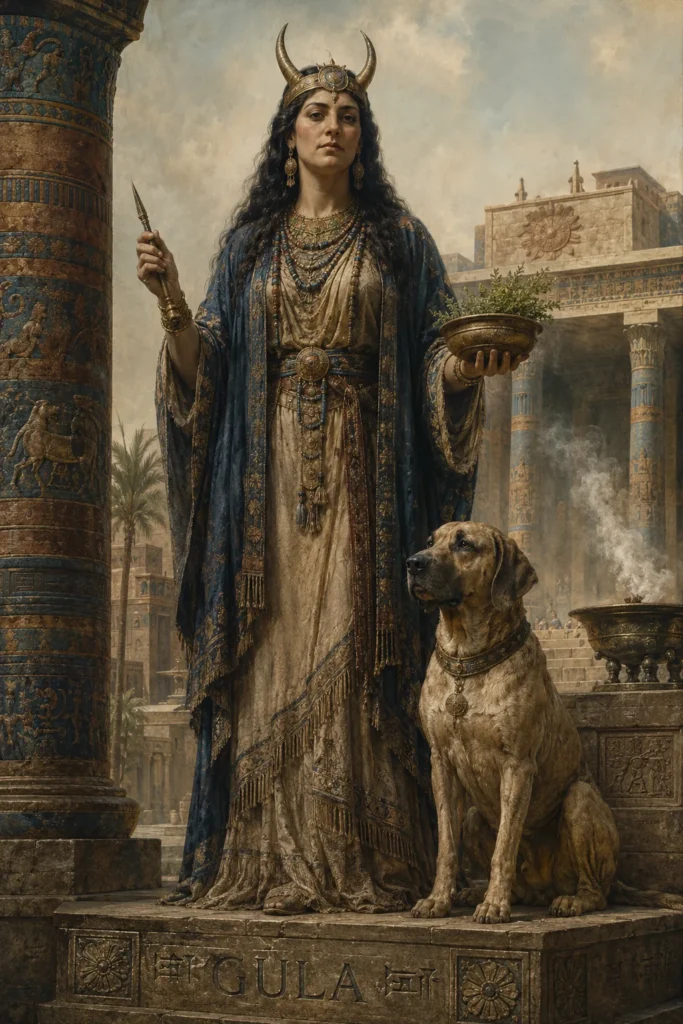
Gula is the Babylonian goddess of the healing arts and is depicted as the Lady of Dogs, whose animal is regarded as a symbol of recovery. Gula is the most important healing goddess of the ancient Mesopotamian religion.
She was venerated above all in the Old Babylonian and Neo-Assyrian periods and was considered the patroness of the healing arts, of physicians, and of midwives.
Her attribute is the dog, an animal that in ancient Mesopotamian thought was associated both with healing and with the threshold between life and death. Her most important temples stood in Isin, Nippur, and Babylon.
Profile: Gula
Gula: the most important aspects at a glance. The following fields summarise origin, function, appearance, veneration, symbols and parallels.
Gula is the later and greater form of older healing goddesses such as Ninisina, Bau and Ninkarrak of Isin, Lagash and Sippar. In the Old Babylonian period their functions merged into her figure. Her name means “the Great One.” She is regarded as a daughter of Anu or Enlil, and her consort is Ninurta.
Gula is the most important healing goddess of Mesopotamia, patron of the art of healing, of physicians and of midwives. She was invoked in childbirth, fever, snakebite and mental disorders. A hymn describes her as physician, nurse, midwife and just judge.
On boundary stones (kudurru) and reliefs a dog sits beside her throne or at her feet. Sometimes she holds a lancet or a medical staff, and on seal impressions she turns toward a sick person. Temple reliefs show her in part with a star or crescent moon.
The main cult was in Isin, in the sanctuary E-gal-mah, where pilgrims dedicated clay models of diseased eyes, limbs or parts of the abdomen. Further temples stood in Nippur and Babylon. The incantation priest asipu invoked her at the sickbed. Women and physicians in particular venerated her.
Her most important symbol is the dog, whose saliva was believed to have healing power and which was at the same time thought of as a companion of the dead. In Isin, dog bones and several hundred terracotta dogs were found as votive offerings. Further signs are the lancet, the star and the crescent moon.
Gula is cultically merged with Ninisina, Bau and Ninkarrak. In some Late Babylonian hymns she is equated with Ishtar, which is disputed. The link between dog symbolism and healing is compared with Asclepius, who appears with snake and dog in the Greek world.
Myth and Origin
Gula is the later and larger form of several older healing goddesses, above all of Ninisina, Bau, and Ninkarrak, who were venerated in the Old Sumerian city-states of Isin, Lagash, and Sippar. Ninisina, the “Lady of Isin,” is the most important predecessor.
As early as the royal inscriptions of the Isin dynasty around 2000 BCE, she appears as the supreme healing goddess and city goddess. In the Old Babylonian period, her functions and characteristics merged into the unified figure of Gula.
Her name Gula means “the Great” in Akkadian. Inscriptions call her azugallu, meaning “great physician.” She is the daughter of Anu, the sky god, or in other traditions the daughter of Enlil.
Her consort is Ninurta, the god of war and the plow, with whom she is joined as a complementary pair: he stands for warlike conquest, she for healing restoration.
Her most important sanctuaries lay in Isin, a city in southern Mesopotamia, and in Nippur, the central religious city. In Babylon, the temple E-galmah was erected for her in the Old Babylonian period. In Sippar she was at home in the form of Ninkarrak. This geographical distribution shows the supraregional importance of the goddess.
A well-known hymn to Gula, the “Bullussa-rabi Hymn,” dates from the Middle Babylonian period and offers a comprehensive self-presentation of the goddess. She describes herself as physician, nurse, midwife, and at the same time as a just judge.
The hymn is important for the history of religion because it summarizes the central functions of the goddess in a form of high literary quality.
Symbols and Attributes
Gula’s most important attribute is the dog. On kudurru boundary stones and reliefs, a dog sits beside her throne or at her feet.
In ancient Mesopotamian thought the dog connected healing and death: its saliva was considered to have healing power, which is attested archaeologically by dog bones in sanctuaries and by healing texts that pronounce incantation formulas over the dog’s saliva.
At the same time, dogs were companions of the underworld deity and could be conceived of as escorts of the dead.
A further attribute is the lancet or the medical staff. In some images she holds an instrument reminiscent of surgical tools. On seal impressions she frequently appears before a sick person, toward whom she turns in a healing manner.
On many kudurru stones the symbol of the seated dog appears alongside other astral or cosmic signs. In this way Gula was an integral component of the theological geography of the boundary stones.
The dog symbolism remained the binding sign that made her unmistakable. Archaeological finds from Isin have confirmed the ritual significance of the dog in her cult, since dog bones in a particular arrangement were found there.
Temple reliefs sometimes show Gula with a star or crescent moon as a reference to the astral dimension of her veneration. The connection between healing, astral interpretation, and incantation was close in ancient Mesopotamian thought, and Gula as a healing goddess also stood within the astral body of knowledge.
Cult and Veneration
The main cult of Gula lay in Isin, in southern Mesopotamia. The sanctuary E-gal-mah was a gathering place for physicians, midwives, and patients. Clay votive offerings in the form of diseased body parts, comparable to the votive gifts in southern Italian healing cults, have been found there in large numbers.
They give a direct insight into practice: pilgrims dedicated to her models of diseased eyes, limbs, or abdominal parts in the hope of healing.
In Nippur her temple was the E-mah, in which the college of physicians assembled. The common Akkadian word for physician, asû, goes back to Sumerian a.zu.
In Sippar she was venerated under the name Ninkarrak, in Babylon in the E-galmah. In Borsippa, the sister city of Babylon, she was integrated as a companion goddess of Nabu, the god of writing.
Her cult was especially popular among women and physicians. Incantation texts from the Old Babylonian and Neo-Assyrian periods invoke her at births, in cases of fever, snakebite, and psychological disorders.
The incantation collections of the royal library of Ashurbanipal contain numerous texts in which Gula is invoked together with Marduk, Ea, and Shamash as a healing deity.
The incantation practice at the patient’s sickbed often comprised several stages. First the asipu, the incantation priest, invoked Gula in formulaic manner.
Then followed concrete instructions, often with herbal mixtures or ritual actions such as stroking with a woolen thread, which was then burned in order to symbolically destroy the illness. This practice, often in connection with the dog as a ritual animal, is documented in hundreds of clay tablets.
In the Neo-Assyrian period, the state veneration of Gula increased. Ashurbanipal had her texts copied and incorporated into his library. Royal women too presented her with personal votive offerings, which underscores the connection of the goddess with birth and motherhood.
Important Myths
Gula appears in the narrative texts less than Inanna or Marduk. Her most important text is the “Bullussa-rabi Hymn,” a long self-presentation of the goddess in 200 lines.
In it she calls herself daughter of Anu, consort of Ninurta, physician of the great gods, midwife of the peoples, and just protector of the weak. The hymn is noteworthy for the history of religion because it completes the theological consolidation of the many healing goddesses under Gula’s name.
In the Anzu myth, Gula does not appear directly, yet in later versions she is named together with Ninurta after his victory and takes part in the triumphal feast. This connection integrates her into the cosmic heroic epic and gives her a narrative link to the Anzu myth.
Relationships within the Pantheon
Gula is married to Ninurta, who is the god of war and the plow. The two form a complementary pair in which warlike upheaval and healing restoration are interwoven. With Damu, a younger healing god and her son, she has a close familial relationship. Damu is often interpreted as Gula’s successor in the healing function.
With Ninisina, Bau, and Ninkarrak she is cultically merged, which shows the theological consolidation process of the Old Babylonian period.
With Marduk, the imperial god of Babylon, she stands in a relationship of cultic cooperation: in the medical incantations both are often invoked together, because Marduk took on an increasingly central role in Babylonian theology and came to overlap healing functions as well.
In the wider pantheon, Gula has relationships with Shamash, the sun god and god of law, as well as with Ea, the god of wisdom. The connection with Ea is especially close, because he is regarded as the cosmic teacher of the healing arts and Gula functions as his earthly counterpart.
In the theological list An, Gula is equated with Ninkarrak, a healing goddess of Akkad, who is named in the curse formulas of the Hammurabi stele as the addressee of medical punishments.
Her consort is Pabilsag, a god of war and healing, who in Late Babylonian astronomy is identified with the constellation Sagittarius. This combination of healing goddess and warrior is a constellation typical of Mesopotamia, in which protection and aggression are united in the same divine couple.
An interesting special case is the identification Gula-Ishtar in some Late Babylonian hymns, which seek to grasp the two goddesses as aspects of a single female power.
This merging is contested and is regarded as a special case of late theological speculation, which under the influence of the increasing Marduk monolatry also sought to unify the principal female goddesses.
Reception and Influence
Gula’s cult ended with the decline of Babylonian high culture in the Seleucid period. Yet her healing texts continued to be copied and preserved in the libraries of the Hellenistic world. Sumerological studies of the 19th and 20th centuries reconstructed her as a central figure in the history of Mesopotamian medicine.
In modern history of medicine, Gula is honored as one of the earliest documented protective goddesses of the healing arts. The reliefs from Isin are reproduced in many textbooks on the history of medicine.
In the religious history of the dog, she appears as an important documentary figure for the dual function of the dog as a healing and death companion.
In popular culture, Gula appears rarely today, yet in texts on ancient Near Eastern medicine and in studies on the history of obstetrics she is a central reference figure.
The connection between her dog symbolism and later healing gods with a dog (such as Asclepius with snake and dog in the Greek world) is discussed in comparative religious studies.
In the history of medicine, Gula is regarded as the earliest healing goddess named by name who patronizes a profession of her own.
Present-day medical-historical research sees the Gula tradition as an important element of the prehistory of Greek healing arts, with concrete traces in pharmacology and diagnostics.
Religious-Studies Classification
Thorkild Jacobsen places Gula in the circle of the great female protective deities, whose function in the Old Babylonian period concentrated on healing and birth. He sees in her merging with Ninisina a typical consolidation process in which several city goddesses flowed together into a single figure valid throughout the empire.
Jean Bottéro emphasizes the social function of her cult. Gula was the patroness of an entire professional group, the asu and asipu, that is, the medical-ritual specialists. The connection of this professional group with the temple was an important structural component of ancient Mesopotamian society.
Stefan Maul has documented in his studies on divination and magic the close interlocking of the Gula cult and incantation practice. Walther Sallaberger and Andrew George have reconstructed the temple cult in Isin and Nippur archaeologically and textually.
Wilfred Lambert critically edited and commented on the “Bullussa-rabi Hymn.” Research sees in Gula one of the most important keys to understanding ancient Mesopotamian medicine and religion.
Gula Hymn of Bullussa-rabi
The most significant literary text on the goddess is the great Gula Hymn of Bullussa-rabi, a scribe known by name from the Middle Babylonian period, probably from the 12th century BCE. The text, comprising 200 lines, is transmitted in several copies; the most important tablets come from the libraries of Assur, Nineveh, and Babylon.
The hymn was first edited in 1967 by Wilfred G. Lambert in Orientalia 36, with extensive commentary and translation. The text is composed in the style of a self-predication, in which Gula speaks in the first person about her qualities, powers, and healing functions.
Bullussa-rabi presents the goddess in an encyclopedic enumeration of her names and functions. She is Belet-ili, the mistress of the gods, Nintinugga, Bauu, and Ninisinna, who were venerated in various cities of Sumer.
This concatenation of regional goddesses under one dominant name is an example of Mesopotamian syncretistic theology, in which local cults were united under one principal name. The hymn is especially important for the history of religion because it transmits the theological integration of numerous healing goddesses into a single Gula figure.
In terms of content, the hymn describes Gula’s activity as a physician. She is “the great physician who turns lament into joy,” she “calms the wound by binding it,” she “lets the dead return to life.” The last phrase is hyperbolic, but it shows the extent of the healing power attributed to her.
A particular passage is the enumeration of healing herbs, whose precise botanical identification poses difficulties for modern research. Stefan Maul commented on this pharmacopoeia in his studies on Babylonian healing arts.
Isin and Temple Archaeology
The main center of the Gula cult was Isin, a city on the lower Euphrates, whose temple of the goddess bore the name E-gal-mah, the “great exalted palace.” The city experienced its heyday in the 20th and 19th centuries BCE under the Isin dynasty, whose kings called themselves chosen “from the house of Ninisinna” (that is, Gula).
The building inscriptions of Lipit-Ishtar and Enlil-bani document extensive endowments, including temple renovations, statue consecrations, and the furnishing of healing rooms.
The German excavation of Isin under Barthel Hrouda between 1973 and 1989 largely uncovered the E-gal-mah. In the temple courtyard a well was found, into which dog figures were thrown as votive offerings after healing.
The excavators recovered several hundred terracotta dogs that had been placed in the water over the centuries. This unusual category of source confirms the dog symbolism of the goddess mentioned in the hymn and gives insight into the popular piety of those seeking healing.
A second large sanctuary stood in Nippur and a third in Babylon, where Gula became the centrally important healing goddess in state theology during the Late Babylonian period. The temple inscriptions of Nebuchadnezzar II name her as the one who granted the recovery of the king after a serious illness.
In the city of Assur in Assyria too there was an E-gal-mah, which was renovated by Sennacherib and Ashurbanipal. This supraregional presence makes Gula one of the principal gods of all Mesopotamia, comparable in influence with Ishtar or Marduk.
The Dog as Attribute and Votive Practice
The dog is the most important attribute of Gula, which is singular in the pantheon of Mesopotamia. Other gods have bulls, lions, or dragons, but only Gula has the dog as an animal companion.
On most kudurru reliefs of the Middle Babylonian period, above all on the kudurru of Meli-Shipak (12th century BCE), she appears enthroned with a seated dog at her feet. This pictorial tradition is also attested on the glazed bricks of Nebuchadnezzar II in Babylon.
For the history of religion, the dog symbolism is multilayered. Dogs in Mesopotamia are on the one hand impure and feared, on the other hand guardians of the threshold. In the healing arts, the dog is presumably a healing animal, whose saliva and wound-licking were considered to heal wounds in popular medicine.
Beate Pongratz-Leisten has pointed out in her studies on Babylonian religion the ambivalence of the dog, which was understood as pure and impure at the same time. Karen Radner too has investigated in several essays the interplay of healing ritual and dog veneration.
Votive practice included, besides the clay dogs, models of diseased body parts. In temple excavations, clay replicas of hands, feet, eyes, and genitals were found, which patients had offered as petitionary gifts.
This practice has direct parallels in later Greek Asclepius temples, above all in Epidaurus, where clay limbs were left behind by those who had been healed. A direct religious-historical continuity is discussed but cannot be clearly demonstrated.
Sources and Further Reading
Ancient sources: “Bullussa-rabi Hymn” to Gula, medical and incantation texts from the Old Babylonian and Neo-Assyrian periods, inscriptions from Isin, Nippur, and Sippar, hymns to Ninisina and Ninkarrak, the Anzu myth in its later versions.
Research literature: Thorkild Jacobsen, “The Treasures of Darkness,” New Haven 1976. Jean Bottéro, “Mesopotamia: Writing, Reasoning, and the Gods,” Chicago 1992. Stefan Maul, “Die Wahrsagekunst im Alten Orient,” Munich 2013. Walther Sallaberger, “Der kultische Kalender der Ur III-Zeit,” Berlin 1993. Andrew George, “The Babylonian Gilgamesh Epic,” Oxford 2003. Wilfred Lambert, “Babylonian Creation Myths,” Winona Lake 2013. Markham Geller, “Ancient Babylonian Medicine,” Oxford 2010.