Shayatin, Demons of the Islamic Tradition
By Ralf Ittermann · last reviewed on
The evil jinn, whisperers and tempters.
Shayatin
Shayatin is a demon of the Islamic tradition.
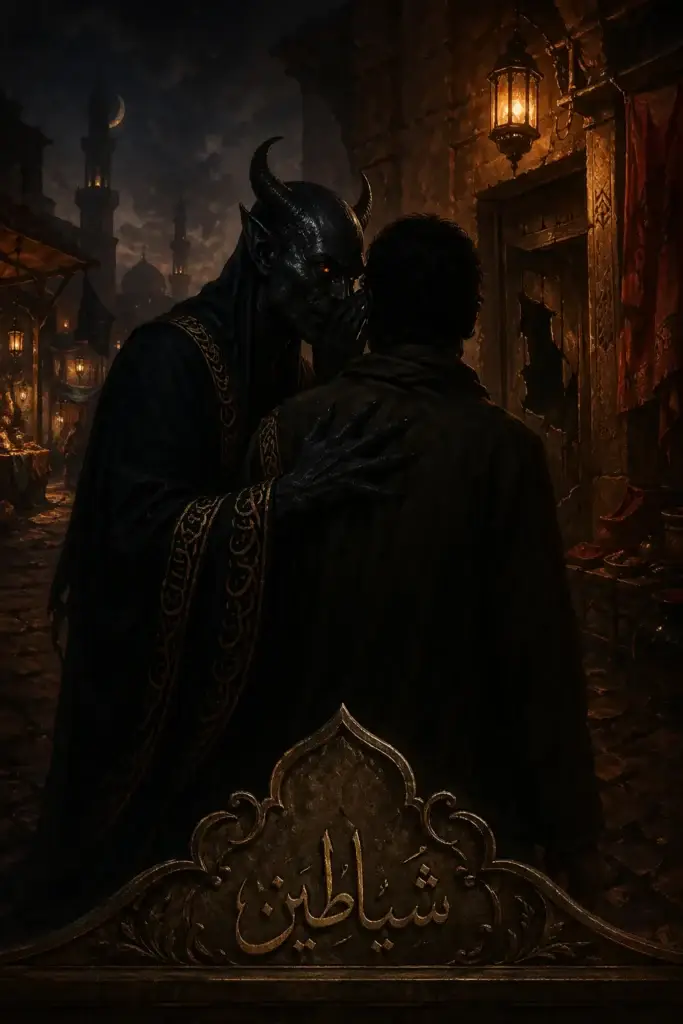
In Islamic tradition, the Shayatin are the malevolent subgroup of the jinn, those who followed Iblis. The Quran refers to them in numerous passages as tempters and whisperers (muwaswisun) who disturb the faith.
They do not operate through physical force but through waswasa: the quiet whisper into the human heart that generates doubt, anger, desire, arrogance, or apathy.
Unlike jinn in general, Shayatin are no longer morally ambivalent. They are unequivocally evil. At the same time, their power is limited: they can only attack those who neglect God.
At the invocation of God, they withdraw. The singular form Shaytan can also refer to the leader of the group, Iblis; the plural denotes the totality of his followers.
Quick Overview: Shayatin
Type: Evil subgroup of the jinn, whisperers
Origin: Obedience to Iblis, their leader
Texts: Quran (numerous passages), Hadith
Period: 7th century to the present
Primary effect: waswasa, whispering
Historical Classification
Quranic foundation, systematic elaboration in classical exegesis, dense presence in hadith literature. Modern theology and popular belief continue the category.
The Islamic world as a whole. The concept of the Shayatin belongs to the universal categories of Islamic demonology and is less regionally coloured than other individual beings.
Quran (countless passages), hadith collections, classical tafsir literature, ethnographic studies on modern everyday religion.
Name
Arabic: Shaytan (singular), Shayatin (plural). Etymologically related to Hebrew satan.
Relationship to Iblis: Iblis is the leader of the Shayatin. In the singular, Shaytan can refer to Iblis himself.
Relationship to jinn: Shayatin are a malevolent subset of the jinn; not all jinn are Shayatin.
The terminology overlaps: in many Quranic passages Shaytan and Iblis are used interchangeably. Only later theology systematized the distinction, treating Iblis as a proper name and Shaytan as a functional term.
Characteristics
Appearance
Mostly invisible, like all jinn. Folk tradition describes them as ugly, fiery, and black. Theologically significant: their effects are not visible but manifest in human thoughts and inclinations.
Behaviour
They whisper thoughts into the human mind that lead away from the right path. Typical patterns include: doubt about faith, postponing prayer, sexual temptation, anger, envy, arrogance, and despair. They are especially active in states of inattentiveness and darkness.
Domain of Influence
All human beings, though more specifically targeting those who neglect God. At night, in solitary thoughts, at turning points in life.
Mythological Classification
They have no genealogy of their own; they are the jinn who followed Iblis. Their community is hierarchical, with Iblis at the top, followed by specialised demons assigned to particular tasks (classical tradition names demonic figures responsible for specific sins).
Profile: Shayatin
The most important aspects of the Shayatin at a glance.
Jinn who followed Iblis. They have no separate line of creation; they are the malevolent subgroup within the general jinn creation.
All human beings, especially in moments of inattentiveness. Targeted attacks on those who neglect God.
Invisible. In folk traditions described as ugly, fiery, and black. Their effect resides within, in thoughts and inclinations.
Waswasa, quiet whispering that brings doubt, anger, desire, and apathy. No violence, only suggestion.
Ta’awudh before every action, Basmala, recitation of the protective surahs, dhikr (remembrance of God). When disturbing thoughts arise: inwardly recite “A’udhu billahi minash-shaitanir-rajim”.
Christian tempter-demons, Shedim as general evil spirits, and the Buddhist Mara as a tempter.
Protection in Everyday Life
Protective Rituals
Seeking refuge with Allah is the foundational practice, performed through the formulaic Ta’awudh. Prayer discipline (five times daily) and Quran recitation are considered the strongest countermeasures. In the case of persistent attack: ruqya, communal prayer at the mosque, and religious counselling.
Recitations
The “Throne Verse” (Ayat al-Kursi, Surah 2:255) is regarded as especially effective against the Shayatin. According to a well-known hadith, reciting it before sleep drives the Shayatin away until morning.
Everyday Rules
Basmala when eating, when entering the home, and before going to sleep. Not yawning with an open mouth, not whistling indoors, not sleeping at night in ruins: these are traditional everyday rules intended to prevent the influence of the Shayatin.
Parallels in Other Traditions
Jewish-Christian Background
The term is etymologically connected to Hebrew satan. In the Christian tradition, the “demons” of the New Testament correspond to it, with a similar function of temptation and whispering.
Buddhism: Mara as a personified tempter, together with his armies, shows functional parallels. In both traditions the weapon is suggestion rather than violence; the counter-weapon is focused prayer or meditation practice.
Zoroastrian
The dew of Zoroastrianism are likewise malevolent beings who entice humans toward evil. Structurally related, they stand within a dualistic theological framework.
The Shayatin in the Quran
The term shayatin is the plural of the Arabic word shaytan and denotes, in Islamic thought, the satans or satanic beings. The word appears in the Quran in numerous passages, and its usage is more layered than a simple translation as “devils” might suggest.
In the singular, al-shaytan most often refers to Iblis, the being who, according to the Quranic narrative, refused to prostrate himself before the newly created Adam and was consequently cursed. In the plural, however, shayatin designates an entire class of beings that seduce, mislead, and sow discord.
The Quran speaks of shayatin among the jinn and even of shayatin among human beings, which shows that the term can denote less a biological species than a function or an attitude: the seductive force that diverts from the right order.
A well-known Quranic concept associates the shayatin with the attempt to eavesdrop on the hidden affairs of the heavens. They ascend to overhear the decrees of the higher spheres but are driven away by shooting stars, interpreted as hurled projectiles.
This narrative served, among other purposes, as an explanation of why soothsayers can only obtain fragmentary and unreliable knowledge. From the perspective of religious studies, it is worth noting that the Quran does not develop a systematic body of doctrine about the shayatin but introduces them in various contexts as a counter-force to right guidance.
Shayatin and Jinn: the Relationship between the Spirit Classes
A question much debated in Islamic scholarship concerns the relationship of the shayatin to the jinn. Both belong to the invisible beings created from fire, yet their precise relationship is determined in different ways.
A widespread view understands the shayatin as the unbelieving, malevolent among the jinn. While the jinn as a category include both believing and unbelieving, both harmless and dangerous representatives, the shayatin are accordingly those who have turned toward evil.
Iblis himself is explicitly counted among the jinn in one Quranic passage, which supports this interpretation. According to this view, the shayatin are a morally defined subgroup within the jinn.
Another view, likewise represented in the tradition, regards the shayatin as the offspring of Iblis and therefore as a distinct lineage with their own origin. Still other scholars emphasise the functional aspect and understand shaytan as anyone, whether jinn or human, who performs the role of the tempter.
This ambiguity is not a deficiency in the tradition but an expression of the fact that the Quran and the early sources did not use the terms strictly systematically.
Later scholarship, in Quranic commentaries and in dedicated treatises on the world of spirits, then undertook various attempts at classification. Research into Islamic demonology, including studies on the concept of jinn, has shown that these classifications vary by region and by scholarly school.
Protection against the Shayatin in Religious Life
Islamic everyday life includes a number of well-established means of protecting oneself from the influence of the shayatin. These are not magical in nature but are rooted in religious practice and are regarded as legitimate by the majority of scholars.
The central means is the isti’adha, the protective formula by which one seeks refuge with God from the accursed shaytan. It is recited, among other occasions, before reading the Quran.
Likewise, certain surahs and verses are considered especially protective, above all the final two surahs of the Quran, known as the Seeking Refuges, as well as the so-called Throne Verse.
Regular prayer, remembrance of God, and speaking His name before everyday actions are regarded as effective protection, because the shayatin are widely held to have no power wherever God is remembered.
The transmission of the Prophet’s words records numerous specific situations in which the shayatin were considered especially potent and corresponding protective acts were recommended, such as when entering certain places, before going to sleep, or in the upbringing of children.
From the perspective of religious studies, it is notable that this form of protection consistently aims at turning toward God rather than at a direct confrontation with the spirits.
The shayatin are not conjured or fought; instead, one withdraws from their influence through piety. This distinguishes Islamic practice from certain folk protective traditions of other cultures, where direct engagement with the harmful being is central.
In the lived popular piety of various regions, however, amulet and incantation practices have also developed, whose relationship to normative doctrine remains contested.
Further Links
Research Literature
Further standard works in the literature index.
The protective practices described here represent a religious-studies classification of historical traditions. iWell Guard draws on this cultural-historical lineage of wearable protective objects and represents a contemporary form of it. Learn more about iWell Guard