Satan, Fallen Angel of the Christian Tradition
By Ralf Ittermann · last reviewed on
The adversary, central figure of Christian demonology.
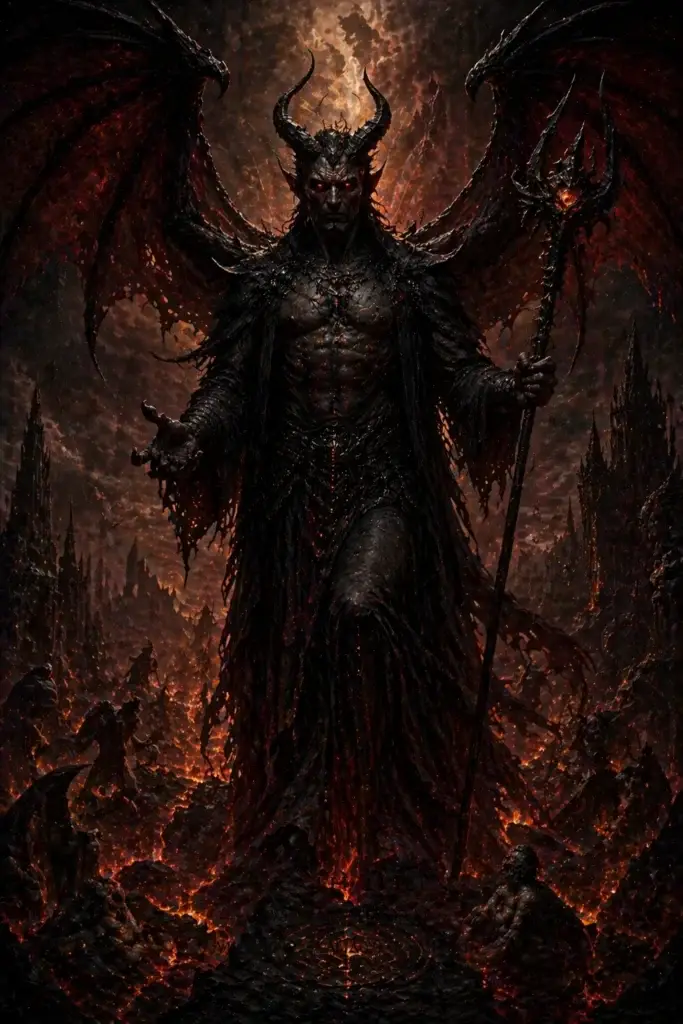
Satan
Satan is the central adversary figure of the Christian tradition. From the Hebrew ha-satan (“the accuser”) in the Book of Job to the personified “devil” of the New Testament, a shift in meaning takes place, from a functional role at God’s throne to a fallen angel and lord of hell.
In patristics and the Middle Ages he becomes the cosmic adversary and leader of all demons.
Structurally, Satan remains within the monotheistic framework: he is a creature, not a counter-god. His power is derived and in the end can be overcome. Nevertheless he develops an enormous iconographic and narrative presence, in art, literature (Dante, Milton, Goethe) and popular culture, where he transforms from an infernal monster into a tragic, rebellious figure.
Layers in the history of religions
Satan is not a homogeneous figure but a layered complex from the history of religions, composed of at least four different lines of tradition. The Jewish layer (Tanakh) shows ha-satan as the “accuser” at the heavenly throne, with a positive function within the divine administration (Job 1, 2; Zechariah 3; Numbers 22).
The intertestamental layer (1 Enoch, the Book of Jubilees, the Testaments of the Twelve Patriarchs) makes this figure independent and connects it with the fallen Watchers of Genesis 6. The New Testament layer turns the accuser into the chief enemy of Christ and the church (Matthew 4, Luke 4, Revelation 12, 20).
The patristic and medieval layer develops this conception into an elaborate demonology in which Satan is the supreme commander of the fallen angels.
Brief Profile: Satan
Type: Chief adversary, fallen angel
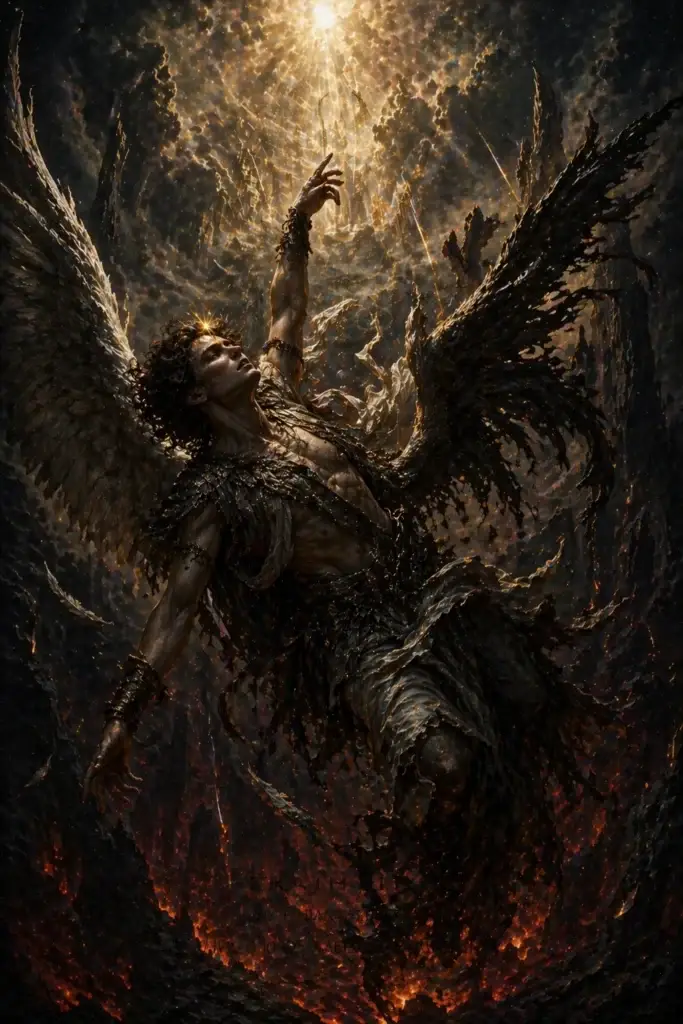
Origin: Originally divine accuser; later tradition: the fall of Lucifer
Texts: Job, the Gospels, Revelation, patristics, scholasticism
Period: 1st century AD to the present
Defense: Sacraments, exorcism, prayer, invocation of saints
Distinction from Leviathan: Unlike the Leviathan, the cosmic sea monster as a symbol of untamed chaos, Satan is a personified figure, the adversary who enters into dialogue with God and with humanity and who appears in the Jewish-Christian tradition as an acting agent.
Classification
In the Old Testament as the “accuser” (Job, Zechariah), without clear personal definition. In the New Testament as an unambiguously evil adversary (the temptation of Jesus, Revelation). Patristics and the Middle Ages develop the figure systematically. The Reformation and the modern era reinterpret it.
Starting from the eastern Mediterranean, spreading with the Christian mission into the whole inhabited world. Each Christian region develops its own popular images of Satan, which in part take up indigenous demon traditions.
The New Testament, apocalypses, patristic homilies, medieval visionary literature (Tundalus, Dante), collections of exempla, grimoires, witch trials, Milton and Goethe in literature.
Name and Variants
Hebrew: ha-satan (“the accuser”, Job).
Greek: ho Satanas, ho diabolos (“the one who throws into confusion”).
Latin: Satanas, diabolus.
Epithets: prince of this world, father of lies, the old serpent, the dragon, Beelzebul.
The multitude of names reflects the process by which Satan became a collective figure of various traditions. Identifications with Lucifer (Isaiah 14, late), with the primeval serpent (Genesis 3, in the New Testament), with Beelzebul (the Gospels) and with the dragon (Revelation) yield a consistently personal figure out of what were originally separate aspects.
Characteristics
Appearance
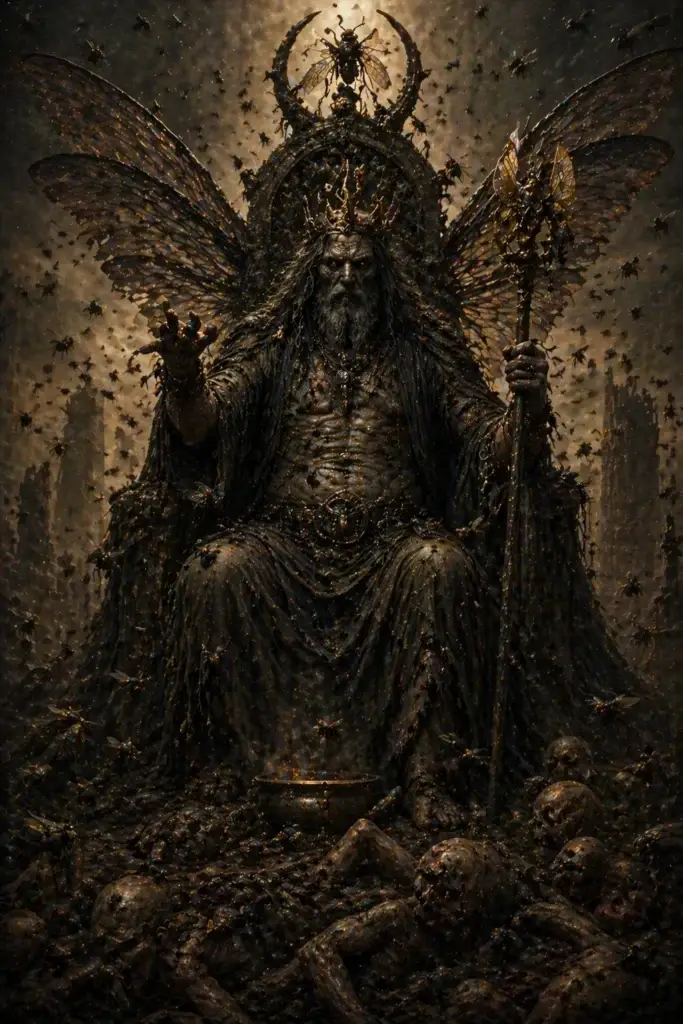
In the New Testament largely without visual description, “prowls around like a roaring lion” (1 Peter 5:8), “angel of light” (2 Corinthians 11:14). Medieval iconography: horned, with a cloven hoof, winged, red or black, with bat wings. Dante: three-headed in the ice palace of the ninth circle of hell.
Behavior
He tempts, accuses, seduces, deceives. He has no brute force; his power is influence and suggestion. In Revelation he fights with Michael and is bound in the end. In between: a constant presence in the believer’s daily life as temptation.
Sphere of Influence
The entire world (“prince of this world”), with emphases: temptation of individuals, seduction of whole peoples, political power (from an apocalyptic perspective), rule over hell.
Mythological Origin
Origin in Hebrew court-of-law metaphor (Job: the accuser before God’s throne). In the Second Temple period a merging with Iranian dualism motifs (Ahriman). Later patristic identification with the fall of Lucifer (Isaiah 14, originally polemic against a Babylonian king).
Patristic theology
Origen discusses in De principiis (ca. 230) the question of whether Satan could be redeemed at the end of the world (the doctrine of apokatastasis); this position was later rejected as heresy, yet it has its own lines in the Eastern Church tradition.
Augustine argues in De civitate Dei (XI, XIV) against Manichaean dualism and insists on the ontological secondariness of evil: Satan is not a competing god but a fallen creature whose existence is possible only as a privation of the good.
This position remains binding for Catholic theology. The scholastic refinement in the Summa Theologiae (I, q. 63, 64) systematizes the doctrine of angels and places Satan at the head of the fallen hierarchy.
Profile: Satan
The most important aspects of Satan at a glance. The detailed treatment of name, description, defense and parallels can be found in the following sections.
From the Hebrew “accuser” motif; later identification with the fallen Lucifer. In the Second Temple period, the influence of Iranian dualism ideas.
All people; emphasis: individuals under temptation, peoples and political powers in apocalyptic interpretation.
NT without an image. Medieval: horned, with a cloven hoof, bat wings, red/black. Dante: three-headed in the ice palace.
Temptation, seduction, accusation, deception. Influence rather than brute force. In the end overcome through Christ.
Sacraments (baptism, Eucharist), exorcism, prayer, invocation of saints, holy water, the sign of the cross. The Orthodox churches with their own exorcism rite.
Azazel (Judaism), Apophis (Egypt), Ahriman (Zoroastrian), Iblis (Islam), Mara (Buddhism).
Defense in Everyday Life
Rituals of defense
Baptism as basic protection (abrenuntiatio diaboli). Regular sacramental practice, personal prayer, the sign of the cross. Exorcism in cases of recognized possession, regulated in the Catholic Church to this day by the Rituale Romanum.
Invocations
Ecclesiastical exorcism formulas (Rituale Romanum, Orthodox euchologia), popular apotropaic sayings (“Begone, Satan”), everyday blessing formulas. In the grimoire tradition, magical binding formulas, condemned by the church.
Amulets and protective symbols
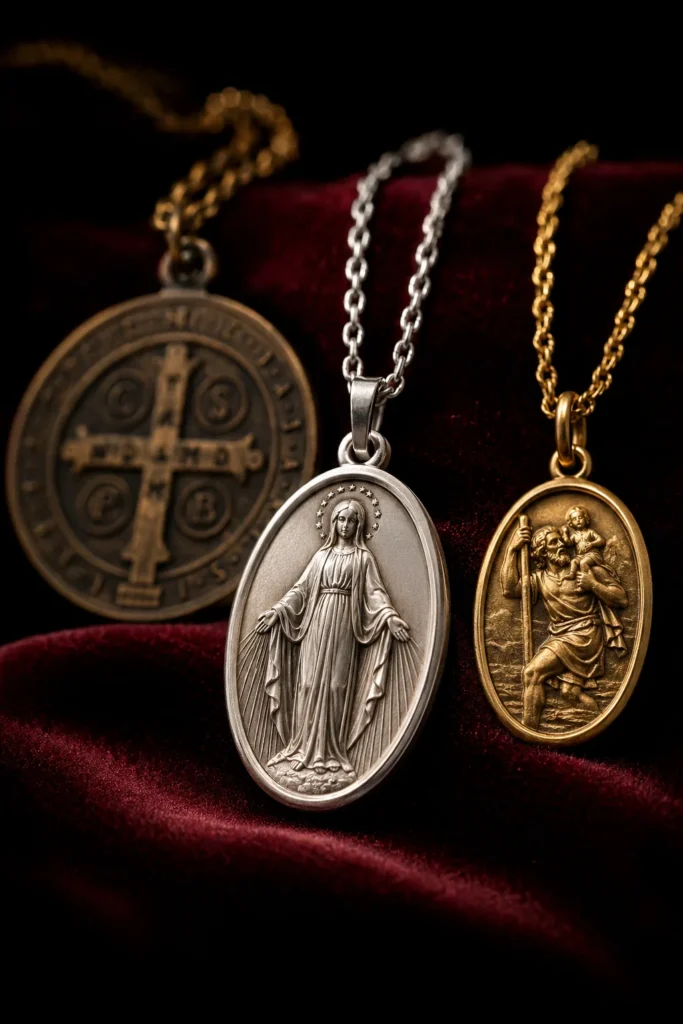
Cross, crucifix, the Benedictine medal with the “Vade retro Satana” formula, Agnus Dei, images of saints. Holy water as a daily means of protection.
Satan, Parallels in Other Cultures
Jewish tradition and prehistory: Job, Zechariah, ha-satan as the accuser. Qumran and apocalyptic literature radicalize the figure. Azazel as a related fallen angel.
Islam: Iblis parallels the Satan motif but is structurally conceived differently (a jinn, not a fallen angel). In Muslim popular piety he is a constant adversary.
Further traditions: Zoroastrian Ahriman as a possible model. Buddhist Mara as the tempter at the tree of enlightenment. Egyptian Apophis as the cosmic enemy of chaos.
Reformation and modernity
In the Reformation, Satan gains a considerable standing in Luther’s theology. Luther’s own accounts of encounters with Satan (such as the inkwell-throwing episode at the Wartburg) are characteristic, from a history-of-religions point of view, of the strong personality of Satan in the Protestant discourse of the 16th century.
The Catholic Counter-Reformation responds with the elaborate exorcism apparatus of the Rituale Romanum (1614).
In the modern era (since the 18th century) Satan undergoes a secularization in the literary-philosophical tradition (Milton, Paradise Lost, 1667; Goethe, Faust, 1808, 1832; Baudelaire, Les Fleurs du Mal, 1857), which turns him from a primary theological function into a literary topos.
The Accuser in the Heavenly Court: Satan in the Old Testament
The Hebrew word satan simply means „adversary“ „opponent“ or „accuser“. In the Old Testament it can also denote, quite unspecifically, a human opponent. Where it refers to a heavenly figure, it usually appears with the article, ha-satan, that is „the accuser“ which is more a designation of function than a proper name.
The best-known passage is in the Book of Job. There ha-satan appears among the „sons of God“ who come before God. Here he is not a counter-god but a member of the heavenly court, comparable to a prosecuting official.
He doubts that Job’s piety is genuine and receives from God permission to test it. The Satan acts only within the framework of what God permits.
The accuser appears similarly in the Book of Zechariah, where he accuses the high priest Joshua before the angel of the Lord and is rebuked.
A special case is a passage in Chronicles that rephrases an older narrative from the Book of Samuel: where there God incites David to a census, in Chronicles it is a satan. Scholarship sees in this an early step toward shifting uncomfortable actions away from God onto another figure.
It should be noted: in the Hebrew canon, the Satan is not an independent power of evil and not the ruler of a hell. He is a subordinate figure with a limited function in the heavenly apparatus. The later notion of the cosmic adversary of God is not yet developed in the Old Testament.
The Intertestamental Turn: From Accuser to Prince of Darkness
The decisive development took place in the centuries between the Old and the New Testament, in the so-called intertestamental literature. During this time, shaped by foreign rule and religious crises, the idea gained ground that the good is confronted by an evil power of its own.
Texts such as the Ethiopic Book of Enoch developed the narrative of the fallen angels who rose up against the divine order.
The Dead Sea scrolls, the texts of the community of Qumran, know a figure named Belial or Beliar and a pronounced doctrine of two spirits, the spirit of light and the spirit of darkness, who contend for the human being.
Scholarship debates the influence of Persian dualism, which knows a good and an evil primal power. Whether there was a direct borrowing or an independent inner-Jewish development under external pressure is contested; much speaks for a combination of the two.
The result is that in the New Testament a markedly developed figure appears. There Satan appears as the tempter of Jesus in the wilderness, as the „prince of this world“ as the opponent of the kingdom of God.
The Revelation of John explicitly identifies him with the „old serpent“ and the dragon and describes his final downfall. The heavenly prosecuting official of the Book of Job has thus become the adversary of God, even though, unlike in the later popular image, he remains subordinate to God’s power.
The Horns and the Cloven Hoof: How the Devil Got His Appearance
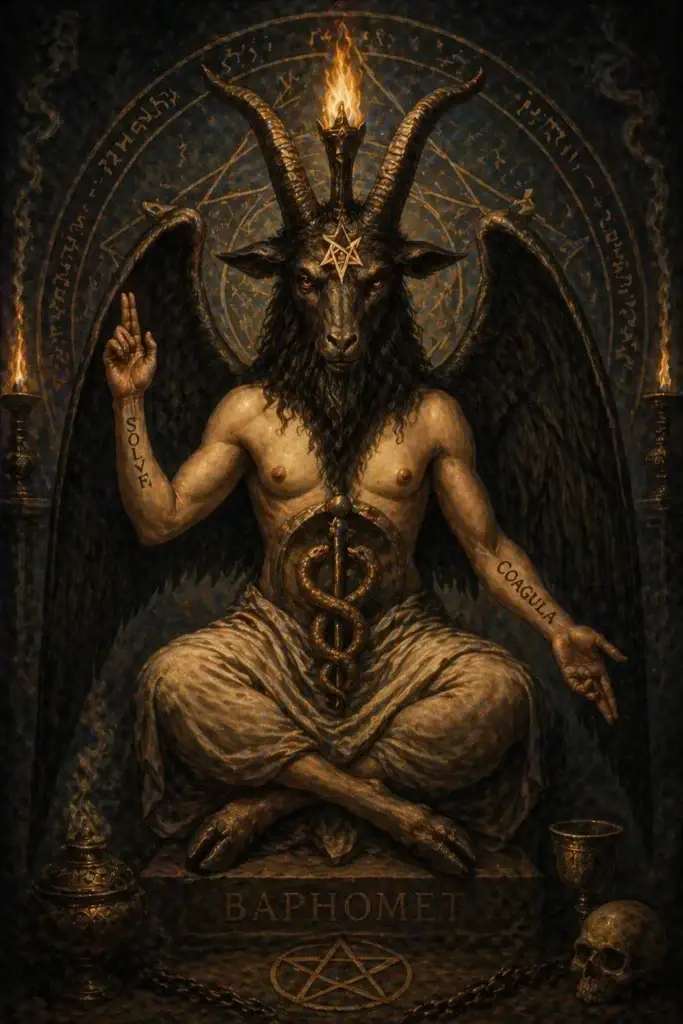
The Bible does not describe Satan’s appearance. The familiar image of the devil with horns, goat’s legs, a tail, a pitchfork and reddish skin is a creation of post-biblical, above all medieval, art. Scholarship can identify several sources of this image.
One role was played by the adoption of features of pre-Christian deities and nature beings. The Greek shepherd god Pan and the satyrs were equipped with horns, goat’s legs and an unruly nature.
As Christianity established itself, such figures were demonized; their external features passed over to the devil. Fauns and other hybrid creatures also supplied components.
Added to this were biblical images that were taken literally. The parable of the Last Judgment speaks of the separation of the „sheep“ from the „goats“; the goat thus became the animal of the damned.
The fire of hell explained the red color and the connection with smoke and pitch. The bat wings, which often distinguish the devil from the feathered angels, emphasized his fall and his inversion of the angelic.
Medieval visual art, from church portals through tympana and wall paintings to manuscript illumination, consolidated and spread this appearance. In the theater, in the religious plays, the devil appeared in corresponding costumes.
From a history-of-religions point of view it is important: the devil’s appearance is not a revealed datum but a cultural product, assembled from pagan heritage, literally read pictorial expressions and the pictorial tradition of the church.
Satan in the History of Theology: Tempter, Executioner, Myth
The theological interpretation of Satan was never uniform. The Church Fathers already wrestled with the question of where evil comes from if God is good and has created everything.
A common answer was that Satan was an originally good angel who fell through pride and a free decision of the will; evil was not a being of its own but a deficiency of the good. This line, associated especially with Augustine, shaped Western theology for centuries.
In the Middle Ages the doctrine was further elaborated, for instance by Thomas Aquinas, who treated the nature of angels and the fall of the angels systematically.
At the same time, in popular piety and in the practice of exorcism and later witch persecution, a far more concrete, drastic image of Satan gained weight, one that often overlaid the more sober theological statements.
The reformers, above all Martin Luther, spoke very directly and personally of the devil as a real adversary of faith. In the modern era, by contrast, a critical distancing set in, especially since the Enlightenment. Many theologians increasingly interpreted Satan as symbolic or mythological language for the power of evil, not as a personal being.
In present-day theology both views exist side by side, from an adherence to a personal evil power to a thoroughly symbolic interpretation.
From the standpoint of religious studies this question cannot be decided; one can only hold fast to the historical finding of a long, many-voiced history of interpretation in which Satan has taken on very different forms, from the heavenly accuser through the prince of darkness to a contested theological concept.
Further Links
Literature (Selection)
Frequently Asked Questions about Satan
Who is Satan in the Jewish-Christian tradition?
Satan (Hebrew ha-Satan, the accuser) is initially not an opponent of God in the Hebrew Bible but a divine court servant who tests people, as in the Book of Job.
Only in early Jewish apocalyptic and in the New Testament does Satan become the adversary of God and leader of the fallen angels. In the Christian Middle Ages the figure merged with various demon conceptions into the personified evil.
What is the difference between Satan, Lucifer and the devil?
The three terms have different roots: Satan comes from Hebrew (accuser), Lucifer from Latin (light-bearer, actually the morning star Venus) and devil from the Greek diabolos (slanderer).
Only in patristic theology were all three merged into one figure, the fallen archangel who rebelled against God. In modern theology the terms are once again treated in a differentiated way.