Demeter, Goddess of the Greek Tradition
By Ralf Ittermann · last reviewed on
Demeter is a goddess of the Greek tradition.
Goddess of grain, fertility and civilization. Demeter is the mother of Persephone and the centre of the Eleusinian Mysteries, the most sacred rites of the ancient world. She represents the grain that nourishes humankind and the cycle of sowing, growing and harvesting. Her grief over Persephone explains winter; her joy explains spring.
Demeter
Quick Overview: Demeter
Type: Greek major deity, goddess of grain, harvest and the mysteries
Pantheon: Greece (one of the twelve Olympians)
Function: grain, harvest fertility, the mysteries, a mother’s grief
Main attributes: wreath of grain ears, torch, sacrificial pig, poppy
Main cult sites: Eleusis (the mysteries), Sicily (Enna), Locri Epizephyrii
Roman counterpart: Ceres
Context
Period of the Texts
Demeter is attested in literature from Hesiod onwards (8th century BC); the central Homeric Hymn to Demeter (7th/6th century BC) recounts the myth of the abduction of Persephone.
The main period of Demeter worship was the Eleusinian Mysteries, one of the most important mystery cults of the ancient world, practised continuously for over 1000 years, from around the 7th century BC until AD 392 (closure under Theodosius). In Roman times the cult spread in parallel as Ceres alongside the Demeter mysteries.
Area of Distribution
Main cult site: Eleusis near Athens (the most famous mysteries). In addition: Sicily (Enna as the supposed site of Persephone’s abduction), Locri Epizephyrii (a southern Italian special cult with pinakes), Corinth, Syracuse, Hermione (Argolis).
Throughout the Hellenistic Mediterranean, especially in agriculturally shaped public life. The temple complex at Eleusis is partly preserved today (the Telesterion, the initiation hall of the mysteries).
State of the Sources
Central sources: the Homeric Hymn to Demeter (the standard text), Hesiod’s Theogony, Pausanias’s Description of Greece (the Eleusis chapter), the Locri pinakes (southern Italian terracotta plaques), inscriptions from Eleusis. Secondary literature: Burkert, Ancient Mystery Cults and Greek Religion; Foley, The Homeric Hymn to Demeter; Clinton, The Eleusinian Mysteries.
Name and Variants
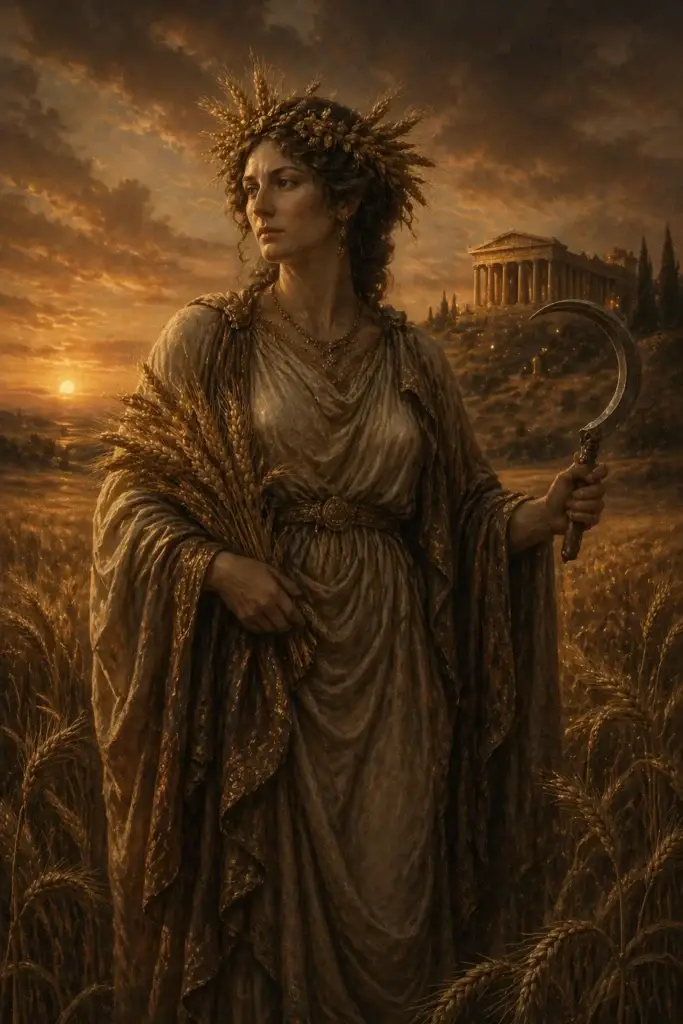
Demeter is depicted as a dignified, mature woman, often with ears of grain in her hair or in her hands.
Her symbols are wheat and barley, the torch (which she carried while searching for Persephone), the cornucopia (abundance), and sometimes poppy seeds (an intoxicating substance, a symbol of the mysteries). She wears flowing garments, sometimes a veil. Her animal is the snake (chthonic, with a connection to the underworld).
Character Traits
Demeter is venerated above all in the Eleusinian Mysteries, where the story of her myth is re-enacted. She is invoked by farmers and sowers. Her offerings are fruits, grain sacrifices and wine. At Eleusis secret rites are performed, and initiates swear to keep silent.
The mysteries promise the faithful a better fate in the afterlife. Demeter’s wrath (frost and famine when she misses Persephone) shows her power: without her grace, the world starves. She is one of the few deities with direct power over human survival.
Appearance and Symbolism
Demeter is depicted as a mature, dignified woman, often with ears of grain in her hair or in her hands, sometimes with a torch, a symbol of her desperate search for Persephone. The torch shows her as timeless. The grain, the barley, the wheat, these are her primary attributes.
The poppy was sacred to her (because of its opium-bearing qualities, which bring forgetting). The pig was her sacred animal, a sacrificial offering for her mysteries. Her colour was golden like ripe grain.
In contrast to other gods, she bore dignity without arrogance; she was the mother of all growth, approachable and at the same time fundamental to human survival.
Profile: Demeter
The most important aspects of Demeter at a glance. The following fields summarise her origin, function, appearance, veneration, symbols and parallels.
Demeter is the daughter of Cronus and Rhea, sister of Zeus, Hera, Hades, Poseidon and Hestia, one of the two principal Olympian goddesses of Titan descent. She is the mother of Persephone (her daughter with Zeus).
Her central myth: the search for Persephone, who was abducted by Hades; during her grief the vegetation withers, and after Persephone’s partial return (two thirds of the year) the fertile seasons come back. A symbol of seasonal return.
Patroness of the grain harvest and of agricultural fertility (especially wheat). In the mystery cult she grants the initiated a happy afterlife under her protection and that of Persephone.
Demeter Thesmophoros (“the lawgiver”) as patroness of marriage and of women’s assemblies (the Thesmophoria festival). In personal cult she was also invoked for protection against hunger and illness.
A mature, matronly female figure, often seated on a throne. A wreath of grain ears on her head, a bundle of ears in her hand, sometimes a torch (a symbol of her search for Persephone). Curly hair, often covered with a veil.
Golden skin colour (the grain). Frequently accompanied by Triptolemus (the youthful god who taught agriculture, her foster child) and a snake-drawn chariot. On the Locri pinakes she often appears in a mourning pose. In the mysteries she is depicted as a crowned mother goddess.
Sphere of influence: Demeter was invoked by farmers before and after the harvest. Her most important festivals: the Thesmophoria (a three-day women’s festival in autumn, widely celebrated), and the Eleusinian Mysteries (held in the month of Boedromion, around September; a nine-day initiation festival with far-reaching appeal).
The mysteries promised a happy afterlife under the patronage of Demeter and Persephone. Initiates from across the Mediterranean travelled to Eleusis. In personal cult she was invoked as a mother goddess, especially by women.
A wreath of grain ears, a bundle of ears (the main attribute), a torch, the poppy (a symbol of the depth of vegetation), a snake-drawn chariot, the pig (the main sacrificial animal), and the kalathos (a tall basket).
Plants: wheat, barley, poppy, pomegranate (through the connection with Persephone), and asphodel. Sacred animals: pig, snake and crane.
Ceres (Rome, an almost identical adoption), Isis (Egypt, syncretistically overlaid in Hellenistic times), Inanna/Ishtar (Mesopotamia, partly, in the vegetation aspect), Hathor (Egypt, a matronly goddess), Annapurna (Hinduism, the giver of food), Sif (Germanic, a grain goddess), Inari (Japan, a rice deity). The Indo-European root of the grain-mother tradition can be recognised in several languages.
Warding Off in Everyday Life
Veneration in Everyday Life
Rituals and invocations
The Eleusinian Mysteries promised the initiated a good lot in the afterlife. Alongside them stood the Thesmophoria as a women’s festival and the solemn procession from Athens to Eleusis along the Sacred Way.
Conjurations and invocations
Textual transmission and formulae
The Homeric Hymn to Demeter recounts the abduction of Persephone and the founding of the mysteries of Eleusis. Orphic hymns and Eleusinian ritual texts supplement the tradition.
Amulets and protective symbols
Material apotropaia and archaeological evidence
Ears of grain served as a visual emblem of the goddess, and the kykeon drink as a cult beverage. From the sanctuary of Eleusis come numerous votive offerings, among them piglet figurines, since the pig was Demeter’s sacrificial animal.
Demeter, Parallels in Other Cultures
Grain goddesses and fertility goddesses are found everywhere: Hathor or Isis (Egypt), Aditi (India), Sif (Scandinavia). Demeter’s cycle of mourning resembles the descent of Ishtar/Inanna (Mesopotamia) or the death of Baldr (Scandinavia).
The Eleusinian Mysteries are unique in their significance and secrecy. Demeter’s role as mother and her agricultural domain set her apart from other fertility goddesses such as Aphrodite or Hera.
Demeter and the Eleusinian Mysteries
The most important cult of Demeter was that of Eleusis near Athens.
The Homeric Hymn to Demeter tells how the goddess, while searching for her daughter Persephone, comes to Eleusis, serves there as a nurse in the house of King Celeus and finally, once her divine form has been revealed, demands the building of a temple and the establishment of her rites.
This narrative is the founding myth of the Eleusinian Mysteries.
The mysteries were an initiation cult that promised the initiated a more favourable prospect in the life after death. They were celebrated each year in autumn and included a solemn procession from Athens to Eleusis, purification rites, fasting and nocturnal celebrations in the great hall of the sanctuary.
The initiated kept silent about the secret core, the central act of showing, and this silence was preserved over centuries. Religious studies can therefore describe the outer framework well, but cannot reliably reconstruct the innermost event.
Significant is the connection between agriculture and the hope of an afterlife that is set out in this cult. Demeter is the goddess of grain, and the seed corn that is placed into the dark earth and rises anew provided a vivid image for the hope of the initiated.
Ancient testimonies from Pindar to Cicero attest that the mysteries were regarded as especially venerable and that initiation into them offered consolation in the face of death. The sanctuary of Eleusis remained in operation into the Christian late antiquity and was not destroyed until the late 4th century AD.
The Goddess of Grain and of Farm Labour
At her core, Demeter is a deity of agriculture, more precisely of grain. Her name has been interpreted in various ways by ancient and modern etymologists; the second component, meter, means mother, while the first is disputed, which is why scholarship remains cautious here.
Her sphere of activity, however, is undisputed. She ensures that the seed sprouts, the grain ripens and the harvest succeeds.
This responsibility made her one of the vital deities for an agrarian society such as ancient Greece. Numerous festivals accompanied the agricultural year.
The Thesmophoria, a festival observed only by women, was among the most widespread Greek festivals of all; it was connected with the sowing and included rites in which the remains of sacrificed pigs were dug up again and mixed under the seed.
The Haloa, the Skira and other festivals marked further points of the agricultural year.
Demeter’s attributes reflect this sphere. She bears ears of grain and poppy capsules, holds a torch that recalls the search for her daughter, and is associated with the pig as a sacrificial animal. In the legend she teaches the hero Triptolemus agriculture and sends him out to carry the knowledge of grain among humankind.
Thus Demeter is also a bringer of culture: the ordered cultivation of grain is regarded in Greek thought as a step from the raw to the civilized way of life, and according to mythical belief, humankind owes this step to the goddess.
Mythical Episodes Beyond the Abduction of Persephone
Although the abduction of her daughter is the best-known narrative about Demeter, the tradition knows further episodes that illuminate her nature. One of these is the story of Erysichthon, a king who has a sacred grove of Demeter felled in order to obtain timber.
As punishment the goddess strikes him with insatiable hunger. Erysichthon consumes his entire fortune, finally sells his own daughter and in the end devours himself. Ovid elaborated this dark narrative in the Metamorphoses. It shows Demeter as a power that relentlessly avenges sacrilege against her sacred places.
Another tradition concerns the union with the hero Iasion, with whom, according to Hesiod’s Theogony, Demeter begets the wealth-god Plutus on a thrice-ploughed field. The name Plutus means abundance, and the episode again connects Demeter with agricultural yield and prosperity.
In an Arcadian local tradition, in turn, the god Poseidon unites with Demeter in the form of a horse; from this union springs the marvellous horse Areion. This legend is connected with the cult of Demeter Erinys or Demeter Melaina, the black Demeter, in Arcadia.
These scattered narratives are valuable for scholarship because they show that Demeter cannot be reduced to the single great mother-and-daughter story.
In the local traditions that Pausanias collected in his Description of Greece, she appears more varied and in part more archaic, for example in wrathful, dark or animal-shaped aspects. Religious studies sees in this layers of different ages that overlie one another in the transmitted image of Demeter.
Afterlife: From the Roman Ceres to Modern Scholarship
The Romans equated Demeter with their own grain goddess Ceres, whose name lives on to this day in words such as cereals.
The cult of Ceres in Rome had a history of its own and was early on connected with the plebs and with the city’s grain supply, but over time it took on numerous features of the Greek Demeter.
With it, the myth of the abduction of the daughter, elaborated in Latin by Ovid and other poets, passed into Roman and later into European literature.
In post-antique art and poetry Demeter appears, usually under the name Ceres, as personified fertility and as summer in depictions of the seasons. The allegorical reading of the Persephone myth as an image of the vegetation cycle was already common in antiquity and remained so into the modern era.
Scholarly engagement with Demeter in the 19th and 20th centuries was closely tied to the debate over mother cults and over the relationship between myth and rite. Older theories saw in Demeter a pure vegetation deity or linked her with speculations about a prehistoric matriarchy; these approaches are now regarded as outdated.
More recent scholarship, such as Walter Burkert in his Greek Religion and specialist studies on Eleusis, emphasises instead the concrete cultic and social function of the goddess: her importance for securing food, for the ritual world of women in the Thesmophoria and for the hope of an afterlife held by the initiates.
Demeter thus remains a central example of how closely Greek religion was interwoven with the basic conditions of life, with food, death and hope.
Further Links
Literature (Selection)
Further standard works in the literature index.
In Greek mythology Demeter appears as the goddess of agriculture and of the sowing seasons, whose grief over her abducted daughter Persephone explains the change of the seasons and was liturgically re-enacted in the cult of Eleusis.
Frequently Asked Questions about Demeter
Who is Demeter in Greek mythology?
Demeter (also Damater, roughly Earth Mother) is the Greek goddess of fertility, agriculture and the harvest, one of the twelve Olympian gods. She is the sister of Zeus and the mother of Persephone. Her Roman counterpart is Ceres (from which the word cereal derives).
The central myth: Hades abducts Persephone, Demeter grieves so deeply that the earth becomes barren; a compromise with Hades makes Persephone’s annual return possible. This is the mythological explanation of the yearly cycle of fertility and fallow.
What is Demeter’s role in the Eleusinian Mysteries?
Demeter is the principal goddess of the Eleusinian Mysteries, the most important mystery cult of ancient Greece. The myth: while searching for Persephone, Demeter came to Eleusis in ragged clothing and was hospitably received there by the king.
She revealed to the Eleusinians her true identity and the mystery of the grain: whoever grasps the secret of the rebirth of the seed may also hope for their own resurrection.
Initiation into the Greater Eleusinia (in September) promised the initiated a happier afterlife, the mystery cult was kept strictly secret and was practised for almost 2000 years.