Nyami Nyami, the river god behind the Kariba Dam wall
By Ralf Ittermann · last reviewed on
Nyami Nyami is a god of the Tonga tradition of the Zambezi.
River god of the Zambezi, a wrathful avenger since the Kariba Dam. Nyami Nyami is the river god behind the wall of the Kariba Dam.
Nyami Nyami is the snake god of the Zambezi, lord of the Tonga’s river, giver of life and food, powerful and feared. Since the Kariba Dam of 1956 he is said to have been separated from his wife; the floods of 1957 and 1958 were attributed to his wrath.
Type: river and snake god
Origin: Zambezi Valley
Texts: oral, treated academically
Period: traditional, alive to this day
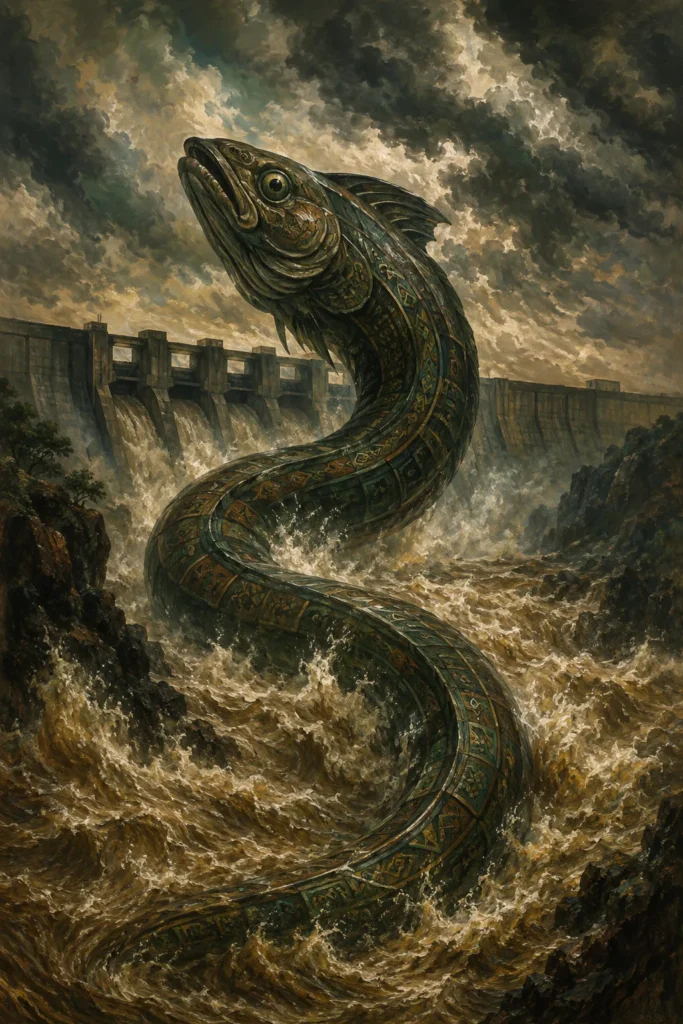
Appearance: serpent body, fish head
Historical Background
Period of the Texts
A living tradition of the Tonga, historically traceable since the Kariba Dam of 1956.
Area of Diffusion
The Zambezi Valley and Kariba region between Zimbabwe and Zambia.
Sources
Oral and treated academically, among others by Howarth and in the Journal of Africana Religions.
Name and variants
Spelling: Alongside Nyami Nyami, Nyaminyami is also common, as used in specialist literature.
Form and symbolism
Appearance
He appears with a serpent body and fish head, also interpreted as a whirlpool or river dragon; the amulet depicts him in a curved form.
Effect
As a provider he gave flesh from his own body in times of famine; his wrath manifests as flood and earthquake.
Profile: Nyami Nyami
The key aspects of the river god at a glance.
River god of the Tonga in the Zambezi Valley.
The Zambezi: life and food, and since Kariba also wrath and retribution.
Serpent body with a fish head, reproduced in the amulet.
Giver of life, and since his separation from his wife also an avenger.
Wearing the amulet, incense and river rituals, environmental preservation.
Mami Wata as well as the Yoruba deities Yemoja and Oshun.
The separation caused by the Kariba Dam
Nyami Nyami is regarded as lord of the Zambezi before the Kariba Dam. The dam construction, begun in 1956, forcibly resettled the Tonga and, according to the story, separated him from his wife. The floods of 1957 and 1958 were attributed to his wrath.
Cultural heritage and souvenir trade
Nyami Nyami is a cultural symbol of Zimbabwe and Zambia, subject to debate over appropriation and commercialisation. The core is traditional, though the present-day form has been strongly shaped by Kariba and the souvenir trade.
Amulet and river ritual
Documented practices include wearing the Nyami Nyami amulet as a protective and lucky sign, incense and offering practices around the river, and blessed water. The reshaping by the souvenir trade is regarded as appropriation.
Water serpents in comparison
Frequently asked questions about Nyami Nyami
Why is Nyami Nyami angry?
The Kariba Dam separated him from his wife; floods and earth tremors are regarded as his wrath.
Is it authentically old?
The core is traditional, but strongly shaped by Kariba and the souvenir trade.
Further links
Internal links:
Literature (selection)
Further standard works in the bibliography.
The Tonga tradition calls its river lord Nyami Nyami of the Zambezi, and as the snake god of Kariba he remains alive today in the curved amulet, a reminder of the river and the wrath of a disturbed order.