Boitatá, the glowing guardian of the forests
By Ralf Ittermann · last reviewed on
Boitatá is a spirit of the Tupi-Guarani tradition of Brazil.
The fire serpent that punishes arsonists and forest destroyers.
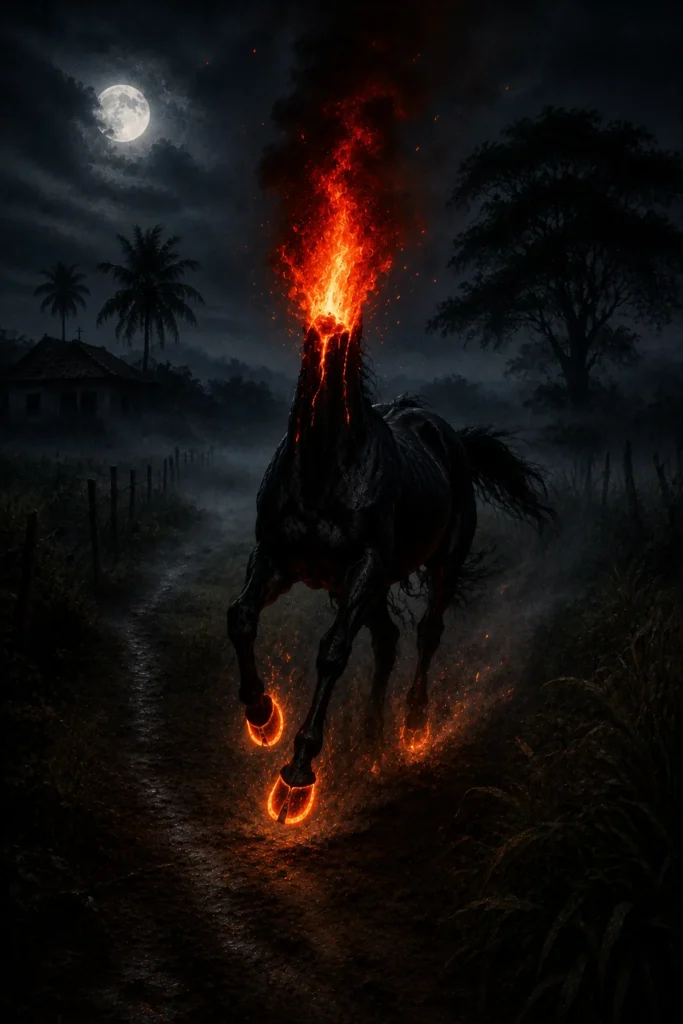
Boitatá, also called Mboitatá or Baitatá, and often written simply as Boitata, is the Brazilian fire serpent: a protective spirit of the forests and fields. It appears as a huge, glowing serpent with fiery eyes and punishes those who destroy the forest or set fires; for the mindful it poses no danger.
It is one of the oldest documented Brazilian legends, mentioned early in the letters of the Jesuit José de Anchieta in the 16th century, and today widespread throughout Brazil with regional variants.
Type: Fire serpent and protective spirit of the forests and fields
Origin: Tupi-Guarani tradition of Brazil
Texts: letters of the Jesuit José de Anchieta, works of Câmara Cascudo
Period: since the 16th century
Appearance: huge, glowing fire serpent with fiery eyes

Context of the tradition
Period of the Texts
One of the oldest documented Brazilian legends: mentioned early in the letters of the Jesuit José de Anchieta in the 16th century, later systematically recorded by folklore research.
Area of Diffusion
Found throughout Brazil with regional variants; the fire serpent belongs to forest and field, though in some versions its light also appears over a river or beach.
Sources
Good: the early Jesuit letters and the standard works of Luís da Câmara Cascudo on Brazilian folklore.
Name and variants
Tupi-Guarani: The common interpretation is mboî or boî, serpent, and tatá, fire, hence fire serpent. According to Câmara Cascudo, the name derives from mba’e-tatá, fiery thing, which was secondarily reinterpreted as cobra de fogo; both interpretations are represented in scholarship.
Description
Appearance
Boitatá appears as a huge, glowing or fiery serpent, often with oversized, fiery eyes. In some versions it is perceived merely as a streak of light over field, river or beach, which brings it close to the will-o’-the-wisp.
Effect
Boitatá is a protective spirit of the forests and fields. It punishes those who destroy the forest or set fires, pursuing and burning or blinding wrongdoers. In one widespread aetiology, it arose from the eyes of unburied dead after a great flood, which absorbed the fire and light into themselves.
Profile: Boitatá
The most important aspects of the fire serpent at a glance.
One of the oldest Brazilian legends, having travelled from the Tupi-Guarani tradition into the folklore of the whole country.
Forest and field: the Boitatá watches over both and turns against arsonists and forest destroyers.
A huge, glowing serpent with fiery eyes; in some versions merely a streak of light over field, river or beach.
An ecological punishing and protective spirit: it pursues, burns or blinds those who harm the forest; it does nothing to the mindful.
Not a cult, but a rule of conduct: do not light fires outdoors at night and do not harm the forest; no formal ritual of defence has been passed down.
The Luz Mala in its light aspect, the forest guardian Curupira of American folklore, and the fire dragons of other cultures.
From Anchieta's letters to Câmara Cascudo
Boitatá is one of the oldest documented Brazilian legends, mentioned early in the letters of the Jesuit José de Anchieta in the 16th century. From there, the tradition passes through the regional variants of the whole country to the standard works of Câmara Cascudo, who recorded the fire serpent lexicographically and geographically.
Eco-guardian of the modern age
Boitatá is very present in school, children’s books, comics and film, including animation and video games, and is interpreted in modern times as an eco-guardian.
From a religious-studies perspective, Boitatá is a prime example of the ecological protective spirit: fire punishes the destruction of nature. It is primarily a protective, punishing spirit, not merely an evil giant serpent. The tatá derivation as fire is well established, while the precise word formation remains disputed.
Rules of conduct instead of ritual
There is no active cult; this should be stated honestly. The legend is rather normative and cautionary: whoever protects the forest is not touched by the Boitatá. The rule of conduct is not to light fires outdoors at night and not to harm the forest. No formal ritual of defence has been passed down.
Between will-o'-the-wisp and fire dragon
Boitatá combines fire serpent and will-o’-the-wisp, thereby forming a bridge between light phenomena such as the Luz Mala and the fire dragons of other cultures. As an ecological punishing and protective spirit, it resembles other forest guardians of American folklore, such as Curupira. Among the fire beings of South America, it thus stands apart from the destructive Cherufe.
Frequently asked questions about Boitatá
What does Boitatá mean?
The common interpretation is fire serpent, from tatá, fire; Câmara Cascudo, by contrast, derives the name from fiery thing. Both interpretations are represented in scholarship.
Is Boitatá evil?
No. It is primarily a protective spirit of the forests and fields, punishing only arsonists and forest destroyers; for the mindful it poses no danger.
How did it arise?
According to a widespread account, from the eyes of the dead after a great flood, which absorbed fire and light into themselves.
Further links
Literature (selection)
Further standard works in the bibliography.
As both the Brazilian fire serpent and protective spirit of the forests, Boitatá shows how a legend becomes a rule of conduct: whoever respects the forest and lights no fires has nothing to fear from its glow.