Atar, the eternal fire of the fire temples
By Ralf Ittermann · last reviewed on
Atar is a god of the Persian tradition.
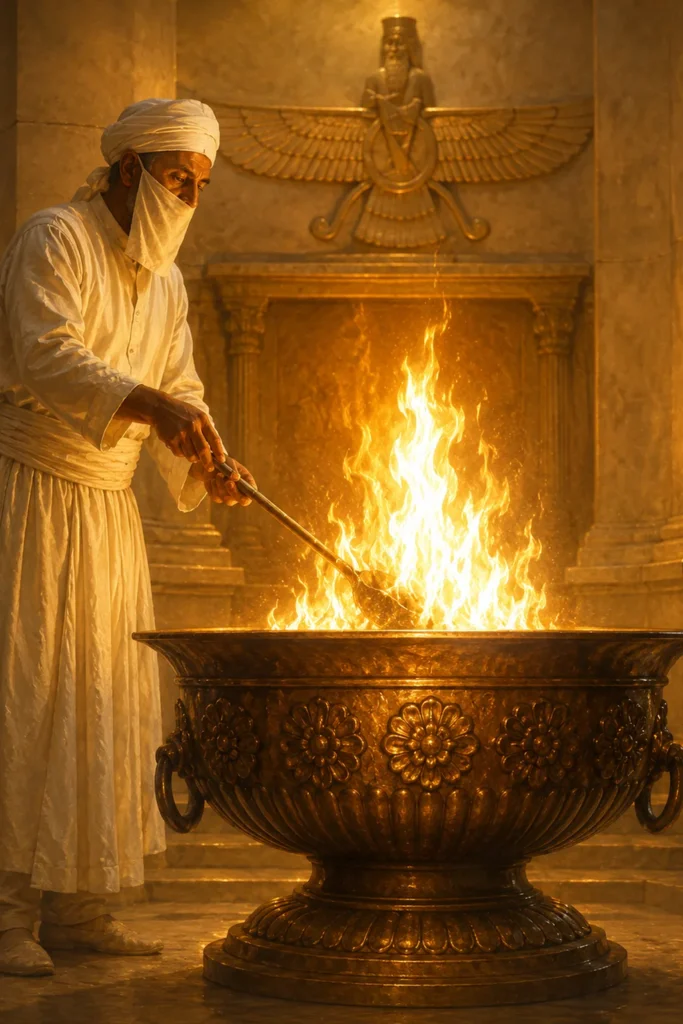
The sacred fire, visible presence of Ahura Mazda.
Atar is the sacred fire and its Yazata, the being worthy of worship, in Zoroastrianism. As the son of Ahura Mazda, it embodies purity and truth and is the central cult element of the eternal fires in the fire temples.
Zoroastrianism is a religion still practised today: in Iran, especially in Yazd and Kerman, and among the Parsis in India, the sacred fires continue to burn, tended by an unbroken priestly tradition.
Type: The sacred fire itself as well as its Yazata
Origin: Zoroastrianism, Indo-Iranian fire cult
Texts: Avesta from the Gathas to the Pahlavi literature
Period: earliest Gathic Avestan to the living practice of the present
Appearance: the pure flame fire of the fire temples
Textual history
Period of the Texts
Attested from the earliest Gathic Avestan to the Pahlavi literature; the practice of the fire temples continues to this day.
Area of Diffusion
Iran, especially Yazd and Kerman, as well as India among the Parsis, where eight of the highest fires burn.
Sources
Well documented: the Avesta itself and the living tradition, illuminated by the standard works of Boyce and Rose.
Name and variants
Avestan: ātar means fire, Middle Persian Ādur or Ādar, New Persian Āzar; the word is cognate with the Vedic term for fire. In the Avesta, Atar is called the son of Ahura Mazda.
Description
Appearance
The pure flame fire is the visible presence of Ahura Mazda and his asha, truth and order. Atar is closely linked with Asha Vahishta, the Best Righteousness, and is often mentioned together with her.
Effect
Atar embodies truth, order and purity; the fire helps to burn away evil. It is the central element of the ceremonies and the focal point of the fire temples.
Profile: Atar
The key aspects of the sacred fire at a glance.
Zoroastrianism: still largely abstract in the oldest Gathas, Atar is personified in later texts as the Yazata of heat and light.
Purity, truth and order; the fire is the visible presence of Ahura Mazda in the world.
No image, but the pure flame fire itself, tended in the fire temples, the Atashkadeh.
Central element of all ceremonies; the fire helps to burn away evil and connects the community with the divine.
Eternal fires of the fire temples; the highest category is the Atash Behram, the victorious fire, tended by the fire priest.
From abstract medium to Yazata of fire
In the oldest Gathas he remains largely abstract, a medium of the creator; only in later texts is he personified as a Yazata, a deity of heat and light. This development reflects the core of the Zoroastrian understanding of fire: fire is first a sign and instrument of truth before it is grasped as a being worthy of veneration in its own right.
Living Religion and Classification
Zoroastrianism is a living religion: the Atash Behram of Yazd is the only one of the highest fires in Iran, alongside eight further Atash Behrams among the Parsis in India. Active fire temples and an unbroken priestly tradition keep the cult alive.
From a religious-studies perspective, Atar is the prototype of the fire cult as a symbol of purity and truth. It is important to clarify that Zoroastrians are not fire worshippers: fire is a medium and visible sign of the divine, not itself the highest god.
The Eternal Fire and Its Tending
The eternal fires in the fire temples, the Atashkadeh, are well documented. The highest category of fire is the Atash Behram, the victorious fire; the fire in the Atash Behram of Yazd has, according to tradition, burned continuously since around 470 AD. The fire priest keeps the fire going and must not allow it to go out. To maintain purity, the priests wear a white cloth over the mouth and nose, the padan, when tending the fire, so that breath and saliva do not contaminate it; only Zoroastrians may enter the sanctum area.
Agni, Girra, Nusku: the Fire Cult in Comparison
Atar corresponds to the Vedic Agni as a direct Indo-Iranian relative sharing a common origin of the fire cult, with fire as purity and mediator of sacrifice. Alongside them stand the Mesopotamian fire and purity gods Girra and Nusku, where fire likewise purifies and mediates, though without any genetic relationship to the Iranian cult.
Frequently Asked Questions about Atar
Do Zoroastrians worship fire?
No. Fire is a symbol and medium of purity and truth and the visible presence of Ahura Mazda, not itself the highest god.
Why do priests wear a mouth cloth?
The padan prevents breath and saliva from contaminating the pure fire. It is part of the strict purity practice of the cult.
How old are the eternal fires?
The fire in the Atash Behram of Yazd has, according to tradition, burned continuously since around 470 AD.
Further links
Further reading:
- Agni – the Vedic relative of the Iranian fire cult
- Girra, Nusku – Mesopotamian fire and purity gods
- Protective candle, smudging, amulet – signs of purity and veneration
- Protection Compass – an overview of protective means
Literature (selection)
Further standard works in the bibliography.
As the Yazata of fire, Atar shows how sacred fire connects Zoroastrianism and lived everyday life to this day: the eternal flames of the fire temples are not objects of worship but the visible sign of purity, truth and the presence of Ahura Mazda.