Machen Pomra, ancestor and warrior of Amdo
By Ralf Ittermann · last reviewed on
Machen Pomra is a god of the Tibetan tradition.
The warrior mountain god and ancestor of the Golok in Amdo.
Machen Pomra, also known as Amnye Machen or Grandfather Pomra, is the warlike mountain deity of the sacred mountain range roughly 6282 metres high in Amdo, in north-eastern Tibet. He is a central national and ancestral god with a war function and one of the most important pilgrimage and Kora mountains of the highland.
As the ancestral and tribal protective god of the Golok, he is both a benefactor and a danger: benevolent towards his own people, warlike, proud and dangerous to enemies. In the Epic of Gesar he appears as the father of King Gesar.
Type: War and protective god, ancestral and tribal god
Origin: pre-Buddhist Bön tradition of Amdo
Texts: Bön and Buddhist ritual texts, Epic of Gesar, specialist literature on pilgrimage and cult
Period: pre-Buddhist to the present
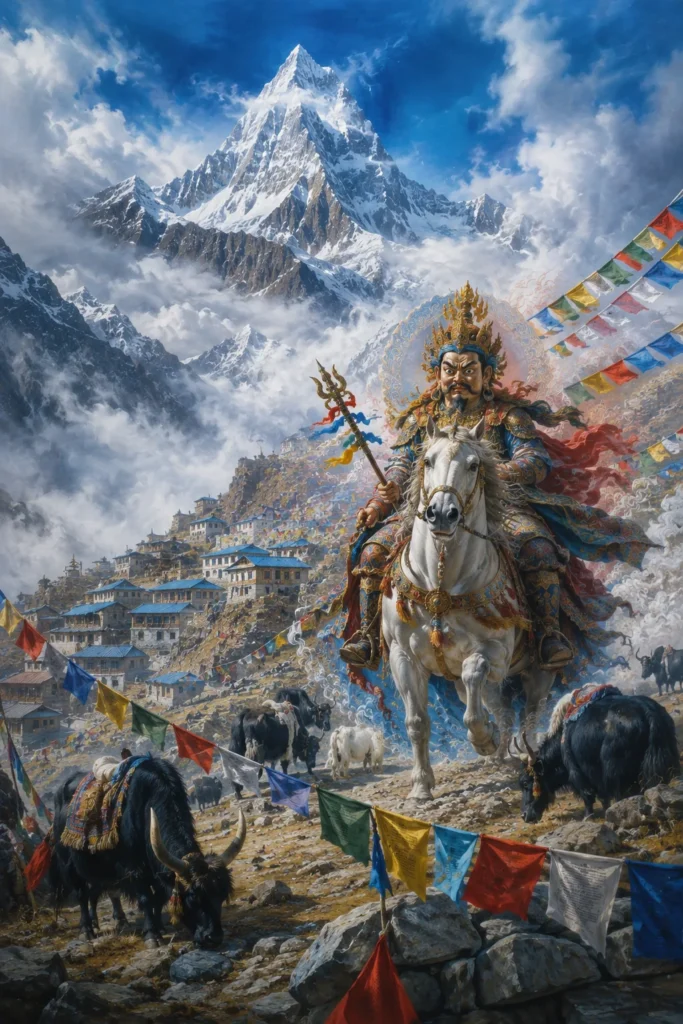
Appearance: white warrior with a spear, riding a snow lion or a horse

Region of origin and sources
Period of the Texts
The tradition spans from the pre-Buddhist Bön tradition through Buddhist ritual texts to the Epic of Gesar and into living pilgrimage practice.
Area of Diffusion
Amdo in north-eastern Tibet, today’s Qinghai province: the land of the Golok, whose ancestral and protective god is Machen Pomra.
Sources
Well documented: specialist literature on pilgrimage and cult, foremost the studies by Buffetrille, Karmay and Huber.
Name and variants
Tibetan: The name combines Amnye, grandfather or ancestor, an honorific title, with Machen and Pomra. The element rMa refers to the rMa river, the Tibetan name for the upper Yellow River; rgyal means king. Amnye is a title, not a proper name of the god.
Form and effect
Appearance
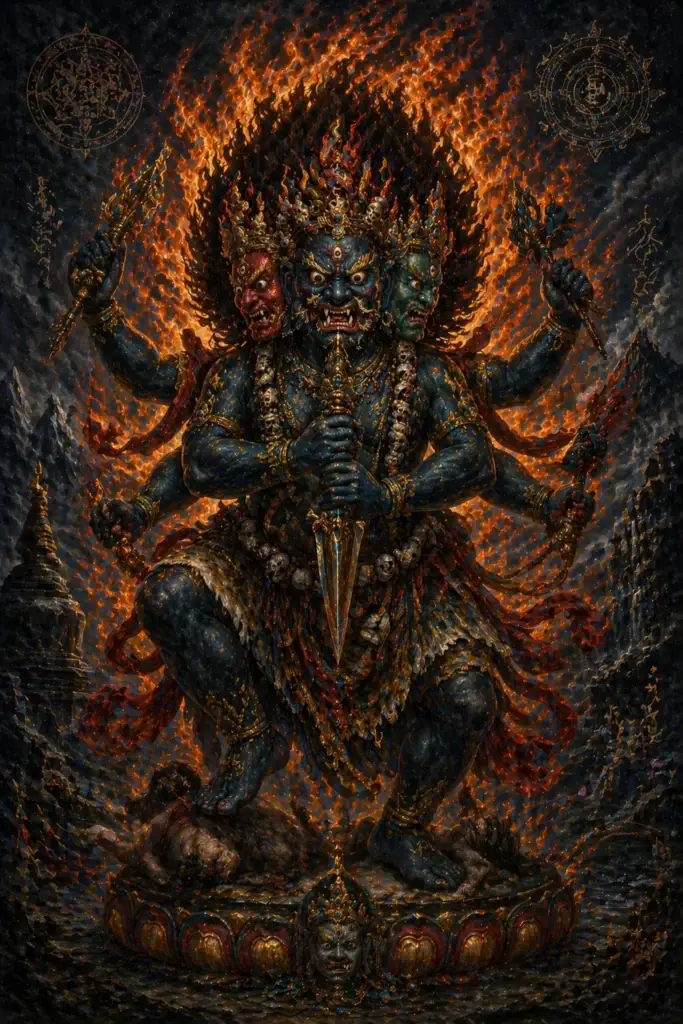
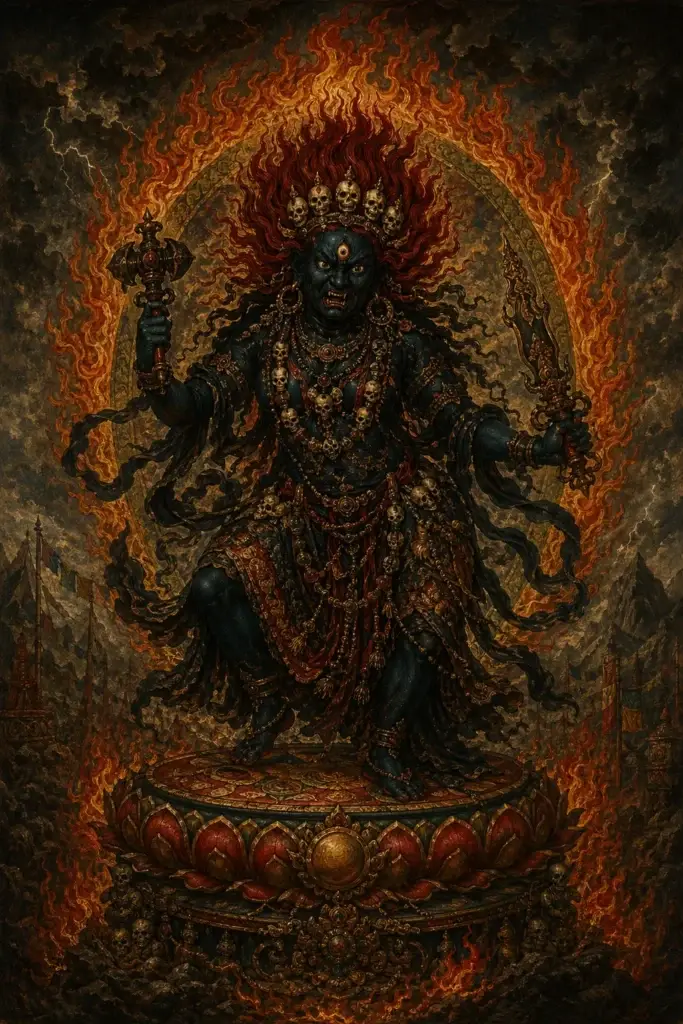
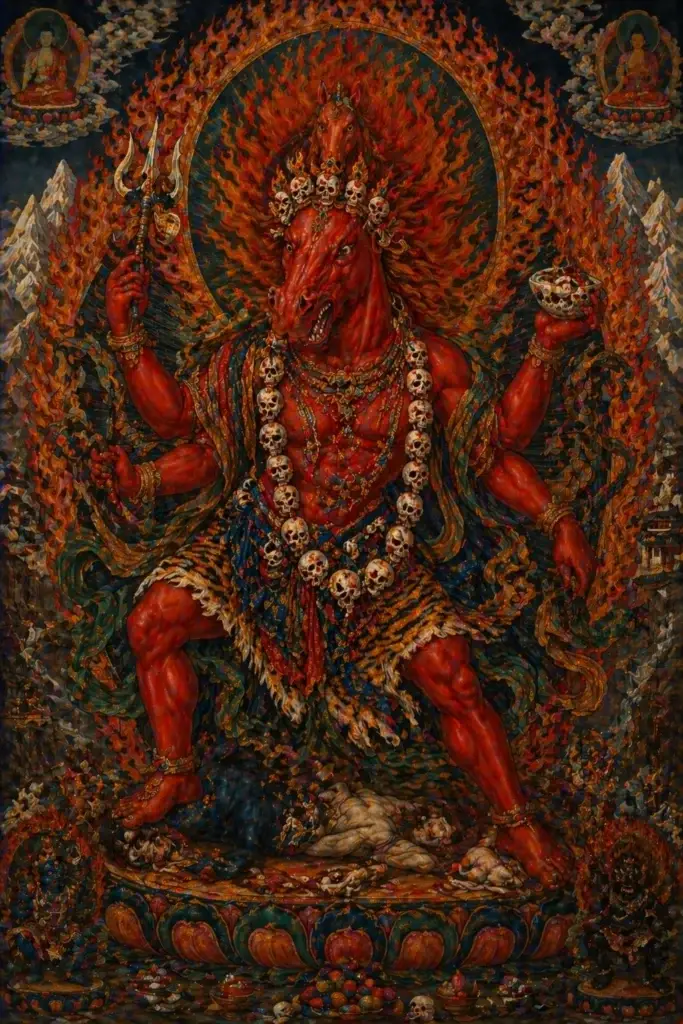
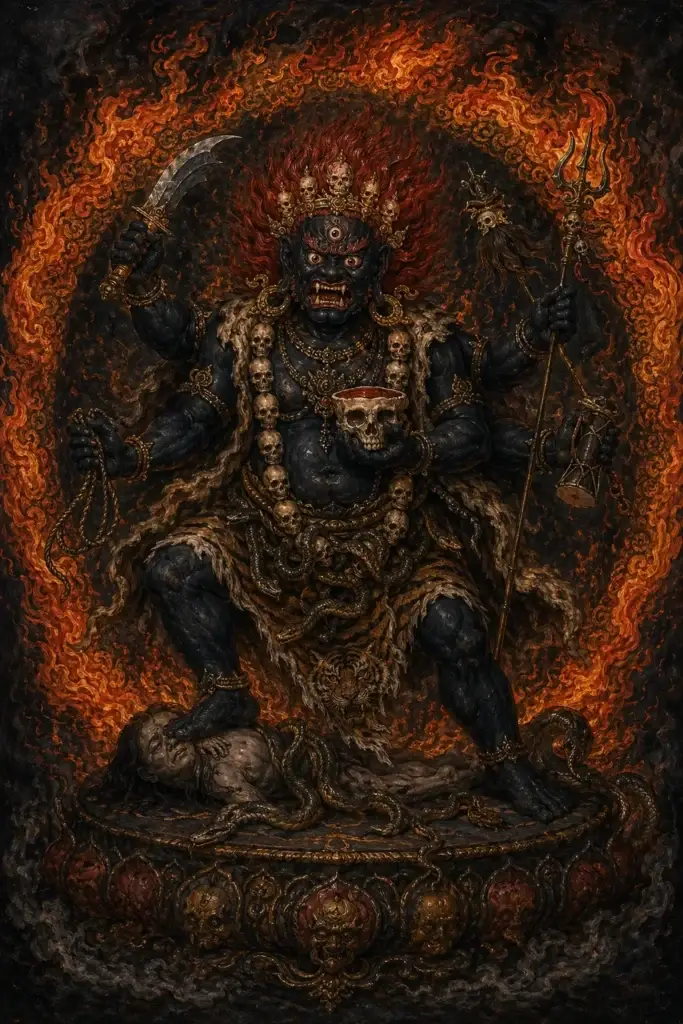
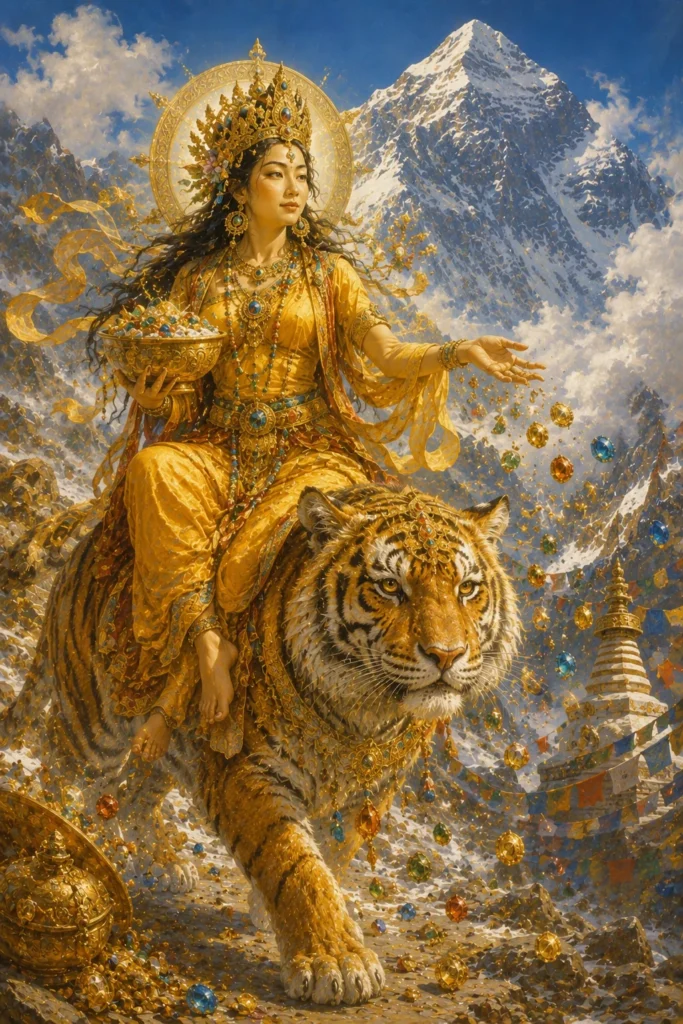
The iconography varies: one Bön thangka shows Machen Pomra as a warrior in helmet and armour with a spear and a golden treasure vase, riding a white snow lion with a green mane; Buddhist ritual texts give him a white battle robe, a spear and a jewel bowl, and a magic horse. The dominant colour is white; his consort is the goddess rMa-chen.
Effect
Machen Pomra is a god of war and subduer of enemies, as well as the ancestral and tribal protective god of the Golok. He makes livestock fertile, his snowmelt water heals illness, and he is a weather and natural force of his land.
Profile: Machen Pomra
The key aspects of the warrior mountain god at a glance.
Pre-Buddhist yul lha and gzhi bdag of the Bön tradition, appropriated by Buddhism through the Padmasambhava myth, yet one of the most defiant spirits.
The Golok and the people of Amdo: war and defence against enemies, fertility of livestock, healing snowmelt water, weather and land.
White warrior in helmet and armour with a spear, along with a treasure vase or jewel bowl; his mount is a white snow lion with a green mane or a magic horse.
God of war and subduer of enemies, ancestral and tribal god; in the Epic of Gesar the father of King Gesar, appearing there in the form of a yellow man.
Sang smoke offerings with juniper, the Kora circumambulation of around a week, especially meritorious in the Horse Year, together with Latse stone cairns and prayer flags.
Brother of Nyenchen Tanglha and Yarlha Shampo, a type of mounted warrior mountain god, the dgra lha; alongside him the Golok ancestor Nyenpo Yutse.
From Bön mountain to bound protector
Machen Pomra is a pre-Buddhist yul lha and gzhi bdag deeply rooted in the Bön tradition, with a war-god function. The honorific title Amnye, grandfather or ancestor, shows his role as a tribal and ancestral god; the element rMa refers to the rMa river, the Tibetan name for the upper Yellow River, rgyal meaning king.
Like many great mountain gods of Tibet, he was appropriated by Buddhism through the Padmasambhava subjugation myth, but is regarded as one of the most defiant spirits. In the Epic of Gesar he fathers King Gesar and appears there as a yellow man; thus his role spans from a local territorial god to the great epic literature of the highland.
Reception and classification
In the 1920s to 1940s the mountain was grossly overestimated and briefly discussed as a possible highest mountain in the world, pure explorer folklore. The first ascent of the main summit took place in 1981.
From a religious-studies perspective, Machen Pomra is a model example of Tibet’s warlike ancestral and protective mountain god. Important clarifications: at 6282 metres he is not higher than Everest; 1960 was not the first ascent of the main summit but only of a subsidiary peak; his origin lies in Bön and the pre-Buddhist period, not purely in Buddhism; Amnye is a title, not a proper name; and his mount varies between a snow lion and a horse.
Smoke offerings, Kora and Latse
Well attested are Sang smoke offerings with juniper as the central gift to the mountain god, the Kora circumambulation of the mountain range, classically taking around a week on foot, especially meritorious in the Horse Year, as well as Latse stone cairns and prayer flags on the passes. Before 1959, up to ten thousand Golok circled the mountain each year; the pilgrimage is among the great pilgrim movements of eastern Tibet.
Brothers and warrior mountain gods
Machen Pomra is the brother of Nyenchen Tanglha and Yarlha Shampo and embodies the type of the mounted warrior mountain god, the dgra lha. In his region of origin he stands alongside the Golok ancestor Nyenpo Yutse; in the wider Himalayan region, Khumbila as land deity of Khumbu and Miyolangsangma as goddess of Everest are related mountain deities.
Frequently asked questions about Machen Pomra
What does Amnye Machen mean?
Amnye is an honorific title, meaning grandfather or ancestor; the god’s name is Machen or Pomra, connected to the rMa River, the Tibetan name for the upper Yellow River.
What role does he play in the Epic of King Gesar?
He fathers King Gesar, appearing as a yellow man in this role.
Is the mountain higher than Everest?
No. It measures about 6282 metres; the brief classification as a possible highest mountain in the world was explorer folklore of the 1920s to 1940s.
Further links
Further reading:
- Tibet – all beings of the Tibetan belief world
- Nyenchen Tanglha – the brother and mountain god of Central Tibet
- Khumbila, Miyolangsangma – mountain deities of the Himalaya
- Censing and Purification, Amulet, Protective Candle – traditional protective means
- Protection Compass – overview of protective means
Literature (selection)
Further standard works in the bibliography.
As the Tibetan warrior mountain god of Amdo, the Amnye Machen unites ancestor worship, pilgrimage and warlike power: Machen Pomra remains the grandfather of his Golok people, and at the same time one of the most defiant among the bound gods of the highland.