Bunyip, water demon and figure of terror of the Aboriginal swamps and waterholes
By Ralf Ittermann · last reviewed on
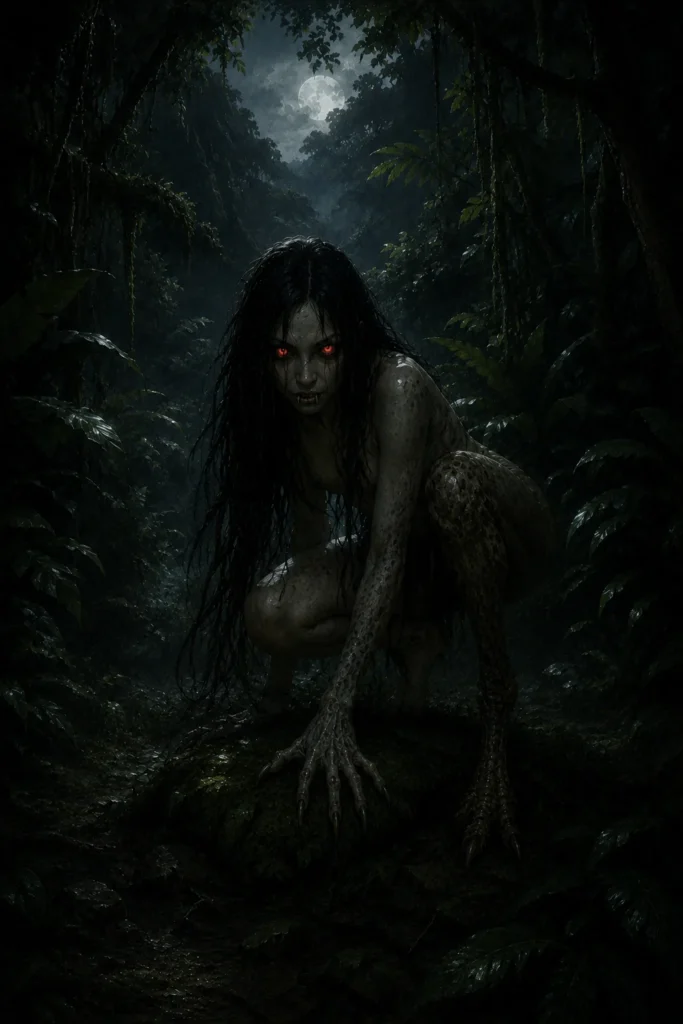
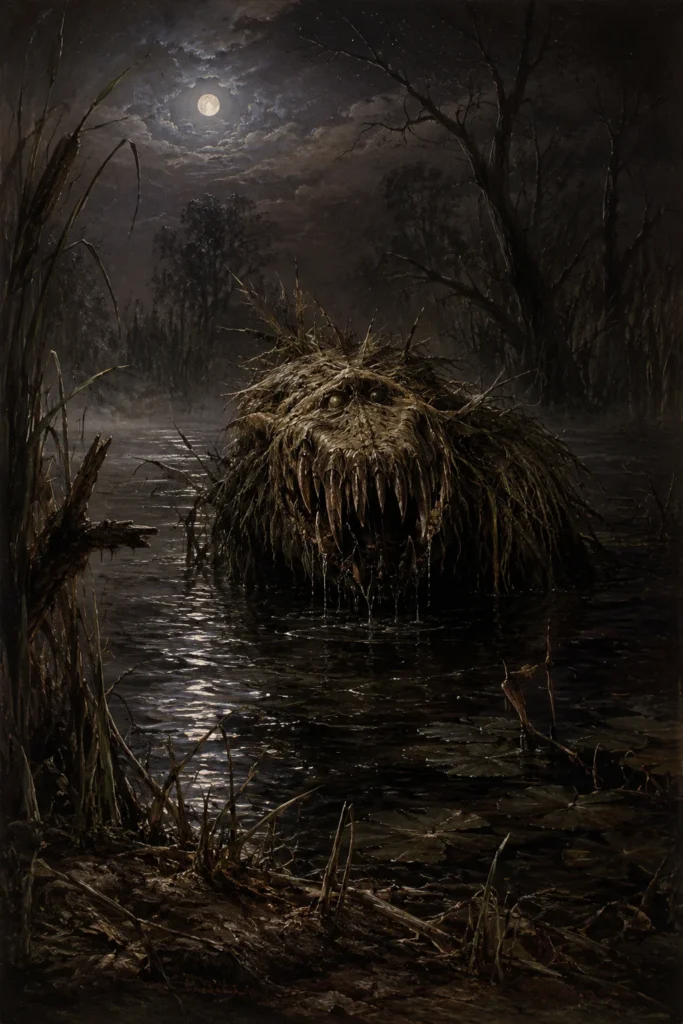
The Bunyip is a feared malevolent figure of the Aboriginal swamps and deep waterholes in south-eastern Australia. It lives beneath the water, calls out at night with a thundering voice, and drags careless people, especially women and children, into the depths. Demon lore surrounds the Bunyip, a water demon said to lurk beneath the swamps and waterholes of south-eastern Australia.
Classification and Brief Profile
The Bunyip (also Banib, Bunyup, Yaa-loo) is a malevolent figure attested in numerous Aboriginal languages of south-eastern Australia.
It lives in deep waterholes, swamps, and billabongs and is regarded as the embodiment of the inexplicable, dangerous power of water. Among the Wiradjuri, Kamilaroi, Kulin, Wemba Wemba, Eora, and many other groups it is feared.
Within the Aboriginal tradition, the Bunyip, unlike the Rainbow Serpent, is not a creative figure but a purely terrifying one. Both are connected to water, but while the Rainbow Serpent acts in a creative, ordering way, the Bunyip is purely threatening.
Of particular interest in the history of religion: the Bunyip is one of the few Aboriginal figures to have passed early into European-Australian popular culture.
As early as the late nineteenth century it was the subject of children’s literature, plays, and popular stories. This process of transition is an important case study in the anthropology of religion.
Name and Etymology
The name Bunyip is an anglicisation of words from various Aboriginal languages; the precise source is disputed. One traditional derivation connects it with the Wemba-Wemba word banib (“devil”, “malevolent spirit“); other scholars propose the Wathaurong buniya.
In the various Aboriginal languages the being is called by different names: Banib (Wemba Wemba), Mungoongarlie (Wiradjuri variant), Wowee-wowee (Kulin), Yaa-loo (Eora). This diversity shows that the “Bunyip” is not a single being but a family of related figures of terror that were combined under one name in European-Australian folklore.
In Bunyips: Australia’s Folklore of Fear (2001), Robert Holden worked through the linguistic and folkloristic history of the Bunyip in detail. His book is the most important overview.
Description and Iconography
The descriptions of the Bunyip vary greatly among the Aboriginal groups. Common elements are: a large, dark body with a seal-like form, broad claws, long fur, glowing eyes, horns or antler-like protrusions, and a booming or barking voice. Some descriptions mention a beak or a tusk.
This variability has led researchers to distinguish three “types”: a seal-like, a water-cattle-like, and a serpent-like Bunyip. Robert Holden worked out this typology systematically in Bunyips (2001).
In Australian popular culture since the late nineteenth century, a consolidated Bunyip iconography has become established: a rather cuddly, kangaroo-like being with a long tail and a friendly face. This domestication in children’s literature (for example Jenny Wagner’s The Bunyip of Berkeley’s Creek, 1973) has largely softened the original terrifying character.
Mythological Narratives
The typical Bunyip narrative follows a pattern: someone (usually a woman, a child, or a careless man) approaches a sacred waterhole without permission; a booming call is heard; the water grows turbulent; a black figure surfaces; the person is dragged into the depths and never seen again.
In The Native Tribes of South-East Australia (1904), A. W. Howitt collected several such narratives from various Aboriginal language groups. They follow a consistent narrative pattern, which points to related but regionally bound narratives.
A particularly well-known Bunyip narrative comes from the Tatjarra region (Mallee region): a young man ignored the elders’ warning not to enter a sacred waterhole; the Bunyip dragged him into the depths, and his bones are said to be visible at the bottom of the hole to this day.
Cult and Veneration
The Bunyip has no cult in the narrower sense; it is a figure of terror to be avoided, not a power to be served. In practical terms this means: certain waterholes and swamp areas are avoided, especially at night; children are warned with Bunyip stories; travellers avoid certain routes through the swamp areas.
These stories of terror have a pedagogical function: they warn of real dangers in the swamp areas (drowning, quicksand) through mythical disguise. In the anthropology of religion this is a classic example of the ecological and pedagogical function of terror stories.
In European-Australian folklore, the Bunyip took on a different role: it became a figure of identification for an “Australian” folklore meant to set itself apart from the European one. This process of appropriation has been documented since the late nineteenth century.
Protective Practice and the Apotropaic
Described in terms of religious studies: apotropaic practices against the Bunyip include avoiding certain waterholes, refraining from camping at the water’s edge, singing loudly when passing through swamp areas (Bunyips dislike noise), and throwing small stones into the water before drinking (“waking the Bunyip”).
One specific practice is calling on the tribal elders before using a new waterhole; the elders determine whether the waterhole is “clean” or “Bunyip land”. This clarification belongs to traditional ecological practice.
From the external ethnographic perspective, these practices are rules that structure everyday life, combining ecological caution with social authority. Bunyip stories were a central means of transmitting knowledge orally about the dangers of water.
Parallels in Other Cultures
Malevolent water beings are attested worldwide in the phenomenology of religion. Structurally comparable are: the Scottish Kelpie, the Irish Each-uisge, the Norse Nix, the Slavic Vodyanoy, the Japanese Kappa, and the Hawaiian Mo’o. In all these cases they are water-connected figures of terror that drag careless people into the depths.
The point of these beings in the phenomenology of religion is their warning function: they disguise real dangers of water in mythical form. The Bunyip is Australia’s characteristic variant here, distinguished above all by the diversity of its descriptions and by the later European-Australian appropriation.
Of interest in the history of religion: in contrast to the European water demons, which are often connected with pre-Christian indigenous religions, the Bunyip is anchored in an indigenous tradition that is, however, less alive today than other Aboriginal traditions. This anchoring makes it a rewarding case study for religious studies.
Reception and Research Today
The most important early sources are Robert Brough Smyth’s The Aborigines of Victoria (1878) and A. W. Howitt’s The Native Tribes of South-East Australia (1904). Both works collect Bunyip narratives from various language groups.
Robert Holden’s Bunyips: Australia’s Folklore of Fear (2001) is the most important contemporary overview. It combines Aboriginal tradition, European-Australian folklore, and popular culture in a comprehensive account.
In contemporary Aboriginal self-representation, the Bunyip is rarely addressed; it is not among the figures of identification of today’s Aboriginal renaissance. Several indigenous voices warn against “domesticating” it and suppressing its original terrifying character.
Research Debates and Open Questions
Several research debates circle around the Bunyip. First: does the idea of the Bunyip go back to a memory of Pleistocene megafauna (Diprotodon, giant kangaroo), whose bones the Aboriginal people found in the waterholes? This hypothesis (Owen 1872) is disputed today, but not entirely abandoned.
Second: how does the idea of the Bunyip relate to the Rainbow Serpent tradition? Both are connected to water, but functionally different. In the history of religion there are probably overlaps.
Third: how should the European-Australian appropriation of the Bunyip be handled? Here folklore research connects with postcolonial studies. The trivialisation of the Bunyip in children’s literature is a form of indigenous cultural appropriation whose ethical implications are critically discussed.
The Bunyip in Australian-European Folklore
The reception of the Bunyip in European-Australian folklore deserves particular attention. Bunyip reports appear in the colonial newspapers as early as the 1840s and 1850s; several “sightings” in swamps are reported, some even with drawn descriptions.
The Bunyip became a figure of identification for an “Australian” folklore identity. In the late nineteenth century, this appropriation became linked with the political project of an “Australian nation” seeking to set itself apart from the British homeland. Robert Holden discussed this political dimension at length in Bunyips (2001).
In contemporary children’s literature, the Bunyip is an established figure; Jenny Wagner’s The Bunyip of Berkeley’s Creek (1973) and many other books have domesticated the Bunyip into a friendly, quirky fellow Australian.
The Bunyip and Ecological Practice
A perspective of interest in the anthropology of religion connects the Bunyip tradition with the ecological practice of Aboriginal communities. Bunyip stories served to warn of real dangers of water: quicksand in swamp areas, dangerous currents in rivers.
From this perspective, Bunyip narratives are a classic example of the “ecological function” of traditional narratives, as described, for example, by Deborah Bird Rose in Nourishing Terrains (1996) for other Aboriginal narratives.
This ecological perspective changes the image of the Bunyip: it is not (only) a superstitious figure of terror, but a cultural encoding of real risks. This encoding was pedagogically effective because it conveyed the risks with emotional force.
Methodological Reflection and Sources
Several methodological problems arise in Bunyip research. First: the most important early sources are colonial external perspectives, which often sensationalised or romanticised the original Aboriginal narratives. A critical source analysis is necessary.
Second: the Bunyip tradition is less alive today than other Aboriginal traditions; many local variations have been lost. What we know today comes largely from the records of the nineteenth century.
Third: the European-Australian appropriation of the Bunyip is demanding in religious studies and connects folklore research with postcolonial studies. A nuanced treatment should take both perspectives into account.
Anyone wishing to study the Bunyip complex in its full breadth will find the most important cross-references to related figures such as Yowie, Rainbow Serpent, and Mimi spirits on the overview page Aboriginal tradition.
The Bunyip and Palaeontological Speculation
A research direction of its own deals with palaeontological speculation about the Bunyip. As early as 1872, Richard Owen proposed that the idea of the Bunyip might be an Aboriginal memory of Pleistocene megafauna such as Diprotodon, Zygomaturus, and Genyornis.
These animals died out around 40,000 years ago, shortly after the arrival of the first people in Australia.
This hypothesis is disputed within the anthropology of religion. On the one hand, it could explain a long oral tradition stretching over tens of thousands of years; on the other hand, it is speculative and not well supported. Robert Holden discussed it critically in Bunyips (2001).
In a broader sense, the discussion is an instructive example of the question of how far indigenous oral traditions can preserve historical realities.
The fact that Aboriginal narratives preserve memories of the rise in sea level 8,000 years ago (Patrick Nunn, The Edge of Memory, 2018) suggests that similarly old memories are in principle possible.
The Bunyip in Australian Identity
The role of the Bunyip in Australian identity deserves a special study. In the late nineteenth century, the Bunyip became a figure of identification for an “Australian nation”; in contrast to European dragons and faeries, it was meant to mark a specifically Australian folklore identity.
This political appropriation is revealing in the history of religion. It shows how indigenous religious content can become national symbols in the colonial period, a process that is ambivalent and is critically reflected upon in contemporary Aboriginal discussion.
In Bunyips (2001), Robert Holden discussed the political dimension of this appropriation at length. It is an instructive example of postcolonial studies in an Australian constellation.
The Bunyip and Patrick Nunn's Oral Tradition Memory
A particularly interesting hypothesis comes from more recent research on the “depth of oral memory”. In The Edge of Memory (2018), Patrick Nunn showed that many Aboriginal narratives preserve memories of real historical events, including the rise in sea level around 7,000 to 8,000 years ago.
Nunn’s thesis is revolutionary for religious studies: it means that oral traditions can carry stable memory over millennia. For the Bunyip tradition, this opens up the possibility that the original idea may indeed go back to a memory of Pleistocene megafauna (Diprotodon, Zygomaturus).
This thesis remains speculative, but it opens up an interesting field of research at the intersection of the ethnology of religion, archaeology, and cognitive anthropology. It also changes the epistemic assessment of indigenous narratives: not “superstition“, but potential historical sources.
The Bunyip and Australian Folklore Identity
In Bunyips: Australia’s Folklore of Fear (2001), Robert Holden examined the place of the Bunyip in Australian folklore identity. He shows that since the late nineteenth century the Bunyip has been styled as the “most Australian” folklore figure, in contrast to the European folklore of dragons, witches, and faeries.
In the history of religion, this political co-option is revealing. It shows how indigenous religious content can become national symbols in the colonial period, a process that is ambivalent. In contemporary Aboriginal discussion, this appropriation is critically reflected upon.
In the sociology of religion, the Bunyip is an instructive example: an indigenous figure of terror becomes a national figure of identification for a settler society. This turn raises complex ethical questions that contemporary Aboriginal research addresses seriously.
The Bunyip and Aboriginal Water Rights
The connection between Bunyip narratives and contemporary Aboriginal water rights deserves a topical political examination. In Victoria and NSW, several Aboriginal groups have asserted claims to traditional water rights.
Since 2015, the Murray-Darling Basin Authority has developed mechanisms for Aboriginal participation in which traditional holders of water knowledge are consulted. Whether Bunyip sites are taken into account here is not documented; in contemporary Aboriginal self-presentation the Bunyip is rather rarely addressed.
In the sociology of religion this would be an instructive example: a traditionally mythical figure would become a reference point for modern environmental and water rights policy. This politicisation would change the meaning of the Bunyip in contemporary Aboriginal practice.
Source Criticism: The Bunyip in Colonial Records
For the Bunyip, source criticism is not a side issue but the main matter. Almost everything that counts as “Bunyip tradition” has passed through colonial filters.
The word itself appeared in English-language newspapers in Australia in the 1840s; a much-cited early mention is in the Geelong Advertiser of 1845 in connection with an alleged bone find.
The term most probably comes from one of the Aboriginal languages of south-eastern Australia, presumably from the milieu of the Wemba-Wemba or neighbouring language groups in the Murray-Darling region.
The settlers, however, quickly used the word as a collective term for every inexplicable sound, every bone, and every aquatic animal that seemed uncanny to them. As a result, very different, regionally bound ideas of various language groups merged under the one English word into a seemingly uniform “Australian monster”.
It is precisely this unification that is the problem: there is no pan-Australian Bunyip. What the respective communities told about dangerous water beings belonged to their own country and their own language.
It is therefore only sound in religious studies to speak of the “Bunyip” as a colonial term and, where they are reliably documented at all, to assign the underlying indigenous ideas to their specific language group and region. Moreover, records of Aboriginal knowledge from the nineteenth century almost always come from outsiders, often without the consent of the knowledge holders, and must be treated with corresponding caution.
Water Beings, Bone Finds, and the Diprotodon Hypothesis
A recurring strand of the Bunyip discussion concerns fossil bones. Several times in the nineteenth century, large bones were excavated in Australia and interpreted in the press as the remains of a Bunyip.
In several documented cases, these were in fact fossils of extinct megafauna of Australia, for example of Diprotodon, a giant herbivorous marsupial of the Pleistocene.
From this a hypothesis still popular today has arisen: the idea of dangerous water beings might be a cultural memory of the megafauna that humans still experienced in Australia before it died out. This idea is appealing, but speculative.
There is no reliable way to demonstrate an oral memory of specific animal species reaching back tens of thousands of years, and the interpretation risks reducing indigenous narratives to a natural-history fact instead of taking them seriously as an independent cultural statement.
More sober is the finding that many of the ideas gathered under “Bunyip” are connected with specific bodies of water: with waterholes, swamps, billabongs, and river bends, that is, with places that are genuinely dangerous, for example through drowning or unstable banks. On this reading, the story of a dangerous water being also has a practical side, in that it keeps children and strangers away from risky spots. Whether and how far this applies to a particular language group, however, can only be said on the basis of the respective, well-documented local tradition, not through generalisation.
Literature (Selection)
- Robert Holden: Bunyips: Australia’s Folklore of Fear (2001)
- A. W. Howitt: The Native Tribes of South-East Australia (1904)
- Robert Brough Smyth: The Aborigines of Victoria (1878)
- Charles Fenner: Bunyips and Billabongs (1933)
- Tony Swain: A Place for Strangers (1993)
- Bill Edwards: An Introduction to Aboriginal Societies (1998)
- Lynne Hume: Ancestral Power (2002)
In the myth of the Aboriginal peoples of the south-east, the Bunyip lives in swamps, billabongs, and waterholes and is regarded as a feared malevolent being that drags children, travellers, and herds of cattle into the depths.
Related key terms: Bunyip Wiradjuri Kulin swamp waterhole malevolent being Yowie.
iWell Guard and Protective Traditions
iWell Guard draws on the cultural-historical tradition of portable protective objects, in the tradition of Aboriginal and many other cultures worldwide. 41 layers, solid gold, platinum, silver, made in Germany. 30-day right of return.
Personal experiences may vary. Not a medical device. No promise of healing.