Eshmun, Phoenician Healing God and City God of Sidon
By Ralf Ittermann · last reviewed on
Eshmun (Phoenician ʾšmn) is the supreme city god of Sidon and one of the most important healing gods of the Phoenician world. He was identified with the Greek Asklepios and stands at the center of a significant healing cult centered on the famous Eshmun temple near Sidon.
The myth of Eshmun links Phoenician healing cults with Hellenistic Asklepios traditions and shaped the temple cult in Sidon for centuries.
Profile: Eshmun
Eshmun: the most important aspects at a glance. The following fields summarise origin, function, appearance, veneration, symbols and parallels.
Eshmun (Phoenician ʾšmn) is the supreme city god of Sidon and closely bound up with the Sidonian royal house. Several kings bear his name, among them Eshmunazar I, Eshmunazar II and Bod-Eshmun. The derivation of his name is disputed.
Eshmun is above all a healing god and city protector, less a weather god. Those seeking healing came from the whole eastern Mediterranean. They slept in the temple and received instructions in dreams, which the priests interpreted. Healing came through the dreaming itself, through ritual baths or prescribed herbal remedies.
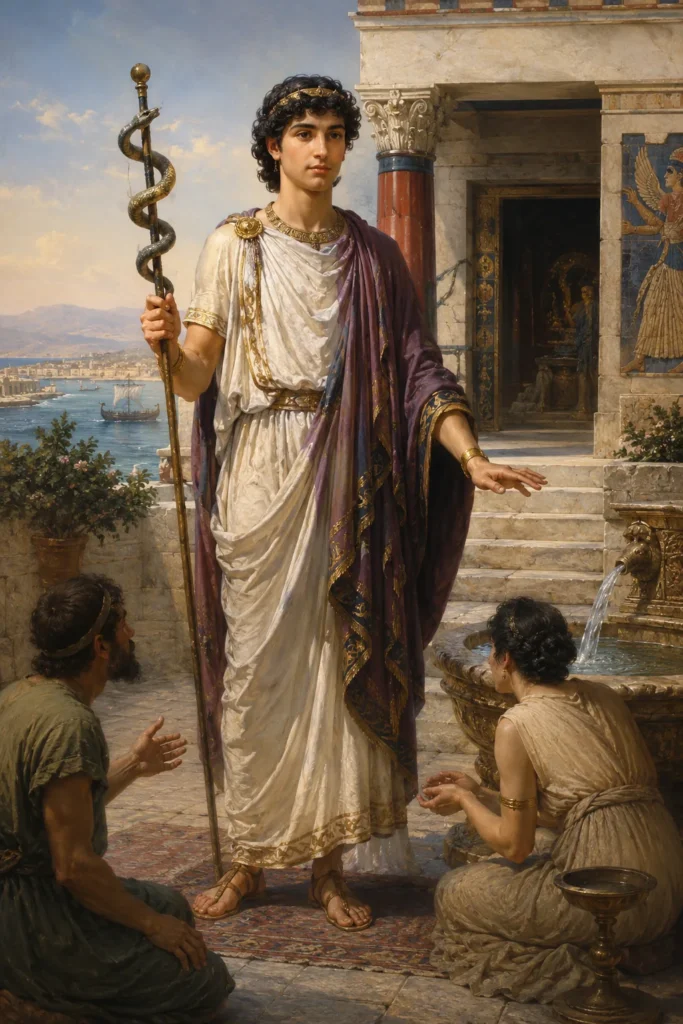
He appears as a youthful god, bearded or beardless, often with staff and snake. In Hellenistic times his image assimilates to that of Asclepius: staff with coiled snake, long cloak, calm bearing. A marble statuette of a child, the “Boy of Eshmun”, was dedicated by Eshmunazar II.
The main cult site was the temple at Bostan esh-Sheikh, about 3 km northeast of Sidon, founded in the 6th century BC by King Bodashtart. It comprised a holy of holies, a healing bath with running water, a forecourt with altars and rooms for incubation. Offerings were bronze bones, clay figurines, inscriptions and “Golden Ears”. Further sanctuaries lay in Beirut, Carthage and Idalion.
His sacred animal is the snake; according to Damascius, sacred snakes were kept in the temple near Sidon. Staff and snake serve as attributes. Occasionally the cock also appears as a companion animal.
The most important parallel is the Greek Asclepius, with whom Eshmun has been equated since the 4th and 3rd centuries BC in bilingual inscriptions. In Mesopotamia Damu and Ninazu partly correspond to him. With Adonis he shares the motif of death and revival through a goddess. Among the Hittites there is no direct parallel god.
Classification and Brief Profile
Eshmun is one of the most important Phoenician deities; he is the city god of Sidon and regularly appears alongside Astarte as the divine couple of Sidon.
Sabatino Moscati showed in Die Phöniker (1966) that the Eshmun cult in Sidon held key religio-political and economic significance; the Eshmun temple at Bostan esh-Sheikh northeast of Sidon is one of the best-preserved Phoenician sanctuaries.
In the history of religions, Eshmun represents the type of healing god who dies and rises seasonally. His functional profile is notably narrower than that of Baal-Hadad: Eshmun is primarily a healing god and city protector, less a weather god.
This specialization in healing and urban functions is unusual within the Phoenician pantheon and makes Eshmun a theologically distinct figure. Within the Phoenician tradition, he is the prototypical healing god.
Corinne Bonnet has examined in several studies the identification of Eshmun with the Greek Asklepios and its theological implications. The identification is attested only from the fourth and third centuries BCE onward in bilingual inscriptions and leads to a mutual influence between both cult traditions. In the Hellenistic period, the Eshmun temple becomes a supraregional Asklepieion.
A remarkable feature of Eshmun is his close connection with the Sidonian royal house. Eshmunazar I, Eshmunazar II, Bod-Eshmun, and several other Sidonian kings bear his theonym in their names. This onomastic tradition attests the central position of Eshmun in the dynastic history of Sidon.
The theological connection of Eshmun with Astarte as the divine couple of Sidon is analogous to the constellation of Baal-Hadad-Anat or Baal-Hammon–Tanit in other Phoenician city-states.
Name and Etymology
The etymology of the name Eshmun is disputed. One plausible interpretation connects ʾšmn with the numeral “eight” (West Semitic šmn); Eshmun would then be “the Eighth,” presumably as the eighth son of a divine family or as the eighth ordinal in a list of gods.
Another interpretation sees ʾšmn as a connection with the word for “oil” (šmn); Eshmun would then be “the Anointed One” or “the One Associated with Oil,” which would accord with his healing function.
In inscriptions he appears as ʾšmn; in Greek sources as Eshmun (Ἐσμοῦν or Ἀσμουνός). Damascius (sixth century CE) reports in his Vita Isidori that Eshmun was a young man from Beirut who fled from Astarte’s love, castrated himself and died, and was venerated as a god after his death.
This late “hero myth” is instructive for the history of religions because it preserves the identification with Adonis and with the mortal-divine hero type.
Eshmun is not directly identified in Akkadian or Hittite material. The Greek identification with Asklepios is the most important; Pausanias and other ancient authors attest it. Eshmun also appears in Carthage and in the western colonies, though considerably less frequently than Baal-Hammon or Tanit.
In the later Carthaginian tradition Eshmun appears under the epithet “Healer” and is directly identified with the Greek Asklepios. This identification with Asklepios shaped Carthaginian healing culture and survived the fall of the Punic state in the Roman period under the name Aesculapius.
Description and Iconography
Eshmun appears in Phoenician iconography as a youthful bearded or beardless god, frequently with a staff and a serpent, the healing symbol par excellence. In the Hellenistic period his iconography is largely synthesized with the Asklepios tradition: staff with coiled serpent, long mantle, composed posture.
His sacred animal is the serpent; the Eshmun temple near Sidon actually kept sacred serpents, as Damascius reports. The serpent sanctuary tradition connects Eshmun with the Greek Asklepieion at Epidaurus, where sacred serpents were likewise kept. The rooster also appears occasionally as his companion animal, representing a further correspondence with Asklepios.
The Eshmun temple at Bostan esh-Sheikh is well documented archaeologically; the excavations under Maurice Dunand and, later, the scholarly processing by Rolf Stucky have published the temple architecture, inscriptions, and votive offerings.
The temple had a healing bath (balneum) with flowing water from the adjacent mountain, in which those seeking healing performed ritual purifications. This healing architecture is one of the most significant testimonies to Phoenician healing cult.
A marble statuette of a child found in the Eshmun temple, known as the “Boy of Eshmun,” is one of the most celebrated individual objects; it was dedicated by Eshmunazar II and displays the iconic youthful-sacred character of the god.
Mythological Narratives
Phoenician Eshmun myths are transmitted only in fragmentary form. Damascius recounts the hero narrative mentioned above: Eshmun, a beautiful youth from Beirut, was pursued by Astarte; to escape her love, he castrated himself and died. Astarte took his body, brought it back to Beirut, and “called him back to new life through life-giving warmth.”
This narrative belongs structurally to the Adonis-Tammuz tradition: a young mortal-divine hero, his death, his resurrection by a goddess. In the history of religions it is an example of the Phoenician variant of the “dying and rising god” motif, which was particularly widespread in the western Mediterranean.
A second tradition connects Eshmun with healing through divine appearance in a dream (incubatio): those seeking healing slept in the temple and received healing instructions in their dreams.
This practice corresponds to the Greek Asklepieion tradition and developed in both cultures in parallel or through mutual exchange. Aelius Aristides’ Sacred Tales from the second century CE document this incubation practice extensively for Asklepios; similar accounts from Sidon and Beirut are transmitted for Eshmun.
A fragmentary Phoenician inscription from Carthage mentions an Eshmun procession with a bier and an “awakening” on a spring day. This spring procession is related, in the history of religions, to the Melqart awakening festival and belongs to the Phoenician spring festival tradition.
Cult and Veneration
Eshmun’s principal cult site was the temple at Bostan esh-Sheikh, approximately 3 km northeast of ancient Sidon. The temple was endowed in the sixth century BCE by King Bodashtart and furnished with a monumental podium terrace.
The famous sarcophagus inscription of Eshmunazar II (in the Louvre) is one of the most important Phoenician inscriptions altogether; it names Eshmun as “my lord” and describes his cultic significance.
The temple comprised several complexes: the main building with the holy of holies, the healing bath with flowing water, a forecourt with altars, rooms for incubation, and areas for votive offerings. Those seeking healing brought gifts in the form of bronze bones, terracotta figurines, inscriptions, and “golden ears” (tokens of thanks for answered prayers).
Eshmun also had sanctuaries in Beirut, in Carthage (where he was venerated on the Byrsa hill), in Idalion on Cyprus, and at several further sites. At Idalion he frequently appears alongside Phoenician Astarte and Greek Aphrodite. In Carthage he appears occasionally beside Baal-Hammon, but retains his independent healing function.
The Eshmun inscriptions from Sidon document the priestly hierarchy in detail: kohen (priest), moqim ʾelim (“awakener of the god”), ʿbd-servants, and ʾmh-serving women. This hierarchy is comparable to that of the Melqart cult.
Protective Practice and Apotropaic Uses
Eshmun was the prototypical Phoenician healing god. Those seeking healing came from across the eastern Mediterranean to find healing in his temple. The incubation practice was central: pilgrims slept in the temple, often on special hides, and received healing instructions in their dreams.
In the morning the dream was interpreted by priests; healing occurred frequently through the act of dreaming itself, through ritual baths, or through prescribed herbal remedies.
Apotropaic Eshmun statuettes were placed in homes; the famous “Sidonian boy figures” from the Eshmun temple (collection at the Beirut National Museum) show small boys or girls, presumably votive offerings for the healing of sick children. The inscriptions on these statuettes confirm their function as thank-offerings or petitionary offerings.
In Phoenician personal names the theonym of Eshmun is very frequent: Eshmunazar “Eshmun helps,” Eshmunpalat “Eshmun saves,” Bod-Eshmun “by the hand of Eshmun.” The frequency of theophoric names demonstrates intense private piety. iWell Guard records Eshmun as a figure of historical religious studies, without references to current healing claims; the healing cult practice is a historical phenomenon that is reconstructed scientifically, not adopted as practical guidance.
Herbal remedies were also prescribed in the healing rituals; the Phoenician priests possessed pharmacological knowledge transmitted in the form of healing texts. Fragments of such texts can be recognized in the Eshmun temple inscriptions.
Parallels in Other Cultures
The most important parallel in the history of religions is the Greek Asklepios; the identification is attested only from the fourth and third centuries BCE onward in bilingual inscriptions.
Asklepios is the son of Apollo, a skilled healer, with staff and serpent as his attributes. The correspondences between the two are so close that mutual influence is probable. Stephanie Budin, Corinne Bonnet, and Mary Bachvarova have examined these connections.
In the Mesopotamian sphere Eshmun partly corresponds to the healing god Damu and the god Ninazu; in the Hittite material there is no direct parallel deity, though there are healing rituals connected with the Hattic-Hittite Kamrusheba tradition.
The Hittite tradition had its own healing culture centered on the “old women” (HAR.HAR), without a specific healing god in the sense that Eshmun represents.
Eshmun shares with Adonis the hero mythologeme of death and revival by a goddess. Both belong to the West Semitic vegetation-hero tradition, which also includes Melqart. In the history of religions this hero family is a significant phenomenon of Phoenician Iron Age religion.
Hittite healing culture traditions, especially the rituals of the “old woman” and the incubation practices, also show functional correspondences with the Eshmun cult. Volkert Haas documented the Old Anatolian healing rituals in Materia Magica et Medica Hethitica (2003); a direct connection in the history of religions cannot be demonstrated, but structural parallels are instructive.
Modern Reception and Research
Eshmun research today stands at a high level. Maurice Dunand’s temple excavations from the 1960s are a classic standard reference; Rolf Stucky and Helene Sader have continued the archaeological research. Corinne Bonnet’s studies on Asklepios syncretism are important for comparative religion.
In popular reception Eshmun is known through his temple near Sidon; the temple is today an archaeological site and tourist attraction. The Eshmunazar sarcophagus in the Louvre is one of the most celebrated Phoenician antiquities altogether.
From a religious-studies perspective, Eshmun is today regarded as a central object of study for Phoenician healing religion, for the Mediterranean Asklepios tradition, and for the theology of the mortal-divine hero.
Current research focuses on the editing of new Eshmun inscriptions, on the analysis of votive offerings from the temple, and on the question of the precise relationship to Asklepios in the history of religions.
Current research by Helene Sader and Mark Smith on Phoenician religion places Eshmun in a broader religious-historical context: as a representative of the younger generation of gods who, in the Iron Age, differentiated the specific functions that in the Late Bronze Age had been held by a single figure.
Literature and Sources
The following selection brings together the most important standard works on Eshmun research. It includes temple publications, inscription editions, and syntheses in the history of religions. Dunand’s temple publication is the classic reference; Bonnet and Sader provide the Phoenician and religious-historical contextualization; Aubet the Mediterranean diffusion; Krahmalkov the linguistic-historical material.
The Eshmun Sanctuary at Bustan esh-Sheikh near Sidon
The most important archaeological evidence for Eshmun lies approximately three kilometers northeast of Sidon in present-day Lebanon, at a site called Bustan esh-Sheikh. Since 1900, first by Ottoman and German, later by Lebanese and French archaeologists, an extensive sanctuary has been uncovered there.
The monumental core is a large podium terrace of carefully fitted ashlar blocks, erected presumably under the Sidonian king Bodashtart in the late sixth century BCE.
The sanctuary is remarkable because it offers a rare direct connection of deity, kingship, and building inscription. Several building inscriptions name Bodashtart as founder and Eshmun as the god to whom he dedicates the complex.
Eshmun is thus not merely a name from lists of gods, but a deity with a datable, monarchically sponsored monumental structure. Water played a central role: channels, basins, and spring enclosures run throughout the complex, consistent with the healing interpretation of the god.
Among the famous finds is the “Throne of Astarte,” an empty divine throne that points to Eshmun’s close connection with the Sidonian city goddess, as well as a series of child statuettes interpreted as votive offerings, possibly connected with recovery or protection.
The excavation results have been published, among others, by Maurice Dunand and later by Rolf Stucky.
Eshmun and Asklepios: An Ancient Equation and Its Limits
Already ancient authors equated Eshmun with the Greek healing god Asklepios. This interpretatio graeca is well attested, for instance in the author transmitted as Philo of Byblos, who records Phoenician traditions in Greek, and it explains why Eshmun was often simply described in older scholarship as the “Phoenician Asklepios.”
This equation is useful and at the same time problematic. Useful because it confirms the healing aspect of Eshmun: the water of the sanctuary, the child dedications, and the ancient accounts of healings are consistent with a god to whom one turned in illness.
Problematic because it tempts scholars to project the entire Greek Asklepios image onto Eshmun, including the serpent iconography and the incubation practice, for which direct evidence in the Phoenician record is not uniformly available.
A separate research question concerns the origin of the name. A widespread but unconfirmed proposal connects it with the Semitic word for “oil” or “anointing oil,” and thereby with anointing as a healing medium; other interpretations see a numerical reference (“the Eighth”). Neither etymology is generally accepted.
More secure than the etymology is the observation that Eshmun rose to the position of chief deity in Sidon and appears in Punic inscriptions, including those relating to Carthage, alongside Baal-Hammon. The god was therefore no local exception, but a cult carried across the Phoenician area of diffusion.
Selected Bibliography
- Maurice Dunand: Le temple d’Echmoun à Sidon (Paris 1965)
- Sabatino Moscati: Die Phöniker (Zürich 1966)
- Corinne Bonnet: Les enfants de Cadmos (Paris 2015)
- Helene Sader: The History and Archaeology of Phoenicia (Atlanta 2019)
- Maria Eugenia Aubet: The Phoenicians and the West (Cambridge 2001)
- Charles Krahmalkov: A Phoenician-Punic Grammar (Leiden 2001)
Related key terms: Eshmun Sidon healing god Phoenician Asklepios temple Bostan esh-Sheikh.
iWell Guard and Protective Traditions
iWell Guard draws on the cultural-historical tradition of wearable protective objects, in the tradition of Phoenician and many other cultures worldwide. 41 layers, real gold, platinum, silver, crafted in Germany. 30-day return policy.
Personal experiences may vary. Not a medical product. No healing claims.