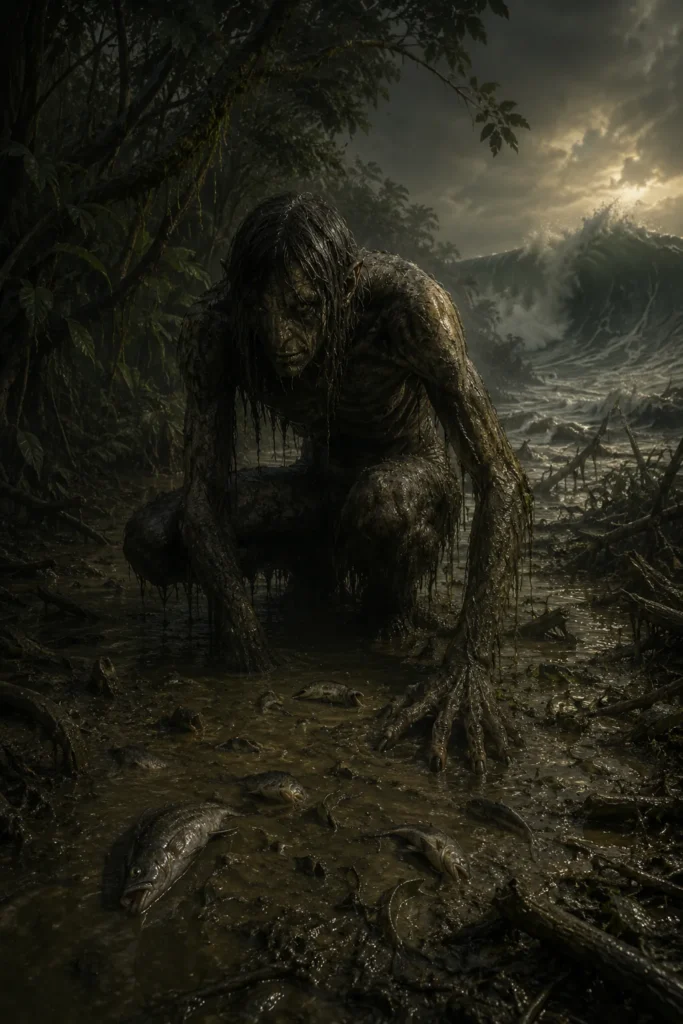
Yowie, mythical wild-man figure of the Aboriginal tradition of eastern Australia
By Ralf Ittermann · last reviewed on
The Yowie (also Doolagarl, Jurrawarra, Yahoo) is a wild, hairy figure of dread from the Aboriginal tradition of eastern Australia. It lives in the dense forests and mountainous regions of New South Wales and Queensland and is regarded as a dangerous wild man.
The Yowie is a wild-man figure of the Aboriginal narratives of eastern Australia, comparable to Bigfoot. Myth and sources derive from Yuin and Gandangara traditions.

Profile: Yowie
Yowie: the most important aspects at a glance. The following fields summarise origin, effect, appearance, function, protection and parallels.
The Yowie is a harmful figure attested in numerous Aboriginal languages of eastern Australia. Among the Yuin it is called Doolagarl, among the Gandangara Jurrawarra, in some groups of Queensland Yahoo. The collective name “Yowie” is an anglicisation that entered European-Australian folklore in the late 19th century.
The Yowie threatens people in dense forests and mountain regions. It devours people and abducts women and children. In the stories the person is attacked or abducted; sometimes he or she narrowly escapes, sometimes is devoured.
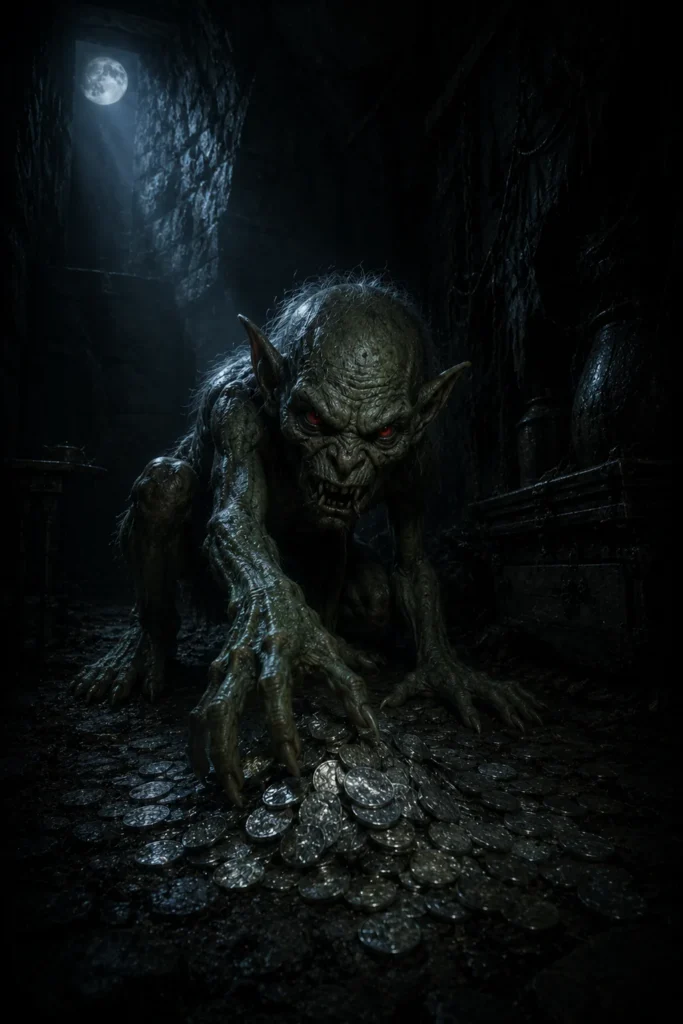
The Yowie is described as a large, hairy, ape-like wild man of 2 to 3 metres, with dense dark fur, long arms, a short neck, a strong smell and a thundering roar. Some descriptions mention red eyes, others long claws.
The Yowie is a bogey figure without a creative function whose stories serve for warning and instruction, for example about dingoes, unsafe paths and rockfall in mountain areas. Unlike the water-bound Bunyip, it is land-bound.
People avoid certain forest and mountain regions, carry a fire when camping overnight, because yowies avoid fire, sing or talk loudly in the forest because they fear noise, and wear small carved wooden figures as protection. The tribal elders know the “Yowie places” and can warn or protect ritually.
Typologically related are Bigfoot or Sasquatch in North America, the Yeti in Tibet and Nepal, Almasty in the Central Asian steppe, Yeren in China and Orang Pendek in Sumatra, large, hairy, shy wild beings in remote forest and mountain regions. They are regarded as the “anti-human”, embodying what humans are not.
Classification and brief profile
The Yowie is a harmful figure attested in numerous Aboriginal languages of eastern Australia. Among the Yuin (southern NSW) it is called Doolagarl; among the Gandangara Jurrawarra; in some Queensland groups Yahoo. The collective term “Yowie” is an Anglicization that entered European-Australian folklore in the late 19th century.
Within the Aboriginal tradition the Yowie is a figure of dread without a creative function, whose narratives serve warning and instruction. It is dangerous, devours people, and abducts women and children; it is explicitly warned against.
In this function it is typologically similar to the Bunyip: both are purely harmful figures, but whereas the Bunyip is associated with water, the Yowie is associated with land.
From a history-of-religions perspective it is noteworthy that the Yowie is typologically related to the globally widespread “wild man” conceptions (Bigfoot, Yeti, Almasty, Sasquatch). Tony Healy and Paul Cropper discussed these parallels in detail in The Yowie (2006).
Name and etymology
The name Yowie is an Anglicization whose exact Aboriginal source is disputed. One traditional derivation links it with the Gandangara word Yowie (“evil being”); others propose a connection with “Yahoo”, a word said to be shared by several Aboriginal languages of eastern Australia.
In the various Aboriginal languages the being has different names: Doolagarl (Yuin), Jurrawarra (Gandangara), Yahoo (Queensland). This diversity shows that the “Yowie” is not a single being but a family of related figures of dread.
Graham Joyner documented the linguistic history of the term Yowie in detail in The Hairy Man of South Eastern Australia (1977). His work is the most important study of the linguistic history.
Description and iconography
The Yowie is described as a large, hairy, ape-like wild man. Recurring elements are: a height of 2 to 3 metres, dense dark fur, long arms, a short neck, a strong odour, and a thunderous roar. Some descriptions mention red eyes, others long claws.
This description is typologically similar to the worldwide “wild man” family (Bigfoot, Yeti). From the perspective of the anthropology of religion, the interesting question is whether this similarity is due to typological convergence or to a universal “wild man” archetype, a question that has been debated controversially since Carl Gustav Jung‘s theory of archetypes.
In the Aboriginal rock art of eastern Australia there are some depictions that have been interpreted as “Yowie” images; this interpretation, however, is not secure in all cases. The rock-art tradition of eastern Australia is less dense than the Arnhem Land or Kimberley tradition.
Mythological narratives
The typical Yowie narrative follows a pattern: a person enters a dense forest or a mountain region; a loud roar is heard; a hairy being appears; the person is attacked or abducted. In some versions the person narrowly escapes; in others they are devoured.
A. W. Howitt collected several Yowie narratives from the Yuin and Gandangara region in The Native Tribes of South-East Australia (1904). They follow a consistent narrative pattern and clearly served as a warning against dangers in the forest.
One particularly well-known Yowie narrative from the Brindabella region (west of Canberra) tells of a camp full of tribespeople who were attacked at night by a Yowie; only a shared fire allowed them to drive it away.
Cult and veneration
The Yowie has no cult; it is a pure figure of dread. In practical terms this means: certain forest and mountain regions are avoided, especially at night; children are warned with Yowie stories; travellers avoid certain mountain peaks.
One particular practice is the use of fire as protection: Yowies avoid fire, which is why campfires were especially important when spending the night in “Yowie country”. This practice has a clear ecological and pragmatic background (protection against wild animals) but is connected mythologically with the Yowie.
In European-Australian folklore the Yowie has taken on a role of its own: it became the emblematic figure of a “Bigfoot Down Under” tradition. Several “Yowie sightings” have surfaced in the Australian media in recent decades; some researchers (Rex Gilroy, Paul Cropper) have documented them systematically.
Protective practice and the apotropaic
Described in religious-studies terms: apotropaic practices against the Yowie include avoiding certain forest and mountain regions, carrying fire when staying overnight, singing or speaking loudly in forests (Yowies fear noise), and wearing small carved wooden figures as protection.
One specific practice is consulting the tribal elders before entering new forest areas; the elders know the “Yowie places” and can warn or provide ritual protection.
From the ethnographic outside perspective, these practices are everyday-structuring rules that link ecological caution (protection against forest dangers) with social authority (the knowledge of the elders). For the anthropology of religion this is a classic example of the didactic function of mythical narratives of dread.
Parallels in other cultures
Wild-man conceptions are attested worldwide in the phenomenology of religion. Structurally comparable are: Bigfoot/Sasquatch in North America, the Yeti in Tibet and Nepal, the Almasty in the Central Asian steppe, the Yeren in China, the Orang Pendek in Sumatra.
In all cases they are large, hairy, shy wild beings said to live in remote forest and mountain regions.
The phenomenological point of these beings is their function as an “anti-human”: they represent what humans are not or are no longer. Here the Yowie is Australia’s characteristic variant; it is independent in terms of religious history but typologically embedded in the global wild-man family.
Tony Healy and Paul Cropper discussed the typological parallels in detail in The Yowie (2006). They warn against simply seeing the Yowie as an “Australian Bigfoot” and argue for a culture-specific reading.
Present-day reception and research
The most important contemporary source is Tony Healy and Paul Cropper: The Yowie: In Search of Australia’s Bigfoot (Anomalist Books 2006). They combine Aboriginal sources with European-Australian sighting reports and modern cryptozoology. Their book is contested but remains the most important overview.
Graham Joyner’s The Hairy Man of South Eastern Australia (1977) is the most important study of linguistic and folklore history. Rex Gilroy’s Mysterious Australia (1995) documents modern sighting reports (with the requisite critical distance that scholarly research demands).
In contemporary Aboriginal self-representation the Yowie is treated rather cautiously; it has not become a cultural emblem. Several Aboriginal voices warn against absorbing it into the popular Bigfoot tradition.
Research debates and open questions
Several research debates surround the Yowie. First: how should the modern sighting reports be handled in religious-studies terms? They are methodologically questionable but, as a phenomenon of popular belief, relevant to the anthropology of religion.
Second: what is the relationship of the Yowie tradition to the global wild-man family? Tony Healy argues for a genetic relationship (an original, Palaeolithic wild-man conception); other researchers see typological convergence under similar ecological conditions.
Third: what role does the Yowie play in contemporary Australian popular culture? It is the mascot of several sports clubs, a character in children’s books, and an element of outback tourism. In sociological terms this appropriation is an interesting case study of the mythologization of indigenous tradition.
The Yowie and Aboriginal forest ecology
One perspective of interest to the anthropology of religion connects the Yowie tradition with the forest ecology of the Aboriginal communities of eastern Australia. Yowie stories served as a warning against real forest dangers: dangerous animals (dingoes, in earlier times also thylacines), unsafe paths, rockfall in mountain areas.
From this perspective, Yowie narratives are a classic example of the “ecological function” of traditional narratives. They encode real risks in mythical form, which is pedagogically effective because it conveys the risks with emotional intensity.
This ecological perspective changes the image of the Yowie: it is not (only) a “cryptid” in the modern sighting reports but a cultural encoding of real forest risks. This encoding was important for the safety of the Aboriginal communities.
The Yowie in modern popular culture
The modern popular-culture reception of the Yowie deserves a study of its own. Since the 1970s the Yowie has been a figure of Australian outback tourism, children’s literature, and advertising. A well-known chocolate figure (Cadbury Yowies, 1995, 2005) domesticated the Yowie into a friendly, collectible children’s mascot.
In sociological terms this domestication is ambivalent. On the one hand it keeps the Yowie alive in cultural memory; on the other it transforms the originally dangerous Aboriginal character into a friendly marketing figure. Robert Holden’s critical reflections on the domestication of the Bunyip apply analogously to the Yowie.
Several Australian sports clubs use Yowie-related mascots. In contemporary Aboriginal discussion this commercial use is received with mixed feelings: some see it as cultural recognition, others as appropriation.
Methodological reflection and sources
Several methodological problems arise in Yowie research. First: the source situation is fragmentary. A. W. Howitt provides some Aboriginal accounts; the modern sighting reports are of interest to the ethnology of religion but empirically questionable.
Second: the mixture of Aboriginal tradition and European-Australian folklore makes source analysis demanding. What is authentically Aboriginal, what is “post-contact” appropriation, what is free modern invention?
Third: the ethical question of dealing respectfully with Aboriginal figures of dread arises here as well. The domestication in popular culture is potentially problematic and should be reflected upon from the standpoint of the ethnology of religion.
Anyone wishing to study the Yowie complex in its full breadth will find on the overview page Aboriginal tradition the most important cross-references to related figures such as the Bunyip, the Mimi spirits, and Baiame.
The Yowie and cryptozoology
A research direction of its own deals with the Yowie from the perspective of cryptozoology. Cryptozoology is a contested discipline that concerns itself with “hidden” animals such as Bigfoot, the Yeti, and the Loch Ness Monster; it is largely rejected by academic zoology.
Rex Gilroy is one of the best-known Australian Yowie researchers; his books (Mysterious Australia, 1995) and essays established the Yowie in popular culture. From the standpoint of the ethnology of religion, his works are of interest as a source of modern Yowie folklore, without the cryptozoological claims being seriously validated.
For the ethnology of religion the most important question is not “does the Yowie exist biologically?” but “what function does the Yowie have in present-day folklore and identity?” Robert Holden answered this question for the Bunyip in Bunyips (2001); a corresponding study for the Yowie is still lacking.
The Yowie and the ethical use of indigenous figures of dread
In contemporary Aboriginal discussion the Yowie tradition stands as a prime example of the ethical question of the use of indigenous figures of dread. How far may indigenous beings be used in popular culture, marketing, and tourism?
The “Yowie” as a friendly chocolate mascot (Cadbury Yowies 1995, 2005) was criticized by some Aboriginal representatives as appropriation and seen by others as cultural recognition.
In sociological terms this debate is a textbook case of contemporary indigenous cultural politics. It cannot be answered conclusively but requires context-specific reflection and negotiation with the traditional owners.
The Yowie in cross-cultural wild-man comparison
The position of the Yowie within the global wild-man family deserves a cross-cultural exploration. In the phenomenology of religion it belongs to a family of beings: Bigfoot/Sasquatch in North America, the Yeti in Tibet and Nepal, the Almasty in the Central Asian steppe, the Yeren in China, the Orang Pendek in Sumatra.
In their book The Yowie (2006), Tony Healy and Paul Cropper examine these typological parallels in detail. They warn against simply seeing the Yowie as an “Australian Bigfoot”; every wild-man tradition has its own cultural layers of meaning.
For the anthropology of religion the interesting question is why so many cultures have developed similar wild-man conceptions. Possibilities are: memories of real hominids (Homo erectus, Neanderthals), typological convergence under similar ecological conditions, or a universal archetypal conception in Jung’s sense.
The Yowie and the ethical question of appropriation
A central ethical question concerns the appropriation of the Yowie by non-Aboriginal culture. The Yowie chocolate figure (Cadbury Yowies 1995, 2005), Yowie mascots of several sports clubs, Yowie themes in outback tourism: all of these use indigenous tradition for commercial purposes.
Indigenous voices assess it differently; some see it as positive cultural recognition. The debate cannot be decided conclusively and requires context-specific reflection.
In sociological terms this debate is a textbook case of contemporary indigenous cultural politics in Australia. It will continue to grow in importance in the coming years, especially with the increasing visibility of Aboriginal voices in the Australian public sphere.
The Yowie and the Aboriginal narrative tradition
The position of the Yowie within the Aboriginal narrative tradition of eastern Australia deserves an exploration of interest to the anthropology of religion. Unlike the great creation figures, the Yowie narrative belongs rather to the “warning narrative” class, short pedagogical stories that convey rules of conduct to children and travellers.
Bill Edwards classified the various functions of Aboriginal narratives in An Introduction to Aboriginal Societies (1998): creation narratives, initiation narratives, teaching narratives, warning narratives. Yowie stories belong to the last category.
For the phenomenology of religion this differentiation is important. Not every mythical narrative carries the same religious weight; the Yowie tradition is more peripheral in religious history than the Rainbow Serpent or Baiame tradition, which, however, makes its own function no less interesting.
The Yowie between folklore, cryptozoology, and popular culture
Among the figures treated here, the Yowie holds a special position because its present-day fame rests less on a closed mythological tradition than on an interweaving of very different layers of sources.
At least three levels must be distinguished: first, accounts of large, hairy beings in the narrative traditions of various Aboriginal language groups of eastern Australia, for which regional names such as doolagarl, yahoo, or thoolagal are attested; second, settler reports of the 19th century, in which colonial observers took up such narratives and mixed them with European notions of the wild man; third, the modern cryptozoological scene since the 1970s, which popularized the term Yowie and placed it close to the North American Bigfoot.
The evidence is thin and methodologically delicate. There exists no physical proof that withstands scientific examination, neither skeletal finds nor unambiguous traces nor verifiable visual material. Sighting reports are anecdotal and can regularly be traced back to known animals, to misperceptions, or to deliberate fabrication.
The folklorist and author Tony Healy and his co-author Paul Cropper collected hundreds of such reports in The Yowie. In Search of Australia’s Bigfoot (2006), but in doing so considered a hitherto unknown animal possible.
Sceptical voices such as those of science journalism point out that the Yowie is a prime example of the migration of a motif from oral narrative tradition into commercialized monster culture.
From a religious-studies standpoint, it is precisely this shift that is of interest.
Where in the indigenous traditions hairy beings were often embedded in a web of local knowledge, rules of conduct, and warning narratives, the popular Yowie today stands for tourism marketing, for festivals in towns such as Kilcoy in Queensland, and for a genre that combines horror with the romance of nature.
A serious account must name both sides without confusing the colonially overlaid secondary layer with the indigenous narrative material, and it should make clear that the existence of an unknown great primate in Australia is supported neither biogeographically nor palaeontologically.
Literature (selection)
- Tony Healy and Paul Cropper: The Yowie (Anomalist Books 2006)
- Graham Joyner: The Hairy Man of South Eastern Australia (1977)
- Rex Gilroy: Mysterious Australia (1995)
- A. W. Howitt: The Native Tribes of South-East Australia (1904)
- Robert Holden: Bunyips: Australia’s Folklore of Fear (2001)
- Tony Swain: A Place for Strangers (1993)
The Yowie is a mythical figure of the Aboriginal tradition of eastern Australia, appearing in the narratives of the Yuin and neighbouring groups as a hairy wild-man type; the Yowie myth combines older bush-spirit conceptions with colonial sighting reports.
Related key terms: Yowie Doolagarl Jurrawarra Yahoo wild man Bigfoot parallel.
iWell Guard and protective traditions
iWell Guard ties in with the cultural-historical tradition of wearable protective objects, in the tradition of Aboriginal and many other cultures worldwide. 41 layers, solid gold, platinum, silver, manufactured in Germany. 30-day right of return.
Personal experiences may vary. Not a medical device. No healing promise.