Gabriel, Archangel of the Jewish Tradition
By Ralf Ittermann · last reviewed on
Gabriel is the archangel figure of the Jewish tradition, herald of divine messages and an actor in eschatological scenes. His significance in religious studies lies in the mediation between heaven and earth, in the revelation of God’s will and in the establishment of the Jewish angelology canon.
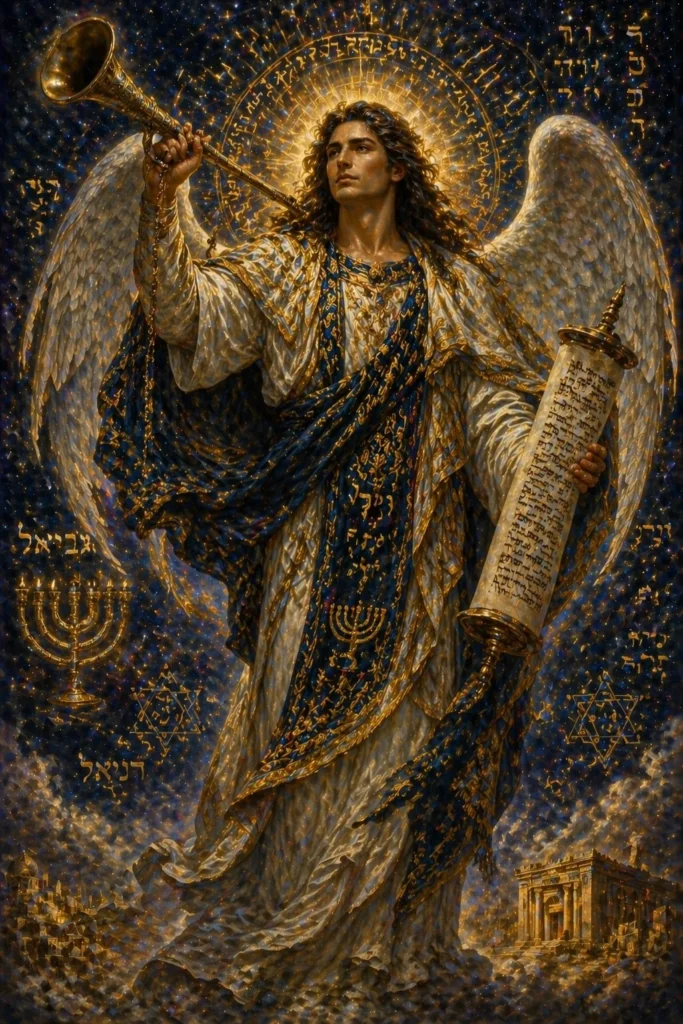
Gabriel
Gabriel acts as a messenger of God and mediator of the divine will. His characteristics include strength, truth and direct proximity to the throne of God.
Central myths are: Daniel’s visions (Dan 8, 9), where Gabriel reveals eschatological times; the announcement of John the Baptist (Lk 1:11, 20, Christian only); and Kabbalistic and mystical roles in Enoch literature and Zohar traditions.
Short Profile: Gabriel
Gabriel originates from biblical primary sources: the Book of Daniel (8:16, 9:21) and apocryphal writings (Enoch 1-2). The framing is assigned to the Hellenistic period (2nd and 1st century BC).
Jewish scholarship documents Gabriel in Scholem (Judaica, mysticism), Bietenhard (Die himmlische Welt im Urchristentum und Spätjudentum), Hughes (Dictionary of Islam, comparative survey) and McLeod (Judaism-Islam parallels). The state of research presents Gabriel as the archetypal archangel of the Middle East.
Context
The continuity of the tradition across these long spans of time is remarkable and shows a deep, stable cultural rooting. Even in modern times the memory and sometimes also active veneration remains alive, sometimes transformed, but still recognisable in its essential features.
Gabriel was not limited to a particular region or to specific locations, but was known and venerated, or respectfully feared, universally throughout the world of Judaism.
Gabriel was received across every level of the societies shaped by the biblical religions, because his figure rested on canonical texts that all shared. Scholars expounded the Daniel visions and the Annunciation in commentary and sermon, while laypeople met him constantly in liturgy, in the Ave Maria, and in the countless Annunciation images of churches and books of hours. In Islam he holds a comparable position as the angel of revelation named in the Quran. His reception thus ran through the ordinary channels of religious instruction and worship rather than through any special or esoteric milieu.
This clearly points to a central role in the self-understanding of the entire people. Trade, migration and cultural exchange contributed to the geographic distribution and to the stable uniformity of veneration.
Primary sources are the Book of Daniel (8:16, 9:21, Hebrew, 164 BC), 1 Enoch 9:3; 10:9, 10; 20:5 (Aramaic, 150 BC), as well as Kabbalistic material (Sefer ha-Bahir, 12th century; Zohar, 13th century). Secondary works by Scholem (mysticism and angelology), Bietenhard (Die himmlische Welt im Urchristentum und Spätjudentum, 1951), Salomon Karppe (Étude sur les origines et la nature du Zohar, Paris 1901), and the dialogue volume by McLeod (Judeo-Islamic Angelology, 2002) analyse the figure of Gabriel as the centre of the Jewish archangel system.
Name
Gabriel is depicted in the various sources and artistic traditions with certain recurring iconographic elements that remain relatively constant across decades and across different geographic areas. These elements are not purely decorative or chosen at random, but are deeply coded symbolically and carry great meaning.
In Christian art, Gabriel is recognizable by fixed attributes: the lily in his hand as a sign of Mary’s purity, often a messenger’s staff or a scroll bearing the words of the greeting from Luke 1, together with the gesture of greeting or pointing. This visual language was legible to viewers like a text. Anyone who knew the Annunciation scene recognized at once: here the messenger of God speaks to Mary. Every detail, from the angel’s posture to the color of his robe, followed iconographic conventions that painters handed down over centuries.
The overall system is like a sacred scripture or a coded image; it allows the initiated or the culturally educated to grasp and correctly understand the essential, deeper meaning. Colours, sacred objects or weapons, physical attributes, specific accessories, everything is significant and traditionally handed down.
Characteristics
Gabriel was central to the religious practice, the everyday rituals and the everyday understanding of Judaism. People turned to this entity in critical or specific life situations or at particular ritual times of the year.
The interpretation of the Gabriel passages followed fixed rules: in Judaism, scribes expounded the visions of Daniel according to the methods of rabbinic exegesis, and in the churches, theologians and preachers interpreted the Annunciation scene from Luke 1 along the lines of ecclesiastical teaching tradition. Whoever spoke about the angel did so not at personal discretion but within the framework of trained scriptural interpretation.
The continuity of these practices across many generations clearly shows that the practice was regarded as effective and necessary. The functions were diverse: some were preventive (warding off potential misfortune), some healing (relief from illness or suffering), some transformative (accompaniment through transitions between stages of life).
Profile: Gabriel
The Profile illuminates Gabriel across six card dimensions: his geographic and cultural origin in Judaea and Mediterranean antiquity, his target group among devout believers and mystics, iconographic features of archangel iconography, his functional role as a messenger of God, comparisons with archangels of other cultures, and his mystical status in Jewish esotericism.
Gabriel first appears in the Book of Daniel, written in the late Hellenistic period of Judaea (164 BC, Seleucid period).
The geographic origin lies in Jerusalem and Judaea; the theological framework developed during the Babylonian exile period (6th and 5th century BC) with a new angel systematics. Daniel is set in Babylon, which shapes Gabriel’s presentation as a cosmic mediator in Hellenistic angelology.
Gabriel addressed himself primarily to devout Jews and mystics as a guarantor of the divine will. The social target group consists of priests, prophets, saints and later Kabbalists.
The occasions are moments of revelation, times of crisis (exile, oppression), festival days (Purim, Hanukkah, where Gabriel’s strength works mythologically) and personal spiritual seeking. The invocation takes place in mystical contemplation.
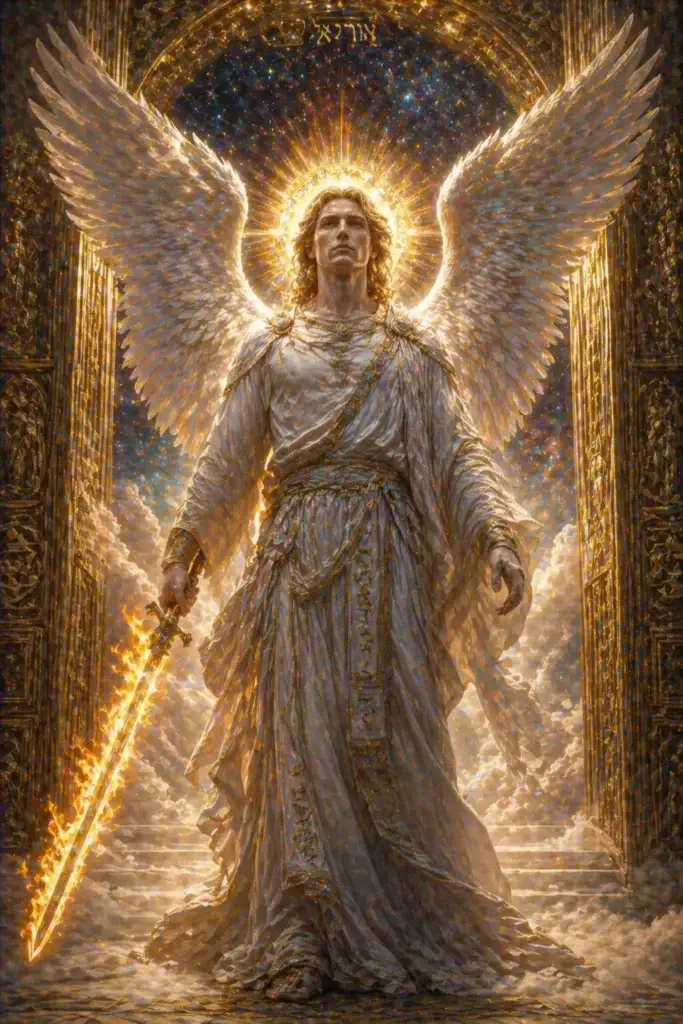
Gabriel iconographically: a male figure with wings, sword or staff, a light aura (halo), sometimes a lily symbol (later adopted in Christianity). Attributes are a lily, a messenger’s staff, a scroll banner (revelation).
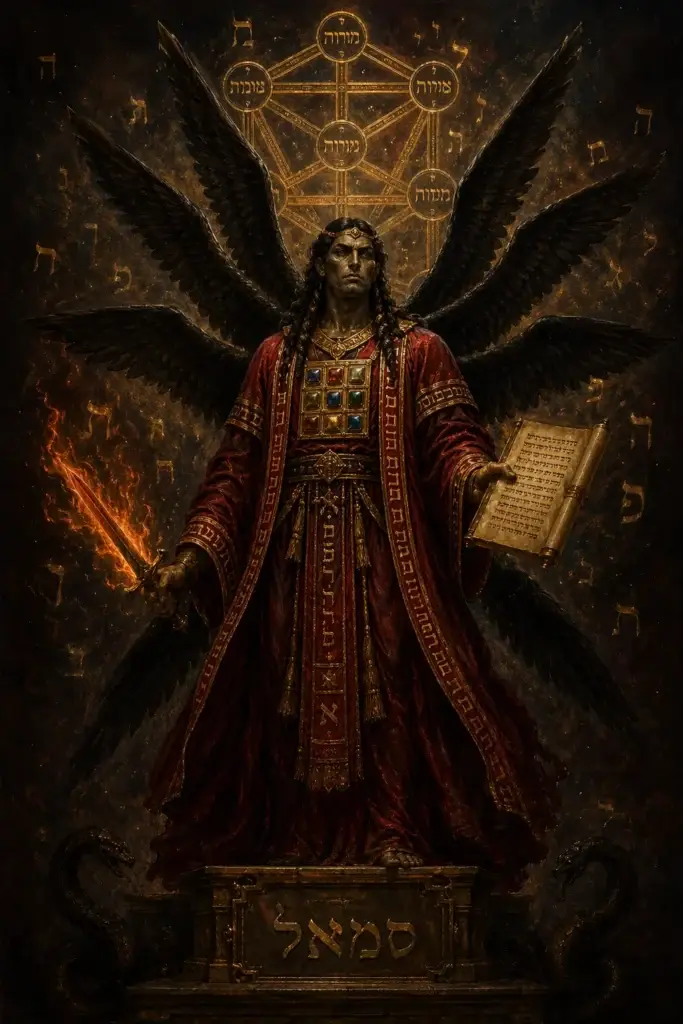
In Jewish mystical art: a white robe, six wings, proximity to the Shekhinah (the presence of God). The typical depiction follows late Talmud descriptions and Kabbalah iconography.
In the Christian-Jewish and Islamic context, Gabriel is an archangel whose primary function is the transmission of divine messages.
Gabriel was regarded as a good, beneficent being. In Kabbalah, meditations on Gabriel were practised (Yichudim, mystical unifications) in order to channel heavenly power. Respect for Gabriel manifested itself in reverence, purity commandments, ritual purification and fasting before mystical contact attempts.
Comparable figures: Raguel (archangel of harmony, Kabbalah), Michael (war leader, vanquisher of demons), Uriel (angel of fire, judgement), Metatron (throne angel of Kabbalah). Outside Judaism: the Islamic Jibril (identical with Gabriel, Quran, Sura 2:97), the Christian Gabriel (Lk 1, the Annunciation), Zoroastrian Yazatas (heavenly mediators).
Warding Off in Everyday Life
Veneration and liturgical commemoration
Gabriel is venerated in Christian churches on the Feast of Michael (29 September) or on Gabriel’s day.
The Annunciation to Mary and its repetition
Liturgical practices (especially in Eastern Christianity and Catholic devotion) commemorate the Annunciation daily.
Protective amulets and signs of grace
The lily (from Renaissance iconography) is Gabriel’s floral symbol.
Gabriel, Parallels in Other Cultures
Jewish tradition: Gabriel is central. Parallels are Michael (war angel), Uriel (fiery judge), Raguel (justice), Tzaphkiel (contemplation, Kabbalah). Michael and Uriel form, together with Gabriel and Raphael, the archangel tetrad in the Talmud and in Kabbalah (Scholem). Gabriel is also mentioned in 1 Enoch (9 to 10; 20; 40; 54; 71), which is not canonical in Judaism.
Greco-Roman world: No direct Jewish angels in antiquity. Distantly related are Greek messengers of the gods such as Hermes or Iris (messengers of the gods), and also the daemonic daimones of the Hesiodic tradition. The role of the intermediary messenger connects them.
Mesopotamia: Mesopotamian counterpart: Nabu (scribe of Marduk, revelation), Shamash (sun god, justice). Gabriel shares the mediator role between gods and humans with Nabu. Akkadian demon lists show similar hierarchies.
India/Asia: No direct parallels. Distantly related are the messengers of Indra (Hindu mythology), Bodhisattvas as mediators of revelation (Buddhism), or Apsaras as heavenly messengers (Sanskrit literature). The functionality of cosmic mediation is shared.
Gabriel in Daniel: the First Appearances
Gabriel is the first angel of the Hebrew Bible to bear a proper name. He appears in the Book of Daniel, a writing that took its present form in the Hellenistic period, in the second century before the turn of the era.
In Daniel 8, Gabriel is charged with interpreting for the seer Daniel a vision of a ram and a he-goat. In Daniel 9 he returns to explain to Daniel the famous prophecy of the seventy weeks of years.
Already in these early appearances Gabriel’s characteristic role becomes apparent. He is the angel of interpretation and of the message. He does not primarily bring punishment or war, as is suggested in the case of Michael, but understanding.
He explains to the human being what they cannot grasp on their own. It is striking that Daniel falls to the ground in terror at the sight of Gabriel, which underscores the superhuman appearance of the angel.
Scholarship sees in the Book of Daniel an important step in Jewish angelology. Here angels are individualised for the first time; they receive names and distinct tasks.
Gabriel and Michael form in Daniel the core of a developing conception of named, high-ranking angels. This development continues in the apocalyptic literature of the following centuries and forms the basis for the later Jewish, Christian and Islamic teaching on angels.
The Annunciation to Mary and Zacharias
In Christianity, Gabriel attains his greatest significance through the Gospel of Luke. In the first chapter Gabriel appears twice. First he appears to the priest Zacharias in the Temple and announces the birth of John, who will later be John the Baptist.
Because Zacharias doubts, he is struck mute until the birth of the child. In doing so, Gabriel expressly introduces himself with the words that he is the one who stands before God.
Shortly afterwards Gabriel appears to the young Mary in Nazareth and announces to her the birth of Jesus. This scene, the Annunciation to Mary, has become one of the most consequential angelic appearances in the entire Christian tradition.
The greeting with which Gabriel addresses Mary has entered the Christian liturgy and the prayer of the Ave Maria. In the visual art of the Middle Ages and the Renaissance, the Annunciation is among the most frequently depicted motifs of all.
Striking is the continuity from Daniel to the Gospel of Luke. In both cases Gabriel is the angel who announces and interprets a significant future. Luke deliberately ties in with the Daniel tradition.
Gabriel is not a randomly chosen messenger, but the angel of salvation-historical announcement already established in the Jewish tradition. Christian iconography has therefore firmly equipped him with attributes of the message, with a lily as a sign of Mary’s purity, with a scroll or a staff.
Jibril and the Transmission of the Quran
In Islam, Gabriel under the name Jibril is the most important angel of all. He is the angel of revelation, through whom, according to Islamic teaching, the Quran was transmitted to the Prophet Muhammad.
The Islamic tradition associates with Jibril the beginning of the revelation in the cave of Hira, where he appeared to Muhammad for the first time and called upon him to recite.
Jibril is named explicitly in the Quran in a few places, for instance in Sura 2 and Sura 66. More often he appears under descriptions such as the trustworthy spirit or the holy spirit, whereby the holy spirit in the Islamic understanding is identified with Jibril and does not, as in Christianity, denote a distinct divine person.
The Islamic tradition ascribes to Jibril further tasks beyond the transmission of the Quran, such as accompanying Muhammad on the nocturnal journey and ascension.
In the comparison of the three religions a remarkable constancy emerges. In the Jewish, the Christian and the Islamic tradition, Gabriel is in each case the angel who delivers a central divine communication. In Daniel he interprets the vision, in Luke he announces the decisive births, in Islam he transmits the entire revelation.
This continuous function as messenger and mediator makes Gabriel one of the few figures that plays a prominent and, at its core, related role in all three Abrahamic religions. Within the hierarchy of angels he usually stands at the highest place, often named together with Michael.
Further Links
Sources and Literature
Further standard works in the literature index.