Palden Lhamo, goddess of the Tibetan tradition
By Ralf Ittermann · last reviewed on
Palden Lhamo (the Glorious Goddess) is the most important female protective deity of Tibetan Buddhism. She is depicted as wild, wrathful and undaunted in the defence of the Dharma against external and internal obstacles. Her veneration extends across all four major schools.
Palden Lhamo
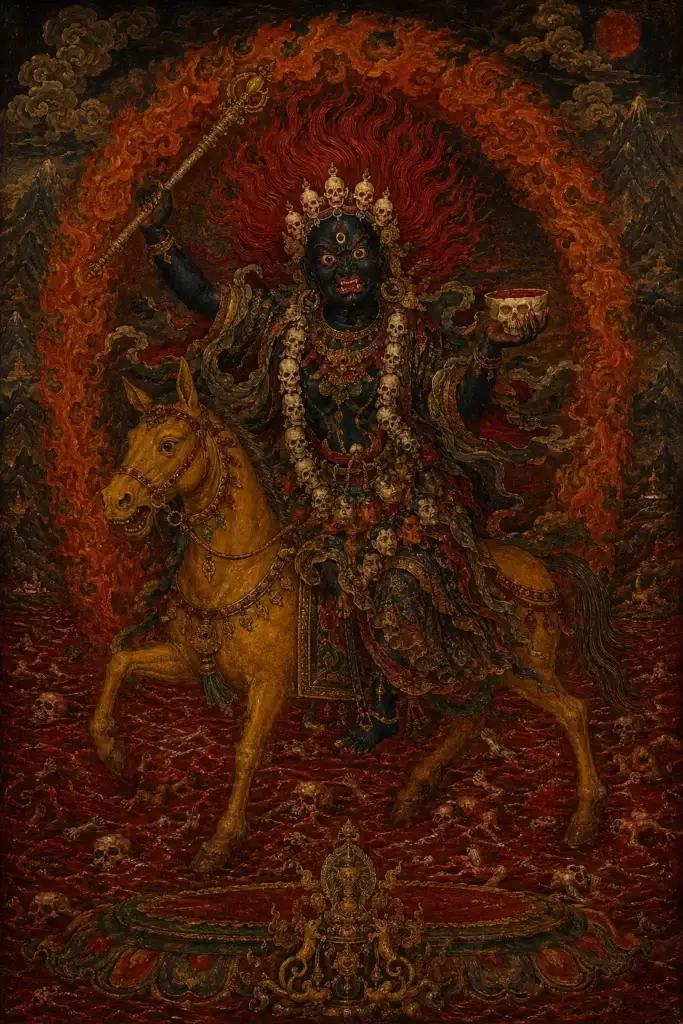
Palden Lhamo rides on a mule across a sea of blood and is depicted with blue skin, two arms and a wrathful face.
She wears a crown of five skulls and holds a club in her right hand and a skull bowl in her left. Her votive practices protect monasteries, teachers and practitioners. She is the personal protective goddess of the Dalai Lama.
At a glance: Palden Lhamo
Type: Tibetan Buddhist wrathful protective goddess, the only female figure among the eight great dharmapalas
Pantheon: Tibetan Buddhism (all schools, especially Gelug)
Function: Protection of the Dharma, protectress of the Dalai Lamas and of the Tibetan government, destruction of the demons
Main attributes: Black-blue skin colour, third eye, skull crown, rides on a mule across a lake of blood
Main cult sites: Lhasa (Lhamo Latso lake), Lhamo Lhakhang in the Potala Palace
Tibetan identity: Palden Lhamo, Sanskrit: Śridævî
Historical context
Period of the texts
Palden Lhamo (Tib. Palden Lhamo, “glorious goddess”) is one of the most important female protective deities of Tibetan Buddhism. Roots in the Hindu Kâlî and Durga tradition. Central in Tibet since the 8th century AD. Main flowering of the Palden Lhamo tradition: 14th/15th century with Tsongkhapa and the Gelug tradition.
She is the principal protective deity of the Dalai Lamas and of the traditional Tibetan government. Before the selection of each new Dalai Lama, the sacred Lhamo Latso lake (lake of visions) is consulted, which is consecrated to her.
Area of distribution
Main cult sites: Lhamo Latso lake (southeast of Lhasa, the sacred lake of visions, in which visions appear for the finding of the Dalai Lama), Lhamo Lhakhang in the Potala Palace in Lhasa (her own temple room), Drepung, Sera and Ganden monasteries (with the Palden Lhamo sadhana tradition).
Present in many Tibetan Buddhist monasteries in Bhutan and Nepal. Internationally present in every Tibetan Buddhist centre that has a practice of protective goddesses.
Source situation
Central sources: Tibetan Tantric sadhana texts on Palden Lhamo (various versions according to monastic tradition), the folk narratives surrounding the Lhamo Latso lake, Tsongkhapa’s writings on the tradition of protective deities.
Secondary literature: Linrothe, Ruthless Compassion; Beer, The Encyclopedia of Tibetan Symbols and Motifs (with detailed Palden Lhamo iconography); Lopez, Religions of Tibet in Practice; Cabezón, Tibetan Ritual.
Designation and spellings
Palden Lhamo is depicted with particular iconographic elements that are symbolically encoded and carry deep meaning. These elements convey above all the functions, sources of power, areas of responsibility and cosmic role of this entity.
The visual system allows initiates and the culturally educated to grasp the deeper meaning. Colours, sacred objects or weapons, bodily attributes, specific accessories, everything is significant and traditionally handed down. The system remains stable and recognisable across generations, which points to fundamental archetypal structures.
Characteristics
Palden Lhamo was central to religious practice and to the everyday understanding of Tibet. People turned to this entity in critical situations or at particular ritual seasons, with structured rituals, prayers or offerings. The practice was precisely transmitted and often led by priests or specialists.
The continuity of these practices over many generations shows that they were regarded as effective and necessary. Functions were varied: preventive (warding off misfortune), healing (alleviation of suffering), transformative (accompaniment through transitions) and protective (continuous guarding).
Appearance and symbolism
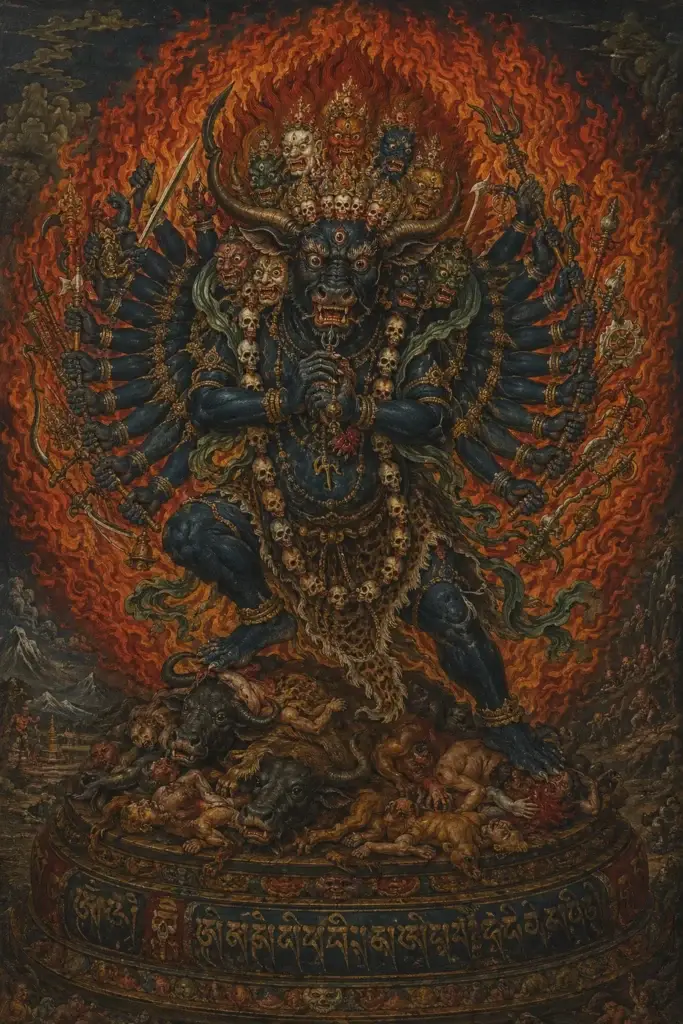
Palden Lhamo is depicted as a black or dark-blue-black goddess with wild hair, often with three eyes. She wears a crown of skulls and holds a club in her right hand and a skull bowl in her left. She rides on a mule or stands on corpses. Flames surround her form. This iconography symbolises her wrathful power against obstacles.
Profile: Palden Lhamo
The most important aspects of Palden Lhamo at a glance. The following fields summarise origin, function, appearance, veneration, symbols and cultural parallels.
Palden Lhamo develops out of the Tantric Kâlî tradition (Hindu root). In the Tibetan myth: she was originally an Indian princess who married an anti-Dharma king; as a Buddhist she sacrificed her son and ate his flesh in order to break the demonic path of her husband.
From this pain grew her wrathful form as protective goddess. Since that time she rides on a mule through a lake of human blood. In the Tibetan consolidation she is understood together with Mahakala as a complementary protective pair (male and female).
Chief protective goddess of the Tibetan tradition. Protectress of the Dalai Lamas and of the Tibetan government. Destroyer of the demonic obstacles to the Dharma.
In the Lhamo Latso lake, visions appear that are consulted in the finding of the next Dalai Lama, a central practice of Tibetan political religion. In the personal cult, invocation in acute emergencies, especially against severe demonic affliction. Patroness of the female wrathful yidams.
Black-blue (or dark-blue) female figure with a third eye, a gaping mouth with fangs. Skull crown (5 skulls), wild red hair, flaming aureole. Rides sideways on a white mule, whose saddle consists of the human skin of her sacrificed son.
Rides through a lake of human blood. In her hands: skull cup (kapala), thunderbolt (vajra), club with skull. Snake necklace, bone ornaments, tiger-skin apron. Accompanied by two beings: Makâravaktâ (crocodile-headed daughter) and Siṃhavaktâ (lion-headed daughter).
Area of effect: Palden Lhamo is venerated daily in every Gelug monastery. In the personal protective cult she is invoked in cases of acute demonic threat.
The Lhamo Latso lake tradition is unique: before each finding of a Dalai Lama, high lamas travel to the lake and meditate for days on the shore, in expectation of visionary inspirations about the next incarnations.
The current Fourteenth lama finding (1935) had here a famous vision of the letters Ah, Ka and Ma in a mirror.
Black-blue skin colour, third eye, skull crown, white mule (mount), saddle of human skin, lake of blood, skull cup (kapala), thunderbolt (vajra), club with skull. Accompanying beings: crocodile-headed daughter, lion-headed daughter. Sacred plants: none specific. Sacred colours: black, dark blue, red.
Kâlî (Hinduism, direct root), Durga (Hinduism, related warrior goddess), Mahakala (Buddhism, male complementary pair), Ekajati (Vajrayana, related wrathful protective goddess), Pehar (Vajrayana, related protective god), Sekhmet (Egypt, blood-drunk goddess parallel), Erinyes (Greece, vengeance-spirit goddesses), Hekate (Greece), Maman Brigitte (Vodou). Palden Lhamo is the unique chief protective goddess of Tibetan Buddhism.
Palden Lhamo, parallels in other cultures
Female protective deities in wrathful form, often with an animal mount and weapons, are found from Hinduism (Kali, Durga) to the Japanese Kishimojin; in the Tibetan context Palden Lhamo stands specifically for the order of the state and of the monasteries.
Jewish tradition
The Shekhinah as female divine presence and Lilith as wild female power share with Palden Lhamo the dimension of the female sacred, though without the wrathful protective function.
Greco-Roman world
Athena as a warlike protective goddess and Hera as a queen with authority approach Palden Lhamo’s role, though without the wrathful Tantric dimension and without demon-feast symbolism.
Germanic tradition
The Valkyries and Freyja as goddesses of war embody female fighting power, while the Norns embody fate and protection, a synthesis similar to this Palden Lhamo.
Hinduism
Durga and Kali as wrathful mother goddesses share with Palden Lhamo the synthesis of femininity, wrathfulness and protective function; both are central in Tantric Hinduism.
The protective deity of Lhasa and of the Dalai Lama
Palden Lhamo (Tibetan dPal ldan lha mo, Sanskrit Shri Devi) occupies a prominent position in Tibetan Buddhism that goes beyond that of a single protective deity.
She is regarded as the most important female dharmapala (protectress of the religion) and as the personal protective deity of the Dalai Lamas as well as of the Gelug school.
Her particular connection to the Tibetan capital is closely bound up with the Lhamo Lhatso, a sacred lake southeast of Lhasa. On its water surface, according to tradition, visions can be discerned that give indications in the search for the rebirths of high lamas.
The Second Dalai Lama Gendun Gyatso (1475 to 1542) founded a monastery on the shore and consolidated the connection between the deity, the lake and the oracle system.
In Lhasa itself Palden Lhamo was represented with her own chapels in the Jokhang Temple and in the Potala Palace. Her statue was carried annually through the city in a procession.
This public veneration joined the state cult with the protection of the political order, for Palden Lhamo was regarded as the guarantor of the government of the Dalai Lama.
From the standpoint of religious studies she is thus an example of how an originally Indian deity was reshaped in Tibet into the bearer of a state-supporting function.
The identification with the Indian Shri Devi points to a long prehistory. In India this figure was connected with the sphere of the wrathful protective deities before she received her Tibetan form in the Tantric systems.
The close bond with the Gelug school arose only in the course of the 15th and 16th centuries, when this school gained political influence. Anyone who wishes to understand the role of Palden Lhamo must therefore consider her within the interplay of monastic politics, oracle tradition and state cult, not as an isolated mythical figure.
Iconography: the mule, the saddle equipment and the symbols of wrath
The pictorial representation of Palden Lhamo follows a fixed canon, whose individual elements are each mythologically grounded. She rides on a mule through a sea of blood, depicted with dark-blue skin, three eyes and a wrathful face with bared canine teeth.
In her right hand she holds a cudgel or a club, in her left a skull bowl. Her hair blazes upward, often crowned by five skulls.
Particular attention is given to the mule. On its hindquarters appears an eye that, according to the legend, came about through an arrow that the enraged god of the realm of Lanka shot at the fleeing goddess. Instead of killing her, the arrow struck the mount and transformed itself into a watching eye.
The saddle is covered with the flayed skin of her own son, the reins consist of snakes. From the saddlebag hang a coil of magical threads and a die for divination. These objects point to her function as a deity who disposes over fate and the thread of life.
The material culture knows numerous bronze figures and above all thangka paintings of Palden Lhamo, which were widespread from the 17th century onward in the monasteries of the Gelug school. In the secret chapels of the protective deities, the gonkhang, her images often stood veiled and were accessible only to initiated monks.
Western collections such as the Museum of Asian Art in Berlin or the Rubin Museum in New York preserve significant examples.
The pictorial tradition has remained remarkably stable over the centuries, which reflects the liturgical fixing of the descriptive texts (sadhana) according to which the painters worked. A comparably dense wrathful iconography is found with Yamantaka and Ekajati.
The myth of the son and the self-binding vow to protect the teaching
One of the best-known narratives about Palden Lhamo explains how she became a protectress of the religion. In her prehistory she was married to the king of the man-eating realm of Lanka, a place where the Buddhist teaching was suppressed.
She vowed either to convert her husband to Buddhism or, should this fail, to wipe out the royal line. When the conversion failed, she killed her own son, the designated heir to the throne, flayed his skin and used it as a saddle blanket. She then fled to the north.
During the flight the king shot a poisoned arrow after her, which struck the mule and transformed itself into the well-known eye on its hindquarters. Palden Lhamo is then said to have drawn the poison out of the wound and turned its effect into a source of healing power.
This drastic narrative is multilayered from the standpoint of religious studies: the killing of the child does not stand for cruelty as an end in itself, but for the radical readiness to subordinate everything to the protection of the teaching. The flayed skin thus becomes a sign of a sacrifice rendered, not of a triumph.
In the Tantric interpretation Palden Lhamo belongs to those deities who originally belonged to the sphere of the dangerous, worldly beings and who were bound by an enlightened master and placed in the service of the teaching. Tradition ascribes this binding to Padmasambhava or to other early teachers.
She thus stands between the purely enlightened protective deities and the worldly spirits. The narrative of the son serves within this system as the reason why a figure of fearsome origin can nevertheless be a reliable protectress: her vow binds her irrevocably.
Rituals, oracles and the annual festival
The liturgical veneration of Palden Lhamo was firmly regulated in the Gelug monasteries. Monks recited her sadhana texts and invocations in the gonkhang, often within monthly and annual cycles.
The most important public celebration fell on the 15th day of the tenth Tibetan month. In Lhasa her image was moved on this occasion in a procession, and the population sought her protection for the coming year.
Closely connected with her is the oracle system. The State Oracle of Nechung was indeed primarily assigned to the deity Pehar, yet Palden Lhamo was regarded as the superordinate female protectress whose will was read in the lake visions at the Lhamo Lhatso.
In the search for the rebirth of a Dalai Lama these visions played a recognised role; this is reported, among other instances, for the finding of the 14th Dalai Lama in the 1930s, when the regent and the search commission visited the lake.
In ritual daily life Palden Lhamo was also appeased through offerings that corresponded to her wrathful character: these included torma figures made of dough, dark tea, alcohol and symbolic representations of flesh and blood.
These gifts are not to be understood as a veneration of violence, but follow the Tantric logic that a wrathful deity is addressed with substances of her own sphere in order to direct her power toward the protection of the practitioners.
A particular bond moreover existed with the winter months, in which protective rituals were intensified. Scholarship, for instance the works of Rene de Nebesky-Wojkowitz in his fundamental book Oracles and Demons of Tibet (1956), has documented this ritual system in detail and remains a central source.
Reception and history of research in the West
Palden Lhamo came comparatively early into the field of view of European Tibetan studies. Travellers and missionaries of the 19th century often described the wrathful protective deities with unease and interpreted them as evidence of a supposedly gloomy character of Tibetan Buddhism.
This judgemental view is now outdated. The scholarly examination began with the great collections of material of the early 20th century.
The decisive contribution comes from Rene de Nebesky-Wojkowitz, whose book Oracles and Demons of Tibet, published in 1956, systematically ordered for the first time the texts, iconography and rituals of the Tibetan protective deities.
Later works, for instance by Amy Heller on the iconography or more recent studies on the history of the Gelug school, have supplemented the picture and traced the historical development of Palden Lhamo from the Indian Shri Devi to the Tibetan state deity.
In more recent reception Palden Lhamo has become known to a broader public through exhibitions of Tibetan art. Her thangka depictions are among the most impressive examples of wrathful pictorial art and are treated in detail in collection catalogues.
In popular perception she is occasionally compared with concepts from other traditions, for instance with dark mother goddesses, which however misses her specifically Buddhist function.
From the standpoint of religious studies she remains interesting above all as a case study: she shows how a deity could over the centuries be at once liturgically fixed and politically functionalised.
Open questions concern above all the precise dating of her binding to the Gelug school and the relationship between the various regional forms of her cult, which have so far been only partly explored.
Further links
Literature (selection)
Further standard works in the literature index.
Frequently asked questions about Palden Lhamo
Who is Palden Lhamo in Tibetan Buddhism?
Palden Lhamo (Tibetan, glorious goddess, Sanskrit Shri Devi) is the most important female protective deity of Tibetan Buddhism and the only female figure among the great dharmapalas.
She is depicted in fearsome form: dark blue, riding on a mule that moves through a sea of blood, with a saddle made from the flayed skin of her own son. This drastic imagery is to be understood symbolically and stands for the uncompromising power with which obstacles on the path to enlightenment are destroyed.
What significance does Palden Lhamo have for Lhasa and the Dalai Lama?
Palden Lhamo is regarded as the special protectress of the city of Lhasa and of the Dalai Lama as well as of the entire Gelug school.
The lake Lhamo Latso, about 150 kilometres southeast of Lhasa, is regarded as her dwelling place and as an oracle lake: in its water surface visions are said to appear that are drawn upon, among other purposes, in the search for the rebirth of a deceased Dalai Lama.
Thus the lake played a role in the finding of the 14th Dalai Lama in the year 1935.