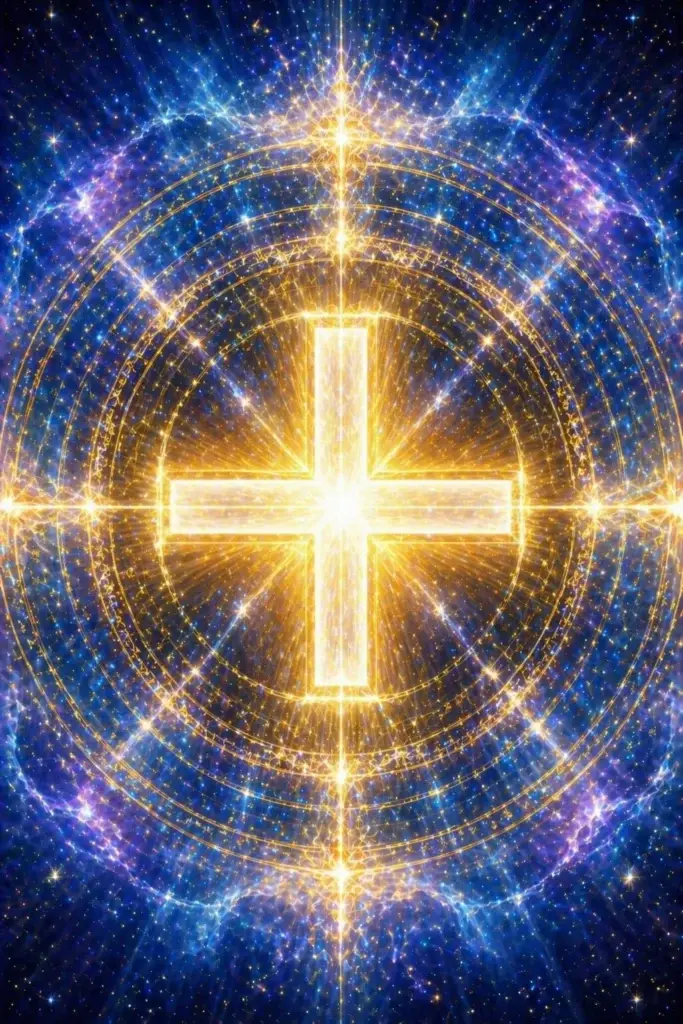
Primordial Source, the origin of all being
The Primordial Source is described in many traditions as the origin of all being, as an indivisible ground from which consciousness, matter and form unfold.
The term and its religious-studies framework
In comparative religious studies, the term Primordial Source denotes a topos that appears in practically every developed religious and philosophical tradition: the concept of an unconditioned, pre-temporal, undifferentiated origin from which all multiplicity, all beings and all manifestations proceed.
It is neither person nor object, but a structural assumption, the logical and ontological point that precedes every further statement about world, being and consciousness. The designations vary from tradition to tradition, yet the function remains comparable: it marks the boundary behind which human conceptual thinking can no longer retreat without dissolving itself.
Characteristic of the Primordial Source in all traditions is a combination of several features. It is ineffable, or at least definable only negatively; most traditions circle around it with a form of apophatic theology, that is, a speech that describes what the Primordial Source is not.
It is absolutely unified, prior to any differentiation, prior to any opposition, prior to subject and object. And it is productive: from it spring world, gods, beings, time and space, without it being diminished thereby.
These three features are found in the Vedic Upanishads as much as in late-antique Gnosis, in the Jewish Kabbalah or in Daoism.
The Primordial Source in the major religions
In Hinduism the Primordial Source is elaborated as Brahman, the absolute, attributeless, formless being, which in the Upanishads is circumscribed only in negation with the words neti, neti (“not this, not that”).
From Brahman there proceeds, in some creation myths, the Hiranyagarbha, the “golden germ” or cosmic egg, in which the multiplicity of the worlds rests in still-unfolded form. Closely related is the concept of Aum as the primordial sonic vibration that precedes the manifest world.
In Daoism the Dao takes on a similar function. The very first verse of the Dao De Jing determines the Dao apophatically: “The Dao that can be spoken is not the eternal Dao.” From the nameless Dao there proceed the One, the Two and the Ten Thousand, the usual Chinese image for full cosmic multiplicity.
Unlike the Indian tradition, the Dao is conceived more processually and less in personal-ontological terms; it is less a being than a continuous enactment.
In the Jewish Kabbalah the Primordial Source is determined as Ein Sof, the Infinite, which lies beyond all Sephiroth. From Ein Sof, through a chain of emanations, there proceeds the world of the ten Sephiroth, which are interpreted at once as attributes of God and as structural moments of creation.
The Kabbalistic theory of emanation later spread into Christian mysticism (Eckhart, Cusanus) and into Renaissance philosophy (Pico della Mirandola, Reuchlin), and to this day it shapes Western speech about divine origin.
Ancient philosophy and Gnosis
The most influential formulation of the Primordial Source for European thought stems from Neoplatonism. Plotinus (3rd century CE) determines the One (το ἕν, to hen) as beyond being, thought and multiplicity.
From the One there emanates, in a three-tiered hierarchy, first the Nous (the intellect), then the Psyche (the world soul), and finally the material world.
The movement is not temporal but an eternal procession. Plotinus’s influence reaches through Augustine into the Christian doctrine of the Trinity, through Ibn Sina into Islamic philosophy and through Eckhart into German mysticism.
Gnosis speaks of Bythos, the “depth” or abyss, as the Primordial Source of the divine Pleroma, the “fullness.” From Bythos and his consort Sige (silence) there arise, in the Valentinian systems, the pairs of aeons that form the Pleroma.
Only through a crisis within the Pleroma, usually connected with the figure of Sophia, does the material world come about, which in Gnosis is interpreted as a falling-away from, or a misrecognition of, the Primordial Source. Here the movement of emanation tips over into a tension between a lost and a to-be-regained home.
Structural parallels across the traditions
Whoever places the concepts mentioned side by side recognizes a remarkable structural similarity, without the historical and cultural differences having to be leveled out as a result. In all formulations the Primordial Source is prior to every determination, absolutely unified and productive.
In all formulations there is a twofold movement: a procession of multiplicity from the One and a potential way back, a re-entry of multiplicity into the origin.
The way back is elaborated differently in the respective traditions, as moksha in the Hindu context, as devekut in the Kabbalah, as henosis among the Neoplatonists, as gnosis in ancient Gnosis, as contemplative union in Christian mysticism.
In twentieth-century comparative religious studies, with Mircea Eliade, Henry Corbin, Frithjof Schuon and others, this structural parallel led to the hypothesis that there is something like a philosophia perennis, an “everlasting philosophy”: a core that was discovered and elaborated independently of one another in the great contemplative traditions.
Scholarship is divided over whether this is a genuine universal deep structure or a projection of Western seekers onto disparate traditions. Whoever reads the material can pose the question for themselves; the findings lie open before you.
Significance for protective practice and the cosmic information field
In the context of iWell Guard the Primordial Source is not a theological confessional formula but a working hypothesis: if all beings, gods, demons, spirits and beings of light proceed from a common, undifferentiated source, then energetic burdens caused by foreign beings can in principle be traced back to this origin and dissolved there.
The methodology uses this train of thought as a structural foundation; the mediumistic examination in the cosmic information field describes the practical procedure by which this happens in the individual case.
An important distinction: the Primordial Source is not a protective deity, not a being to which one could turn. It is the precondition for being able to speak of beings, of effect and of protection at all.
In this respect the term stands in a line with other fundamental religious-studies concepts such as cosmic information field, mediumistic information or Aether, concepts that structure the world of experience without themselves being objects of experience.
Indigenous and shamanic traditions
Outside the major religions, too, the concept of the Primordial Source is found in many indigenous and shamanic traditions, there mostly embedded in concrete cosmological narratives.
In Siberian shamanic cultures one often speaks of a “world oak” or “world tree” whose roots flow into a primordial source from which life force, souls and animal spirits proceed.
In North American indigenous traditions the notion of a “Great Spirit” or a “source of all beings” is common, among the Lakota for instance as Wakan Tanka, among the Algonquin as Manitou.
Neither term can be reduced to a personal deity; they circumscribe a comprehensive ordering and creative power that is active in everything living.
In African traditions comparable concepts are found. Among the Yoruba, for example, Olodumare or Olorun is the unconditioned, remote creator god who lets the manifest world operate through the Orishas; this structure was carried on in the diaspora as the foundation of Vodou and Santería, where the Loa or Orishas function as mediating beings between the Primordial Source and the human world of experience.
The structural parallel to the Neoplatonic chain of emanation is evident, without historical influence being demonstrable; it points to the typological constancy of the model.
Related topics and further reading
Whoever engages in depth with the concept of the Primordial Source will find several thematically connected entries on iWell Guard. The detail page Sophia describes the Gnostic figure whose crisis structures the relationship between the Primordial Source and the manifested world.
The entry Aether treats the ancient and early-modern concept of a subtle carrier medium that bridges the Primordial Source and matter. The class beings of light gathers those appearances that in many traditions are regarded as immediate emanations of the Primordial Source, from the archangels of the Jewish-Christian tradition to the Devas of the Indian.
As scholarly introductory literature, the translations of the central Upanishads by Paul Deussen are recommended for the Hindu tradition, the studies of Isabelle Robinet for Daoism, the standard works of Gershom Scholem for the Kabbalah, the Plotinus edition and the studies of Pierre Hadot for Neoplatonism, and for Gnosis the critical editions of the Nag Hammadi writings and the overview by Kurt Rudolph.
You will find a commented selection in the bibliography overview.
The notion of a Primordial Source as the indivisible ground of all being belongs to the oldest religious-philosophical concepts of all. In the pre-Socratic speculations Thales speaks of arché (origin), Anaximander of the apeiron (the unlimited); both mean by this that first principle from which all determinate appearances proceed.
In Hinduism this corresponds to the Brahman of the Upanishads, in Daoism to the Dao as the “mother of all things” (Daodejing 1), in Buddhism to Tathata or Dharmadhatu.
In the Jewish mysticism of the Kabbalah it is En Sof, the “Infinite” beyond all attributes (Gershom Scholem: Die jüdische Mystik in ihren Hauptströmungen, Frankfurt 1957). In Christian Neoplatonism, in particular in Plotinus and Pseudo-Dionysius the Areopagite, it is the supra-essential One, from which all reality flows in a hierarchy of emanations.
Of importance for the philosophy of religion is the difference between the Primordial Source as creator (theistic tradition) and the Primordial Source as ground (mystical-immanent tradition).
In the theistic understanding the source stands over against what is created; in the mystical understanding everything created is still within the source and inseparably bound to it. Both understandings have their own spirituality: prayer and invocation in the one, immersion and recognition in the other.
The affirmation mantra of the iWell Guard deliberately works with the second mode; the Primordial Source is not invoked as an external power, but made present as an ever-already-present inner ground.
In modern integral spiritualities, for instance in Ken Wilber or in the work of Sri Aurobindo, the Primordial Source is described as the origin of consciousness, that “empty” ground that is exhausted by no form, but from which every form is possible.
Phenomenologically, this ground cannot be had as an object of experience, but can only be disclosed as its precondition. The practice of many contemplative traditions accordingly consists not in searching for a distant origin, but in letting go of all concepts about the origin, in the trust that what remains is the Primordial Source itself.
Further standard works in the literature index.

Connection within the iWell Guard
In the iWell Guard, the connection to the Primordial Source is described as a separate functional level of the protective field (level 5 of the Seven Building Blocks). In the brand cosmology, the Primordial Source stands for the origin of all being and for the return of transformed energy.
Directions of effect are described in functional terms only. Not a medical device. No promise of healing.