Durga is a goddess of the Hindu tradition.
The war goddess and demon slayer, protector of the world. Durga is one of the most powerful goddesses of Hinduism, an embodiment of *Shakti*, the cosmic feminine power. She was created by the gods to defeat the demonic buffalo *Mahishasura*, whom no god could destroy alone.
Enthroned on a tiger, with ten arms full of weapons, Durga is the symbol of the victory of good over evil. During Durga Puja, the largest festival of Bengal, she is welcomed anew each year.
Type: Major Hindu goddess, principal manifestation of the Devi (Mother), warrior goddess
Pantheon: Hinduism (especially Shaktism, venerated in all Hindu traditions)
Function: Destruction of demons (especially Mahishasura), protection of the world, cosmic mother
Main attributes: Eight or ten arms with the weapons of all the gods, tiger or lion as mount, Trishula
Main cult sites: Kalighat (Bengal), Vaishno Devi (Jammu), Mysore (Chamundeshwari), Kamakhya
Aspect of: Parvati, in the Tantric hierarchy one of the ten Mahavidyas
Durga has been central to the Hindu tradition since the Devi Mahatmyam (5th/6th century CE, part of the Markandeya Purana).
Her main myth is the battle against the buffalo demon Mahishasura, who can only be defeated by a woman; Durga arises from the combined energies of all the gods, and each god grants her his most important weapon (Vishnu the discus, Shiva the Trishula, Indra the Vajra, and so on).
The main period of Durga veneration: according to the Puranas, consistently central. Today she is celebrated especially in Bengal with the Durga Puja festival (September/October, the largest regional festival of Bengal).
Main cult sites: Kalighat (Kolkata, together with Kali), Vaishno Devi (Jammu & Kashmir, one of the most visited Hindu pilgrimage sites), Chamundeshwari Temple (Mysore, Karnataka, with the famous Mysore Dasara festival), Kamakhya (Assam, one of the most important Shakti Pithas).
The 108 Shakti Pithas are the pilgrimage sites where parts of Sati’s body are said to have fallen, many of them Durga temples. Internationally present in every larger Indian diaspora community with a Hindu temple.
Central sources: Devi Mahatmyam (also called Durga Saptashati, the central source of Durga theology, 700 Sanskrit verses), Devi Bhagavata Purana, Markandeya Purana, Skanda Purana. Tantric texts: Sundara-Kanda, Lalita Sahasranama (1000 names of the Devi).
Secondary literature: Kinsley, Hindu Goddesses; Coburn, Encountering the Goddess (classic Devi Mahatmyam translation with commentary); Pintchman, The Rise of the Goddess in the Hindu Tradition; Erndl, Victory to the Mother.
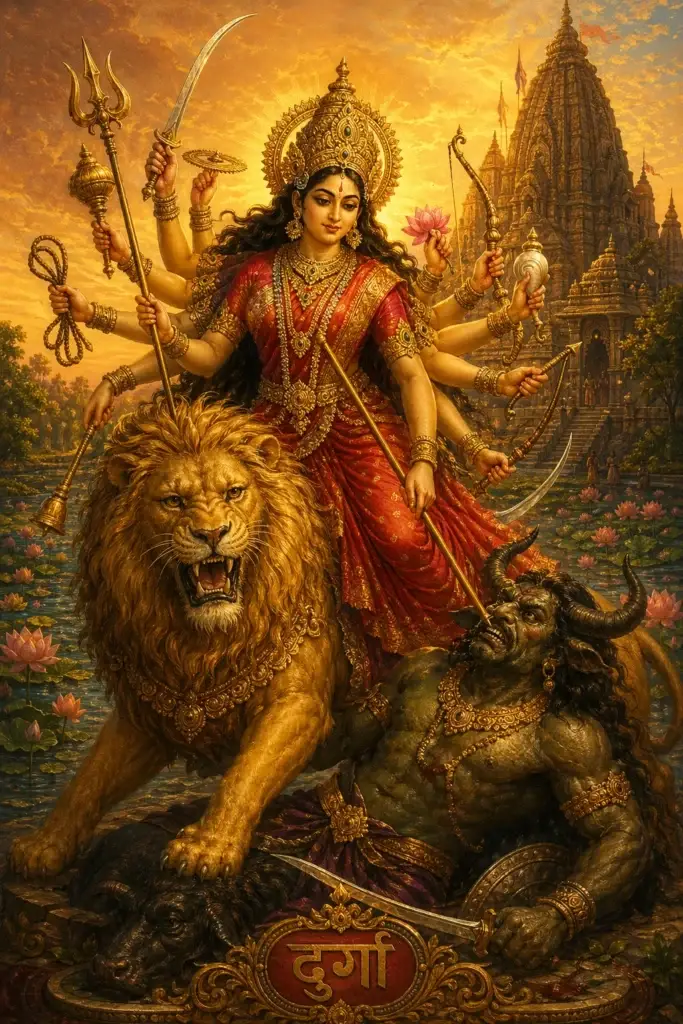
Durga is a beautiful, warlike goddess who rides on a tiger or lion. She has ten arms, each armed: a sword, a discus (Sudarshana), a trident, a bow, a mace, a lance, and further weapons.
She wears a red garment and gleaming jewels. Her face radiates gentleness as well as unshakable determination. The animal beneath her, the tiger, symbolizes the wild, uncontrollable nature that stands under her rule.
Durga is the protector against evil forces and cosmic disorder. The battle against Mahishasura symbolizes the eternal conflict between Dharma (order) and Adharma (chaos). For nine nights (Navaratri) she is venerated with fasting, meditation, and dances.
On the tenth day, Dussehra or Vijayadashami, the victory over Mahishasura is celebrated. At household altars, the faithful receive her blessings for protection and prosperity.
The most important aspects of Durga at a glance. The following fields summarize origin, function, appearance, veneration, symbols, and cultural parallels.
Durga is the warlike principal manifestation of the Hindu Devi (mother goddess). In the Devi Mahatmyam myth, she arises from the combined energies (tejas) of all the male gods, who are helpless against the buffalo demon Mahishasura.
She is more than the sum of the gods: each grants her his most important weapon, so that she has eight or ten hands full of divine power.
In the theological consolidation, she is regarded as a wrathful aspect of Parvati, and thus as the consort of Shiva. In the Tantric tradition, she stands above all other Devi aspects as Mahashakti.
Destroyer of all that is demonic, protector of the cosmic order. Patron of warriors and kings (in historical India, Durga Pujas were performed before battles).
In the Bhakti cult, she is invoked as Maa (Mother); in Bengal she is not the warming, motherly figure (that is Kali in the Bengali tradition), but radiantly protective and motherly. In the Mysore Dasara festival she was historically invoked as the protective goddess of the kingdom.
A radiant, beautiful female figure with golden skin, in a golden-yellow or red sari, with rich jewelry. Eight or ten arms (in Bengal usually ten).
In her hands the weapons of all the gods: Trishula (from Shiva), Sudarshana Chakra (from Vishnu), Vajra (from Indra), bow and arrow (from Surya), sword (from Yama), skull cup, snake, bell (Damaru), lotus.
Mount: lion or tiger (in Bengal usually a lion, in Karnataka the tiger). She stands or kneels on the defeated Mahishasura. Third eye on the forehead. Long dark hair.
Sphere of effect: Durga is invoked in acute situations of need for protection. Durga Puja in Bengal (September/October): a ten-day festival with elaborate clay statues (made by a lineage of kumorti craftsmen) that are ritually immersed in water at the end of the festival.
Mysore Dasara in Karnataka: the same occasion, but with the Mysore Palace as the stage. Navratri (nine nights) as her universally Hindu festival, with ecstatic dance rites (garba, dandiya in Gujarat). Pilgrims to Vaishno Devi climb about 13 km up to the cave sanctuary.
Trishula, Sudarshana Chakra, Vajra, sword, bow and arrow, shield, bell, skull cup, lotus, snake, lion/tiger (mount). Sacred plants: bilva tree, hibiscus, lotus. Sacred animals: lion, tiger. Sacred colors: red and gold.
Kali (Hinduism, her wrathful aspect), Parvati (gentle form), Lakshmi and Sarasvati (parallel Devi aspects), Athena (Greece, warrior and protector), Sekhmet (Egypt, blood-drunk lioness), Ishtar (Mesopotamia, love and war, lioness on lions), Anahita (Persian).
Functionally: all warrior goddesses who destroy demons share Durga’s aspects. In the broader context: the Madonna of Mariazell and the Black Madonna of Częstochowa as Christian motherly protective parallels.
Veneration rituals
Durga is the warrior-mother aspect of the Devi/Shakti. The main festival is Navaratri (nine nights, in the month of Ashvin, Sept./Oct.) with daily pujas to different Devi aspects.
In Bengal, Navaratri culminates in the four-day Durga Puja with artfully shaped clay statues (immersed in the Hooghly River at the conclusion on Vijayadashami; cf. McDermott, Encountering Kali). In southern India, the more prominent equivalent is the Mahishasura Mardini festival with a procession.
Mantras and invocations
The Devi Mahatmya (Markandeya Purana, c. 6th century) is her central hymnic text, 700 verses, hence also called Saptashati. The seed mantra “Dum” and the longer “Om Dum Durgāyai Namaḥ” are used in japa repetition. The Mahishasura Mardini Stotra (attributed to Adi Shankara) is a liturgical standard.
Amulets and protective symbols
Durga’s ten arms (each with a weapon of one of the individual gods) and the lion as mount are iconic. The Trikona Yantra with a bindu at the center serves as a geometric protective symbol.
Red sindur and yellow mustard seeds (haldi) serve as protective paste in birth rituals. Copper plaques with her nine forms (Navadurga) were traditionally hung at house entrances.
The central myth of Durga is her battle against the buffalo demon Mahishasura. It is told in detail in the Devi Māhātmya, a text handed down as part of the Mārkaṇḍeya Purāṇa and dated to roughly the 5th to 6th century.
This text is regarded as the most important foundation of goddess veneration in Hinduism.
The narrative begins with a crisis among the gods. Mahishasura, a demon who can take the form of a buffalo, has attained invincibility against any male being through ascetic practice and has driven the gods out of heaven. Since no single deity can defeat him, the gods combine their wrath and their energies.
From this united power, Durga arises as a radiant, many-armed goddess. Each god equips her with one of his weapons: Shiva gives the trident, Vishnu the discus, and so on. Her mount, the lion, comes from the mountain deity.
A long battle follows against Mahishasura and his hosts. The demon changes form several times, but Durga sees through every transformation. Finally she kills him with her trident as he steps half out of the buffalo body.
From the perspective of religious studies, the construction is significant: Durga is not one goddess among others, but the bundled divine power itself, the shakti.
The myth thus provides the theological grounding for why the goddess can be venerated as the highest reality. The iconography of Mahishasuramardini, the slayer of the buffalo demon, has been among the most widespread image types in Indian art since the Gupta period.
The Devi Māhātmya, also called Durgā Saptaśatī or Caṇḍī, comprises about seven hundred verses and is divided into three large narrative sections, each of which is assigned an aspect of the goddess. This tripartite division is central to understanding Durga theology.
The first part tells how the goddess, as Yoganidrā, the cosmic sleep, awakens Vishnu so that he can defeat two primordial demons. The second part contains the Mahishasura myth. The third part depicts the battle against the demons Shumbha and Nishumbha as well as their generals.
In this third section, further goddess figures emerge: from the goddess’s wrath comes the black, terrible Kali, and the Matrikas, the mother goddesses, appear. A famous passage emphasizes that all the individual goddesses are ultimately forms of the one Devi.
The text is not only narrative but also liturgy. It contains several great hymns in which the goddess is praised, and it is recited in its entirety as a ritual, especially during the autumn festival of Navaratri.
Scholarship, such as Thomas Coburn in his works on the Devi Māhātmya, has shown that this text represents a turning point: it gathers previously scattered conceptions of the goddess into a unified theology in which the feminine appears as the highest, all-encompassing power.
Later texts of the Shakta tradition build upon it, but the Devi Māhātmya remains their foundation.
The veneration of Durga centers on the festival of Navaratri, the nine nights, which is observed twice a year, most famously in autumn.
In large parts of India, the goddess is venerated during this time in her various forms, often with daily recitation of the Devi Māhātmya, with fasting, and with the veneration of young girls who are regarded as a living manifestation of the goddess.
In Bengal and eastern India, the festival has taken on a particularly pronounced form as Durgā Pūjā. Here, elaborate clay figures of Durga are made, usually depicting her with ten arms in the act of killing the buffalo demon, surrounded by her children Lakshmi, Saraswati, Ganesha, and Kartikeya.
The figures stand in temporary pavilions that are artfully designed and visited by large crowds over several days. At the end of the festival, the figures are dissolved in solemn processions in rivers or other bodies of water.
From the perspective of religious studies, the connection of the festival with the harvest cycle and with a mythical reference to the Ramayana is of interest: according to one tradition, Rama venerated the goddess before his battle against Ravana, which provides the basis for the autumnal Durga Puja.
The festival has, moreover, developed a strong social and, in modern times, political and economic dimension; in Calcutta it is the defining major event of the year.
In 2021, UNESCO added the Durga Puja of Calcutta to the list of intangible cultural heritage. The festival thus exemplifies how a religious myth can become a vehicle of regional identity and collective practice.

Within the Shakta tradition, that is, the current that venerates the goddess as the highest reality, Durga is not an isolated figure but a nodal point in a wide network of relationships.
Theologically, she is regarded as a form of the one great goddess, Mahadevi, who can be both peaceful and terrible, motherly and warlike.
Closely connected with her is Kali, who in the Devi Māhātmya arises from Durga’s wrath. While Durga embodies the ordered, victorious fighter, Kali stands for the unleashed, boundary-transgressing side of the same power.
In Parvati, the goddess has her form as the consort of Shiva and a loving mother; Durga and Parvati are understood in many traditions as identical or as aspects of one person.
Alongside these stand the groups of the Matrikas, the mother goddesses, and the series of the Mahavidyas, the ten great wisdom goddesses, among whom figures close to Durga are classified.
This interweaving follows a theological principle. The individual goddesses are not competing persons but aspects in which the same shakti shows itself according to task and mood.
Durga embodies in particular the function of protection and of victory over chaos; her name itself is traditionally associated with a fortress difficult to traverse or with overcoming difficulties, an etymology that is linguistically plausible.
In lived piety, devotees turn to Durga above all as a protective power. From the perspective of religious studies, she is an example of how a single deity can be at once a concrete cultic figure and a theological principle that holds an entire pantheon of female powers together.
Further standard works in the literature index.
Durga (Sanskrit, the Inaccessible) is one of the most important forms of the great goddess (Mahadevi) in Hinduism, the motherly yet combative protector of creation.
She is typically depicted with eight or ten arms, in which she carries the weapons of all the gods (trident from Shiva, discus from Vishnu, thunderbolt from Indra, and so on).
She rides on a tiger or lion. In the central myth, she defeats the buffalo demon Mahishasura, whom none of the male gods could defeat, hence the epithet Mahishasuramardini.
Durga Puja is the most important Hindu festival in West Bengal and eastern India, a ten-day celebration in September/October (the month of Ashvin) that ends with Vijaya Dashami (the day of victory). In each city district, large temporary shrines (pandals) are erected with artfully formed clay statues of Durga defeating Mahishasura.
On the last day, the statues are carried to the river in solemn processions and released into the water, a symbol of the goddess’s return to the cosmic primordial waters. The festival is a UNESCO World Heritage tradition.
Against its influence, cross-cultural tradition names these protective means:
Recommended protective means
The simplest protective means in this collection: 41 layers of fine gold 999, platinum, silver and silicon, manufactured in Ruhla, Thuringia. It requires no activation, is bound to no person, and is effective within a radius of around 50 meters, even without being worn.
Related Beings

Mamo, female and dark mother spirits of the Tibetan tradition: dakini-related beings between prot...

Kagutsuchi, the Japanese fire god, whose birth killed Izanami. Origin, the festival against fires...

Sethlans is the Etruscan god of the forge and fire, counterpart to the Greek Hephaestus. A religi...

Khormusta is the supreme sky god of the Mongols, a fusion of Iranian-Buddhist and Tengrist layers...

Pinga is the mistress of land animals, guardian of women in childbirth and soul guide in the Inui...

Jumbie, the collective term for evil spirits of the Caribbean. Origin in the Kongo word zumbi, th...