Vedava, the appeased mistress of the fish
By Ralf Ittermann · last reviewed on
Vedava is a spirit of the Finno-Ugric (Volga) tradition.
Nurturing mistress when given offerings, deadly when disregarded.
Vedava, also distinguished as Vedava Mari from the Mordvin Ved-ava, is the water mother of the Mari, a Volga-Finnic people on the Volga. As mistress of the waters and the fish, she determines the success of the catch; fishermen appease her with the first catch.
She belongs to Mari paganism, the still-living nature religion of the Mari, whose Ava system also includes further mother spirits for earth, forest, wind and sun besides her. Vüd-ava, as she is called in the Mari’s own wording, is closely related to the Mordvin Ved-ava, but is an independent being of her own tradition.
Type: water mother of the mermaid type, mistress of the waters and fish
Origin: Mari paganism, nature religion of the Mari on the Volga
Texts: type and kinship clearly attested, Mari-specific details derived from the Volga-Finnic tradition
Period: ethnographically documented, still living practice today
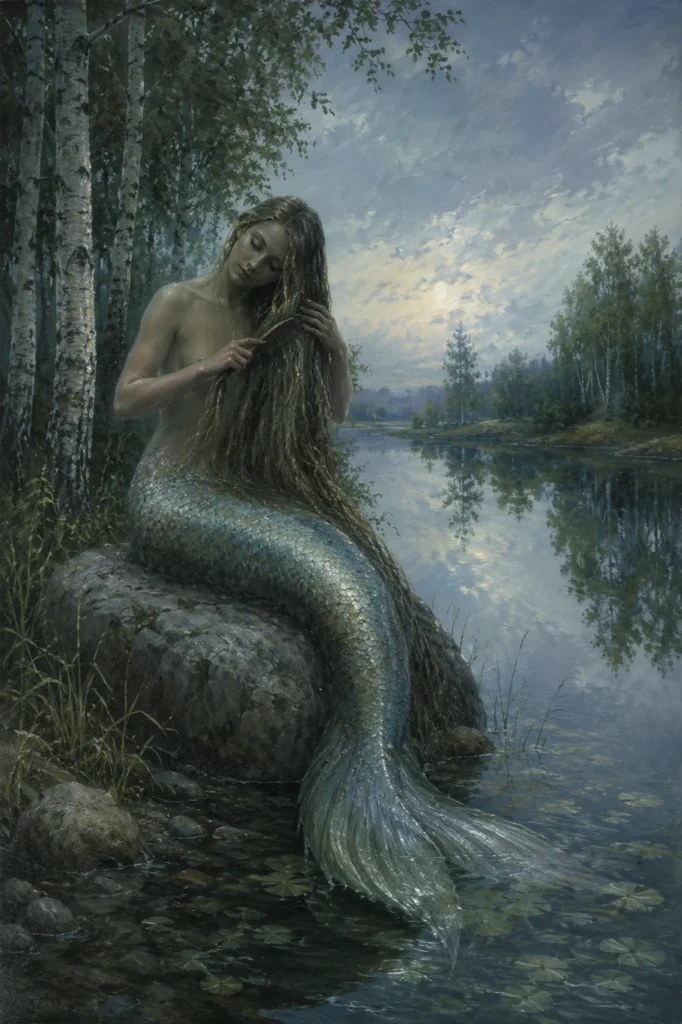
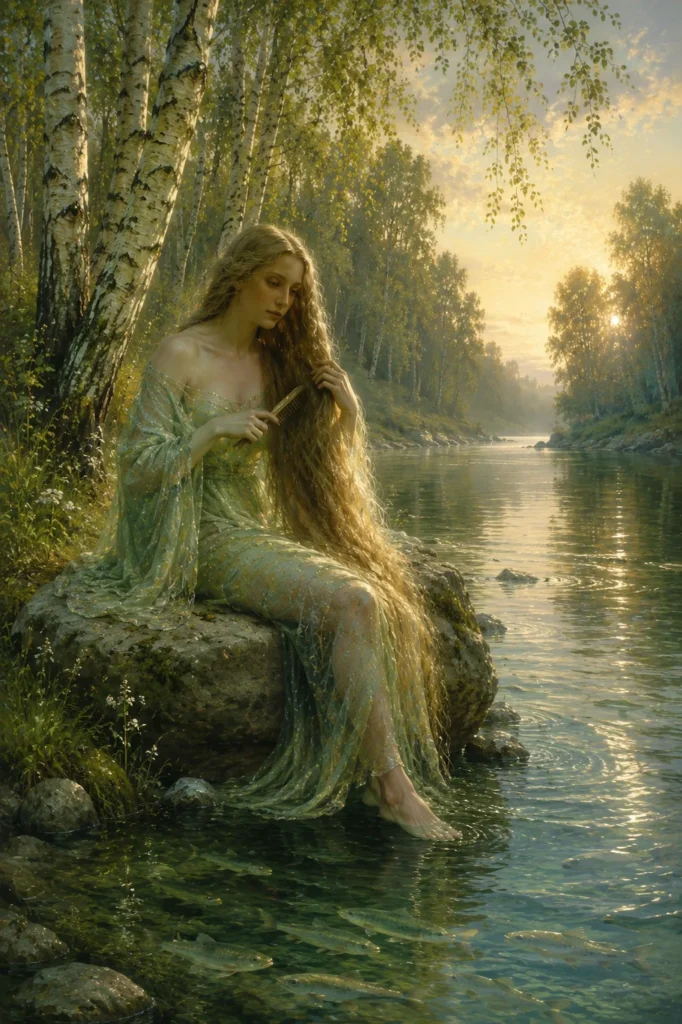
Appearance: long hair, large breasts, fish-like lower body, combing herself while sitting on a stone
Area of origin and sources
Period of the Texts
The tradition belongs to the nature religion of the Mari, still practised today, and is ethnographically documented rather than dated through literary-historical sources like many other water spirits.
Area of Diffusion
Found in the Republic of Mari El on the Volga, Russia, the Mari settlement area.
Sources
The type and kinship of the water mother are clearly established; the specifically Mari-named Vüd-ava is more thinly documented in the accessible sources than the Mordvin Ved-ava, so the description partly relies on the shared Volga-Finnic tradition.
Name and variants
Mari: vüd means water, ava mother: Vüd-ava, Vedava in German, literally means water mother. The name follows exactly the Ava system of the Mari, in which mother spirits govern earth, forest, wind, sun and, indeed, water.
Appearance
Appearance
Within the Ava type, Vedava corresponds to the pan-European mermaid image: long hair, shown as she sits combing it on a stone, large breasts and a fish-like lower body. She makes herself noticed by singing or making music, drawing people’s attention to her.
Effect
As mistress of the fish, Vedava determines the success of the catch and must be appeased by fishermen. Her appearance is considered a bad omen, usually announcing drowning. With correct behaviour, however, through offerings and observance of taboos, she instead secures a good catch and well-being: she is nurturing mistress and danger at once.
Profile: Vedava
The key aspects of the Water Mother at a glance.
Part of Mari paganism, the still-living nature religion of the Mari on the Volga, with the Ava system of mother spirits as its framework.
The fishermen of the Mari, whose catch success depends on her goodwill; disregarding the taboos is considered a cause of drowning.
Long, combed hair, large breasts and a fish-like lower body, sitting on a stone by the water.
Catch success and well-being when offerings and taboos are honoured, drowning as an omen when disregarded: a dual effect.
The offering of the first catch and the observance of fishing-related taboos, embedded in the veneration of the mother spirits in sacred groves.
Between Mari nature religion and the Volga-Finnic Ava family
The Mari, formerly called Cheremis, are a Volga-Finnic, Finno-Ugric people. In their nature religion, Mari paganism, still living today, the world is pervaded by mother spirits, the ava: the earth mother, the forest, wind and sun spirits, and indeed the water mother. In the Mari context she is called Vüd-ava, literally water mother, from vüd, water, and ava, mother, and is the mistress of the waters and their abundance, especially the fish.
Structurally, she is identical to the Mordvin Ved-ava and the Estonian Vete-ema. Mari religion rests on tree and animal offerings in sacred groves, in which the veneration of the water mother is also embedded. The specifically Mari-named Vüd-ava is more thinly documented in the accessible sources than the Mordvin Ved-ava, so the description partly relies on the shared Volga-Finnic tradition.
Between the epic Jugorno and lived veneration
In the Mari nature religion, still practised today, the water and other mother spirits are living objects of veneration. The great literary work on Mari mythology is the epic Jugorno, which unfolds the overall mythological framework in which the water mother also has her place.
In religious studies, Vedava belongs to a class of nature spirits found among all fishing-dependent Finno-Ugric peoples. The Ava type, the mother-mistress of a natural domain, is structurally related to the Finnish mother concepts and the Haltija principle, placing the Volga-Finnic mother spirits in the wider North Eurasian context.
The fishermen's first-fruits offering
Well attested by sources is the fishing offering: fishermen offered the water spirit their first catch and observed numerous taboos while fishing. The first-catch offering and adherence to taboos form the core of the protective practice. Mari practice places such offerings within the system of sacred groves, where the mother spirits are venerated. Protection thus lies in a proper, reverent relationship to the water mother, not in warding off or banishing her.
Water mothers between the Volga and the Baltic Sea
Vedava is the direct sister figure of the Mordvin Ved-ava: both names mean water mother, both belong to the same Ava type, which they share with the Estonian Vete-ema, yet each has her own people’s tradition and is an independent being. Among the functionally related water mistresses is the Finnish Vellamo, and, in the Russian neighbourhood, the Slavic Rusalka. As a river and water goddess, Vedava is also close to the Indian Sarasvati, and she shares her mermaid form with the Germanic Nix.
Frequently asked questions about Vedava
Is Vedava the same as Ved-ava?
No. They are two related water mothers of neighbouring Volga-Finnic peoples with almost the same name, water mother. They belong to the same Ava type but have their own traditions and are independent beings.
Is the water mother of the Mari still venerated today?
Yes. Mari nature religion is one of the few living ethnic religions of Europe, and the water and mother spirits are still part of its cult today.
How is Vedava appeased?
Through the offering of the first catch and observance of the fishing-related taboos. Her appearance, on the other hand, is considered a bad omen, usually announcing drowning.
Further links
Further reading:
- Ved-ava – the Mordvinian sister figure
- Vellamo – related Finnish water mistress
- Amulet, Smoke Cleansing, Salt – traditional protective means
- Protection Compass – protective means at a glance
Literature (selection)
Further standard works in the bibliography.
Known as Vedava, Mother of the Water, she embodies what Mari mythology has taught from the beginning: whoever honours the water of the Volga is given fish, whoever disrespects it is pulled into the depths.