Chaneque, the rightful dwellers of the forest
By Ralf Ittermann · last reviewed on
The Chaneque are spirits of the Nahua tradition of Mexico.
Child-shaped forest guardians who lead intruders astray. In the Nahua tradition, the Chaneque are encountered as child-shaped forest guardians who lead intruders astray.
Chaneque are child-shaped nature spirits of the Nahua, guardians of the forest and of wild animals. They frighten intruders, lead them astray, and can, through a severe fright, loosen the soul, the susto, which affects children in particular.
The belief is rooted in the Aztec-Nahua worldview, is mentioned in colonial-era sources, and remains alive today, especially among the Nahua of the Mexican Gulf region, as well as among the Totonac and Mixe. Anyone entering forest, river or cave moves within the domain of these small local lords.
Type: Child-shaped nature spirits, guardians of forest, animals and water
Origin: Aztec-Nahua worldview, colonial-era mentions
Texts: Sahagún, Inquisition records, living oral tradition
Period: pre-Hispanic roots to the present
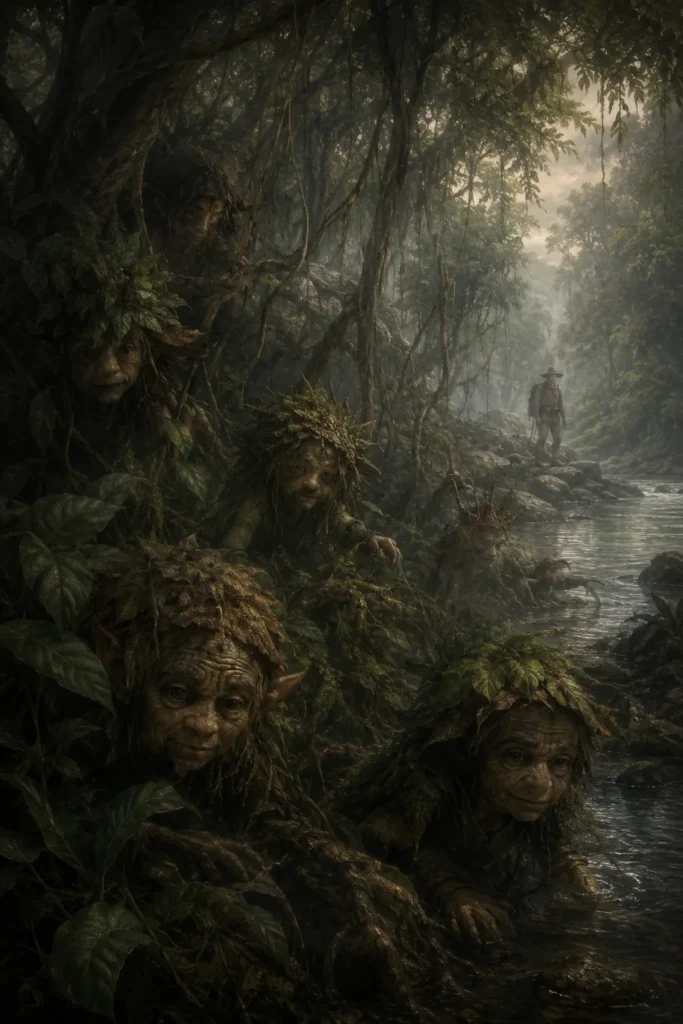
Appearance: small, child-shaped beings, often naked, some with an elderly face, frequently invisible
History of tradition
Period of the Texts
Its roots lie in the Aztec-Nahua worldview; colonial-era mentions are found in Sahagún and in Inquisition records, and the tradition remains alive to this day.
Area of Diffusion
The Nahua in Mexico, especially the Gulf region, as well as the Totonac and Mixe; preferred places are forest clearings, riverbanks, caves and crossroads.
Sources
Good: early colonial documentation by Sahagún and in Inquisition records, together with folklore collections and a living oral tradition.
Name and variants
Nahuatl: Chaneque is the hispanicised form of chanehqueh, from chantli, house, and a possessive ending, meaning roughly the rightful dwellers of the place, that is, of the forest or stretch of land.
Nature and effect
Appearance
The Chaneque are small in stature, childlike or dwarf-like, often naked and invisible, in some accounts children with elderly faces. They represent the animated, wild nature of threshold places and nature’s claim of ownership against human encroachment.
Effect
The Chaneque protect plants, animals and sacred springs from encroachment. Their core effect is leading astray: they disorient intruders, cause them to wander for days, and produce gaps in memory. Central is the susto, the soul loss: a severe fright can cause the soul’s energy to leave the body, especially in children; without a ritual retrieval, illness and death threaten.
Profile: Chaneque
The key aspects of the small forest guardians at a glance.
Nature spirits of the Nahua worldview with pre-Hispanic roots, recast in colonial times as demonic temptation, today a living tradition of the Gulf region.
Intruders into forest, river and cave, especially children: they are most at risk from the fright and the resulting soul loss.
Small, child-shaped humanoid beings, often naked, some with an elderly face, frequently invisible; at home in clearings, riverbanks, caves and crossroads.
Guarding forest, animals and water; leading astray, days of wandering, gaps in memory, and the fright-induced soul loss susto.
Ask permission before entering the forest, wear clothing inside out, bring offerings such as sweets and tobacco; in cases of soul loss, the susto ritual.
The Maya Alux is the direct counterpart: he guards field and milpa in Yucatán, while the Chaneque guard forest, animals and water; the two are sometimes equated.
From chanehqueh to Chaneque: name and tradition
Chaneque is the hispanicised form of the Nahuatl chanehqueh, from chantli, house, and a possessive ending, meaning roughly the rightful dwellers of the place, that is, of the forest or stretch of land. The full Aztec form is understood as those dwelling in dangerous or sacred places. The Spanish Duende has a different root; the parallel in the house motif is a coincidence of translation.
Early colonial documentation is found in Sahagún and in Inquisition records, which recast the Chaneque, in Christian terms, as demonic temptation. Despite this overlay, the tradition remained alive and is still part of the worldview of the Nahua of the Gulf region as well as the Totonac and Mixe today.
Reception and classification
In colonial literature, Chaneque were negatively portrayed as demons close to the devil. In the Los Tuxtlas region, good Chaneque are held to dwell within settled areas, bad ones only in remote places. In popular culture, the name appears among other things as a ring name in Lucha libre, often as a symbol of environmental and nature protection.
In religious studies, the Chaneque are nature spirits and guardians of forest and animals within the Nahua worldview, closely linked to the soul concept of the tonalli and the ethnomedical susto complex. They belong to the Mesoamerican belief in the small people and the local lords, towards whom reciprocity and permission are required. Two clarifications: the demonisation is a colonial reinterpretation, not a Nahua finding. And the comparison with the Duende rests on translation, not on a shared root.
Permission, reversed clothing and the susto ritual
It is well attested to ask the Chaneque for permission before entering the forest or gathering medicinal plants. Anyone walking through the forest wears their clothing inside out, to confuse the Chaneque and pass by unnoticed. Offerings such as sweets, food, drinks and tobacco keep them favourably disposed. In cases of soul loss, a dedicated susto ritual serves to retrieve the soul’s energy.
Alux, Duende and the small people
The Chaneque are directly comparable to the Maya Alux and are sometimes equated with it; the distinction lies in the sphere of responsibility, field and milpa there, forest and water here. In the broader field of the small people stand the Spanish Duende, the European dwarfs and goblins, the Irish Leprechaun and the Celtic Aos Sí; the North American typological counterpart is the Pukwudgie. The motif of being led astray by nature spirits and reversed clothing as a means of defence have parallels in European forest-spirit folklore.
Frequently asked questions about the Chaneque
What is a susto caused by a Chaneque?
A fright-induced soul loss: the being frightens so strongly that the soul’s energy leaves the body; without a retrieval ritual, illness and death threaten, especially in children.
How does one protect oneself in the forest?
Ask for permission, keep offerings such as sweets and tobacco ready, and wear clothing inside out.
Are Chaneque evil?
Ambivalent; fundamentally guardians of nature, friendly when respected, dangerous when encroached upon.
Further links
Further reading:
- Alux – the Maya equivalent of the Chaneque
- Pukwudgie – ambivalent forest being of North America
- Aos Sí – the Irish fairy folk as a typological parallel
- Ehecatl, Tezcatlipoca – further beings of the Aztec world
- Amulet, Smudging, Mugwort – traditional protective means
- Protection Compass – protective means at a glance
Literature (selection)
Further standard works in the bibliography.
As a Nahua nature spirit and guardian of the forests of Mexico, the Chaneque embody the claim of ownership held by wild nature: whoever enters their domain asks permission, or risks getting lost and losing their soul.