Tuulikki, the little wind of hunting luck
By Ralf Ittermann · last reviewed on
Tuulikki is a goddess of Finnish tradition.
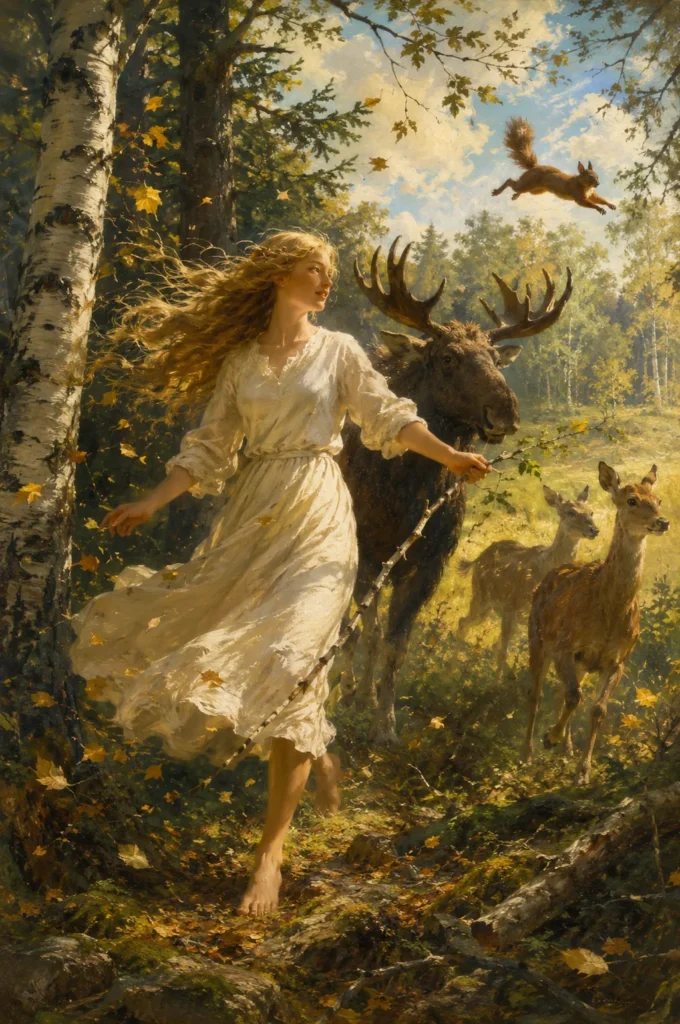
She drives the game toward the open clearings for the hunter. As a small wind spirit, Tuulikki guides the game within the hunter’s reach. Tuulikki is the Finnish goddess of forest animals, and this depiction illustrates the role and responsibility attributed to her.
Tuulikki is the forest daughter of Finnish mythology, daughter of Tapio and Mielikki. In the Kalevala she drives game towards the hunter onto open clearings and clears the trail for him; her name literally means ‘little wind’.
In the handbooks, Tuulikki is goddess of the forest animals, while in the songs she is an invoked helper: the petitionary formulas of canto 14 describe her work precisely, from driving sluggish game with a birch switch to clearing the run.
Type: Forest daughter, helper of hunters, regarded as goddess of the forest animals
Origin: Karelia, Ostrobothnia, Kainuu, Savo and Ingria
Texts: Rune songs (SKVR, individual records from 1789), Kalevala 1835/1849
Period: documented 18th/19th century
Appearance: ‘Forest maiden, lovely maid’ (metsän tyttö, mielineiti)
Traditional context
Period of the Texts
Rune songs of the 18th and 19th centuries with individual records from 1789 onwards; the figure only received her canonical name in the Kalevala of 1835/1849.
Area of Diffusion
Karelia, Ostrobothnia, Kainuu, Savo and Ingria, under widely varying name forms such as Annikki, Tyytikki, Myyrikki and Tuometar.
Sources
Sparse and formulaic: the hunting songs of the SKVR collection and canto 14 of the Kalevala; the field of names remains unclear.
Name and variants
Finnish: Tuulikki, commonly interpreted as tuuli, ‘wind’, with the diminutive ending -kki, thus ‘little wind’. Martti Haavio proposed instead an original form *Lyydikki, borrowed from the Old Norse hluti, ‘lot, share’: the daughter would then, like the whole forest family, be a giver of the hunting lot, and the initial T arose through alliteration with Tapio. Alongside Tuulikki stand Annikki (influenced by Saint Anna), Tyytikki, the ‘mother of the squirrels’, Myyrikki, Lumikki and further forms.
Appearance
Appearance
The 14th canto invokes her as ‘maiden of the forest, fair virgin, Tuulikki, daughter of Tapio’. Tradition offers hardly any fixed image; she becomes tangible through her tools and gestures: the birch switch from the marsh forest, with which she drives on sluggish game, and the two palms of her hands, which she holds like a railing on either side of the game trail, so that the animal cannot break away.
Effect
She is said to drive the game from its hiding places ‘onto the most open clearings’, to line the path, clear away fallen wood, break trees in two, lay down fences and throw silk as a bridge, red cloth as a footbridge, across rivers. In short: Tuulikki turns the impassable forest into a track at the end of which the hunter waits. The name ‘little wind’ fits this manner of action, for she moves the game as wind moves the forest, invisible yet perceptible.
Profile: Tuulikki
The key aspects of the forest daughter at a glance.
Daughter of the forest household in the Finnish-Karelian hunting songs; the tradition surrounding her name is notably unstable, and she became canonical through Lönnrot.
Hunters asking for game: she is invoked with the same words as Mielikki and Tellervo, and the boundaries between the female figures of the forest household are fluid.
Barely a fixed image: the ‘maiden of the forest, fair virgin’ with a birch switch; a runic song of 1803 places Tapio’s beautiful daughter on the rainbow.
Driving on game and clearing paths; in the name variants animal associations shimmer through, such as the squirrel mother Tyytikki.
Invocation and offering within the forest family at the sacrificial spruce (Tapionpöytä); a dedicated cult site or offering for Tuulikki alone is not attested.
Despite the wind name, not a wind spirit: the wind maiden Tuuletar is a different being; Tuulikki belongs entirely to the forest.
From formulaic verse to canonical name
Tuulikki belongs among the daughters of the forest household, as invoked in the Finnish-Karelian hunting songs. The tradition surrounding her name is notably unstable: alongside Tuulikki stand Annikki, Tyytikki, Myyrikki, Lumikki and further forms; another daughter figure appears as Tuometar, the ‘woman of the bird cherry’, chiefly in bear songs. Elias Lönnrot chose the form Tuulikki for the 14th canto of the Kalevala, thereby giving the figure her canonical name.
A runic song recorded in 1803 has Tapio’s beautiful daughter sitting on the rainbow and setting Väinämöinen impossible tasks; Lönnrot transferred this motif in the Kalevala to the maiden of Pohjola. More recent handbooks also attribute to Tuulikki concern for the continued existence of wild animals; this sharpening of her role stems from popular literature, not from the runic songs themselves.
Namesake and classification
Tuulikki remains a common Finnish female name to this day. Its best-known bearer was the graphic artist Tuulikki Pietilä, life partner of Tove Jansson and model for the Moomin character Too-ticki, through whom the name gained resonance far beyond Finland. In neopagan and nature-oriented circles, Tuulikki is regarded as a figure to turn to for the protection of wild animals; in translations and retellings of the Kalevala she appears as the most active of the forest daughters.
From a religious-studies perspective, Tuulikki is a textbook case of how invocation formulas generate figures: the metre required an alliterating ‘daughter of Tapio’, and singers filled the slot differently by region, with Annikki, Tyytikki or Tuulikki. Haavio’s lot etymology would tie her closely to the core function of the forest family, the allotment of hunting luck. Whether an independent pre-Christian goddess stood behind the formulas, or a poetic role figure, cannot be decided; her present fixed contour as ‘goddess of the forest animals’ is the result of Lönnrot’s editing and the later handbook literature.
Greeting and offering to the forest daughter
What holds for the whole forest family also holds for Tuulikki: her help was won through invocation and offering, not through warding off. The hunting songs were sung before setting out and at the edge of the hunting ground; the plea to the daughter stood alongside those to father, mother and brother Nyyrikki. First-catch offerings were brought to the topless sacrificial spruce (Tapionpöytä). Whoever came away empty-handed repeated the greeting rather than bearing a grudge against the forest, for withheld favour was seen as the result of poor conduct; a dedicated cult site or offering for Tuulikki alone is not attested.
Hunting maidens and forest women
As a virgin helper of the hunt, Tuulikki stands close to the Greek Artemis and the Roman Diana, who command wild animals and allot quarry; the Celtic Cernunnos represents the male type of the lord of animals. The Slavic Leshy drives and confuses game according to his own will, whereas Tuulikki guides it in service of the pleading hunter; the Rusalka tradition, by contrast, shows how ambivalently female nature beings were thought of elsewhere.
Frequently asked questions about Tuulikki
Is Tuulikki a wind goddess?
No. Although the name means ‘little wind’, the sources show her exclusively as a forest being who drives game towards the hunter; other figures of Finnish mythology were responsible for wind and weather, such as the wind maiden Tuuletar, a separate being. Martti Haavio even doubted the wind etymology and derived the name instead from an old word for ‘lot, share’.
Where does the claim originate that she is goddess of the forest animals?
From a combination of her roles: in the Kalevala she guides the game, and name variants such as Tyytikki are considered ‘mother of the squirrels’. The catchy formula ‘goddess of the forest animals’ was only coined by modern handbook and retelling literature; the runic songs themselves speak in pleading formulas, not in offices.
How does Tuulikki differ from her sister Tellervo?
Tuulikki works for the hunter: she drives the game on and clears the way. Tellervo works for the household: she tends the grazing cattle and brings them home in the evening. Within the stock of formulas in the songs, however, the two overlap, and at times they are invoked with the same words.
Further links
Further reading:
- Tapio and Mielikki – the parents of the forest household
- Nyyrikki and Tellervo – the siblings
- Tuuletar – the wind maiden, not to be confused with her
- Talisman, juniper, smoke cleansing, salt – traditional protective means
- Protection Compass – an overview of protective means
Literature (selection)
Further standard works in the bibliography.
As daughter of Tapio and goddess of the forest animals, Tuulikki turns the impassable forest into a track for the pleading hunter: a little wind that cannot be seen, yet whose effect every hunting song extols.