Hiisi, from cult site to evil giant
By Ralf Ittermann · last reviewed on
Hiisi is a spirit of Finnish tradition.
First a sacred grove, then an evil giant of the mountains and rocks. The article traces the transformation from sacred cult site to feared giant. Even the title situates Hiisi’s shift from sacred grove to mountain demon.
Hiisi is a Finnish mountain and wilderness spirit whose meaning changed fundamentally over time: originally a sacred grove and cult site, then a mountain and wilderness spirit, and after Christianisation an evil giant or demon of the mountains and rocks. The plural is Hiidet.
In Finnish and Baltic-Finnic tradition, hiisi sites often coincide with Iron Age burial grounds, cup-marked stones and striking terrain features such as boulders and cliffs. In the Kalevala, finally, Hiisi is a malevolent power and adversary of the heroes.
Type: Mountain and wilderness spirit, after Christianisation a giant and demon
Origin: Finland and the Baltic-Finnic region
Texts: Kalevala, folkloric collections from Holmberg to Siikala
Period: pre-Christian cult through to demonisation in the Kalevala
Appearance: gigantic and eerie, often collectively as Hiidet

Context of tradition
Period of the Texts
The tradition spans from a pre-Christian cult to demonisation in the Kalevala; this very shift in meaning is the real story of this figure.
Area of Diffusion
Finland and the Baltic-Finnic region; the Estonian equivalent is hiis, the sacred grove, often situated on hills.
Sources
Well documented: Lönnrot’s Kalevala, folk tradition with its hiisi sites, and research from Holmberg to Siikala.
Name and variants
Finnish: hiisi originally meant a sacred grove or cult site, comparable to the Estonian hiis, often situated on hills. The plural is Hiidet. The shift in meaning led from cult site to mountain and wilderness spirit, and after Christianisation to an evil giant, demon or devil.
Appearance
Appearance
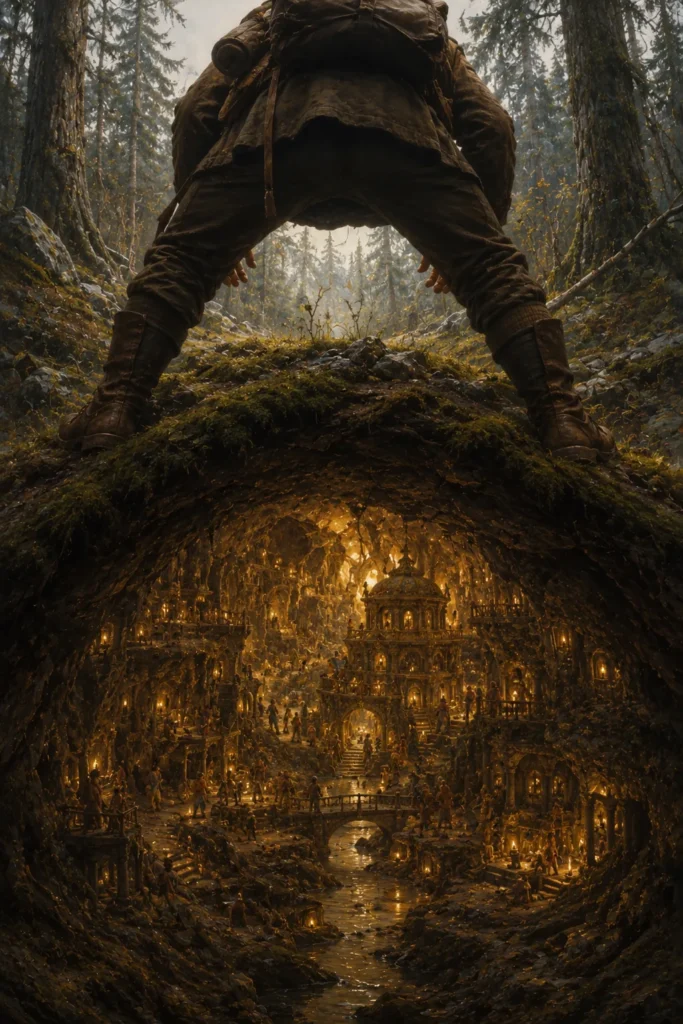
After demonisation, Hiisi is gigantic and eerie, without a fixed individual form, often appearing collectively as Hiidet, a host of demons; in the Kalevala he is a malevolent power.
Effect
Interpreted as a shaper of the landscape, the hiidenkirnu, the glacial pothole or giant’s kettle, and the hiidenkiuas, the stone cairn, are regarded as the work of the Hiisi. In the Kalevala, Hiisi is an adversary of the heroes, for instance the elk of Hiisi that Lemminkäinen hunts.
Profile: Hiisi
The key aspects of the mountain and wilderness spirit at a glance.
Reinterpretation of a sacred site as a demon: hiisi places often coincide with Iron Age burial grounds and cup-marked stones.
The folk belief of the mountains and wilderness: striking boulders, cliffs, glacial potholes and stone cairns are regarded as the work of the Hiisi.
Gigantic and eerie, without a fixed individual form, often appearing collectively as Hiidet, the host of demons in the demonised conception.
In the Kalevala, an adversary of the heroes, for instance the elk of Hiisi that Lemminkäinen hunts; previously a spirit of the mountains and the wilderness.
First offerings and veneration at the sacred grove, after the demonisation Christian defence; a unified anti-Hiisi ritual practice does not exist.
Lempo, Piru and Juntas, demon names from the Kalevala; Estonian hiis; functionally Hiisi was brought closer to the Christian devil.
From the sacred grove to a word for the devil
Hiisi originally meant a sacred grove or cult site, comparable to Estonian hiis, often located on elevated ground. The shift in meaning led from the cult site to a mountain and wilderness spirit and, after Christianisation, to an evil giant, demon or devil.
That there was indeed originally a place is supported by toponymy: hiisi sites in the Finnish and Baltic-Finnic tradition often coincide with Iron Age burial fields, cup-marked stones and striking terrain features such as boulders and cliffs. The landscape itself has preserved the memory of the old cult, while the narrative turned the sacred place into a sinister figure.
Afterlife and classification
Hiisi is central above all through Elias Lönnrot’s Kalevala; in Finnish it lives on in hiisi place names and in the phrase Mene hiiteen, go to the devil, and is present in fantasy and metal.
From a religious-studies perspective, Hiisi shows the reinterpretation of a sacred place as a demon. Important clarification: a common mistake is to read Hiisi as always having been an evil mountain demon; correct is that the original meaning was sacred grove or cult site, and the demonisation is a secondary shift in meaning brought about by Christianity.
From veneration to banishment
Originally there was a positive cult with offerings and veneration at the sacred grove; after the demonisation, Christian defence took its place. A unified anti-Hiisi ritual practice does not exist; historically, the approach shifts from veneration to banishment. Traditional protective means against the demonised giant are said to include iron and salt, along with the protective sign in reverent dealings with the old mountain place.
Lempo, Piru and the devil
Hiisi is related to or identified with Lempo, Piru and Juntas, demon names from the Kalevala; Estonian hiis corresponds to it, and functionally Hiisi was brought closer to the Christian devil. Within the Finnish spirit world, he is to be distinguished from the Maahinen, the small underground people; as a giant mountain spirit, he is closely related to the Scandinavian mountain troll.
Frequently asked questions about Hiisi
What was Hiisi originally?
A sacred grove and cult site, not an evil demon. The dark meaning is more recent.
How did Hiisi become a demon?
Through a secondary shift in meaning brought about by Christianisation.
What are the Hiidet?
The plural of Hiisi, a collective host of demons in the demonised conception.
Further links
Further reading:
- Maahinen – the small underground people of Finland
- Mountain troll – the giant Scandinavian relative
- Iron, salt, amulet – traditional protective means
- Protection Compass – an overview of protective means
Literature (selection)
Further standard works in the bibliography.
As a Finnish mountain spirit, Hiisi carries his whole history in his name: sacred grove and demon at once, depending on which era of the tradition is speaking.