Llamhigyn y Dŵr and the scream from the mountain lake
By Ralf Ittermann · last reviewed on
Llamhigyn y Dŵr is a demon of Welsh tradition.
A frog-like winged monster tears fishing lines and attacks livestock. The account describes a scream rising from the mountain lake before this frog-like monster attacks.
The Llamhigyn y Dwr is a frog-like monster from Welsh legend: with wings and a spiked tail, it tears fishing lines and drags sheep, and reportedly fishermen, into the depths. Its tradition rests almost entirely on a single source, John Rhys 1901.
Type: Frog-like monster with wings and a spiked tail
Origin: Wales, Snowdonia
Texts: Rhys, Celtic Folklore, 1901
Period: since 1901, narrowly attested
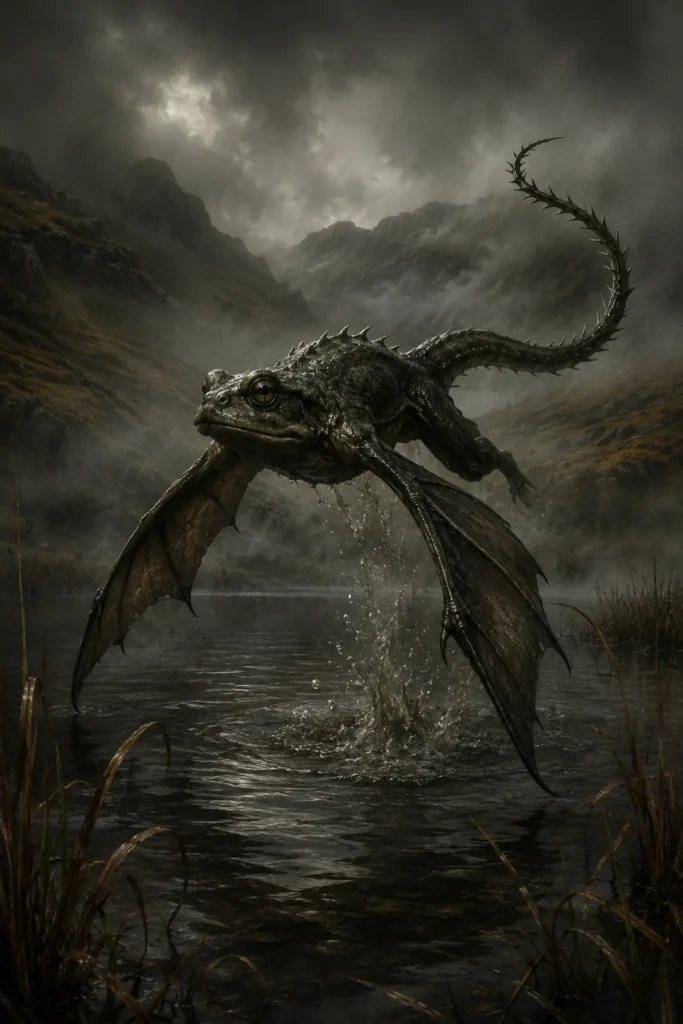
Appearance: toad with bat wings instead of legs
Source Context
Period of the Texts
Very narrow: it rests on a single source, John Rhys 1901, based on the account of the fisherman Ifan Owen.
Area of Diffusion
North Wales, especially Snowdonia: marshes, ponds, mountain lakes such as Llyn Glâs.
Sources
Thin: a single source; Rhys seemed more taken by the informant’s storytelling skill than convinced of the belief itself.
Name and variants
Welsh: llam means leap, dŵr means water: literally the leaper of the water.
Appearance and symbolism
Appearance
A chimera of toad, bat wings and spiked tail that hops across the water; its cry is chilling. Effect: it tears off fishing lines and drags sheep, and reportedly people, into the depths.
Profile: Llamhigyn y Dwr
The key features at a glance.
Welsh legend cycle of Snowdonia, transmitted almost solely through John Rhys 1901.
Anglers and grazing livestock, especially sheep near marshes and mountain lakes.
Toad-like body with leathery bat wings instead of legs and a long spiked tail.
Tears fishing lines, drags livestock, and reportedly fishermen, into the depths.
Avoid dangerous waters such as Llyn Glâs, take care while fishing, keep livestock away.
The fisherman Ifan Owen and Llyn Glâs
The tradition stems almost entirely from John Rhys 1901: the fisherman Ifan Owen recounted that his father had hooked a toad-like monster with a tail and wings in Llyn Glâs, which screamed dreadfully.
It is also said to drag sheep in the water down into the depths.
From angler's report to bestiary motif
Despite the narrow source base, the Llamhigyn y Dwr features in bestiaries and fantasy culture as the Welsh Water Leaper; almost every depiction traces back to Rhys 1901.
It is a lesser water monster embodying marsh and mountain lake as places of danger.
Avoidance rather than banishment
No specific protective means are recorded; the source material is too thin. What can be inferred is avoiding dangerous waters such as Llyn Glâs. Against water demons in general, iron, protective circles and salt are considered effective.
Freshwater monsters compared
Frequently asked questions about the Llamhigyn y Dwr
What does the water leaper look like?
Like a large toad with bat wings instead of legs and a spiked tail.
Where do almost all reports come from?
From a single book, Celtic Folklore by John Rhys, 1901. The source material is thin.
Literature (selection)
Further standard works in the bibliography.
Those searching for the Llamhigyn y Dwr water leaper will find a Welsh water monster whose cry still echoes at Llyn Glâs today: frog-like, winged, and attested by a single source.