Swastika: the Hindu sign of good fortune and its history
By Ralf Ittermann · last reviewed on
In Hinduism the Swastika is an ancient sign of good fortune and protection. It is used at festivals, at entrances and in worship. In the twentieth century the sign was appropriated and distorted by National Socialism. This page presents the original Hindu meaning and clearly distinguishes it from that appropriation.
Classification
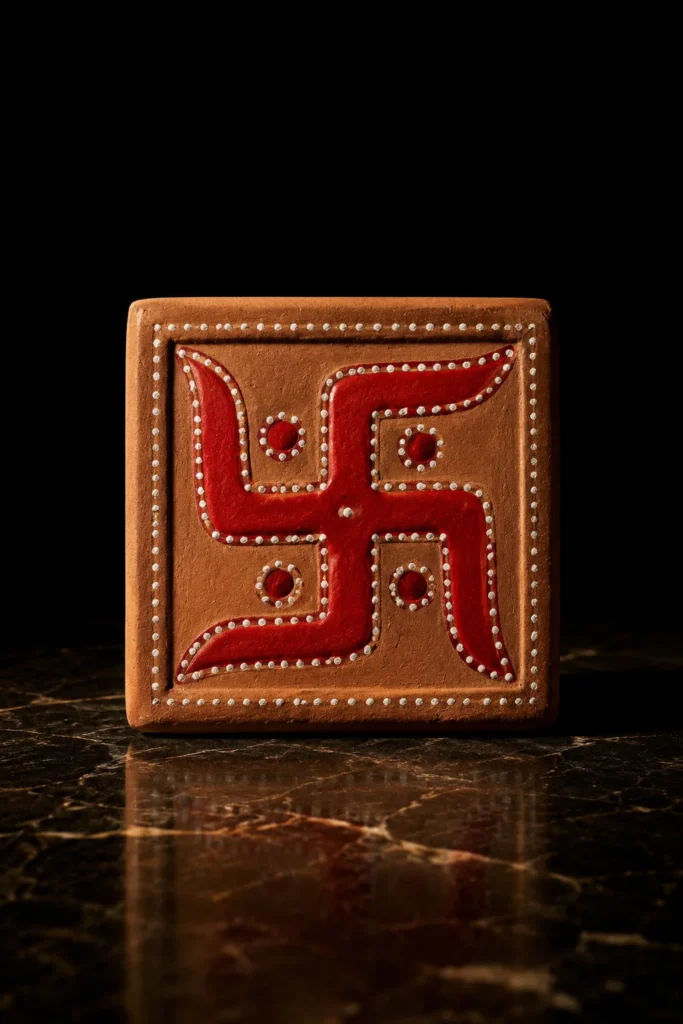
The Swastika is an ancient sign that still plays an important role in Hinduism today. It is a cross whose four arms are bent at right angles at their ends.
The word Swastika comes from Sanskrit. It is connected with a word element that means good, salutary or bringing good fortune. By the sense of the word, the Swastika thus denotes the sign of well-being.
In Hinduism the Swastika is a sign of good fortune and protection. It is used at festivals, at entrances, in shops and in worship, and is meant to attract well-being and keep misfortune away.
This page deals with the Swastika in its original, Hindu meaning. It is, however, essential to state clearly from the outset that this sign underwent a grave distortion in the twentieth century.
National Socialism took over the swastika, a particular form of this sign, and made it the emblem of its criminal rule. Through this appropriation the sign has become inseparably linked in Europe with the injustice of National Socialism.
A factual account must therefore accomplish both. It must honestly present the ancient religious meaning of the Swastika in Hinduism, and it must clearly name the National Socialist appropriation and distinguish it from the religious meaning. This page is committed to both.
The form and the name of the sign
The Swastika has a simple, clearly defined form. It consists of a cross with four arms of equal length whose ends are bent at right angles.
These bent ends create the impression of movement. The sign appears as though it were turning around its centre. This suggested rotation belongs to the characteristic impression the sign gives.
The bends of the arms can point in two directions. Depending on this, the sign appears turned towards one side or the other. In Hinduism both forms occur and are in part interpreted differently.
The name Swastika goes back to Sanskrit and is connected with the notion of the salutary and of that which brings good fortune. The name itself therefore points to the original, favourable meaning of the sign.
In German the sign is also called Hakenkreuz, because its arms run out into hooks. This German term is, however, heavily burdened by its National Socialist use and should be employed with care for the Hindu sign.
The form of the Swastika is so simple that it could arise independently in different cultures. It is precisely this simplicity that explains why the sign is encountered in many parts of the world.
The age and the diffusion of the sign
The Swastika is a very ancient sign. It can be traced in many cultures and across long periods of time. Its exact age and its origin are, however, not clarified in every respect.
In India the sign can be traced far back. It is already encountered in very early testimonies of Indian cultural history and thus belongs to the oldest signs in use on the subcontinent.
Beyond India the Swastika is also known from numerous other cultures. It is found in European prehistory, in the ancient world and in cultures of other parts of the earth.
An honest classification is important here. This wide diffusion cannot be explained by a common root. The simple form of the sign could arise independently in many places.
Nor did the Swastika have the same meaning everywhere. In the various cultures the sign was interpreted differently. There is no uniform, original meaning of the Swastika.
The only thing that is certain is that the sign is ancient and widely diffused, and that in Hinduism it was used early and consistently as a favourable sign. This Hindu use is well attested and stands at the centre of the following sections.
The Swastika as a sign of good fortune in Hinduism
In Hinduism the Swastika is a sign of good fortune. It stands for well-being, for good success and for favourable circumstances. This is its most important meaning.
The Swastika is used on joyful occasions. At festivals, at weddings, at the consecration of a house and at the beginning of undertakings, the sign is painted on or affixed.
The Swastika is widespread at the entrances of houses and shops. Placed above the door or beside the entrance, it is meant to call good fortune and well-being into the space.
The Swastika also appears on everyday objects, on documents and in the books of merchants. At the beginning of a new business year it is drawn so that the coming year may take a favourable course.
The use of the Swastika in these contexts expresses a wish. The sign is meant to attract the good and to promote the favourable course of an undertaking.
The Swastika is thus a friendly, well-disposed sign in Hinduism. It belongs to moments of joy and of new beginnings and expresses the wish for well-being.
The Swastika in worship and as a sign of protection
Beyond its meaning as a sign of good fortune, the Swastika has a firm place in Hindu worship and is at the same time regarded as a sign of protection.
In worship the Swastika is often drawn before a ceremony begins. It marks the place as sanctified and places the undertaking under a favourable sign.
The Swastika is connected with various deities, above all with the god venerated as the bringer of the favourable beginning. The sign therefore belongs to the beginning and to the good precondition.
As a sign of protection the Swastika is meant to keep misfortune away. Placed at entrances, it is regarded as a sign that protects the space behind it and wards off harmful influences.
The protective and the fortune-bringing meaning of the Swastika are closely connected. Both go back to the same basic idea, that the sign attracts the good and keeps misfortune away.
In Hinduism the Swastika thus belongs to the signs that combine blessing, favourable beginning and protection with one another. In this meaning it is used to this day.
The appropriation and distortion by National Socialism
It is essential at this point to state clearly and plainly that the sign of the Swastika underwent a grave distortion in the twentieth century. National Socialism in Germany appropriated the sign.
The National Socialist movement took over the sign, called Hakenkreuz in German, and made it its central emblem. It appeared on the flag, on the uniforms and on the insignia of the National Socialist state.
This adoption rested on false and racist notions. National Socialism reinterpreted the sign in the sense of an invented doctrine of supposedly superior peoples. This interpretation has nothing in common with the Hindu meaning of the sign.
Under this sign unprecedented crimes were committed during the period of National Socialism. In Europe the swastika therefore stands inseparably for National Socialist tyranny, for war and for genocide, above all for the murder of the European Jews.
Through this history the sign is heavily burdened in Germany and in large parts of Europe. The public display of the swastika is prohibited by law in Germany for good reasons, unless it clearly and recognisably serves education or similar purposes.
This distortion must be clearly named. National Socialism unlawfully appropriated an ancient sign and connected it with a criminal content. This appropriation is not Hinduism, and it is not the original meaning of the sign.
The necessary distinction
From the foregoing follows the necessity of a clear distinction. The Hindu Swastika and the National Socialist swastika must not be confused with one another.
The Hindu Swastika is an ancient religious sign of good fortune and protection. It stands for well-being, for the favourable beginning and for protection, and is used in a religious context.
The National Socialist swastika, by contrast, is the emblem of a criminal political movement of the twentieth century. It stands for tyranny, for war and for genocide.
These two meanings have nothing in common with one another, even though the basic form of the sign is similar. National Socialism took over an ancient form but gave it an entirely different, criminal content.
This distinction is also important in dealing with the sign. In India and in the Hindu communities the Swastika is a living religious sign. In Germany and in Europe, by contrast, the basic form of the sign inevitably calls forth the memory of the injustice of National Socialism.
An honest account therefore holds fast to both. It respects the religious meaning of the Swastika for the people who use it as a sign of good fortune and protection, and at the same time it clearly and without palliation names the criminal appropriation of the sign by National Socialism.
The Swastika in other religions of India
The Swastika is not limited to Hinduism. Other religions that arose in India also use the sign as a favourable sign.
In Jainism, an ancient Indian religion, the Swastika has an important meaning. There it belongs to the venerated signs and is connected with fundamental teachings of this religion.
The Swastika is also known in Buddhism. It is encountered in Buddhist art and in the Buddhist countries of Asia as a favourable sign, frequently in connection with the Awakened One.
In all these religions the Swastika is a favourable, often venerated sign. It belongs to the common heritage of the Indian religions and of those shaped by India.
In the countries of Asia where these religions are widespread, the Swastika is therefore to this day a familiar and unburdened sight. It appears on temples, on maps and in everyday life.
This makes the distortion described above all the more clear. For many hundreds of millions of people in Asia the Swastika is an ancient, peaceful religious sign. The National Socialist appropriation is a European history of the twentieth century that was imposed on this religious heritage from outside.
Reception today
The reception of the Swastika today is marked by a deep division that follows directly from its history.
In India and in the Hindu, Jain and Buddhist communities of Asia, the Swastika is a living, everyday sign of good fortune and protection. It appears at entrances, at festivals and in worship, and is unburdened there.
In Germany and in large parts of Europe, by contrast, the basic form of the sign inevitably calls forth the memory of National Socialism. Here the sign is heavily burdened, and its public display is legally restricted.
This division sometimes leads to tensions, for instance when Hindus or Buddhists use their religious sign in Europe and thereby meet with incomprehension or rejection. Education is important here.
A factual account must hold fast to both sides. It respects the religious meaning of the Swastika for the people who venerate it as a sign of good fortune and protection. And it clearly names the criminal appropriation of the sign by National Socialism and the burden that follows from it in Europe.
The Swastika is thus a striking and at the same time a distressing example of how an ancient religious sign can be split in its meaning by a political distortion. Whoever speaks about the Swastika must know this history and clearly separate the two meanings from one another.
Literature (selection)
Related key terms: Swastika sign of good fortune swastika emblem Sanskrit well-being Nazi appropriation distortion distinction Hinduism.
iWell Guard and traditions of protection
iWell Guard stands in the cultural-historical line of wearable objects of protection, to which the Swastika also belongs. A modern companion for people who live with protective symbols: made in Germany, 41 layers of solid gold, platinum and silver, with a 30-day right of return.
Personal experiences may vary. Not a medical device. No healing promise.