Guan Yu, god of the Chinese tradition
By Ralf Ittermann · last reviewed on
The deified general, symbol of loyalty, god of war and justice. Guan Yu is not a mythological god but a historical general from the era of the Three Kingdoms (184 to 280 AD) who was deified through centuries of folk tradition.
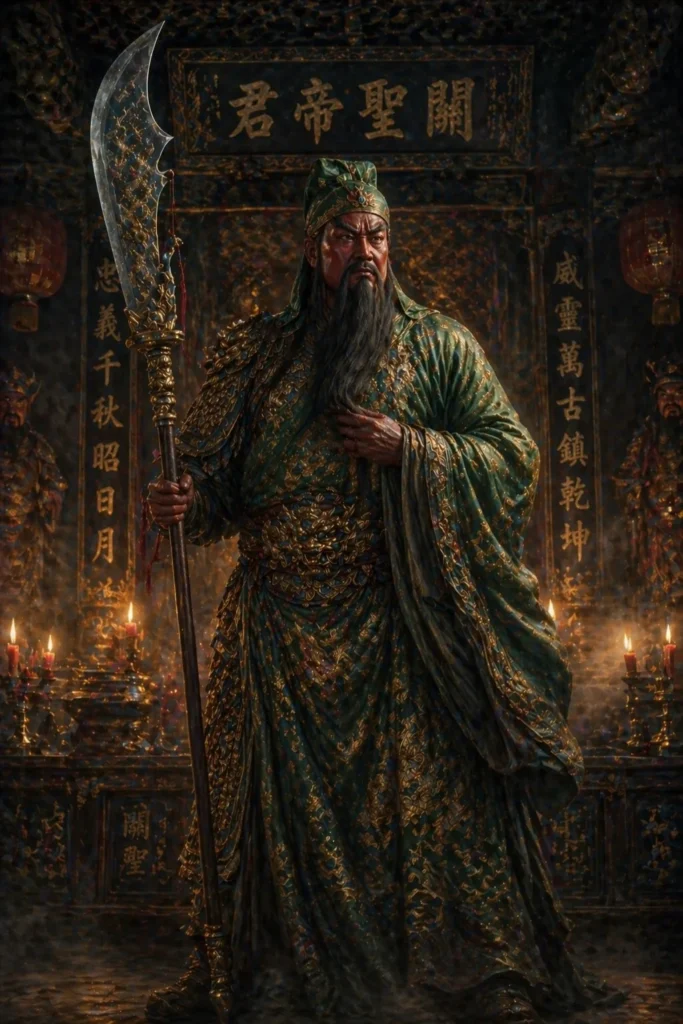
With red cheeks, a long black beard and his flaming halberd *Guan Dao*, he embodies virtue, loyalty unto death and martial honour.
In the *Romance of the Three Kingdoms*, the most widely read Chinese novel, Guan Yu is a radiant figure: a general who does not abandon his lord even as defeat is imminent.
His execution became legend. Later Guan Yu was admitted into temples, and from there into the Daoist and Buddhist pantheon, not as a god of transcendence but as the patron of morally upright people.
Guan Yu
At a Glance: Guan Yu
Type: Chinese major deity, god of war and warriors, deified historical hero
Pantheon: Daoism, Chinese folk religion, Buddhism (as Sangharama Bodhisattva)
Function: war, loyalty, justice, wealth, protection of business and police
Main attributes: long beard, green robe, the horse Red Hare, the giant halberd Guan Dao
Main cult sites: Guandi temples in Luoyang (his tomb), Mt. Yuquan, in every Chinese district
Buddhist syncretism: Sangharama Bodhisattva (protection of temples)
Historical Classification
Period of the texts
Guan Yu (162 to 220 AD) was a historical general of the Later Han dynasty, made famous by the novel Sanguo Yanyi (The Three Kingdoms, 14th c.). Deification begins as early as the Sui dynasty (6th/7th c.); his canonised position in the Chinese pantheon dates from the Tang period.
Under the Ming empire (1368 to 1644) he rose to become the “Martial Saint” (Wu Sheng), parallel to Confucius as the “Civil Saint”.
In the Qing dynasty he was institutionalised as a protective god of the empire. Today he is one of the most popular Chinese folk deities worldwide, present as a protective figure in every Chinese restaurant and shop.
Area of distribution
Main cult sites: the Guanlin temple in Luoyang (Henan, his tomb; one of the largest Guan Yu temples worldwide), the Yuquan temple in Hubei (the mythical site where his spirit acted), the Xiezhou Guandi temple in Shanxi (his birthplace).
Every Chinese city has several Guandi temples. Internationally he is found in every Chinese restaurant, shop and martial arts studio, and in the police stations of Hong Kong (he is the patron of police officers as well as of the Triads).
Source situation
Central sources: historically the Sanguozhi (3rd c. Chronicle of the Three Kingdoms), in literature the Sanguo Yanyi (Luo Guanzhong, 14th c., the main source of the folk tradition), and the Guan Sheng Dijun Sheng Ji Tu Zhi (a Ming-era hagiography).
Secondary literature: ter Haar, Guan Yu. The Religious Afterlife of a Failed Hero; Werner, Myths and Legends of China; Yang/An, Handbook of Chinese Mythology.
Name and spellings
Guan Yu is immediately recognisable: red cheeks (an artistic symbol expressing the pain of loyalty, not anger), a long black beard, traditional armour or silk robes. His blade Guan Dao is a halberd with a crescent-shaped blade, a weapon that is symbolic rather than practical.
He is often shown on horseback, or enthroned with a calm, dignified presence. Unlike Zhong Kui (wild) or Raijin (demonic), Guan Yu is majestic rather than frightening. Artistically his portrait is central to temple altars and military academies. The colour red is central: red cheeks, and later red robes in temple depictions.
Description
Guan Yu is venerated as the patron of loyalty, of fidelity to business contracts and of military honour. Merchants set up a Guan Yu statue in order to swear honesty in commercial agreements.
Military academies, police and military institutions venerate him. Unlike other deities, Guan Yu is asked not for a blessing but for moral strength. His birth festival is celebrated on the 13th day of the 5th or on the 24th day of the 6th lunar month.
The Guan Gong temple in Guangzhou is one of the largest and oldest, with a thousand years of history. Buddhist circles identify Guan Yu as a manifestation of the Bodhisattva Guan Gong, not a transformation but a recognition of his spiritual quality.
Unlike Yuhuang (administration) or Yanluo (judgement), Guan Yu is personally approachable; one can ask him for advice, not merely for formal permission.
Appearance and symbolism
Guan Yu is portrayed as a tall, red man with a long beard, often in battle armour. He carries a halberd (Guandao) and sits on a red horse. His red face symbolises righteousness and courage. He is often depicted together with his companions (Guan Ping and the fictional character Zhou Cang) as a triad.
Profile: Guan Yu
The most important aspects of Guan Yu at a glance. The following fields summarise his origin, function, appearance, veneration, symbols and cultural parallels.
Guan Yu was born in 162 AD in Hedong (today Yuncheng, Shanxi) and died in 220 as a general of Liu Bei in the late Han period.
In the historical Sanguo Yanyi he is immortalised as a brother in the Peach Garden Oath of Liu Bei and Zhang Fei, the most famous image of brotherhood in the Chinese tradition.
His death (his execution by Sun Quan) is seen as an unjust separation. A wife and son are mentioned in the sources, but only peripherally; the central mythological theme is his unbroken loyalty to Liu Bei.
Patron of loyalty (zhong) and of justice (yi), the two central Confucian virtues in their mythological embodiment. Protective god of warriors, police officers and (paradoxically) of the criminal secret societies (Triads).
Patron of merchants and businesspeople because, according to legend, he always paid his debts honourably. In modern China and Hong Kong: protection against financial losses, fraudulent business partners and danger in one’s profession.
Characteristically depicted with a long beard and red face (a symbol of inner purity and loyalty, a rare and unmistakable iconography), a green (sometimes golden) long-sleeved robe and an official’s hat.
In his right hand the Guan Dao (a sickle-shaped halberd-like weapon named after him). Often on his famous horse Red Hare (Chitu). Accompanied by his adopted son Guan Ping and his loyal servant Zhou Cang. In standing or seated poses, always with majestic calm.
Sphere of influence: Guan Yu is venerated in every Chinese restaurant, shop and martial arts studio and in many private homes, one of the few gods whose statue reaches into modern secular spaces. Daily incense is offered before his household altar.
His birthday on the 13th day of the 5th or the 24th day of the 6th lunar month is celebrated with great festivals. In Hong Kong and Taiwan, police stations honour him as their patron. In the traditional Triads he is paradoxically also the central recipient of oaths, a cultural tension that has been much discussed.
Guan Dao (a sickle-shaped halberd named after him), long beard, red face, green long-sleeved robe, official’s hat, the horse Red Hare (Chitu), adopted son Guan Ping, servant Zhou Cang. Sacred plants: peach (the Peach Garden Oath). Sacred animals: the horse Red Hare. Sacred colours: red and green.
Sangharama Bodhisattva (Buddhism, Chinese-Buddhist syncretism), Bishamonten (Japan, protective god and warrior), Mars (Rome, god of war), Tyr (Germanic, warrior god), Karttikeya/Skanda (Hinduism, god of war), Ogou (Vodou, warrior Loa).
Comparable as a “deified historical hero”: St. George (Christian), Genghis Khan (Mongolian in some folk traditions). Guan Yu is the most famous “historical person turned major god” transformation in the religious history of China.
Protection in everyday life
Rituals of veneration
In China Guan Yu is venerated as the god of loyalty (Guandi/關帝), with large Guan Yu temples in all major Chinese cities. Main festival: Guandi Sheng Dan (his birthday on the 13th day of the 5th or the 24th day of the 6th lunar month) with ritual offerings (fruit, meat, wine, incense sticks).
Veneration in business and military communities, with statues in guard rooms and offices for loyalty and courage. Chinese folk practice: morning bows before Guan Yu altars.
Invocations and appeals
Daoist invocation: 「關公關聖帝君保佑」 (Guan Gong Guan Sheng Dijun Baoyou, Great General Guan, Holy Emperor, protect us). Historical texts use scenes from the Three Kingdoms novel (Sanguo Yan Yi) as a basis for prayer. Talismans with a Guan Yu portrait and Daoist seals are available from Daoist priests.
Amulets and protective symbols
Guan Yu statues and talisman images (Fu) in shops, police stations and war memorials. Archaeological evidence: Guan Yu bronze statues from the Ming period (14th to 17th c.), temple reliefs in Changshu and Shaoxing.
Modern Guan Yu shrines in Taiwan, Hong Kong and Singapore show a tradition of veneration since the Sui and Tang dynasties (6th to 9th c.).
Guan Yu, parallels in other cultures
Guan Yu resembles the European Saint George (soldier, virtue), the Greek Achilles (warlike, honour) and the Hebrew David (bravery, loyalty to the king). Unlike these, Guan Yu is clearly attested historically, not mythological and poetic.
With the Aztec Huitzilopochtli he shares the status of a war god, but Huitzilopochtli is primarily a god, whereas Guan Yu is primarily a deified human.
With Susanoo (the Japanese storm god) he shares aspects of war, but Susanoo is a cosmic god, whereas Guan Yu is a moral hero. Unique is the literary mediation: a novel turned a general into a god, showing the power of narrative over spirituality.
From general to god: the historical person Guan Yu
Guan Yu was originally a historical figure. He lived in the late 2nd and early 3rd century, toward the end of the Han dynasty, and served as a general under Liu Bei, one of the warlords from whose conflicts the period of the Three Kingdoms emerged.
The earliest accounts of him are found in the Sanguozhi, the “Chronicle of the Three Kingdoms” by the historian Chen Shou from the late 3rd century, supplemented by the commentary of Pei Songzhi from the 5th century.
The historical tradition portrays Guan Yu as a capable but also proud commander. His capture and execution around 220, following a military defeat against the kingdom of Wu, are attested.
The sober chronicle notes give hardly any indication of the later religious veneration; they show a man of his time whose reputation rested above all on loyalty to Liu Bei.
The path from this person to a deity took centuries. Local cults at the place of his death and at sites of his activity arose in the Tang and especially in the Song period.
What was decisive was that the person of Guan Yu became a bearer of the virtue of loyalty (zhong) and of righteousness (yi), that is, of values prized by the Confucian state as well as by Buddhist and Daoist circles.
His deification was therefore not a break but a gradual charging of a real biography with moral meaning. Religious studies research, for example the work of Prasenjit Duara on the “superscribing” of symbols, has shown how different social groups each filled the cult with their own content.
The Romance of the Three Kingdoms and the shaping of the legend
The image of Guan Yu that is popular today derives less from the chronicles than from the novel Sanguo Yanyi, the “Romance of the Three Kingdoms”, which took its familiar form in the 14th century and is attributed to Luo Guanzhong.
The novel works older oral narratives, theatrical material and historiography into an elaborate story.
In this work Guan Yu acquires his well-known attributes and episodes. The oath in the peach garden, in which Liu Bei, Guan Yu and Zhang Fei vow brotherhood unto death, shapes his image as the epitome of fidelity.
Episodes such as the crossing of five passes, in which he fights his way from an enemy camp back to his lord, or his stoic endurance when the physician Hua Tuo cuts open his poisoned arm while he calmly plays on, condense into a fixed repertoire.
The novel also gave Guan Yu his iconographic markers: the red face, the long beard, the halberd named “Green Dragon” and the horse Red Hare. These features were spread through opera and woodblock printing so thoroughly that they now define every temple and every statue.
Important for scholarship is the interaction: the novel fed the cult with narrative material, and the growing cult in turn made the novel more popular.
The literary and the religious tradition therefore cannot be cleanly separated. Whoever reads the novel is at the same time reading a religious source work, and whoever studies the cult cannot avoid the novel.
Guan Di: imperial titles and the career of a state god
The elevation of Guan Yu to a state god took place through a long series of imperial titles. He already received honours in the Song period, but the decisive rise occurred under the Ming and Qing dynasties.
The Manchu rulers of the Qing promoted the cult with particular emphasis; they saw in the loyalty embodied by Guan Yu a model that their subjects were meant to internalise.
The titles escalated over the centuries. A “prince” became an “emperor” (di), from which the widespread form of address Guan Di emerged.
By the 19th century his official title had grown into a long chain of honorific epithets, and his cult was integrated into the state sacrificial system, with its own temples in the capital and in the provincial cities. The officialdom offered him regular sacrifices.
This state promotion made Guan Yu one of the few figures claimed at the same time by Confucianism, by Daoism and by Buddhism. The Confucian state saw in him the loyal servant, Daoism admitted him into its pantheon, and Buddhism venerated him as a protective deity (qielan) of the monasteries.
Religious studies research has recognised in this multiple affiliation a typical feature of Chinese religious practice, in which the same deity can be interpreted differently by different traditions and social groups and yet be venerated jointly.
With the end of the empire in 1911 the state cult lost its official framework, but the folk-religious cult continued unbroken.
Guan Yu as god of trade and of the secret societies
One of the most striking developments of the cult is the veneration of Guan Yu as a protective god of merchants. At first glance it seems inconsistent that a war hero should become the patron of trade. Scholarship explains this above all through the value of yi, righteousness and fidelity to contracts.
In commercial life, which rested on reliability and keeping one’s word, Guan Yu became the guarantor of honest agreements. Merchant guilds built him temples, and his image stood and still stands in countless shops, often provided with an offering.
A second, partly connected line is the veneration by brotherhoods and secret societies. Organisations based on sworn brotherhood invoked the oath in the peach garden as their mythical model. New members swore their oath before the image of Guan Yu, who thus became the guarantor of loyalty within the group.
This function at the same time made him the protective deity of soldiers and police, that is, of professions that depend on comradeship and reliability.
To this day his images are found both in police stations and in the rooms of organised criminal associations, which shows that the cult is about the social logic of the binding oath, not about a particular morality of the group.
With Chinese migration Guan Yu spread across Southeast Asia as far as North America and Europe. In the Chinatowns of the world his temple is part of the basic infrastructure of the community.
Religious studies research uses this broadly conceived, adaptable cult as an example of how a single deity can religiously secure the state, the economy and the informal social order all at once.
Iconography: the red face and the green dragon
The pictorial representation of Guan Yu is so fixed that he is immediately recognisable on statues, paintings and in opera. Decisive is the deep red face, which in the Chinese theatrical tradition stands for loyalty and upright character.
The novel explains the colour with an episode of its own, but its real meaning lies in the symbolic language of the stage, from which it passed onto the religious images.
Further fixed markers are the long, well-kept beard, which in the sources earned him the byname “the man with the beautiful beard”, and the heavy halberd known as the “Green Dragon Crescent Blade”.
He often wears armour and the green robe of a general; sometimes instead he holds a book, namely the annals Chunqiu, which emphasises his learning and his Confucian character.
In the temples Guan Yu often does not stand alone. At his sides typically appear his son or adopted son Guan Ping with the commander’s seal, and his loyal arms-bearer Zhou Cang with the halberd.
This group of three is an iconographic unit in its own right. The arrangement follows the pattern of a court and underlines Guan Yu’s rank as an imperial god.
Material culture is found far beyond the great temples. Household altars, woodblock prints for the New Year festival, amulets and business shrines spread his image into everyday life.
The reliability of the iconography has a practical reason: it made the god immediately identifiable for a largely illiterate population over centuries, regardless of region and social class.
Guan Yu in Daoism and Buddhism
The institutional religions of China have each integrated Guan Yu into their own systems without this displacing the folk-religious cult. In Daoism he received a fixed place in the celestial bureaucracy.
Daoist texts and temples list him with high titles; he is regarded, among other things, as a subduer of demons and as a deity who oversees oaths and punishes injustice.
A widespread legend tells how the 30th Daoist Celestial Master Zhang Jixian (Song period) called on the spirit of Guan Yu for help in subduing a demon, which mythically grounds his admission into the Daoist tradition.
In Buddhism Guan Yu is venerated as qielan pusa, as a protective deity who guards monastery grounds and community.
The legend attached to this places his conversion at Mount Yuquan: his restless spirit is said to have met a Buddhist master there who instructed him about the law of karma, whereupon Guan Yu committed himself to the Dharma and became a protector of the teaching.
In many Chinese monasteries his figure therefore stands as a guardian in a prominent place.
This multiple affiliation is instructive for religious studies. It shows that Chinese religiosity does not think in sharply separated denominations, but that the same powerful figure can be claimed and interpreted by different traditions.
Guan Yu is not a special case in this, but a particularly clear example, because in him state Confucianism, the Daoist pantheon, Buddhist monastic protection and folk-religious veneration converge in a single person. Scholarship speaks here of a shared symbol that could become so enduring and widespread precisely through its openness to interpretation.
Further links
Sources and literature
Further standard works in the literature index.
Frequently Asked Questions about Guan Yu
Who was Guan Yu and how did he become a god?
Guan Yu was a historical general who lived in the 2nd and early 3rd century during the period of the Three Kingdoms in China and was executed in 220. He became famous for his proverbial loyalty, bravery and integrity, above all through the classic novel Romance of the Three Kingdoms.
Over the centuries the memory of him turned into religious veneration: he was deified and received titles from several emperors, up to the rank of a god.
What role does Guan Yu, also called Guandi, play today?
As the deity Guandi or Guangong, Guan Yu is still widely venerated today. He is regarded as the god of loyalty and justice and is invoked at the same time as a god of war and as a patron of merchants and businesses, since honesty is regarded as the foundation of trade.
His image is found in temples, shops, restaurants and even among the police and in criminal brotherhoods, both of which appeal to his code of honour. Guan Yu is also venerated in Daoism, in Buddhism and in Confucianism.