Perun, god of the Slavic tradition
By Ralf Ittermann · last reviewed on
Perun is the supreme thunder god of Slavic mythology and embodies lightning, thunder and the power of the sky. Religiously central until the Christianization of the 10th and 11th centuries, he later remained culturally effective in folklore and regional practices up to the present day.
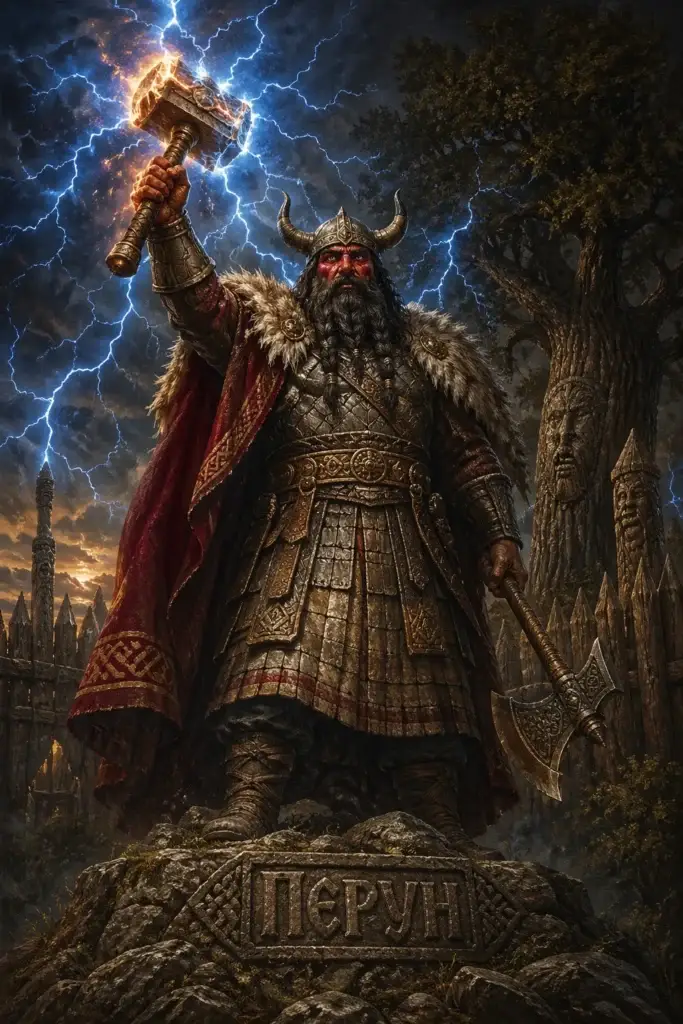
Perun
Perun governs weather, justice and martial valor. His symbol is the axe or the wheel. In cultic practice he is connected with offerings, oaths and the protection of borders. Relics of his veneration survive in European place names and folk rites to this day.
Quick overview: Perun
Type: Principal Slavic deity, thunder and storm god, supreme god of the Slavic pantheon
Pantheon: Slavic (East, West and South Slavic)
Function: thunder, lightning, war, kingship, cosmic order, the subduing of the chaotic Veles serpent
Main attributes: thunder axe (or hammer), oak (sacred tree), eagle, bearded and imposing appearance
Main cult sites: Kiev (Vladimir’s pantheon before 988), Novgorod (Peryn sanctuary), Pomerania (Szczecin)
Indo-European kinship: Donar/Thor (Germanic), Indra (Hindu), Zeus (Greek), Tarhunna (Hittite)
Historical classification
Period of the texts
Perun is the most important Slavic deity, attested in all three Slavic language groups (East, West, South Slavic). Main floruit: the pre-Christian period (until about 988, the Christianization of Kievan Rus by Vladimir the Great). Around 980 Vladimir erected in Kiev the famous pantheon with Perun at its head (Primary Chronicle of Nestor).
After Christianization, Perun’s image was thrown into the Dnieper. Folk customs survived in many Slavic regions into the 19th century (thunder rites, oak veneration). In the 20th century there was a rodnovery revival in Russia, Poland, the Czech Republic, Slovakia and Ukraine.
Area of distribution
Main cult sites: Kiev (Vladimir’s pantheon with a Perun statue with a silver head and golden moustache, 980-988), Novgorod (Peryn sanctuary on the Volkhov River), Szczecin (Pomerania), Mount Triglav (in some South Slavic traditions).
Alongside these, thousands of oak sanctuaries stood in the Slavic mountain regions. In the modern Slavic pagan movement (rodnovery, from the 1990s onward in Russia, Poland, Ukraine) he is once again centrally venerated.
State of the sources
Central sources: the Primary Chronicle of Nestor (Russian original chronicle, 12th century, with a description of Vladimir’s pantheon), Helmold of Bosau, Chronica Slavorum (12th century, West Slavic), Saxo Grammaticus, Gesta Danorum, folk tales and folk songs.
Secondary literature: Váňa, Mythology and the world of gods of the Slavic peoples; Gimbutas, The Slavs; Ivanov/Toporov, Issledovanija v oblasti slavjanskich drevnostej (classic study); Pittner, Slavic mythology.
Designation and spellings
In the few available sources Perun is depicted as a large, strong man with a golden moustache.
His sacred weapon is the axe (or sometimes the hatchet), with which he hurls lightning: thunder is the sound of the axe, lightning its light. The thunderbolt or Peruna is a six-part or cross-shaped geometric symbol that was frequently worn as an amulet.
The oak is his sacred tree: offerings were brought beneath oaks, and his sanctuaries often lay near oak groves, where the wood was venerated as belonging to the god.
His temple in Kiev bore on its summit a wooden statue with a silver head and a golden moustache, a deliberate symbol of dominion over heavenly fire and earthly power alike. In the ritual dances and processions, raw meat offerings were often brought as tribute and veneration.
Description
Perun was not only a personified force of nature, but the guardian of social order, of justice and of the contract.
Warriors swore their oaths before his altar, and the oath was sealed with his name; breaking an oath counted not merely as personal disgrace, but as sacrilege that Perun himself would avenge. In times of crisis the Rus implored him for victory, and after successful wars extensive offerings were presented.
His festivals took place at times of intense thunderous activity, especially at the transitions of the seasons (spring and summer), when storms were frequent. The cult was hierarchically organized: only trained priests could touch his sacred fire, and the grand prince himself was the chief offerer, a function that justified and legitimized this high standing.
After Christianization the open cult vanished quickly, but folk traditions and rural practices preserved memories, often hidden in the form of superstitions about lightning, thunder and oaks.
Profile: Perun
The most important aspects of Perun at a glance. The following fields summarize origin, function, appearance, veneration, symbols and cultural parallels.
Cultural context
Perun is the principal god of the Slavic pantheon, with Indo-European roots in the shared thunder god tradition (comparable to Germanic Donar/Thor, Vedic Indra, Greek Zeus). In the central Slavic myth: an eternal struggle between Perun (heavenly order, thunder) and Veles (chthonic power, serpent god of the underworld), a classic dragon-slaying myth.
Perun fights Veles because the latter has stolen his cattle, wife or son (depending on the version), drives Veles back into the underworld, and from this arise the thunderclaps, the rain and fertility. Father of Yarilo (in some traditions).
Object of effect
Thunder and lightning god. King god (venerated in Kiev as the chief god of the princes). Patron of war (invoked before battles). Patron of oaks (the sacred tree struck by lightning).
In the personal domestic cult, invocation for protection against lightning strike and against misfortune. In folk belief he was identified with the Christian St. Elias (Ilya): Elias rolls across the sky with his fiery chariot and strikes with lightning, which corresponds to Perun’s function.
Appearance
Characteristically depicted according to the Primary Chronicle of Nestor: a statue with a silver head and a golden moustache, in early Slavic warrior garb. Later pictorial representations (especially in the modern rodnovery movement): a powerful bearded man with a long red or blond beard, in Slavic warrior clothing with a fur cloak.
A thunder axe (or hammer) in his hand, the main attribute. Sometimes with an eagle on his shoulder (sacred bird). He rides on a fiery chariot or horse. His skin color is reddened (through wrath and thunder energy).
Activity
Sphere of effect: In pre-Christian Slavdom Perun was invoked as the chief god, before battles, in oath formulas (Slavic oath formulas invoked Perun), in matters of weather. Oak sanctuaries were his main cult sites.
His annual main festival fell on 20 July (retained in the Christian tradition as the feast of Elias). In modern rodnovery tradition he is once again venerated with blót-like gatherings, with active communities in Russia, Poland, Ukraine, the Czech Republic and Slovakia.
Forms of defense
Thunder axe (or hammer), oak (sacred tree), eagle, fiery chariot, arrows (thunder arrows), hatchet. Sacred plant: oak (all oaks struck by lightning were considered sacred), iris. Sacred animals: eagle, bull (sacrificial animal), rooster. Sacred number: 4 (the four cardinal directions, the four thunder-axe blows). Sacred weekday: Thursday (in some traditions).
Donar / Thor (Germanic, thunder god with hammer, shared Indo-European root), Indra (Hinduism, Vajra thunderbolt, Vritra battle myth), Zeus (Greece, thunderbolt king of the gods), Iuppiter (Rome), Tarhunna/Teshub (Hittites), Marduk (Mesopotamia, storm hero), Adad (Mesopotamia), Baal (Levant), Raijin (Japan), Lei Gong (China).
The Perun-Veles battle myth can presumably be compared structurally with the dragon-slaying myths of the other Indo-European thunder gods.
Perun, parallels in other cultures
Perun corresponds structurally and functionally to the Baltic Perkunas, the Lithuanian Perkūnas and, more distantly, to the Germanic Donar/Thor and the Roman Jupiter Tonans (Zeus Keraunios).
All these gods rule over weather and war, all are powerful men with axes, hammers or lightning bolts, and all are supreme or nearly supreme gods of their respective pantheons. The broad Indo-European consensus shows a fundamental, archetypal pattern.
West Semitic tradition: The god Hadad or Baal in Semitic cultures shares with Perun dominion over weather phenomena and fertility. Both are depicted with thunder weapons (lightning, hatchet) and venerated at high places of worship.
Greco-Roman world: Zeus and his Roman counterpart Iuppiter resemble Perun structurally: supreme deities with a thunder weapon (lightning), cosmic authority and a connection to oath-taking as well as war. The Indo-European form *perkʷunos is linguistically reconstructed.
Germanic tradition: Donar/Thor of Norse mythology parallels Perun: a thunder god with a hammer (Mjölnir) instead of an axe, a similar function in border protection and oath-taking, comparable folk adaptations after Christianization (Thursday denominations, protective formulas).
Hinduism: Indra, the Vedic sky god and thunderer, bears structural features such as dominion over weather, a warrior function and sacrificial reciprocity. There is linguistic and mythological continuity with the Indo-European ancestral god.
Perun and the state of the sources of Slavic mythology
Anyone engaging with Perun must first understand the difficult state of the sources of Slavic mythology. Unlike the Greek, Roman or Norse tradition, the pre-Christian Slavic religion left behind no literary tradition of its own.
There is no Slavic Edda, no Slavic Theogony. Everything we know derives from indirect and mostly late testimonies.
The most important sources for Perun are chronicle and ecclesiastical texts.
The Old Russian Nestor Chronicle, also called the Tale of Bygone Years, from the early 12th century, reports that Prince Vladimir of Kiev, before his Christianization, had a series of god-images set up in the year 980, at the head of which stood Perun, whose image is described as made of wood with a silver head and a golden moustache.
The same chronicle reports that the Perun statue was toppled at the Christianization of 988, beaten and thrown into the river.
Further indications are provided by treaties between Kievan Rus and Byzantium, in which the pagan Rus swear by Perun and by the cattle god Volos. Added to these are sermons against pagan customs, archaeological finds and folklore recorded much later.
Scholarship, for instance in Roman Jakobson, Henryk Łowmiański or the later works of Boris Uspensky, emphasizes that from these scattered fragments only an incomplete picture can be gained. Much that appears in popular accounts as established knowledge is in fact reconstruction or hypothesis. This caution is the foundation of any serious engagement with Perun.
Perun as thunder god and the Indo-European comparison
According to the prevailing scholarly opinion, Perun is the Slavic thunder and storm god. His very name points in this direction. In several Slavic languages a related word simply means thunder or thunderclap, and the name can be connected with an Indo-European root that has to do with striking.
This linguistic finding drew the early attention of comparative mythology. Perun belongs to a series of Indo-European storm deities that includes, among others, the Baltic Perkūnas, the Norse Thor, the Vedic Indra and, in some respects, the Greek Zeus.
The closeness to the Baltic Perkūnas in particular is striking and well grounded linguistically, since Slavs and Balts long formed a close linguistic and cultural community.
Characteristic of these storm deities is the notion of a battle against a serpent-like or dragon-like opponent. In Slavic scholarship this notion was elaborated as the so-called basic-myth model by Vyacheslav Ivanov and Vladimir Toporov.
According to this hypothesis Perun, who resides above, in the sky and on mountains, fights against Volos or Veles, who is connected below, with cattle, water and the underworld.
This model is influential but contested. Critics charge that it constructs an overly closed system out of thin sources. The religious-studies assessment is that Perun’s character as a thunder god is well established, but that the precise shaping of his mythical conflict remains well-founded conjecture.
Cult, sacred sites and the sanctuary of Novgorod
Concerning the concrete cult of Perun, a few statements can be derived from the sources. The Nestor Chronicle mentions that Vladimir had a Perun image erected not only in Kiev but also in Novgorod, which was later likewise toppled and thrown into the river Volkhov.
Archaeologically, near Novgorod, at a place called Peryn, an installation was excavated that some researchers interpret as a Perun sanctuary.
It is a circular structure with a central pit, possibly for a cult image, and traces of hearths along the edge. The interpretation, however, is not undisputed, and scholarship warns against reading every round feature too hastily as a deity’s sanctuary.
From later folklore and from place names it can be inferred that Perun remained connected with heights, with oaks and with thunder.
The oak was regarded in many Slavic regions as Perun’s tree, which in turn fits the Indo-European parallel, since other storm gods too are linked with the oak. Trees struck by lightning and stones of unusual shape, which in folk culture were considered thunderbolts, were in part associated with Perun.
After Christianization, functions of Perun were transferred to Christian figures, above all to the prophet Elias, who in the Orthodox folk culture of Eastern Europe is regarded as lord over thunder and storms and on whose feast day thunderstorm customs were observed.
Saint George too took on features of the dragon slayer. This transition shows how pagan notions could live on beneath a Christian surface.
Further links
Sources and literature
Frequently asked questions about Perun
Who was Perun in Slavic mythology?
Perun was the supreme god of the East Slavic pantheon, god of thunder, lightning, war and royal power. His sanctuary stood on the hill of Kiev until Vladimir the Holy toppled it in 988 with the Christianization. Perun is closely related to the Baltic Perkunas, the Germanic Thor and the Indian Indra.
Which symbols belong to Perun?
The classic Perun symbols include the oak (sacred tree), the axe or the hammer (thunder weapon), the six-spoked thunder wheel (Perun sign), boar and bull (sacrificial animals) as well as the lightning itself. The Perun sign later reappeared as a protective symbol on the house gables of Slavic farmsteads.