Rusalka, Spirit of the Slavic Tradition
By Ralf Ittermann · last reviewed on
The water woman, a drowned soul on the Slavic shore.
Rusalka
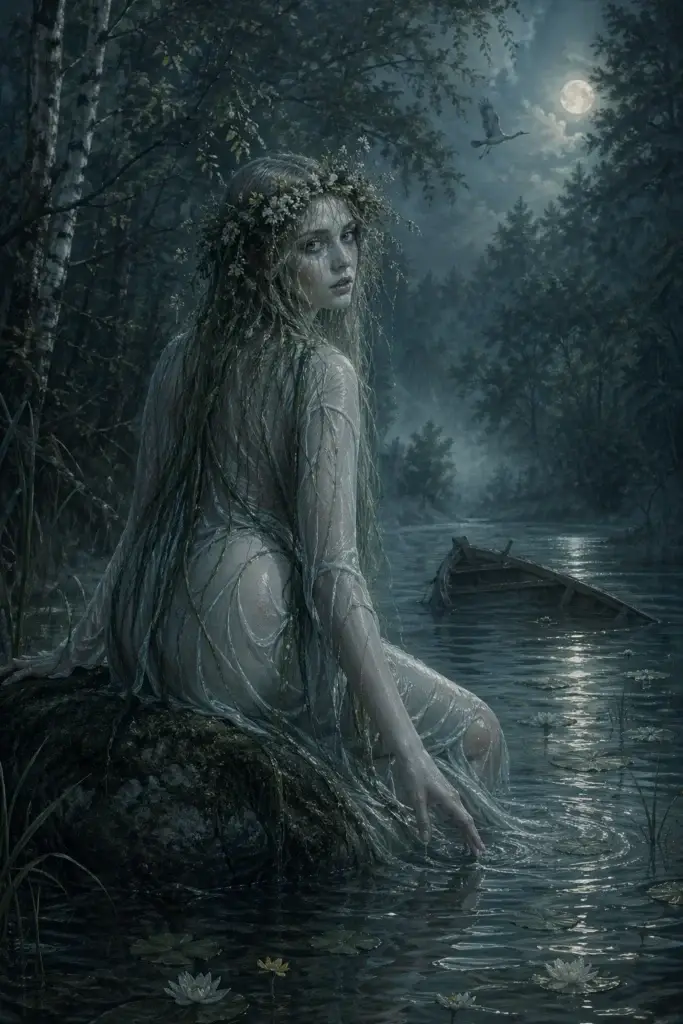
The Rusalka is the classic water woman of Slavic folklore. In East Slavic tradition she dwells in rivers and lakes; in West Slavic tradition more often in forest pools and springs.
What all variants share is this: she is the soul of a girl who drowned before marriage, died unbaptized, or took her own life. Unredeemed and caught between worlds, she seeks the living along the shore at night, seduces young men with dance and song, and draws them into the water.
The Rusalka has regional variants in Russian, Ukrainian, Polish, and South Slavic tradition (Rusałka, Víla, Samovila).
Her high season falls in the “Rusalnaja nedelja,” the Rusalka Week around Whitsun, during which certain taboos apply: no swimming alone, no singing through the fields, no spinning. Dvořák’s opera Rusalka (1901) and Pushkin’s drama (1829, 1832) made the figure internationally famous through literature.
Rusalka at a Glance
Type: Water woman, unredeemed female soul
Origin: Girls who drowned, died unbaptized, or died before their wedding
Texts: Slavic folk narratives, Pushkin, Dvořák
Period: Pre-Christian to the present
Peak season: Rusalnaja nedelja (Whitsun week)
Historical Classification
Pre-Christian Slavic tradition, with a rich body of oral tradition that survived Christianization as folk belief. An intensive phase of collection occurred in the 19th century (Afanasyev, Chečová, Karadžić). Pushkin (1829) and Dvořák (1901) brought the figure into high culture; she remains alive to this day in ethnological archives.
East Slavic territory (Russian. Русалка, Ukr. Русалка) as the core area. West Slavic (Polish Rusałka, Czech Rusalka). South Slavic tradition features related Víla and Samovila figures. The dwelling place varies by region (river vs. forest), while the character type remains recognizable throughout.
Russian folk narratives (Afanasyev), Ukrainian and Belarusian ethnographies, Pushkin The Mermaid, Dvořák Rusalka, modern folkloristics (Pomeranceva, Toporkov).
Names and Spellings
Russian/Ukrainian: Rusalka, plural Rusalki.
Polish: Rusałka.
South Slavic: Víla, Samovila, Samodiva.
Etymology: disputed; linked either to Latin rosalia (a feast of the dead associated with roses) or to Proto-Slavic rusy (light blond).
The connection to the Roman Rosalia feast of the dead is well supported linguistically and points to the figure’s roots in ancestor veneration: the Rusalka was originally a soul of the dead who returned at a specific time of year. Only secondarily did she become the seductive water woman.
Characteristics
Appearance
A young woman with long green or blond hair, often naked. In some regions she has a fish tail; in others, human legs. Pale skin, wet hair, a light garment. Ukrainian tradition depicts her as cheerful; Russian tradition tends toward the melancholy and dangerous.
Behavior
She dances and sings on the shore. She lures young men into the water through her beauty or enigmatic voices. She tickles her victims to death. During Rusalnaja nedelja she leaves the water and climbs into trees, dancing in cornfields; she is especially dangerous at this time.
Sphere of Influence
Rivers, lakes, and mill ponds; in West Slavic tradition also forest pools and springs. During Rusalnaja nedelja her range extends to fields, forests, and trees. Certain trees, especially birches and willows, are regarded as “Rusalka trees.”
Mythological Classification
Originally a soul of the dead (connected to the Rosalia feast), later a seductive and life-threatening water woman. Slavic folk tradition holds both layers simultaneously: the Rusalka is an unredeemed dead soul AND an active water demoness.
Profile: Rusalka
The most important aspects of the Rusalka at a glance.
An unredeemed female soul who died before marriage, by drowning, or unbaptized. The name etymology links her to the Rosalia feast of the dead.
Young men on the shore, especially during Rusalnaja nedelja. In that week: all who enter water, fields, or forests without due care.
Young woman with long green or blond hair, pale, naked or in a light garment. With or without a fish tail depending on region.
Lures with dance and song into the water, tickles victims to death. During Rusalnaja nedelja also dangerous in fields and trees.
During Rusalnaja nedelja: do not bathe alone, do not walk through cornfields, do not wash laundry. Wearing wormwood on the body is regarded as protection against the Rusalka. Garlic and crosses after Christianization.
The Annual Cycle and Protective Practices
Rusalnaja Nedelja
The “Rusalka Week” falls on the week before or after Whitsun. It is regarded as the most dangerous time of year. Traditional prohibitions: no swimming, no washing, no spinning, no singing in the field.
Women wear wormwood at their belt; when confronted by a Rusalka, calling out “Wormwood!” is said to force her to flee.
Protective Practices
Wormwood is the primary means of protection. Alongside it: garlic, parsley, lovage, horseradish, and other bitter or pungent plants that water beings are said to avoid. Crosses on riverside trees after Christianization.
The Rusalka Burial
At the close of Rusalnaja nedelja, some regions celebrate a Rusalka burial: a straw effigy representing the Rusalka is thrown into the water or torn apart. This act marks the end of the dangerous period.
Literature and Reception
Russian and Czech Literature: Pushkin began a Rusalka drama in 1829 (left as a fragment). Gogol’s “A May Night, or the Drowned Maiden” (1831) draws on the Ukrainian variant. Dvořák composed the opera Rusalka in 1900/1901, a romantic-tragic masterwork.
International Reception: Fouqué’s Undine (1811) and Andersen’s The Little Mermaid (1837) are literary-Western parallels that share thematic overlap with the Slavic Rusalka. Modern fantasy, horror, and popular culture continue the motif.
Contemporary Culture
In Eastern Europe the Rusalka remains present in folklore and is explored in modern literary and film projects (Polish and Czech film adaptations). In neo-paganism and esotericism she is received as a symbol of female ambivalence.
The Rusalnaja Week and the Whitsun Custom
In East Slavic folk belief the Rusalka is closely tied to a fixed point in the year.
The week around the Orthodox feast of Pentecost, known in Russian sources as Rusalnaja nedelja or the Rusalka Week, was regarded as the period during which the Rusalki left the waters and took up residence in fields, forests, and birch groves.
During this week peasant women avoided bathing, washing at the river, and in some areas fieldwork as well, out of fear of being seized, tickled, or dragged into the water by a Rusalka.
The week typically closed with a rite known under names such as provody rusalki or rusalku khoronit, meaning the escorting or burial of the Rusalka.
A straw effigy or a girl dressed as a Rusalka was led through the village in a procession and then laid in the grain, thrown into the water, or torn apart. The ethnographer Dmitrij Zelenin and, later, Soviet folkloristics interpreted this as a vegetation rite marking the end of the dangerous transitional period.
This calendrical binding is instructive from the perspective of religious studies. It shows that the Rusalka was not merely a narrative motif but a belief with practical consequences for the annual rhythm of village life.
The Rusalka marks a liminal phase between spring and summer, during which the boundary between the world of the living and that of the dead was considered permeable. The custom of the escorting rite served to close this boundary again in a ritual manner.
Rusalka and the Restless Dead
At the core of the East Slavic conception stands the connection of the Rusalka to the so-called unclean dead, known in scholarship by the Russian term zalozhnye pokojniki.
These are people who did not die a natural death: the drowned, suicides, children who died unbaptized, and above all girls who died before their wedding. Folk belief held that these dead found no rest and had to spend the time allotted to them, as it were, outside the grave.
In many regions the Rusalka was the female manifestation of this fate. Particularly widespread was the narrative of the pregnant or seduced and then abandoned young woman who drowns herself and returns as a Rusalka.
The ethnographer Linda Ivanits highlighted this social dimension in her study of Russian folk belief: the Rusalka also embodies the fear attached to the fate of the woman who has become illegitimate, cast out.
This sets the folk Rusalka clearly apart from the literary water woman she became in the 19th century. In folklore she is rarely seductive and beautiful in the Romantic sense. Regional descriptions, especially from northern Russia, know her as a shaggy, wild-looking figure with unkempt hair.
It was literature, from Alexander Pushkin to Antonín Dvořák’s opera Rusalka, that shaped the image of the melancholy, beautiful nixie that dominates international perception today. Scholarship carefully distinguishes between these two layers.
Regional Variants Between North and South
The Rusalka is not a uniform being but a bundle of regionally distinct conceptions. The ethnographer Dmitrij Zelenin as well as Russian collections reveal a clear north-south divergence.
In northern Russia the Rusalka appears more as an ugly, shaggy, and uncanny dead figure dwelling in water or forest who startles passersby. Here she is closer to the image of a ghost.
In Ukraine and southern Russia, by contrast, the Rusalka is more strongly associated with grain and the field. She is conceived as younger, more girl-like, and also more beautiful, often garlanded, and her habitat shifts from the water to the ripening grain.
Some scholars connect this with the Rusalka’s role as a vegetation spirit capable of granting or withholding moisture and growth for the fields.
The name also varies. Alongside Rusalka, various regions know designations such as kupalka, vodjanica, or, regionally, mavka, the last being particularly widespread in the western Ukrainian and Carpathian tradition and treated in some sources as a distinct being, in others as a synonym. The etymology itself is disputed.
An older hypothesis derived the word from a Roman spring festival, the Rosalia, which was said to have reached the Slavs via the Balkans.
This derivation is now considered possible but not established, and part of Slavic studies prefers a connection with Slavic words for blond or light. The disagreement illustrates how elusive the early history of the belief remains.
Further Links
Selected Bibliography
A selection of key works on the Rusalka:
- Pomeranceva, E. V.: Mifologicheskie personazhi v russkom folklore. Moscow 1975.
- Rybakov, Boris: Jazytschestwo drewnej Rusi. Moscow 1987.
- Hubbs, Joanna: Mother Russia. Bloomington 1988.
- Worobec, Christine D.: Possessed. Women, Witches, and Demons in Imperial Russia. DeKalb 2001.
Standard Literature (Slavic):
- Mańczak, Witold: Slavic Mythology. In: Encyclopedia of Religion 13, Macmillan 1987.
Further standard works in the literature index.
The protective practices described here represent a religious-studies classification of historical traditions. iWell Guard draws on this cultural-historical line of wearable protective objects and represents a contemporary form of it. More about iWell Guard →
Frequently Asked Questions about Rusalka
What is a Rusalka in Slavic mythology?
Rusalka (Russian русалка, plural rusalki) is a water spirit of East and South Slavic folk religion, most commonly the spirit of a girl who drowned young and unmarried, or of a woman who met her death in water.
Rusalki typically appear as beautiful young women with long, often green hair, sitting on the banks of rivers and lakes and combing their hair. They are ambivalent: in some traditions they assist with the harvest and fertility; in others they lure young men into the water and drown them.
What is the Rusalnaja Week?
The Rusalnaja Nedelja (Rusalka Week) is an important folk custom of the Slavic calendar, falling around late May or early June, that is, around Whitsuntide. During this week the Rusalki leave the water and roam through fields and forests.
Young women and men had to exercise caution; going alone to springs was considered especially dangerous. Protective practices included wearing wreaths of mugwort, placing peonies and birch branches in the home, and reciting protective formulas. Antonín Dvořák composed the celebrated Czech opera Rusalka in 1900, based on this figure.