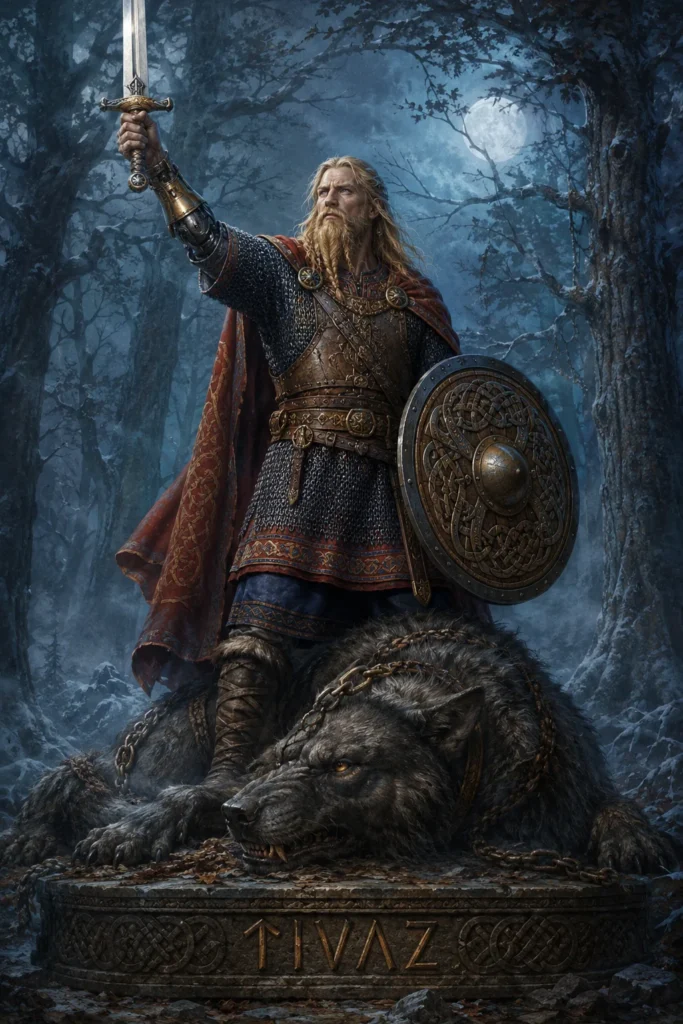
Njord, Vanir God of the Sea and Seafaring
By Ralf Ittermann · last reviewed on
Njord is a Vanir god of the sea and seafaring, whom fishermen and seafarers asked for calm seas and safe passage. Njord is the Germanic god of the sea, seafaring, the wind and wealth.
He belongs to the race of the Vanir, but came to Asgard as a hostage after the Vanir war and remained there permanently within the pantheon of the Aesir.
His seat Noatun (“ship enclosure”) lies by the sea. Njord is the father of Freyr and Freyja, the two most important Vanir deities within the Aesir pantheon. In religious studies he is regarded as an example of the merging of two originally separate divine races, the Aesir and the Vanir, in the Eddic tradition.

Profile: Njord
Njord: the most important aspects at a glance. The following fields summarise origin, function, appearance, veneration, symbols and parallels.
Vanir god who came to Asgard as a hostage after the Vanir war and stayed there with the Aesir; in exchange the Aesir sent Hönir and Mimir to the Vanir. He is the father of Freyr and Freyja, begotten with his nameless sister. His name is linked with the goddess Nerthus.
Njord is god of the sea, seafaring, wind and wealth. According to Snorri he calms sea and fire, and whoever goes fishing or sailing should call on him. He can grant wealth in land and movable goods and is expressly called the god of merchants.
Njord is recognisable in myth by his feet: Skadi chooses the most beautiful feet in the hope of Baldur and gets Njord. His seat Noatun, the “ship enclosure”, is regarded as a central attribute. The swan, a bird of Skadi, appears in his surroundings but is not his attribute.
Place names with the element Njord are numerous in Norway and Sweden, and largely absent in Iceland. Sagas mention oath formulas on “Njord, Freyr and the almighty Ase”. Animal sacrifices are not described in detail; remnants live on in Norwegian and Faroese fishermen’s sayings and protective formulas.
His seat Noatun points to a harbour, and wealth, above all movable wealth, is his characteristic trait. In kennings “land of Njord” stands for the sea, “ship of Njord” designates the sea as a route of travel. The word Vanir serves in skaldic poetry as a designation for ships and seamen.
Nerthus, described by Tacitus as Mother Earth of the north-west Germanic tribes, is the linguistically direct feminine counterpart of Njordr. According to Dumézil, Njord belongs to the third Indo-European function (fertility, economy, wealth); Edgar Polomé and Folke Ström view this critically.
Myth and Origin
In the “Prose Edda” (Gylfaginning 23) Snorri Sturluson describes Njord as ruler over the course of the wind and calmer of the sea and of fire. Whoever goes fishing or seafaring should call upon him. He is said to be so wealthy that he can grant all riches in land and movable goods.
His father is not named, and his sister (with whom, in old Vanir tradition, he begot children, Freyr and Freyja) remains nameless.
In the “Lokasenna” 36 Loki mocks this sibling incest: “With your sister you begot sons, as was to be expected.” Incest was regarded as permissible among the Vanir but reprehensible among the Aesir. The marriage to Skadi thus bridged the two conventions.
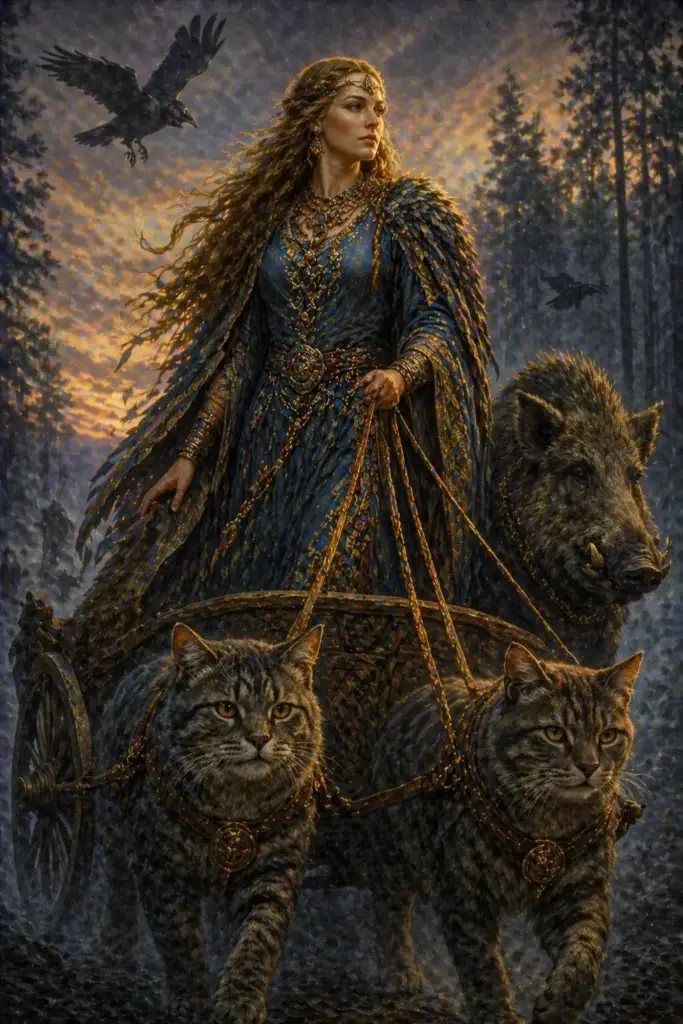
The name Njord (Old Norse Njordr) is etymologically connected with the Germanic goddess Nerthus, of whom Tacitus reports in the “Germania” chapter 40. Nerthus, an earth and fertility goddess, was driven about in a wagon by a group of north-western Germanic tribes.
Linguistically Nerthus is the direct feminine counterpart to Njordr (Proto-Germanic *nerthuz). Scholarship from Hans Kuhn through Edgar Polome to Rudolf Simek assumes that an old fertility-divine double figure (male-female, presumably a sibling pair) was split in the further development into Njord and his sister, with Njord as the later principal figure.
This Nerthus-Njord connection is one of the few bridges between continental Germanic religion (1st century AD, Tacitus) and Norse-Icelandic tradition (13th century, Snorri). It shows a stable tradition of a maritime-fertile double figure across more than a thousand years.
The connection between Tacitus’ Nerthus and the Norse Njord tradition is the most important bridge between the continental religion of the first centuries AD and the literarily preserved Norse mythology of the 13th century.
Tacitus reports in the “Germania” chapter 40 that seven north-western Germanic tribes (among them the Angles and the Warni) jointly worshipped Nerthus, Mother Earth.
On an island in the ocean stands a sacred grove, in which a sacred wagon stands. Only a priest may touch the wagon. When the goddess is present in the wagon, he travels through the land, and peace and feasting follow.
In the end the image of the goddess and the wagon are washed in a lake, and the slaves who performed the washing are drowned in the lake.
Scholarship from Hans Kuhn through Edgar Polome to Rudolf Simek assumes that Nerthus and Njord are an old sibling pair or an androgynous double figure that was split in the further development into a male (Njord) and a female (Nerthus, the sister) form.
The Vanir incest tradition mentioned in the “Lokasenna” could be a reflex of this original identity. The assumption of a continuous tradition over a thousand years rests on the exact linguistic correspondence of the names (Nerthus = *Nerthuz, Njordr = a later reflex of the same stem).
Symbols and Attributes
Njord’s central attribute is his seat Noatun, the “ship enclosure”. The name points to a harbour or a sheltered bay. In the “Grimnismal” 16 it reads: “Noatun is the eleventh (dwelling), there Njord has built himself a house, the upright prince of men.
He, the guiltless, rules over the high-built temple.” The phrase “high-built temple” (timbradan har horg) points to a particular cultic function.
Animal sacrifices to Njord are not described in detail in the sources. In skaldic poetry the word for Njord’s race (Vanir) serves as a designation for ships and seamen. The swan, a bird of Skadi, appears in Njord’s surroundings, though not as his direct attribute.
Wealth, above all movable wealth, is his defining characteristic. In the “Skaldskaparmal” it is said that Njord grants land and loose wealth. “Land of Njord” is used in kennings as a designation for the sea. “Ship of Njord” denotes the sea as a route of travel.
This skaldic terminology shows how closely Njord was linked with the maritime economy. Snorri explicitly calls him the god of merchants.
Cult and Worship
Adam of Bremen does not mention Njord directly at the temple of Uppsala, but his son Freyr (called “Fricco” by Adam) is regarded there as one of the principal deities.
Scholarship sees in Njord’s position in the literary layer of the 13th century a memory of older cult forms that already stood in the background at the time of Christianisation.
Place names with the Njord element are numerous in Norway and Sweden: Njardarheimr, Njardarvik, Njardarlog (the last denoted a region in western Norway).
In Denmark the element is rarer, and in Iceland it is largely absent (which supports the finding that the emigration to Iceland took place in a phase when Njord’s cult was already in decline). Oluf Rygh collected about a hundred place-name attestations in “Norske gaardnavne” (19 vols., 1897 to 1936).
The “Vatnsdaela saga” and other family sagas mention oath formulas invoking “Njord, Freyr and the almighty Ase”. This triad shows Njord as an oath god alongside the principal gods.
In the “Ynglinga saga” (Snorri Sturluson, around 1230, chapter 9) Njord is introduced as a legendary king of the Swedes, in a euhemerised version of the myth. According to Snorri’s account, his reign is said to have brought peace and wealth, and after his death he was worshipped as a god.
Important Myths
The central myth is Njord’s marriage to Skadi. Skadi, daughter of the slain giant Thjazi, comes to Asgard for restitution. She is allowed to choose an Ase as her husband, but recognising him only by his feet.
She chooses the most beautiful feet, hoping to obtain Baldur, but they belong to Njord. The marriage is full of conflict: Skadi loves the mountains of Thrymheim, Njord the sea at Noatun.
They try to spend nine nights each at the other’s seat.
Skadi laments: “The screeching of the birds cannot let me sleep, the bird that comes from the wood to the sea every morning.” Njord answers: “The howling of the wolves keeps me awake, which I heard on the mountain.” The two separate, each returning to their own place.
This myth is elaborated in Snorri’s “Skaldskaparmal” and mentioned in a deriding context in the “Lokasenna” 51.
The second myth is Njord’s function as a Vanir hostage. The “Voluspa” 23-24 and the “Ynglinga saga” 4 describe the war between the Aesir and the Vanir, which was finally settled through an exchange of hostages.
Njord and his children Freyr and Freyja came to Asgard. In return the Aesir sent Hoenir and Mimir to the Vanir.
This peaceful resolution of a war between gods through exchange is of interest in religious studies because it mythically explains the merging of two divine races.
Georges Dumezil read this episode in “Tarpeia” (1947) as a reflex of an Indo-European conflict of the three functions: two sovereign functions (Aesir, magical-juridical) versus a third function (Vanir, fertile-economic) interact with one another.
The third myth is Njord’s fate at Ragnarok. In the “Vafthrudnismal” 39 Vafthrudnir says: “At the beginning of the ages of the gods he came from the Vanir, sent by the wise powers as a hostage.
In the latter days he will return home to the wise Vanir.” Njord thus survives the world-fire and returns to his original people. This eschatology distinguishes him from most of the Aesir, who fall at Ragnarok, and underlines his special status.
The wedding of Njord and Skadi is one of the few elaborated myths in which the tension between Aesir, Vanir and giants becomes visible. Skadi belongs to the mountain giants, Njord to the Vanir, and both are integrated into the circle of the Aesir through a hostage marriage.
The marriage fails not from personal incompatibility but from geographical-cosmological incompatibility: mountain and sea are irreconcilable in the mythical geography. The stanzas in which both lament their suffering (“the screeching of the birds cannot let me sleep”, “the howling of the wolves keeps me awake”) belong to the most memorable verses of the Eddic tradition.
In religious studies this marriage is an example of the failure of the attempt to mediate cosmic opposites ritually.
Margaret Clunies Ross showed in “Prolonged Echoes” (1994) that Norse mythology repeatedly dramatises marriages between cosmic polarities (Vanir-Aesir, giants-Aesir, sea god-mountain giantess) and in many cases presents the failure of these marriages as a necessary condition for the stability of the world.
The separation of Njord and Skadi is not a personal tragedy but a cosmological necessity.
Relationships within the Pantheon
Njord is the father of Freyr and Freyja, begotten with his nameless sister according to Vanir custom. In Asgard he marries Skadi, but the marriage remains childless and effectively ends in separation. In the “Lokasenna” 34 Loki claims that Hymir’s daughters used Njord as a spittoon, which is a coarse insult without mythological background.
Toward the Aesir Njord behaves as an integrated member. He sits in the council, takes part in the assemblies and is treated like a full Ase in the Eddic sources.
Nevertheless his Vanir origin remains remembered. Margaret Clunies Ross showed in “Prolonged Echoes” (1994) that the Vanir origin is often mentioned in the literary layer as a positive distinction (wealth, fertility), rarely as a deficit.
The most mythologically striking relationship is with Skadi. She is a giantess, he a Vanir. Their short, failing marriage between mountain and sea is often cited in Norse literature as an example of irreconcilable ways of life.
In the later tradition Skadi is regarded as the mother of Njord’s children, which contradicts the earlier sources. This genealogical shift shows how myths are reshaped in the literary tradition.
Reception and Influence
In the Icelandic family sagas Njord appears in oath formulas and brief allusions. The “Egils saga Skallagrimssonar” and the “Vatnsdaela saga” mention him in oath contexts. In the Christian-shaped medieval culture Njord, like other pagan gods, was literarily preserved in the Snorra Edda, but in living folk tradition his traces were largely lost.
Folkloric remnants are traceable in Norway and on the Faroe Islands in some fishermen’s sayings and maritime protective formulas. Magnus Olsen systematically recorded these traces in “Hedenske kultminder i norske stedsnavn” (1915). A direct continuous tradition from the pagan cult to modern folk customs cannot, however, be demonstrated.
In the 19th century Njord was less prominent in Norse Romanticism than Thor, Odin or Freyr. Adam Oehlenschlaeger included him in “Nordens Guder” (1819), but Njord remained a minor figure there.
In comparative religious studies of the 20th century he gained profile, above all through Edgar Polome (“Old Norse Religious Terminology”, 1969) and Folke Strom (“Nordisk hedendom”, 1961).
Njord experiences a modern revival in contemporary pagan movements of Northern Europe, above all in maritime occupational groups in Norway and Iceland that invoke him as a protective deity of seafaring. This practice is neo-pagan and not historically grounded, but it is not without sociological interest.
Classification in Religious Studies
According to the Dumezil school, Njord belongs to the third Indo-European function (fertility, economy, wealth). This classification is supported by his function as god of the sea, seafaring and wealth. The Vanir as a whole represent the third function in Dumezil’s model, the Aesir the first two (magical-juridical and warlike).
Edgar Polome in “Essays on Germanic Religion” (1989) differentiated the three-functions thesis for the Germanic material. Njord appears here not as a pure third-function god but as a more complex figure with aspects of sovereignty (he sits in the council of the Aesir) and of mediation.
The Vanir-Aesir synthesis, he argued, cannot be clearly divided by function but is the result of historical convergences.
The Nerthus-Njord connection is one of the most important traces of the continuity of Germanic religion over a thousand years. Hans Kuhn elaborated this line in several essays (collected in “Kleine Schriften”, 4 vols., 1969-78).
It shows that Norse mythology is not a creation of the 13th century but preserves traces of a far older continental tradition.
The question of whether Njord is to be classified as a third-function god in Dumezil’s sense has received controversial answers in scholarship. Dumezil himself saw the Vanir as representatives of the third function (fertility, economy).
Edgar Polome and Folke Strom critically questioned this classification and stressed that Njord also shows sovereign aspects: he sits in the council of the Aesir, is invoked as an oath god and rules over the wind. This mixture of functions, they argued, does not fit unambiguously into the three-functions scheme.
An alternative reading is offered by religious-ecological scholarship. Andren, Jennbert and Raudvere showed in “Old Norse Religion in Long-Term Perspectives” (2006) that the Norse gods are characterised more strongly by geographical-ecological anchorings than by functional classifications.
Njord is the god of the coasts, the islands, the seafarers. This geographical profiling often stands in conflict with the abstract three-functions doctrine and provides a more realistic picture of ancient religious practice.
Sources and Further Reading
Primary sources: “Prose Edda” (Snorri Sturluson, Gylfaginning 23, Skaldskaparmal), “Poetic Edda” (“Grimnismal”, “Lokasenna”, “Vafthrudnismal”), “Ynglinga saga” (Snorri Sturluson, around 1230), “Germania” chapter 40 (Tacitus, 98 AD, on Nerthus). Place-name material in Oluf Rygh “Norske gaardnavne” (19 vols., 1897 to 1936) and Magnus Olsen “Hedenske kultminder” (1915).
Secondary literature: Jan de Vries “Altgermanische Religionsgeschichte” (1956/57), Rudolf Simek “Lexikon der germanischen Mythologie” (3rd ed. 2006), Folke Strom “Nordisk hedendom” (2nd ed. 1985), Edgar Polome “Essays on Germanic Religion” (1989), Georges Dumezil “Tarpeia” (1947) and “Les dieux des Germains” (1959), Margaret Clunies Ross “Prolonged Echoes” (1994/98), Hans Kuhn “Kleine Schriften” (1969-78), Jens Peter Schjodt “Initiation between Two Worlds” (2008).